In this October 18, 2018 market briefing, the presenter walks through several macro‑economic developments affecting global markets. He begins with a technical and fundamentals‑driven analysis of crude oil, noting a sharp downside break below $70.50 triggered by a four‑week streak of rising U.S. crude inventories (the longest since early 2017) and a breach of a key trend line, while seasonal demand patterns are also discussed. He then shifts to the Federal Reserve’s FOMC minutes, highlighting a more hawkish tone that suggests a higher neutral rate, which helped strengthen the dollar and put pressure on EUR/USD. Next, he examines the U.S. Treasury’s decision not to label China a currency manipulator, despite political rhetoric, and points out the continued weakness of the yuan—its lowest level in 21 months—along with Treasury concerns about the euro’s valuation and Japan’s large trade deficit and slipping exports. Finally, he reviews recent Brexit‑related news from Brussels and the pound’s whipsaw price action over the past few days, emphasizing technical uncertainty ahead of upcoming meetings. Throughout, he references market commentators, provides specific price and inventory figures, and notes calendar events that could influence trading later in the day.
Chapters
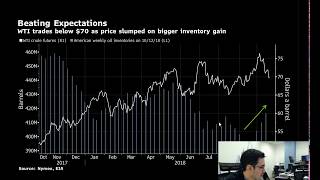
Very good morning, Thursday 18th of October. Hope you are well. A couple things I want to cover this morning. Going to have a look at— you can see on my chart here, oil. We'll briefly talk about that. Some sizable moves to the downside yesterday, and as you can see here, breaking quite a clear trend line. We're going to talk a little bit about Brexit, obviously updates coming out of Brussels. That's kind of the main media focus of the morning. And we'll look at how the pound's reacting and what we can expect going forward for today specifically. Then we'll have a look at a few other things. We had the, the Fed minutes last night, and then we also had a couple of large-cap European, Swiss-related earnings as well, just to bring to your attention. And then a few things on the calendar as well that we need to be aware of today. So just kicking things off, looking at oil. This Well, if you, uh, if you're prudent and you follow a particular chap on Twitter by the name of Sam North, he was talking up this trend line very early in the day, you know, when the price was still up at the upper bound around what would have been the pivot from yesterday morning, and was just highlighting the fact that, you know, from a fundamental point of view, as we've discussed Before in these briefings, always since the beginning of the week, that kind of initial gap up and what looked quite bullish at the open on the prospect of fallout between the Saudis and the US, the kind of knee-jerk reaction to some of the aggressiveness of the response from the Saudi ministry. The point is that reading between the lines, there's just too much at stake here to really jeopardize that relation. From oil specifically. And we didn't really think fundamentally that was enough to keep the price supported. And then obviously coming out on a, on regular weekly on the Wednesday, you get the infantry numbers and we had a bit of a trigger point, the technical breach of these levels and then the fact that the data came out in the fashion that it did, providing then the additional catalyst for quite a violent break lower. Down to the lower bound, and initial targets were quite clear, I think around that $70.50, which was then the S2 yesterday, which kind of just coincided with the, the lower bound of the end of last week's price action. Was a nice target at the time, but you can see the market when it broke through there really remained quite heavy. We managed to snap through the $70 handle as well, which we remain below at the moment. Now, the secondary move to this, of course, and probably one thing that's kept oil a little heavy this morning, is the fact that although the dollar index is basically flat, the dollar index did rally last night, i.e., stronger dollar coming on the back of the hawkish FOMC minutes. And so again, there's kind of a dual-fold effect here, or three, considerably. A few things on oil just to have a look at from a Stats point of view. And so oil traded near the lowest level in a month after a bigger than expected gain in American stockpiles. Uh, well, here it is, makes it graphically a little bit more easier to see. And, uh, kind of driving season in the States typically is when you see the, the most highest increase in demand. And so as a net result, typically June and August see a lower amount of— as you can see on the left axis here, the amount of barrels Well, let me just move my chart down so you can see it. Here you go. So this is what I'm referring to, this kind of the seasonal drop-off that you get over the summer period. If I just make my screen a bit smaller, you can see. And what we've had here is a 4-week now consecutive pickup, and, and quite considerable in terms of the, the infantry side of things. Coinciding with this obviously is, yeah, you can almost map this in an inverse relationship from where we were, um, peaking in the price of oil at the time. And now as this has started to climb quite aggressively to the highest stockpile levels that we've had really since the beginning of summer— would have been going back to June— the price of oil has managed to get itself back below the $70 handle. Now, a couple of, um, statistical points, as I said, to be aware of here. Um, the nationwide crude stockpiles then have risen for 4 straight weeks. This hasn't actually happened now, but where we've had 4 stockpile increases. It's the longest streak they've gained since early 2017. Cushing, Oklahoma, which is obviously that kind of American storage hub, that, that key kind of geographic location of the transport of crude and storage of crude. And that saw the highest level in almost 4 months as well. So typically what has been the case for oil in recent weeks and months has been that the market has tended to look beyond and through these weekly numbers, uh, as just typically noise, given the, the kind of pressing other broader fundamentals at play, like these impending Iranian sanctions. Hence the reason where we rallied up to 75 in recent weeks. However, when you start to see statistical anomalies in the sense of, well, hang about, we've not had this kind of persistent gain in stockpiles for some you know, almost 2 years, and Cushing, you know, in a number of months. That does highlight then a kind of a little bit changing of the tide, and then that in combination, you get a bit of a perfect storm and you get a decent move to the downside under those kind of conditions. So that was oil yesterday, and obviously very interesting. Uh, just jumping over though, let's, uh, let's have a look at a few other things that have been coming out. And one thing we've got to talk about, of course, is, is this: Fed officials debated hiking interest rates to restrictive territory. The interesting thing here was that the Federal Reserve officials stepped deeper into the debate over how high to push interest rates, as majority favored an eventual and temporary move above the level they deem neutral for the economy in the long run. If you remember, one of the key catalysts that created a lot of the market selling last week, and it felt like, you know, is this the beginning of something a little bit more meaningful in terms of a correction? Then it was all down and sparked by Jerome Powell's comments at the time where he was particularly optimistic about the economic prospects of the United States. And so what we've had here is almost this validated in a view in the Federal Reserve minutes. One of the interesting things here, I mean, I wasn't around to see this released live, but apparently it wasn't actually the minutes in itself, it was the accompanying notes to officials in reference to the recent economic projections, i.e., things like the dot plot, as we know and we're very familiar with. And it was this that showed that potentially there could be flexibility to to move the neutral rate higher. And this is what Donald Trump has been trying to force Jerome Powell to do, which is he wants, uh, you know, a more buoyant equity market, certainly heading into the midterms in the coming weeks. And nothing's better than an extremely accommodative policy, which would be the opposite of which Powell's doing, which is responding to the economy's improvements by putting the options out there. But potentially they need to tighten and have a higher rate of neutral, uh, kind of interest rate. So this was a little bit hawkish in that sense. The dollar strengthened, and as a byproduct then, if we look at the things like EURUSD here, we've had a little bit of a bounce this morning. There's probably a little bit of profit taking on those dollar longs from yesterday, given a pretty decent climb in the greenback. But EURUSD generally trending lower. I mean, if I just isolate the part of where the actual minutes came out. So we're looking around this time frame and we just drifted down in the Asia-Pac session. If we were looking at cable, kind of similar setup and a similar type of bounce this morning. So still the dollar driving quite a lot of the dynamics here in some of the currency pairs. The other thing of course that we've had from a news perspective is this, a report we've been waiting for, for a little while. And this is the Treasury's kind of declaration of who they deem upon their measures of being currency manipulators. And the big question, of course, in the context of the ongoing trade wars is, is China a currency manipulator? Because as far as Donald Trump and his rhetoric have been concerned, ever since day one of his presidency, or even before then, China for sure is a manipulator. However, lo and behold, and as per the source comments, and I think absolutely was purposefully managed by the administration when the equity market was falling quite aggressively last week was when they decided that, you know what, let's call up Bloomberg under the cloak of being a source and just say we're not going to call China a manipulator, therefore let's just quell any kind of escalation in market sensitivity to a worsening trade situation. And let's help prop this market back up. And then, as we've seen then, and as I think to be expected, US has spared China. So despite what Donald Trump says— and this is for me classic Trumpism for his political management of the populace— it's, I know, I call China all these different types of things. People in America really, you know, warm to the the feeling that you're fighting in the best interests of putting America first policy, and yet in the actual details you don't actually declare them manipulator at all. But that's something, of course, of which the normal man on the street is probably not going to know about these specific kind of legal documents. So he kind of achieves it on both fronts. He satisfies his political narrative, but he also manages the situation on on the trade war. So yeah, a little bit of a bounce, you could say, on maybe the, the risk factor about this potentially was a tail risk, i.e., a low probability that maybe they did, and maybe then this cajoles China into being more forceful in the response. But that hasn't happened. The one thing that has happened though is some of the accompanying comments though are still pretty punchy. If you look at it Treasury Secretary Mnuchin said of particular concern that China's lack of currency transparency and the recent weakness in its currency. We will continue to monitor and review China's currency practices, including through ongoing discussions with the People's Bank of China. Now, how has the yuan moved overnight? Well, the renminbi touches a 21-month low. So irrespective of the fact that they've been spared in this case the pressure is still kind of on. I mean, economically, the economy is coming under some constraints through this cloud of political uncertainty. And you can see here, I mean, this axis giving you the timeline, really is from 2018. The Chinese yuan has been under pressure ever since Q2. It's when it gets to 7 against, you know, per dollar, of when then we start to get this idea of potential more aggressive intervention tactics deployed by the Chinese officials. But not quite there yet. But point being is that the yuan is trading as low as since January of 2017, irrespective of the fact that they've managed to dodge being singled out in that report from the Americans. On that note, just so you're aware, who else did— this report's not just about China. The euro appears undervalued for some of the stronger economies in the currency block, including Germany. The Treasury said. Other countries— Treasury remains concerned about the persistence of a large trade deficit with Japan. So, you know, they're definitely the aggressor in a lot of these, these situations at the moment, the Americans. On that front, just to wrap up the kind of other news headlines from this morning, we did also, talking of Japan, see that their exports fell for the first time in close to 2 years in September. Shipments to major trading partners including the US and China contracted as the administration pushed for Tokyo to enter bilateral trade negotiations. So even what is, you know, kind of more traditionally an ally of America, um, is also feeling a little bit of the brunt of this, this ongoing trade spat at the moment. So something to just be aware of. Okay, a few other things then. Let's talk, let's talk Brexit. Let's have a quick look at the pound. The one thing I was just looking at the pound this morning was a couple of interesting technical points here. I'm looking at the pound over the course of what, the last 4 or 5 days, and you can see still relatively, you know, whipsaw price action. I think the market's a little bit awaiting to find its, its more clearer direction given the meetings that are occurring in Brussels.