US CPI & ECB Preview
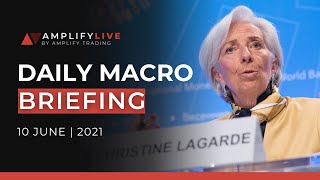
Markets are quiet before two major events: US CPI expected around 4.7% and an ECB meeting where Lagarde's language on stimulus will matter. A higher-than-expected CPI could spike Treasury yields and hurt tech stocks, while the ECB has signaled no taper until September at earliest.
Chapters
Okay, very good morning. It's Thursday the 10th of June. Hope you are doing well. I had my first jab yesterday and feeling absolutely a-okay, so all good so far. Um, otherwise, in terms of what I'm going to cover in this briefing, I'm not going to look too much at the, the charts because I'm going to cover things like the ECB meeting and so on. and the US CPI report live in the Amplify Live community. So I'll leave that technical assessment for then, but I definitely do want to talk about those two major factors, of course, in a little bit more detail, because they're really going to shape probably the main moves in the intraday, but also for the rest of this week. And this is certainly what the market's been gearing up for, and that was very much evident at the close on Wall Street last night. In terms of the NASDAQ closing flat yesterday, closed flat the day before. And the S&P 500 was down about 2/10, the Dow about 4/10. So all very minor movement as the market gears itself up for the potential reaction and then subsequent direction to see off this week. As I said, on the back of predominantly the US CPI report, because the ECB in summary should be a fairly contained event as far as market reaction is concerned. But we'll talk about that in a moment. First off, starting about Starting chronologically then from the Asia-Pac session, we did see moderately higher Asian equities, so a little bit more positive than the fairly flat finish that we had to a minor negative in some of those US indices. Some of that coming on the back of this, which is commerce ministers from China and the US agreed to push forward and investment links with their first call since the Biden administration has come into power. So this is kind of different, different departments, but obviously key to that of trade. US Trade Representative Tai, though, is one thing that I would keep an eye on. She is going to talk with her Taiwanese counterpart at some point today, according to reports in the Wall Street Journal. Now, why that is important is because China opposes any official contact between that of the US and Taiwan, because as you probably know, China sees Taiwan as part of one China. And then it would be an admission then that you're seeing Taiwan as an independent entity if the US was to engage in separate dialogue of that, not with Beijing. And that's going to cause increased friction about that territory dispute ongoing. So things could and still likely to remain tense. There's obviously been lots of different things that have been going on the backdrop. The G7 kicks off in the next day as well in Cornwall in the UK. And there's lots of reports talking about Biden trying to unify the Western front, if you like, against the Chinese threat on the competitive side and technology, which we saw a congressional ruling on some of those tech names earlier this week. So it's kind of— they're talking. Are they going to get anything really concrete agreed or anything really done, and is anything going to change a great deal? No, but they are in dialogue. But at the same time, it's kind of— there are these other still, still, um, kind of anti-China rhetoric and also, um, actual tangible things that are happening. And so it's kind of with China, as I've said recent weeks and months, really, I think though the US strategy will be to continue to engage but the likelihood of an outcome of some significance is low because of the domestic focus at the moment in the US. And that's likely to remain the case for the next year. So it's kind of this simmering tension, but with dialogue. And I'm not really expecting a great deal to change on that front anytime soon. So overall, though, the fact that the commerce ministers did talk slightly positive, I wouldn't really see that as a carry-through into the European Open. Hasn't really been much in the way of any impact initially so far, having gone through 7 o'clock. Elsewhere, you have the Chinese Central Bank Governor Yi Gang said that consumer inflation will likely stay below the government's target this year and monetary policy must remain stable. So looking to just downplay some of those inflation concerns that we saw yesterday. Um, the consumer inflation side obviously is fairly flat in comparison to the surging PPI rate at the moment. So just looking to alleviate any concerns on that. Price pressure front. So not really too surprising either. From a charts perspective, as far as this morning is concerned, things are pretty quiet. Obviously it's kind of the quiet before the storm in some respects ahead of CPI. So index futures seem pretty flat across the board. The dollar touch firmer, but very minor. Gold then down about $6. The 10-year has been a really interesting one, and I think the 10-year out of all of the products because dollar actually staged a bit of a rally during US hours yesterday. Otherwise, what, what had been positioning itself up for, I would have said, vulnerability on a high side inflation print today— what I mean by that is if the dollar had remained considerably weak, it could have created a knee-jerk reaction then if we see an upside number where the dollar could have had quite an explosive move to the upside. But some of that's been I guess reduced to a certain degree given the dollar movement yesterday. But US yields have persistently declined since we had that US nonfarm payroll print. So this is what this movement is here. And obviously US payrolls, when we're still creating in excess of half a million jobs, it's just the point being is that many have been leaning on the side of much more robust numbers, particularly when you put the last two payrolls together. You're talking around 800,000 jobs where expectations were we could have had 2 million or 2.5 million as a cumulative number. And since then, the market's been kind of just buying into the belief of an addition of transitory inflation. Some different forward-looking inflation indicators have been decreasing, which gives the rationale for the persistency that we've had in, in this week's trade since Friday. Of declining US yields. But the point being is that given the fact that the 10-year is now trading up at where it is and where we were just a week or so ago, I do feel like this is a vulnerable product to a snap lower on a pop higher in yields, given the fact that they— I think that we're trading now below 1.5% as of yesterday in the US 10s. So That to me smells like a recipe for a knee-jerk reaction higher if we were to get a high side number. Of course, if we get a low number, perhaps then a lot of that move has been somewhat factored in. And so therefore the, the actual reaction effect here would be higher, but perhaps more contained. But we'll talk about CPI reactions a little bit more in a moment. Let's talk about CPI first— not CPI, ECB. Let's go to the ECB first. And the calendar is pretty quiet this morning, so these really are the two main events. And with the ECB, what can we expect? Well, a few things. The, the first is, in terms of an overall summary, um, conditions in the eurozone have obviously started to improve. I mean, this is a look at the euro area services number in black. The manufacturing PMI reading in orange, and economic confidence in blue in the euro area. And several of these gauges are starting to point to recovery in Europe. And we've had a continued kind of steepness, progressive, progressive nature of vaccinations continuing to pick up, which is a positive factor. And as such, that's leading to increased confidence, which is then on the back of the fact that there's more confidence about reopening of these economies in the near future. And so things are looking bright. It's just at the point where it's not bright enough, or we're not far enough down that track yet for the ECB to making any type of decisions as we go through the summer. And so there's a couple of things to look out for today, one of which— the key phrase to look out for is whether the ECB expects to buy debt under its pandemic emergency purchase program, PEP, at a significantly higher pace than during the first months of the year. That's the phrase that they've had before, and most are expecting that phrase to remain. So any alteration there would be a trigger effect for subsequent price movement. Net buying under the €1.85 trillion program is currently running at €20 billion a week, up from €14 billion a week at the start of the year. So there, your reference kind of points in terms of what we're, we're talking about. Most economists expect no longer, or no longer expect, a significant reduction in the coming quarter And this comes after we've had a number of kind of dovish comments coming out. For one, out of the ECB president Christine Lagarde herself, just basically saying it's too early. And then other senior officials from the Governing Council saying similar dovish type rhetoric. On that point then, this is where it has subsequently led to a change in what markets are anticipating over the timing, timing of tapering to that extent. And so this is looking at a Bloomberg survey, economists, and it's looking at what current cumulative responses are for when the ECB will lower the pace, um, from a June survey. And it's bombarding from the survey they did back in April, which is the blue bar. And as you can see, back in April there were expectations that perhaps we could have seen the them pulling back on their bond purchases by the end of June or July. But as you can see, that has, um, now— or excuse me, the blue bar said end of June was seen over 50% probability. Now if you look at the black bar, you can see just how drastically that's been reined in. It's gone from 56% to 21%. So actually, when you look over 50% probability, you've got to go all the way through to the end of summer So September. And so again, we're not looking for any alteration really on policy or their bond buying program. And as I'll discuss then, you know, what are we actually looking for? And this is where the crib sheet from ING obviously comes in handy. I did tweet this, I'll share it in the community again this morning. But this is that good breakdown again, just to explain going on the left axis from what would be a dovish twist on the four major areas of two, the economy, inflation, growth, and the other side being the rate policy and commentary and the exchange rate. So these, these would be from ING's perspective, their base case here, the center one which has got the dotted outline, what would constitute a dovish reaction in terms of the change in subtleties in language, and then hawkish on the other side going from um, top to bottom. So in terms of the base case, because I definitely think that this is the most appropriate and the highest probability, quite clearly in my mind, is that recent data suggests a return to low core inflation in 2022. So that's the idea that the ECB see any emerging upside inflation pressures as simply transitory. The growth outlook— recovery will gain momentum over summer but high uncertainty, which I think is probably the the prudent and appropriate approach the ECB will adopt. And then as far as policy is concerned, no change, taper discussion avoided, um, and front-loading more conditional. The point being there, the quite key one, um, is that of Lagarde not being drawn into any type of conversation of timing of exit. And what that means is about when they're going to start reducing bond buying. She's not going to— she's going to be pressed on that, I'm sure, in the Q&A. And it could be if she was to make a mistake and be explicit on timing, create quite an aggressive move. I would say then if she did explicitly draw a line in the sand and say on this date, the more likelihood is you'd probably see a hawkish reaction to that because the open-endedness of not committing gives flexibility and that generally is perceived then as more dovish in that extent. And so, yeah, that's kind of the summary overall. Um, ING in their kind of, uh, overview said on the balance risks are skewed to modestly higher euro-dollar as expectations are low and communication missteps cannot be ruled out. I mean, I'm sure some of you would agree Lagarde doesn't feel quite up to the, the kind of Draghi level of being able to dodge the bullets that come from the press in attendance. And so Perhaps she can make a mistake. It's something that we obviously will be monitoring live in real time. And if the mistake is one to be had, it would most likely be on the hawkish side. So a spike in yields in Europe, probably a move lower in European equities and a pop in the euro on the upside, because the issue at hand here is one about reduction of stimulus, not addition of stimulus. That makes sense. All right, well, look, as I said, the calendar is pretty quiet. There isn't a great deal going on this morning, so it's very much just a wait and see. ECB two-part event, of course, the rate decision at 12:45. Again, that's probably, um, the lesser interesting. The press conference at 1:30 will be where the main focus will be. Don't forget as well, Lagarde will unveil new economic projections for the eurozone. So I think it's the staff economic projections this time, and it's likely to confirm a bit of a brighter outlook. So Analysts anticipating a bit of a bump up in both growth and inflation outlook. Um, a more significant upward revision to inflation forecasts will likely draw questions over the continued need, of course, for the ongoing additional elevated stimulus that they are doing through the bond buying program at the moment. So again, the questioning is likely to be centered on that front. What do you think about inflation? If it is going to go up and if things in Europe are improving, well then when are you going to stop doing your bond buying or reduce it? And she's going to have to swerve those questions, uh, in a pretty slick fashion to not cause any market disturbance today. So US CPI, that's where the party is at, to be quite frank. And that is the much bigger deal for global assets for sure, and will likely dictate then be the trigger for how the week is going to finish. So a few things to have a look at. Here's the year-on-year figures, expected to come in, um, at 4.7%. That would be the biggest year-on-year increase since September 2008, and obviously follows the move up that we had to 4.2%, uh, rise in April. This is May report that we're looking out for today. Uh, the anticipated drop will partly reflect the dropping of last spring's weak readings from the calculation. These so-called base effects are expected to level off, uh, in June. Coming next month. So again, slightly for the argument for the transitory view, is it still reflective of somewhat those base effects? And we're not really going to be able to see with real clarity what the real inflation situation looks like from a more pure sense without then dropping out that calculation, which won't come until the following report. Um, a couple of things: inflation could get a boost from employers raising wages as they compete for what has been a scarce workforce. You probably read lots— people in America don't want to work. Talking about a very small— well, I'm talking about a segment of people because of the fact that minimum wage is so low in the US and the fact that federal programs and stimulus checks and so on have been more beneficial for them not to go into the workplace. And hence the reason why we've seen earlier this week job openings are like spectacularly high. It's like a million increase that we had in JOLTS earlier this week. And yet in actuality, the actual fulfillment of those jobs as seen in payrolls is pretty low. However, my argument there is that that's a short-term effect. And going forward, now that a number of federal states— I know, I think Mississippi and that area is one— they are ending those, those federal programs and so encouraging people to get back into the workplace. I personally do not foresee that kind of wage, although it might lift inflation today, I don't see that as sustainable. And so therefore, by definition, temporary and transitory on that one area. Analysts at Nordia, I thought, pointed out a very interesting thing. They basically said that there's two main components to watch in the core inflation report today, and that is that The first is the price on used cars. If you remember, that made up a very large proportion of the previous report, and you can see here, um, what we're talking about. So, um, this is looking at the darkest blue is used cars, transportation services, and shelter, or, or rent in this sense, is the other part, uh, and how much of it is contributing to year-on-year core inflation. Uh, and we know the situation with used cars. We talked about that a lot last month. The chip manufacturing kind of supply shortage, which is impeding then production of new cars and subsequently leading to a price spike in used car vehicles. That is actually— Nordia, they're actually saying that that effect on used cars is even going to be more prevalent this time than even a very high number last time. So that's one thing to consider. But I think that the market will now, with the hindsight rearview ability to look at the understanding of the components of this report will be able to see through that, would be my interpretation. The other areas are the rent and shelter component, and as I said, transportation services were flipping in the April core inflation report toward an upward direction. So these are the key areas I think that people will be, will be latching on to. But a couple of overall summary of how markets might react So far this week it's been, you could argue, very quiet. Markets have been very indecisive, no real definitive reaction. You can see that by the S&P 500, for example. So one of the charts, as I said earlier, I think is susceptible to perhaps more prevalent movement, given it's, it's fairly more consistent positioning, is T-notes. Equities, I think, are kind of primed for move in either direction, to be quite honest. So go back to the headline, this expected at 4.7, the range is 4.2 to 4.9. So you can see here, this is S&P 500 for the week. It's done close to nothing basically other than just gyrate within this fairly tight range. If we look on the daily chart, we have got up this week within that range to test back up at the all-time high seen in the futures here at 4238.25. So for me, what I'd say is that, um, an inline to low number, I say we move higher and the markets will take that as just more sign of relief to keep equities elevated. Remember, if anything, tech, large tech, NASDAQ tends to outperform in that scenario of lower yields. And a delayment in any Fed discussion on tapering, because that plays the sensitivity to yields impacting tech on that kind of rotation play with growth against value comes back in. So yeah, an inline low number, we'll be looking for equities generally to appreciate. And the opposite, looking at that range low, should we get a high number, the high being, you know, if we get a 5% reading, the core breaking through the top end as well of expectations. And for that to materialize, the core would need to be coming in at 3.8% to 4%. If you get those types of numbers, sure, I think equities come off, um, and, and the NASDAQ will be the hardest hit in that scenario. And, and in that scenario, T-notes would probably get hit quite aggressively. Gold would spike lower. But again, we'd need to see bigger deviations away from consensus estimates to see those types moves. So in summary, I think kind of like with payrolls, right, the payrolls report was okay. It's just that the market's kind of taken it as in, right, it's just reassurance that the jobs market is going to impede, in addition to the inflation view, the Fed to do anything anytime soon. And so here I feel with CPI, everyone's kind of of a mindset psychologically of an upside-leaning figure. And so anything short of a spectacular number, I think, might just come as a kind of disappointment to those inflation bulls, or the way the market generally is primed for this kind of inflation obsession. And so therefore, anything short of very strong inflation will be perceived as a net positive in terms of equities, in terms of gold, in terms of, um, T-notes, um, and that could result in a weaker dollar reversing some of yesterday's gains, supporting those major pairs. But I'll cover it more in full later and live. Otherwise, we do have the initial jobless claims coming out as well. Don't forget, that is expected to print a consistently new pandemic low back-to-back weeks. So 370 from 385, uh, definitely this is, um, secondary to the CPI report. Um, even if that number comes in at 350, 400, I don't think it really shifts the needle dependent on deviation of the inflation figures away from their consensus, consensus estimate. Obviously, if you get a uniform type of release where inflation is very low and jobless claims jumped for some reason to like 450, 500. So bucks the trend and shows a worsening situation with low inflation. All the more for the equity bulls. Yields would fall and dollar weakness under that scenario. Um, quick wrap up then. Chief Economist Andy Haldane does speak, but he leaves the MPC of course this month. He has already spoken. He sounded hawkish. No one cares. Kind of the summary. Pound did come off a little bit yesterday. There was a lot of Brexit headlines. Obviously, no agreement met on this kind of issue, thorny issue still of Northern Ireland. And this is all because of the looming end of the grace period of the current rollover of the trade agreements of how that Irish Sea border would be used. And so we can expect that rhetoric and aggressive assertiveness of those— of that dialogue to continue going further forward. Don't forget, you got the G7, so these heads of state will be gathering there. But then as we go through the coming weeks, unfortunately for those who thought and were getting very tired of talking about Brexit, it's probably going to be talked about a lot more going forward. Ultimately, I don't really see too much in the way of sensitivity for the pound over that, although it might sound quite frightening with some of the comments that you're going to hear about retaliation effects if nothing is done from both sides of the channel. But ultimately, I think that with COVID being such a main focus both economically and politically, with still a lot of work to be done, and particularly on the reopening of these economies, I think neither side's interest is to cause too much friction. Then you're probably just going to get rollover of grace periods and so on. Obviously, with Brexit, we've been here many times before. Before, and the goalposts have moved. And I think in the context of COVID that would be probably the, the rational conclusion in this situation. Otherwise, fixed income, Italian supply, then you've got $24 billion in a longer-dated 30-year bond auction in the States. But look, gonna wrap it up there, leave it at that, let you guys get on with the day. If you've watched this on YouTube and you've made it this far, thank you very much, and don't forget to subscribe to the channel. Otherwise, for the other guys I'll see you for the, the afternoon CPI and ECB extravaganza. All right, have a good day.
More from Anthony


Inside the Biggest Banking Stories You Need to Know This Week (Anthropic, Diageo, Private Credit)


Inside the Biggest M&A Deals You Need to Know This Week (UniCredit, GameStop, eBay, Eli Lilly)







AI Breakthrough or Hype? Anthropic’s Claude Mythos, Tim Cook Steps Down & LIV Golf Collapse