US Non-Farm Payrolls *LIVE*
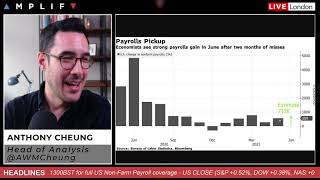
Anthony Cheung breaks down the US Non-Farm Payroll release live: 850,000 jobs added versus 700k expected, unemployment at 5.9%. Equities rally on the strong number while higher joblessness tempers expectations for aggressive Fed tightening. He walks through immediate moves across Treasury yields, currencies, gold, and oil.
Chapters
Okay, very good afternoon. If you are just joining us, I am just now doing a couple of sound checks before I'll do a briefing for NFP, obviously coming out momentarily. So hope everyone's had a good day so far. Looking forward to this one, should be definitely interesting and market-moving. To what extent, we're going to find out shortly. So I'm just getting up a couple of screens for the moment, and then we'll look to kick things off. But yeah, hope everyone's doing well and had a good week. Okay, yeah, I'm just kind of onboarding people at the minute, just get everyone in, and I'm going to make sure I can see all the chat and everything. So if there's anything that you guys ask me as questions over the next 45 minutes, hour or so, absolutely happy to help. So again, just setting up a few things at the minute. Okay, cool. So Okay, we're going to start the formal rundown in 1 minute's time. Yeah, it's just a, just a slight marginal uptick in oil prices here just before we get stuck into payrolls. If I put this on a 1-minute, you can see that short reaction, just a little pop-up in price, about 15 cents. Just had some news break: OPEC+ meeting to go ahead today, no deal yet in sight according to a delegate. If no new OPEC deal, they output remains unchanged. And obviously, just given a lot of the headlines pertaining to an increase but of a slightly more moderate size than what the markets are expecting that lift prices yesterday, not even committing to the 400K certainly is enough to bump prices higher if that does materialize. And we're waiting for that meeting to kick off, um, in just around an hour's time or so. So a bit of upside in oil actually just being observed here, but just having a quick check Um, who have we got? Owen, Sammy from South Africa, amazing, great. David in Canada, how's it going? Yeah, amazing to have so many people around the world tune in, feel privileged. So yeah, I hope everyone's good. Um, yeah, James, there probably is going to be a slight delay on, on the feed, so it won't be real time, real time, but I will be relaying it at that point, but then the YouTube and we'll be re-sharing and distributing the broadcast, obviously. All right, well, I think we're all ready to go, so let's get to it. I'm going to run through a bit of a preview first, just get into context what it is that we're looking out for today. I've got the chaps at News Squawk who are going to release the news as it comes out, and of course we can listen in live, and I'll be here to kind of give you a bit of an idea of why it's reacting in the way that it does, and hopefully I can guide you through any subsequent volatility, uh, as to the rationale. But let's kick things off and let's start with a bit of perspective. And so this is then the recent run of US non-farm payroll readings, and in particular kind of drawing your attention to the last two readings 5.99 and sub-300K. And these were both on the prior occasions disappointments. And just at a very top level, I've just been reading some of the general bank commentary on the street, looking at what the general primary dealers kind of range of estimates for the headline change in payrolls is. I can't help but feel like we've been here 2 months in a row where everyone's kind of much more favoring on the balance an upside surprise. And if you remember, that definitely was the figure we were looking for back 2 months ago when we had that expectation of around 960. People were talking up 1.5 million and it came out at 266 at the time. So the market definitely, from a positional point of view, is highly susceptible to another downside surprise. That would probably be one of the nicest scenarios to see in order to see potential quite nice trading opportunity. And that being then is that a lot of people, for right reasons, and we'll discuss them in a moment, are anticipating the job market to have picked up. Bottom line is further administering of vaccinations allowing further state-level reopenings. And there's some nuance to the types of jobs, but generally speaking, we should see some positive job numbers here on out, particularly if we start to lose out or start to fade out some of the stimulus checks and things like that, which could have been culprits for why people weren't coming back to work, um, in the previous instances. So let's have a look at things and then we'll talk about charts and reactions in a moment. So today's figure, we'll look at the numbers in a moment, but the idea being that payrolls remains roughly around 7.5 million short of closing the gap of the volume of jobs that were lost during the initial onset of the pandemic. And for context, obviously what we are trading in asset prices day to day is our understanding about future monetary policy adopted and implemented by the Federal Reserve, the US central bank. And so there has been quite a growing divergence within the Federal Open Market Committee where, albeit the hawkish-minded members, they've been really upping the ante on some of that hawkish rhetoric. We had Kaplan most recently, we've had other members saying very similar, talking about this idea that policy should tighten quicker rather than the current kind of Fed projections. Powell, the New York President Williams, they've been much more of the idea of this kind of gradual, cautious approach. And generally speaking, then, that is the official party line, so to speak, that of which what Powell says. And so here then lies a kind of interesting juncture for this economic data, because The weakness of the jobs data has really given Powell ammunition to remain fairly conservative with this more optimistic outlook being issued by the hawks. And so if this number was to be particularly strong— and we'll look at the ranges, but the top end of the range is just over a million— so if we start seeing prints at, say, 1.2, 1.5, which would be a massive upside surprise, in line with decreases more aggressively than expected in things like unemployment rates, well then perhaps we get quite a severe recalculation by the market as to, wow, Powell's going to have to change sooner than we thought in terms of aligning himself a little bit more on the hawkish side of things. Policy is going to tighten in the future. We are going to taper. We are going to hike rates. The idea being is when and what does that timeline look like? And this data certainly carries the propensity to move the needle a little bit on the timings. Remember, tapering is the first in this policy sequence that we're looking for, and that's not expected to really start kicking off until the Jackson Hole Symposium at the end of August, to be formalized in the September new dot plots and so forth, and projections to then commence then tapering probably in the beginning of 2022. But that doesn't mean in the intraday environment an upside number will get people thinking of those dominoes are going to happen, they're going to fall faster. And so what would that look like given equity markets are at record levels? And the likes of the NASDAQ has been seeing some really stretched moves of late, and the S&P's traded an all-time high obviously just this morning. So they are a little bit susceptible to big upside numbers for a bit of a pullback on that initial tightening apprehension. Now that doesn't mean that, you know, that's the end of the equity appreciation, but a pullback intraday would probably be the more likely thing to see, an initial reaction. Firmer dollar, currency pairs have been weakening. There is a growing divergence fundamentally, obviously, about the situation that the US and the Fed are at comparative to what we're seeing in Europe, which is much more of a dovish disposition against the ever-increasing hawkishness of the Fed. And that has been exerting downside pressure at the moment, and the euro has continued that downward trend, as too has cable, at the, at the strength of the dollar, which through June had its best month in several months. So this is the kind of overall thinking. A few other things to have a look at then. A number of factors have really impeded most belief of why this jobs market data has been a bit lackluster of late, and they include everything from enhanced unemployment benefits So people who are just not willing to take a minimum wage job where the unemployment benefits are better for them, at least at that point in time. Ongoing childcare responsibilities, so that impedes people's ability to go back to work. And then healthcare concerns. Again, just because we reopen, that doesn't necessarily mean that every single individual would return to normal behavioral patterns, given the fact that there's probably going to be some behavioral scarring from what the pandemic has taught us as a society. And not everyone's going to adapt and just continue life as it was in the past. So there's a little bit of that also playing into retirement rates have been increasing, stock market valuations are helping pump up pensions. And if you're near that age, well then why not just call it a day? And so there's quite a few different, uh, things to contemplate that should in the end decrease as restraints and see the job data move higher. Hence the reason why people are generally looking for an upside figure. Job openings are not a problem at the moment as far as the US is concerned. Job openings at the present point in time are very high. It's filling these jobs which has been slightly problematic. And when we're looking at the actual breakdown of the labor report, we can obviously break it down into its components of actual job sectors. And leisure and hospitality is being the real area that's experienced the most meaningful job creation of late. This, of course, comes because those type of activities that are non-office-based, public-facing, human-to-human interaction, they're the ones that were heavily impacted by the severity of the lockdowns. But remember, we're going through a period now when 2 weeks ago, New York, California, we've reopened now for business, and a lot of the— nearly every measure has been dropped. And so given the fact that even though there's some emergence of the Delta variant, Hospitalizations, deaths remain low, obviously a positive thing. That's allowing these, these areas to reopen, and hospitality, leisure and hospitality should continue to be the biggest benefactors of that. And more hiring at restaurants, bars, entertainment venues could well start to have emerged even in this month, gearing up for what we're looking out for now, which is that reopening. Remember, that happened 2 weeks ago or so. Does There's a few other things Goldman Sachs mentioned, a few other good points. So to share, they said the arrival of youth summer labor market force. Remember, just given the seasonal period of where we are in the year at the moment, that could also be a benefit, a benefit to this data report. And then obviously the wind-down of federal unemployment top-ups, that has been a considerable labor supply constraint, which now should start to fade out as time goes on, as people now have a necessity to go back to work. Not optional anymore, getting the government kind of handouts in that respect. A few other things we look at, obviously going into this from a fundamental perspective, and that is, well, what does it look like from the job components we've seen that would give us a precursor, a forward-looking insight as to how this labor report might perform? And to be honest, it's been a little bit mixed. So on the ISM PMI numbers, the service figure, the employment section of that survey dipped to 55.3 after hitting a 3-week peak, a 3-year peak in the previous reading. The manufacturing side, the employment subindex dipped into contraction territory, actually below 50. So if anything, these would be more moderations, if anything. However, on the flip side, on the 4-week average for jobless claims, they've gone below 400K for the first time since the pandemic. And then we had ADP, of course, which was strong, just short of a million. This, this often gets the greatest weighted proportional impact for people's estimations, given that it's a very far wide-reaching survey, uh, to give you some heads up as to how the, the Labor Department's report might look like. And that number hints at a stronger number today if that correlated kind of effect is gonna read it, read through. Um, yeah, so that's kind of overview. So let's have a look at the data, then we'll look at the charts. Um, while I'm doing this on my own at the minute, the team are on online. Uh, there's a few other guys, so shout out to Alex who's with York University. I've just been with Credit Suisse EMEA division this morning, so hi to you guys. There's our summer analysts as well going through this, and then there's obviously our mainstay community as well, both Amplify Live as well. So hope everyone's doing well. But yeah, just, they'll take care of the, the, the questions in, in the chat, and I'll pick them up as and when I can after the release. But looking at the numbers, be important to think about the framework of A, the inputs. And if you remember a few probably years ago, the average hourly earnings was kind of where the main focal point of interest of what would, what would dictate the type of price reaction we'd likely see. But the kind of focus has shifted and now definitely it's on just the headline changing on farm payrolls first and foremost. And if you think about that kind of reaction function, it's obviously a lot of automated systems that hit the initial release. So always advisable to stay out of that initial explosive pop. which is often a function of the illiquidity in the market because no one's going to want an open position going into the release. And so that is going to be defined on the first in, first out put, which is typically the headline reading that will create the spike. On that basis then, it's expected at 700K. The range on the low, 376. So I talked about the market potentially vulnerable to a downside surprise, given the market's leaning to a positive outcome for today's report. Downside surprise, I'd be saying anything in the 250 region, anything, anything south of there. I would look for yields to decline, T-notes to break through the weekly high, gold to catch a bid. And gold already is backed off its initial highs, but I'd look for weakness in the dollar to propel those markets higher. And that's going to support the major currency pairs in EURUSD and Cable. If we start looking at the top end of the expectations, then it's going to be very different in that respect. All right, we've only got a short amount of time now, so I'm going to turn the squawk on and I'll flip over to the charts. I've not, not had a great deal of time to look at the technicals, but I will make the charts bigger as I look at different products.
10 seconds.
Okay, I'm handing you over to the squawkers now. You'll hear the release come out. 5 seconds.
850. That's 850 for the headline, both expected off 700. Unemployment, 5.9, both expected 5.7. The prior, that was revised higher to 5.83. For earnings month to month, 0.3, below expected 0.4. Year on year, 3.6, below expected 3.7. Workweek hours, 34.7, below expected 34.9. Labor force participation, that's 61.6, 6, matching the prior. Private, that was 662, above expected 600. Manufacturing, 15, but expected 28. Government, that rises to 188 from 67. The trade data, that was a deficit of 71.2 billion against expected 71.4. Canadian trade, a deficit of 1.39 billion against expected surplus of 0.37.
Okay, I'm going to turn those guys off. So the headline number, to iterate, 850,000 above the expected 700. The unemployment rate though did tick up to 5.9% against the expected 5.6%. 7. Average hourly earnings are 0.1 miss on both the month-on-month and year-on-year, with the participation rate as per the previous at 61.6%. So interesting moves here and something to be a bit careful of because initially you can see the US 10-year here popped lower. You saw a similar type of move with gold, popped lower, and it's had a bit of a retracement of that move. So the initial The first reaction, of course, was on the headline print, but the unemployment rate was higher than expected, 5.9%, which is at the top end of the analyst range. So you've got a positive headline but a negative unemployment rate. So that's why you've probably had a bit of a pullback on those initial moves in the yield space. Currencies a bit indecisive, initially popping lower in the euro currency, only then to fade that move very quickly on the mixed data. Equities, on the other hand, Equities kind of like it, and I get that. You've got pretty much on the initial glance here a positive development, which is jobs are picking up. They're not spectacularly strong where it's going to really shift the Fed's timing, but it's a positive, healthy improvement in the job situation. The unemployment as well restricts the hawks really of having evidence to really support being more aggressive. So for me, this is quite a perfect cocktail for positive equity reaction. And that to me explains why equities are liking this at the minute. S&P session highs, we're now back in firmer positive territory. The NASDAQ has just also printed fresh highs as well. So let me just quickly get that up and we can take a look. So here, put this on a daily chart, all-time highs now in the NASDAQ. So this is looking like daily continuation. We're just breaking above that double top of the last prior two-day sessions. So yeah, as I said, it's a good situation. It's a healthy improvement in jobs is my initial assessment, but it's not good enough where it's going to alter the perception of the center ground at the Fed, which is the most important. And so people like Powell is not going to be fazed to change his mind and become more hawkish on the back of evidence of what he's just seen, particularly as well with the unemployment rate that further gives him reason to hold off and continue the line and not become more hawkish. So for anything, it's a sigh of relief for the market, which now— look, yields are now moving lower, 10-year session high, equity and bonds rallying plays and fits with what I'm trying to describe. So it isn't going to alter— there was fears going into this that it was going to be a blockbuster print, it's going to change the shape of what markets think on Fed timing. To me, on the initial glance, this report does not do that, doesn't achieve that magnitude of positivity. So look, the US 10-year is breaking higher, and if you actually look now, full reversals across the board on that initial spike. Dollar now weakening. The Dixie has broken out of its range of the last 24 hours, so you're getting a meaningful response now here in EURUSD. EURUSD is just coming up, testing up at quite a key technical short-term level of respect. So you can see here those previous lows, highs from the overnight APAC session, just finding a bit of resistance there now in the euro at that level. So yeah, nice response here in the dollar lifting those pairs. Cable the same. So if you're looking at— if you're an FX trader, we're back at pivot, just went through the early late Asia, early European open high. So the pivot there just above, and then just above the pivot you've got those previous lows that we've seen back on the 21st. It's a bit of a congestion of resistance levels just above there in cable. And yeah, gold exactly back to where we were. So really tough instrument to trade gold on, on releases like this. You can get easily chopped up. But at the moment, yeah, now there's another move lower there in the dollar. And just saw EURUSD kick on. So gold here, keep an eye on those highs. You've got the range high going back to on the 25th. So gold could have another retest up here on, on the upside and full retracement because the dollar is still weakening. Euro, you can see, you see that extension of that initial price spike and the dollar had another flush, and that just helps then the technical catalyst on that break. Add another 10 pips on that move to run up to pivot there. In the euro currency. Equities still rallying, so again, nothing's changed. It's just the other asset classes— equities were the real bellwether there that really led to that time arbitrage to maybe get in some of that turnaround in the currency space. And there you go, look, gold follows suit. So for me, the FX market was a good pre-warning flag for that gold long position there because you could see that it was gaining momentum on the upside reversal And now not only has it broken that high, it's broken the high on the 25th, and we're having a run-up now to highs not seen since going back to the 23rd. And so R2 with that level, you might see some short-term profit taking here on this, on this further extension of gold. But you see how equities went, then the currencies went, yields followed suit, and then gold was the aftermath pop that you saw then on that last technical breach. And you can see here short-term fast money traders just booking profits there on that nearest clearest point of technical resistance up and around those prior highs that were seen on 23rd. So yeah, nice, nice price action actually playing out here. Starting to see a little bit of reprieve now on that move. So with that gold, what would make me lack conviction now of extensions in euro and gold is if you look at the 10-year, 10-year rally's over, down up back to where we were. And now we're just starting to see the other currency pairs follow suit, finding a bit of technical resistance around these levels. And some of that momentum upside just fading gives me lesser conviction than for gold to just power on up again. And you can see it's starting to fade a little bit. So this is where the cross-asset correlations are quite key for timing. Remember, equities was a trigger, and the equity bid is also abating now. Which again means, I don't know, if you're in longs in euro gold, you haven't exited, then you probably missed your most optimal point now that equities have started to back off. So yeah, nice, nice price action. Oil, as you would anticipate, not interested in payrolls. It certainly doesn't change the game in terms of the demand-supply equation on the former in regards to the US economy and Fed policy on that side. And context is key. Remember, there's OPEC happening and it's happening right now, so oil traders are looking at a different thing right now. All right, any questions at all while I'm on? Hopefully that all made, made sense. It seemed fairly clear to me the types of reactions that we were seeing, but obviously happy to, um, to help and explain things. Just having a quick look at the DAX in German equities here, just finding a bit of resistance around the, the highs. This is kind of the price pattern I've been tracking in the DAX the last couple of sessions. So you've got that rising trend line going back to low on the 21st, it's been holding nicely in play. Pivot short term, nice support this morning on the bounce, and then you're just finding some resistance here. European equities appreciating in sympathy with the appreciation of US indices. But here you've got that previous high that was seen yesterday morning, which has been a significant inflection— well, resistance area, I should say, for, for the DAX. And you've got the R1 sitting just above as well. So yeah, a bit of a tough time there at the minute to try and push on. Certainly not as pronounced as the equities reaction stateside. But yeah, look, the currencies are backed off and reason, you know, for good booking on those initial fast money moves. T-notes back where they were and gold's back where they were. Net-net, for me, after this down-up type price reaction across assets, this does not change what the Fed are going to do. So ultimately, there's no reason really to alter too much materially, X-ing out the volatility of the last 10 minutes from where we were before. You know, if you were a trader not intraday and you were more a fund manager, this, this does not information change your game plan, I would say, looking at it from different duration or market participant point of view. Yeah, next up, if you are going to be trading, obviously keep an eye out for the cash open on the NYSE in 50 minutes' time, 2:30 London. You know, with payrolls, it's often one of those where we've kind of had the initial wave. People will chew over the bones and have a think and try to rationalize what they've had and where they want to take this market. And sometimes the general pickup in volume from the open that we get subsequently on the NYSE might help give that a bit more of a direction. Okay, any questions at all while I'm here? Fire away. Um, I think the team can message me if there's anything that comes in on LinkedIn or Facebook. I can see YouTube at the moment. So, um, Alex, how's it going to be reflected when the US open? Um, yeah, I mean, I'd be looking at this as generally a supportive story for equities. Um, we are already quite high in US indices like the NASDAQ or S&P, and that is a consideration. But let's have a look technically. So thinking of in an hour's time at the open, so you've got the previous— on the weekly price pattern in the NASDAQ, you've got the all-time high that was printed midweek and then also yesterday. And obviously payrolls has helped us power above that. So now, generally speaking, I'd be looking at that as a kind of near-term price area of support. So even if we got a pullback, I wouldn't feel particularly comfortable of entering the market around here. That opportunity has passed. Strategically, if the market came back down, then wouldn't mind then the idea that equities remain supported, and whether they print new highs or not, it comes back down and looking to reassert then a general positional trade to play out for further stock appreciation across the rest of the session. Same kind of play in, in the S&P, I guess. Probably be my bias if I had any. Um, let's put it down onto a— this is on a 60-minute chart. So this is a 60-minute chart of the S&P 500, and this starts to encapsulate the last 10 days or so of price action. Just been keeping on a trend line over this week which has been respected on 3 different occasions. So for me, there's a very nice technical point, um, much lower down if we start coming in coinciding horizontally around the 4300 level, 4306, previous all-time high support in the late US session yesterday with the trend line coming in. I'd kind of like that area. Jumping in at these types of levels, I think it's a bit more tricky, so I prefer to just wait, see how the first initial 15 minutes of NYSE trade plays out. Um, which would be how I would look at it. For the gold and 10-year market, messy. I mean, you've only got to look at those candlesticks to think, yeah, if you stood on the wrong way of that freight train, it would have been painful. So hopefully though, when you saw it, me describing it in real time, it definitely can be tradable, but you've definitely got to be of a certain characteristic and skill level on the execution side to be able to pull off a very fast-moving move like that. This is a 1-minute of gold. And so you can see, to me, this tells a very clear story in a way, which is, um, let me just remove some of these boxes just to make it clear. So on a minute, this is the downward reaction on the headline. So this is that kind of more like algo-related first-in-out spike on the fact that 850 is better than 700. Then you get the, hold on, this isn't quite as, as spectacular as we were perhaps looking for, and the unemployment rate has ticked up. We get the reversal, and that's the second move. And in the gold market, the third move kicks in. And all the meanwhile, this is respecting technical patterns outside of a very short 1-minute on a more high time frame, on a 30-minute, 60-minute. And then you get the realization of Does this really change things? Not really for the Fed. And then we're back to ground zero again. So for me, for gold, if I was looking at this this afternoon, um, I would be looking more to the dollar to give me a bit of guidance perhaps on any subsequent follow-through on those moves. And EURUSD is just perking up a little bit here. If EURUSD really wants to push on, break above its initial spike high at the pivot the next kind of target doesn't really start coming in until quite a bit higher above. You've got the R1 at, um, 1.1894, and then you've got the 1.19 handle, which also is that high and low that you can see here on a few prior occasions. So if that happens, that's more dollar weakness, euro strength. So again, could be then that could support gold if we get follow-through of the euro and the dollar weakness. Yeah, equity is just perking up again a little bit. All right, well, a couple of other things just wanted to say, um, and that is if you are not already following us on YouTube, please do. I would be massively appreciative if you would be part of our community. We put out daily videos. I have macro briefings that go out a bit later in the morning, but there's other stuff you might find useful and interesting. So just, just punch in Amplified Trading, hit the subscribe button, and if you click on the bell icon, you'll get notified anytime we go live like this or there's new video content. Feel free to follow me on Twitter. Probably the most useful thing both for traders and students is every morning I put out my morning call, and my morning call is only things you need to know for the day ahead. So for a trader, part of your preparation routine, fundamentally, strategically thinking about the day. For a student, super important that you remain connected to markets. And if you can spend 2 minutes reading this every day, I do it for the purpose of trying to make you guys, in a nice digestible way, on top of what's happening, because I know you're pushed for time with your studies and work and so forth. So feel free to check that out. I do tweet other stuff throughout the day as and when I find something interesting. Just be careful, there's a lot of fake me's these days. This is, um, the real Anthony Cheung, if you want to put it that way. And my handle is @awmcheung, so feel free to connect there. We also have a podcast, me and the head of trading, Piers Curran. We have a very informal chat at the end of every week where we talk over some of the bigger stuff of the week, and our purpose is to try and deconstruct more complex things that might happen in the market. But put it in a way that everyone can understand and make sense of. So last week we talked about stress tests, and the week before we talked about the dot plots because everyone was talking about the Fed and the dot plot change, the composition, so on and so forth. So check that out. It's also on Spotify, Google, Apple Podcasts, just called The Market Watch. Um, and yeah, be great to, um, to speak to you guys more often. Okay, I'm gonna wrap it up there for the live coverage. And so, um, I will see those who are members of the AmplifyLive.com community online, and I'll wish the rest of you a good rest of the day. All right, take care everyone.
More from Anthony


Inside the Biggest Banking Stories You Need to Know This Week (Anthropic, Diageo, Private Credit)


Inside the Biggest M&A Deals You Need to Know This Week (UniCredit, GameStop, eBay, Eli Lilly)







AI Breakthrough or Hype? Anthropic’s Claude Mythos, Tim Cook Steps Down & LIV Golf Collapse