US non-farm payrolls preview
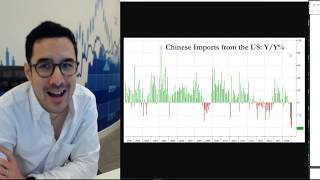
China's exports and imports hit their weakest levels since 2016, triggering a global risk-off move. The US non-farm payroll report is expected around 183k jobs, but wage growth will be the key market driver, with a 0.3-0.4% rise anticipated versus a low 0.1% scenario.
Chapters
Good morning, it is Friday the 8th of March. Hope you are well. In terms of the briefing today, going to cover a couple of things, a bit of an update from Chinese data overnight and how their markets moved accordingly. That's kind of created some risk-off sentiment for the market open today in UK and Europe. We're then going to have a look at some news that came out, a bit of a summary from what the ECB and their dovish surprise from yesterday We'll also look at a quick update on Brexit, and then we'll talk about US non-farm payrolls and what we can expect from that release later on at 1:30 this afternoon. I'll go through all of that, and then I'll hand you over to Sam, as per usual, who can look over the charts. But if you're looking at the, the cross-asset class mix as it stands at the moment, you can see here quite a distinct kind of pattern to proceedings. You've got quite noticeable weakness in the not just US but global index futures. Comes after a very poor session overnight in China. I think some of the major indices there down to the tune of 3 to 4%. We'll get into the reasons why in a second. But that's prompted, I guess, a little bit of a flight to quality move. Gold up about $7 for the moment, trading back up to $1,294, finding some resistance at its R2 already this morning. In fixed income futures, kind of drifted up, slight consolidation. Much of that move in the US 10-year came and booms yesterday. Obviously you had that, that real dovish surprise from the ECB capturing a lot of the market attention, and we kind of held on to that move. So T-notes are flat but still holding on to around a 122.21 level for the moment. So Let's get into what's kind of triggered this move, particularly in the, uh, the equity market, and it's all about China. Now, just from a quick mention, the trade war obviously is still ongoing. Senior Chinese diplomat overnight, in fact, the top diplomat from their State Council, was talking about how talks had made substantial progress. That's all well and good. The problem is, is that economically China really is suffering. And this is kind of dual fold. People looking at this data, you've got the trade balance, so import-export numbers that came out overnight. Now this graphic here is overlaying the last, what, 4 or 5 years of Chinese data, specifically looking at exports in the the kind of orange line and the imports in the white line. Now, one thing you'll notice here is if we go back to every single year, so if you look at February of 2015, you get a big spike, move down, go to 2016, get a big spike, move down, repeats, repeats, and has repeated somewhat again this time. So that's that kind of traditional Lunar New Year period in February. So you get the kind of front loading of orders so you get the kind of artificial spike in the month before, and then you get the drop-off as kind of China goes into shutdown during that period. Remember, it's a complete week closed-door kind of policy as everyone celebrates that New Year. What we've had here though is that if you look at exports, it's quite a monumental collapse seen, because not only right now as of 2019, obviously Well, not only are we dealing with the kind of the global growth concerns at the moment, but obviously the difference between now and current context to previous is we've got an escalated trade war situation, which of course has meant that these numbers are far lower than where we were in recent years, in 2016, '17, for example. To put this in a bit more perspective, here's what the export number looks like comparative to to recent history. So you've got to go all the way back to basically the beginning of 2016, the last time the export number was this weak. I mean, check that out for a real reaction comparative to where we had been for the best part of '17, '18. Then if you look at imports, in fact, Chinese imports from the, from the US specifically, year-on-year percentage change is the worst on record. So we saw that somewhat reflected in the trade balance data that we had from the US yesterday. But just interesting to see how this is playing out while the overall trade discussions are happening with the powers that be at the top level. Underlying this, there definitely is being an impact. And then what happened overnight? Well, this is kind of the twofold reaction. Chinese equities were already on the back foot then the kind of latter part of the session they continue to weaken as well. So a lot of this kind of movement overnight comes as well in the context— if you remember this time yesterday we were talking about, I think it was 80% of the— was it 80% of the Shanghai Composite or the CSI 300 was trading above its kind of I think it was the 200 daily moving average, or it was— there was a percentage figure which was basically indicative of the fact that the market is the most overbought. If you think about the supreme recovery that not just Chinese but global equity markets have had since the dip and low that we saw around Christmas, you know, a lot of these markets are ripe for a bit of a pullback. And then you throw in the catalyst of some extreme negative data particularly on a country which is traditionally an export-led economy, and then you get this type of move. And then of course this filters through into the negative read across, impacts US equity futures overnight, and accordingly the European markets open on the back foot as well to boot. On that front then, given concerns of China, well, this obviously has implications for demand for commodity products, particularly that of crude oil. Crude still within its relative range. I mean, it's not going— this isn't anywhere close to breaching, at least at this point, any key technical levels to the, the broader picture that we've had of late. But WTI crude is down about 54 cents, sitting just above the $56 handle, $56.12 at last print. So again, fundamentally obviously weighing on concerns on the demand side. So that was the kind of Chinese story overnight. That's probably the biggest thing that's, that's happened for me to update you on. Other things, um, German industrial orders this morning, just to get it against expectations, it came in at -2.6%. Expectations were for +0.5%. So the economic data downside surprises continue basically, maybe globally, but Germany in particular has seen some pretty shocking numbers. of late, which is particularly worrying when it's about industrial production, manufacturing, PMIs that we've had. Um, one thing I would say though with the industrial order data is that it does see some quite extreme volatility, month-to-month swings, not detracting from the point that this was a very, uh, weak number. In fact, the steepest decline in factory orders since June of last year amid decreases in both domestic order orders and foreign demand. So it does, when you start going into this report, reflect that overall implications of an ongoing kind of trade dispute and global growth slowdown. On that point, because I did have some questions yesterday from a couple of you about why did Halifax house prices jump 5.9% month-on-month— that was the biggest month-on-month increase in UK house prices since 1983. I did have a quick read into it last night, and effectively what they're saying, most economists, is that Halifax is one of the least reliable housing indicators. Uh, the previous month to the last one we had yesterday was -3%, so it's gone from -3% to +5.9%, and essentially it's all over the place when you actually look at the data set. So no one's really looking at it as too much of a reliable indicator. Just to cover that off. Leading on from then, uh, obviously the German situation. We of course had the ECB yesterday. Now just having a look, I mean, obviously the euro was under heavy selling pressure yesterday, and I'll leave Sam to give his view technically and what this means. But obviously this was the kind of rectangle of price action that we were looking at, was that definitive range of recent kind of 6-month price activity around that 1.1250 area. And certainly we broke through that, which puts the, the euro currency against the dollar at its lowest levels going back to the summer of 2017. So I guess be interested to hear what Sam has to say about his views going forward from there. But certainly from a fundamental point of view, it was a pretty surprising decision. And actually kind of kicking myself a little bit because I'm thinking, well, as much as we did a good job in isolating the key things to look for and that all the kind of planning played out in that way, the one thing is, is that if I actually think back to Mario Draghi's tenancy or his reign as the president of the ECB, he's always actually been pretty forthcoming with taking quite aggressive action. He's, he's kind of been quite aggressive in beating the market to it rather than being passive and kind of forced into a corner. And he's kind of done it again. He over-delivered in response to yesterday. It wasn't that anything that he did was new, it was that the things that he did, he did earlier than what the market was expecting. So things like forward guidance and changing the specific terminology to hiking interest rates, you know, at the end through summer, i.e., Q3, Q4. He pushed that to the end of the year and even longer if necessary to hit inflationary targets and so on. So we weren't really expecting that so soon. Not only that, the Teltro detail came in, in force, and we were— the baseline scenario in markets that we were going to get definitely a a nod that this was going to happen, but potentially details would be forthcoming in the following meeting in April. But yet they all came yesterday. Then we had, and I think as to be expected then given that aggressive action at 12:45, a substantial reduction in inflation and growth forecast that followed in the ECB staff projections. And, and then consequently the market kind of bought into it. The one thing I guess if you were looking at it and being, uh, very critical. The few question marks there were was that the actual mechanics around the loan, what it was tied to in a fixed-rate nature, its duration of being 2 instead of longer, which could have been more dovish. Some people have highlighted that. And then the other thing, of course, is from a bigger, broader point of view from monetary policy, is where do you go from now? Or where do you go from here? What if things do start to substantially deteriorate? Well, what next? This is the problem that you have when you fire all of your guns at once. It's, well, what next? Um, what was interesting was this article here that I'm showing, and if you remember what we were talking about yesterday, whenever there's quite an interesting juncture for monetary policy, this is when it's quite likely that you hear of source comments. We had a source comment the day before the ECB, and what we were suggesting were, depending on the market's interpretation, and the more complex the release from the central bank, the more the necessity is for them to be transparent, to try and provide as much forward guidance as possible to allay any fears in the market of what might happen as a net result. So what happened last night, or late yesterday afternoon? We had more source code comments, and this was it. So some ECB policymakers considered that the central bank's downgrading of growth forecasts for 2019 is still too optimistic. So apparently there was a split amongst the Governing Council that even though they were downgraded substantially, even though Draghi's kind of throwing the kitchen sink at things, for now, that actually quite a few of them wanted more. They wanted to actually push the rate pledge way into 2020, is some of the discussion. Apparently, um, the officials argued that the pickup assumed in the projections, i.e., for growth for the second half of the year, might not materialize. So just quite interesting to see how responsive the ECB have become to what has been arguably quite a significant change in economic conditions in the eurozone. But for one, following the lead, perhaps you could say, of the world's biggest central bank, that of the Federal Reserve, who's already flipped to become this kind of new dovish angle for the last couple of months. And we've seen what impact that's had on markets. So that was the kind of ECB update. Otherwise, Brexit, it's the usual scenario. Quite a few headlines, not a lot of movement, because we've kind of— again, whether it's a degree of headline fatigue, but ultimately I don't think any of the news that's coming out really is, is that revolutionary. The last thing that we've had here is that European Union— this came out last night— apparently have made a new offer in a bid to break the Brexit impasse. Though it falls short of what Britain has demanded, according to people familiar with the EU side of negotiations. So what's happening here is that talks are expected to continue into the weekend, and if they fail, Parliament will likely vote against May's deal for a second time. We had those headlines yesterday. Apparently the latest informed sources are saying at this point she's going to fail by at least 100 votes, and then that goes down that kind of tree, if you like, of other options. To eliminate no deal, and then we vote on the extension of Article 50 and so on. According to Bloomberg, they say it's unclear whether this latest EU proposal will be enough. What that proposal is saying is it aims to bolster the review system that's been already set out in the deal. These check-ins are scheduled every 6 months to help track and speed up the process of replacing the backstop with a better solution. But this is way short of what the Attorney General Geoffrey Cox was asking of the EU 2 days ago, when apparently the EU officials abruptly ended talks because what he was asking was way too much. He wanted a change, if you remember, to the arbitration system set out in the deal to make it easier for the UK to leave the backstop without the EU's approval, something which I feel the EU are not going to accept. So yeah, all things remain equal at this point. I guess we're going to get a lot more information, I would have it a guess, on the weekend for sure, the Sunday papers. Just as a reminder as well, I will be doing a Sunday live session on our Amplify YouTube channel. I normally do this earlier on in the day. I do it live, so if you do want to join, what you can do is go to our YouTube channel, click subscribe, and then click the notification kind of bell icon, and then when I go live, it will send a push alert to your phone. If you don't catch it live, you can just then— it will go up as a recorded video in the Sunday live sessions in the category section. Okay, let's move on then to the final thing of today, of course, which is non-farm payrolls. And because this morning, if we follow the traditional kind of theme, the market's kind of already moved off the, the handover of the negative lead from Asia. Things might now largely consolidate as we head into the jobs data. I'm not going to go through all of this in detail. I did send this out via email to you guys yesterday, and this gives you the view of what Deutsche Bank, Westpac, ING, Danske Bank, a couple of the big banks, are saying about non-farm payrolls. But let's talk NFP for a second. I know that we always have a bit of a sweepstakes— who can guess the headline jobs number. So if you wanted to see the median, the dealer median estimate, as you can see down here is 183,000. Your most optimistic out of these is NatWest. NatWest are going for 235,000. The cluster around the median, of course, you've got UBS, HSBC, Citi, and so on. The most pessimistic, Morgan Stanley, they're going for 141,000. Goldman's close, just above at 1.50. So the way to, I guess, think about this is got to look at ADP. How did ADP come out? This typically is seen as a bit of a lead indicator, it being private payrolls, the biggest kind of employment survey that we could see to give you a bit of an insight as to the employment conditions, at least in the— on a more nationwide basis. As to what then the government's report could indicate later on today from the BLS. Now, ADP came out earlier this week, 183,000. That was slightly below expectations of 189, so broadly in line. Um, but if you remember, the previous ADP got revised. I think it was previously about 213, and it got revised up to 300,000. I mean, that's a, it's a monster revision. Um, that then leads us to, if you look at what happened here, then the revision back up in ADP to 300 kind of then starts to mimic what Non-Farm was last time, where you had a 304,000 number. And if I remember rightly, I actually wasn't here the last time payrolls came out, but I believe that people were expecting a depressed number because of the government shutdown and got a big surprise because it came in at 304. So in terms of the number today, the range that you've got— so expectations, we're looking around the 180 figure. You've got a range of 94 is the most pessimistic on the street. 94 would breach, would break this chart. Basically, we'd have to go to a 5-year. 94 would be the worst reading, got to go back to late, mid-late 2017, the the last time we were that low. If we were to get on the upper side, upside surprise, top end of the range, 263,000, that would be not that shocking looking at the kind of range that we have been. The downside would probably be more so in that respect. Either way, whether jobs comes in, I think, uh, low 100s or high 200s, that's definitely not the focus. I don't think that's going to detract too much from overall market thinking of really moving the needle for the Federal Reserve members. What does move that needle, of course, is average hourly earnings, which, if you remember, in the last payroll report you had a spectacular jobs creation figure, but you had a very bad, um, actual average hourly earnings number. And that's what people are looking at. This kind of flies against, I guess, traditional theory of an unemployment rate— well, at this point did tick up slightly to 4%, but we are looking for that by median consensus today to drop back down to 3.9%. So consequently then, as those workers from the US come back to work, those who had temporarily been registered as unemployed come back into the workforce, the unemployment rate should drop back down by 0.1%. And the median estimate here for average earnings is that we pop back up to where we were, basically 0.3%. We do have a range of 0.1— we remain where we were— to 0.4%. I would say if you're going to pick a target from what out of quite a busy release is going to really move the market, it's this number. and it draws interest not only because of its inflation implications, and that's certainly center to Fed thinking, but also it's so depressed it broke the general trend before. But given that reasoning behind the government shutdown, was that a one-off effect, or actually is there something more to it with more substance? If this was to remain low, i.e., at 0.1, let's say, which is the bottom end of the range, and you get a fairly benign in-line job reading, well, that's going to just further cement the fact that the markets are right to interpret the Fed commentary that they're going to pause. And then come 20th of March, they're going to revise then the dot plots, more than likely to go from the 2 current to 0. Going forward. If though we get a removal back to 0.3 or even top-end range 0.4 with a healthy jobs number, then it makes things quite interesting because despite elsewhere economic weakness materializing, from a jobs perspective and potentially future inflation perspective from wages, if it does go up to 0.4, then, you know, if the Fed are going to be reactive to data incoming, they've got a bit of a problem because you've got weakness extreme one side but potential strength on the other. What do you do? Do you go from 2 to 1 instead of zero rates? It's all going to depend on the data, is what I'd say. Other than that, looking at the calendar, you've got the Baker Hughes rig count coming out for any energy traders later on. You've got ECB speaker Mersch speaking at 4 30. But otherwise, I would say it's going to be a payroll focus, always is, uh, even though, as I said, it's going to generate a lot of short-term price reaction and movement intraday. I think only if that wage data is kind of very low 0.1, very high 0.4, would we be looking for a little bit something more substantial to carry on a trend for the rest of the, uh, for the rest of the session. Alright, that's it from me. I'll hand you over to Sam. Wish you a good weekend and then hopefully I'll catch some of you online on Sunday. Thanks very much and enjoy your weekend.
Hi guys, good morning. Hope everyone had a better evening than I did after Arsenal lost 3-1, incredible, to French side to a heartache tablet called Rennes. Who are they? Exactly, exactly. Um, I've just done my own study on non-farm payrolls, and for anyone that wants to know the number from a two-time winner of the NFP guesses, it's going to be 250,000. But having a look over the markets, and we'll start off with, with the euro. Obviously, after yesterday, decent move to the downside. Um, I said yesterday about the Canadian dollar how sometimes you can get that retracement all the way back to sort of where you had the, the move from off a data release over the coming days. And I don't know, I wouldn't be too surprised to see a bit more of a retracement today. For those that like the Fibonacci, and I know some do, you've got an interesting area around where we had the previous low, the pivot That's something I keep an eye on, um, for the continuation lower. I mean, would you want to get involved before non-farm? Arguably not, but decent trend line from those lows being respected so far. A bit of a break below that, then you might get the, uh, the further push to the downside. But I mean, I wouldn't have been surprised if people like the, the idea of that previous low as an area of resistance, not really respecting it too well. So for me, I'm looking more, uh, key, key area around the— what is the, the pivot? Let me just remove that line. No, that's not the one I want. Around here, around the pivot, or a break below here. The dollar obviously had such a good day yesterday, not just against the euro, but you can see the pound, uh, obviously under pressure as well, following that move, but with a bit of weakness this this morning. You've seen a couple of retracements. Now this might be, you know, quite decent to look at a couple of pairs that you did want to get short higher up. That Aussie dollar didn't quite make it yesterday. That pivot held so firmly. Uh, R1 today wouldn't be the worst trade in the world if we were to get up there at some point, but still keeping an eye on 70.57 as a level to, to get in for, for the short, uh, again, non-farm payroll permitting, to see how that comes out as well would be worth having a look at. I'm not a massive fan of trading the morning of NFP, but there's a couple of half-decent trend lines, not just to the downside for a continuation of the dollar strength, euro weakness in euro-dollar, but Aussie dollar here. I'll be interested to see what happens around, uh, this potential, uh, trend line, a break of that, then you might see a continuation of some dollar weakness. With equities, a really good opportunity was— and you can't see on this time frame— but the classic short off the S1. Just drop it down to maybe a 5-minute to go through that. I mean, even there you can— you just had to be quick. It came back to, to test it post-cash open, uh, and then even, you know, later on into the back end of, of the, the session. Really good level of support. And we talked where the line you can see I've just drawn up is is the key, key area. We were talking about the S1 and previous highs from the 13th, 14th, uh, of February as a good level of support. We broke through, found resistance. Next key level to look at would be that low, the 15th, 2732. But I would not be surprised now to see a bit of a grind lower to 2688, and it takes us, us back to sort of November, early December time, where I think if you are to get any Trump comments on trade, you might get the spike higher to then sell into sentiment to the downside. For now, I think for equities, and 2688, 2690 is a— is not a bad short-term target, uh, if we get through 2732, I think. And that's going to be replicated in those other equity pairs. You can see the Dow Jones, obviously similar day, and the NASDAQ of course following suit as well and just testing those lows, uh, this morning. As you can— well, you might not be able to see, but today we have rolled over in the futures to the June contract. So you can see on the left-hand side the liquidity here on the futures just a bit thinner now we're trading the June contract. So just be wary of of that for European equities still on the March one as well. Let's have a quick look over at oil. A bit of a messy range, and I think, you know, looking at this, you know, Friday for oil was always notoriously a tricky one. However, last Friday we did have a big push down, uh, in the, in the afternoon. And gold is as well commodities. The last two Fridays we've seen decent moves, so Just something I would bear in mind. And gold already pushing higher, breaking out of that range this morning. Possible opportunity should we get back to $1,292 area as a place to, to look for that long. But again, non-farm payrolls morning, do you really want to be getting involved too much or not? I'm, you know, not too sure on that. But, uh, yeah, oil a couple of times looked like it really was gonna break lower yesterday, perhaps saved by a couple of trend lines. We've had a retest of that this morning, it's worked pretty well. Um, so yeah, maybe a break of 56, uh, and then we could, we could get a bit lower, I think, for, for oil. But, you know, saying that, last couple of weeks it's been in a bit of a range, and if you take the low to the 58 high, you know, it's not too far away from being in the middle of that. So perhaps opportunities will present themselves elsewhere. For that. Euro pound, I know quite a few people are still in this. And just having a look here on the, on the weekly chart, just to, to wrap it up, that nice breakthrough. We had the, in my eyes, ridiculous Brexit comment that got us back up. But what an opportunity was for people to get back in that maybe missed it last Friday on the retest. And hopefully, I mean, I've just posted myself and Charlie's trade on this you know, we're still in, and I can see us continuing lower. Obviously Brexit comments will probably be the overall confirmation that this goes higher or lower, but sentiment, again, like I was saying in S&P, now we've broken this level, the sellers are firmly in control, hopefully anyway, of this, this trade as well. Any questions, as usual, please do let me know. We'll come on the mic before for non-farm payrolls, to talk over a couple of them. I'll just be a bit wary about any continuation in EUR/USD unless that trend line was to break, but pivot looks quite nice as well. But if I don't speak to you, hope you'll have a great weekend, um, and a good non-farm payrolls as well.
More from Anthony


Inside the Biggest Banking Stories You Need to Know This Week (Anthropic, Diageo, Private Credit)


Inside the Biggest M&A Deals You Need to Know This Week (UniCredit, GameStop, eBay, Eli Lilly)







AI Breakthrough or Hype? Anthropic’s Claude Mythos, Tim Cook Steps Down & LIV Golf Collapse