US Non-Farm Payrolls Preview
Markets await US non-farm payrolls data expected around 180k, with ADP coming in weak at 129k. Sterling could rise 3% to 1.35 if Brexit gets a customs union deal and second referendum, or drop 5% to 1.20-1.22 if talks stall. Fed officials split on rate cuts as Trump pushes for easing.
Chapters
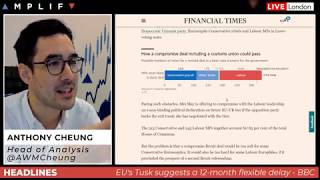
Okay, very good morning, Friday the 5th of April. Hope you are well. I'm going to cover in the briefing an update on Brexit. It's been a couple of interesting comments coming out of EU Tusk this morning, which certainly adds a new dimension to potentially discussions happening between the PM Theresa May and opposition leader Jeremy Corbyn. Also, we're going to have a look at a few things in the run-up to US non-farm payrolls. How has the US data been this week and what can we expect from that release later on today? And then, as per usual, I will hand you over to Mr. Sam North and he can talk you over the charts from a bit more of a technical perspective. But starting off with the general overview of the, the risk sentiment, let me just transition my screens over to the, the charts so you can get a bit of a feel for what's going on. We've got a Slightly weaker dollar. The Dixie's down about 0.1% at the moment. So as a consequence, both EURUSD and cable trading marginally higher, up 14. And actually pretty decent move for the moment for cable on the back of this, as we'll discuss, Tusk comments that have come out early this morning and have just been ratified by another senior EU official, basically talking about a flexible 12-month long extension. And obviously durations of, of that nature being on the longer side tend to be more pound positive. And we've moved back to pivot where we've kind of just been gravitating towards at the moment in the futures, up 50 pips at 131.59. Otherwise, equity markets were pretty flat. Normally, of course, it's relatively quiet from here on out as we go into the run-in in the kind of general space equities included, for the release of US non-farm payrolls, of course, coming later. Just having a look here, having kind of popped higher overnight in China, or China trade. This came on the back of a news story as well we're going to discuss. There's been further positive developments about the kind of time frames associated with what still looks like at the moment on track for President Trump and his counterpart Xi Jinping to meet to sign this trade deal, and that's caused a positive reaction in terms of the equity markets and the futures overnight. We popped there overnight at around 1 AM London time. We've kind of, although pulled back, we've managed to climb back higher to retest up at that R1, which was also close to— this would have been Wednesday's high on the session. Looking on the daily continuation though, I mean, obviously we've, we've been fairly bullish throughout and we continue to remain up at around these weekly highs at the moment. So depending on payrolls, that could be a catalyst. Will we get up to the, the 2900 handle or not? We shall see in due course, of course. Okay, otherwise let's get straight into the news. There's quite a few Brexit things to have a look at. Yeah, I do, I do realize, Alfredo, I've got Phil Mickelson here, Bloomberg advertising. He's nothing to do with Brexit, by the way. He just happens to have landed on the advertising space. But let's talk about a couple of things here with Brexit. So this is the main headline that Bloomberg are carrying: May to keep alive the option of a Brexit deal referendum. So talks with Corbyn could result in a menu of Plan B choices. Brexit-backing ministers alarmed though at the prospect of May allowing this idea of a second referendum. Now this leads us on to something quite interesting, and I'm going to talk you through this infographic that the FT have done because the FT have been really good at doing their own very specific analysis on how individual voters could vote in based on the 3 failed meaningful votes that we've had, the indicative votes, they can take a rough calculation then about how people are likely to vote going forward to generate this idea of how likely or not the success is of getting these types of deals over the line. And a long story short, they actually say that this compromised deal that we're looking for between May and Corbyn at the moment is probably unlikely to pass. Now, before I get into the nitty-gritty of the numbers, what does that mean for the pound? Well, we've already really seen this play out to a certain extent. I mean, let me just get the cable chart up, and, you know, if we just— let me remove some of these boxes and ellipses. So here, this was when the initial news came out that Theresa May unexpectedly was taking the turn to the opposition party to try and find a way to just deliver Brexit. Let's just, let's just get this done, and if that means a concession of sorts, well, let's at least start negotiations because time is running out. And the market took that as a net positive then. However, I think this is, and quite fairly so, market realization of the fact that, well, actually, hang about, this doesn't necessarily mean that we're actually going to make a deal here. The vote that went through on Wednesday night as well, where the lower house said they wanted to avert a no deal— okay, that's fine, that's what our Parliament wants by one vote majority, but that doesn't necessarily mean that Europe are going to accept that, because if we can't come to the table before next Friday and say this is why we want that extension, well, there is this still possibility of an accidental no deal and we stumble out. And now in that type of circumstance, well, this is where the pound is going to come crashing back down. So again, this has been quite a familiar pattern, I would say. So possibly something you can take going forward, which is I think that markets on Brexit news have been very overreactive Whenever there's been a positive story, the market's just kind of bolted to the upside. However, then I think once the kind of euphoric feeling passes that no deal is averted and we've got a Brexit solution, you actually start punching the numbers and you find out, though, hang about, you've got to have Conservative Party and Labour Party come together when their own individual parties are already splintered. So the possibility of coming to some kind of compromise is definitely not an easy process. I mean, talks are going to be continuing today, and obviously I would imagine there will be no outcome today— would be my base case scenario. It's going to be over the weekend. We'll be looking to the Sunday papers for the latest kind of developments there. So let me just run you through then this graphic. Let me blow it up a little bit so you can see it. Hopefully that's a bit bigger now so you can you can make sense of it. But let me talk you through these numbers about how a compromise deal including a customs union could pass. And just bear with me, it'll take me a few minutes, but these numbers hopefully will make a little bit more sense of, of what to expect and how to shape your expectations of the outcome. So a Conservative-Labour Brexit deal will be far from certain according to the FT analysis. Large numbers of potential rebels in both parties who have highlighted their concerns in recent votes mean that Theresa May and Jeremy Corbyn could be confident at best the support of 335 to 360 MPs in the 650-member Commons. So obviously that would be enough to pass it, but that is the best-case numbers that they could possibly get through on the analysis. About 20 to 45 more holdouts than those best-case figures, and a Tory-Labour deal basically gets voted down and doesn't go through. So we're talking about a 20 to 45 margin off the best-case scenario, and this whole deal falls down as it currently is being discussed at this point. So talking through these numbers on this infographic here, the 313 Conservative and 245 Labour MPs together account for 85% of the total House of Commons. The problem is that a compromise Brexit deal would be too soft for the Conservative Eurosceptics. It would also be too hard for the Labour Europhiles if it precluded the prospects of a second Brexit referendum. In general terms, as you can see here on the left-hand side of the graphic, Mrs. May can usually be confident confident that the 130-odd MPs on the government payroll will back whatever she proposes. But perhaps 20, or 10 to 20, would step down rather than back a customs union. We've already seen that with the Welsh, junior Welsh Office minister, Nigel Adams, earlier in the week, and the junior Brexit minister. Around another, or a further, 145 Conservative MPs backed Mrs. May's withdrawal treaty last week, but about 70 of those are members of the Eurosceptic ERG, of course. Now, to give you a bit of flavor for that, remember, BoJo, Boris, put his weight behind the withdrawal agreement deal. However, he has said quite strongly that if it involves something like a second referendum and backing a customs union, then he would support that under no circumstance. So Mrs. May could only count on the support of no more than about 185 to 195 Tory MPs for a compromise Brexit deal including Labour's minimum demand. On the Labour side, 8 Europhile MPs refused to vote for a customs union proposal last week because it did not include a commitment to a second referendum. They would not back a deal that was not subject to a public vote, a proposal that Corbyn is lukewarm to and Mrs. May has steadfastly opposed thus far. So nearly 100 Labour MPs backed a second referendum before it was party policy, and many of these would not back a May-Corbyn compromise that did not allow for a public vote. So even if some of these MPs soften their position, a Brexit deal that did not allow for a referendum would receive the support of at most two-thirds of Labour MPs. MPs at most, a ceiling of 145 to 160. 5 independent MPs who voted for Mrs. May's withdrawal deal would be expected to back a compromise deal. So if you bring all 3 of those parties, the Conservative, the Labour, and the Independents, then basically that produces a rough range of 335 to 360 votes in favour of this potential compromise customs union deal. This is above the number, of course, needed for a Commons majority, even if all MPs vote. But there could be many more Tory and Labour MP rebels, of course. And not only that, independent group, the Lib Dems, the Greens have all refused to settle for anything less than a second referendum. So they're, without that being included, are not going to back it. The SNP are unlikely to further compromise. The alternative is for Mrs. May and Mr. Corbyn, of course, to agree to a deal that does allow for a referendum. So I would say, if you're trading or looking for headlines to trade pertaining to this matter, what would be a big cable positive would shoot higher and possibly add to an aggressive entry to get long again on a fast money move if there is commitment moment within the talks as they develop, let's say today between May and Corbyn, where this idea that they are going to have a second referendum included as part of this deal, as part of an outcome, um, if the talks continue, well then that would be a net immediate sterling positive. Because at the moment, without that, this vote is too much on the fence whether it will go through or not. Um, so if that went through and they did make that concession, that would win over 62 MPs from small opposition parties and perhaps 50 more Labour MPs. The only caveat here, of course, is it's going to be of huge consequence to Conservative support because of the amount of Euroskeptics there are. So point being is the market right, I feel, to pull back like it has, because hopefully just going through those numbers quite quickly, you start to understand that actually this is far from a slam dunk situation and there's a lot more to come. With that being said, there was a Reuters poll done overnight and basically they're looking at if this deal muddles through and it's resolved and looking likely to leave the European Union with a deal, then they're looking on the basis of major banks on average an appreciation of 3% in the price of the sterling currency. So let's just mark that up. Where does 3% put us from the current price? 3% would put us at about the 1.35 handle, so we'd break above that 1.3350 the futures, which has provided an area of resistance through 2019 year-to-date so far, but also the second half of 2018. So a break above that would probably help accelerate that move to the upside, I would, I would think. On the downside though, if there's no deal and if we have that situation, they're looking at 5% move, and that basically brings us back down to the the year low, which was the December— or this is December low, I should say. The, the risk, of course, being if you break that level, that takes us back down to the early 2017 mark, and then I think losses start to accelerate. So I actually think I'm a little bit more bearish on that call. I actually think if we didn't get a deal and we accidentally had that crash-out scenario, I'd actually be looking myself more for a move down to an area probably 1.2250, in between that and 1.20, because that is not at this point priced in to a large degree at all. And if anything, the closer we get without any compromises coming, I'd expect weight to continue to grow on the sterling currency from the political side. Of things. This of course is the potentially the silver bullet to save things, and this has— this explains the small recovery we have had here on the right-hand side of the chart. If I go back, this ellipse here, we have actually rallied and we're up 36 pips this morning in cable. And this has come on the back of this comment, which is EU's Tusk has suggested a 12-month flexible delay. Now, some of the details here is that his plan would allow the UK to leave sooner if Parliament ratifies a deal, but it would need to be agreed by EU leaders at the summit next week, which they're having just before next Friday when the deadline is. So importantly, a couple of things. Attorney General Geoffrey Cox has told the BBC that if they fail, the delay, the delay is likely to be a long one. He's basically said that actually he thinks this is a good idea because this is a fairly open, flexible approach of which Europe have been quite clear that if Parliament can ratify a deal, then they can leave earlier. If not though, what Europe want to avoid is kind of this 3-month rolling unknown uncertain period. So if you can't get it done, you're locked in for 12 months. And to be fair, I think that's pretty— that's a pretty good deal, I'm afraid. And I think that that is probably something I think it's got some legs. Reading into it this morning, I think that it will end up us signing up to that kind of agreement because it gives us both the best of both worlds in that sense. And it averts the no-deal scenario, gives us flexibility. If we can get a ratified deal, then we can leave earlier. But to keep Europe onside and to make sure that no deal is averted, then we sign up for 12 months essentially. The point being here though, Europe has been quite definitive in saying if that is the case, well then May and Corbyn need to sort this out in the next coming days before the EU summit happens, which is 2 days, basically midweek next week. So the stop clock is on. They got 5 days if they want this to happen. All right, let's move on. There's a few other things I want to cross over. That's enough Brexit talk for the moment. Um, China— I mentioned that US equities have performed positive overnight in the futures space. This is the, the new thing here. China hails new consensus on trade as Trump talks up unfinished deal. Trump, I think, was saying it's going to be monumental. Not just monumental, he said it twice, monumental deal, Trump style. So he's obviously still pretty bullish, but the article here was coming from Trump— sorry, from Xi Jinping, who was saying that he's quite keen to get an early conclusion to these talks. So actually, it's China being the almost aggressor here in being quite proactive in trying to get a deal over the line. And actually, it's Trump that's holding it back a bit. Now, I can actually sympathize with Trump. I think if I was Trump, what I would be doing is I'd be saying, no, let me string this out, let me keep the market— the market is doing what I want it to do. At the moment. There's no need for me to rush this through. The longer I can stretch this out and then sign the deal in the end, the more positive it is for me in the long term. So I don't think Trump's in any rush to get this over the line, not when at the moment the markets are responding in a positive fashion that they have been doing. With that being said, what has Trump said for the timeline? He's kind of indicating around a 4-week period before they get to the to the point of setting up what would be quite a symbolic meeting, probably in the US, where the Chinese president will get the official treatment, if you like. Red carpet comes out and they would both be there to ink a deal. So that's the latest on that. So still a relative positive from a risk perspective for global assets. This is something else which I thought I'd quickly mention. This is Fed officials resist rate cut idea pushed by Trump's advisers. So obviously Donald Trump is still remaining of the, of the mindset that he wants rate cuts from the Federal Reserve, even though the Fed have already drastically gone from multiple rate hikes to this unchanged pattern of pausing now in their future policy. Trump wants more, of course, because he wants to elevate, have a low lending environment to help stimulate the economy for his own kind political agenda. Now, a couple of interesting things have happened here, and one is there is a new chap that's come into the Fed. Now let me just bring over my Twitter account because I had to tweet about this this morning because I thought it was brilliant. So basically yesterday, Trump— not sure if you caught this— he's appointed a new Fed. There's basically, I think, 2 vacancies on the Fed at the moment. And one of the strange things about this is that the president can shortlist who he wants to go on the Fed. So let me just read you his appointee Stephen Moore, who recently commented in the New York Times. He said, "I favor cutting rates by as much as 0.5%—50 basis points"—though he also said, "I still need to do more research." I mean, that's just incredible. I mean, you know, I spend so much time dealing with the new trainees trying to explain to them how different central bankers are to the president in terms of how pivotal clarity of communication is key to managing markets through forward guidance. And that is the most ridiculous comment I've ever I've ever heard for a person who potentially could become a central banker at the world's biggest and most important central bank. Of course, this fits Donald Trump, you know, hand in glove of what he would want. Now, quite interestingly, on the back of this, what's happened is, well, the Fed have come out in force, and you've had two people come out. This lady is Loretta Mester, Now she is the Philadelphia Fed, head of that reserve bank, and she is pretty much the most hawkish member. And she has been saying, well, yes, we're in wait-and-see mode, but actually if the economy performs like I think it will perform, I think actually we could end up needing more rate hikes. Not only that, you've then had other members come out. Patrick Harker of the Philadelphia Fed, and he said sees hike potential its growth picks back up. So this is basically the Fed coming back and saying, hang about, let's not, let's not be irrational about this. Although the market has turned dovish, the Fed have done so, let's not forget that this is a little bit more even in a neutral phase than it is we've just turned ultra dovish. Because let's not forget, markets are also pricing in a fairly substantial, I think about a 40% probability of a rate cut by the end of of the year. So yeah, I just thought I'd point this out, it's quite interesting. All right, payroll preview, then I'll hand you over to Sam. A couple things I wanted to mention. First of all, the main thing that you should always do when you're looking at payrolls is have a run-through of the employment indicators that have come out from the US preceding the, the labor report from the government. The main precursor to payrolls obviously is ADP employment change, private payrolls. Although it's not an exact science, it does tend to be fairly reflective of, um, the overall jobs data we get on a nationwide basis. And that came out on Wednesday, 129,000. That was actually quite a bit lower than expect— expectations of 170,000. It was the smallest payroll increase since September of 2017. So as you can see here on the 12-month pattern. Uh, it's definitely the lowest that you can see we've had here in 12 months. If we put it back, well then that's when we start to draw in here that sep— 2017 time period. So ADP, exhibit number 1, slightly on the weak side. Number 2 then is ISM Manufacturing PMI, and that came in— the headline reading was a slight beat on expectations, and importantly on the constituents of which comprise of things like new orders, production, inventories. The employment component did improve from the prior month, so it was a faster increase across new orders, production, and employment. So ADP slight miss, ISM Manufacturing constituent slight beat. The service sector in the US relatively benign. The non-manufacturing PMI came in at 56.1 1, that was actually quite a bit weaker than expected. So if anything, that's a slight negative. But then if you look at Challenger Job Cuts, actually job cuts announced in the US fell by 21%. So actually that's a good number. So the number of job cuts over the survey period was down about 20%. The other thing then is initial jobless claims, and obviously the thing that market looks at is the 4-week average here rather than the week-to-week numbers. But the one thing I wanted to show you here is that the payroll report we're looking out for is for the month of March. And if you look at the month of March on the 4-week average, then people claiming benefits, initial jobless claims, has continuously gone down. So actually, this is a positive situation. So of the evidence of which we have to hand to try and ascertain what the strength be of this figure, the headline change in non-farm payrolls? To be honest, it's a bit of a mixed bag. Uh, there is no outlying clear view that would mean that you've got an idea that the whisper number is particularly strong or weak. I would say though, one thing that I've been reading, which is a shared belief amongst economists who are talking about what their expectations are. So there's a report here that I did, um, tweet from the Amplify Twitter account earlier. ING, TD, Citi, Nomura— basically the consensus estimate for payrolls today, if we jump back, is for 180,000. So what we're looking at is a, a steep pullback on the suppressed number of 20,000 that we had last time. Now don't forget, last time payrolls came out, we were expecting 180,000 and we got 20,000. But most banks and the research that I've read this morning are saying that last month's reading was an anomaly, and it was based predominantly on the back of bad weather that was experienced in the US in the month of February that led and contributed heavily to a low figure. And what these analysts are expecting then is a bounce back, a reversion back to the mean, if you like, which would be on balance, if you took these 12 months, around the 170 to 180 mark. The interesting thing here you'll need to overlay on this is that's the headline reading. I'd be particularly interested not just in wages, which we'll discuss, but also about the the potential strength in any revision of that 20,000. And is that going to be subject to potentially an upward revision or negative, you, you could say. But what I'd be looking for here is maybe we get a print of about 170, 180, we get a revision higher, plus if we get a supportive, uh, a decent average earnings figure, well well, then that comes out as a pretty bullish report then in that sense. On those other factors, average hourly earnings of course is important. This is what kind of counteracted the initial knee-jerk reaction last time payrolls came out. You had the response to the amazingly low headline figure, algos hit the market, dollar weakens but then snaps back because ultimately average earnings is the kind of critical figure and that was higher than expectations by 0.1% at 0.4%. Expectations today are for 0.3%, but do be aware we have a range on Wall Street for this figure of 0 to 0.5. Let me put this on a 5-year. 0 would be the weakest since 2017, 0.5 would be the highest since 2017. So the upper or lower bound, I would of that range would probably mitigate what I feel is going to be a pretty standard headline release of around 170, 180. So again, I'd still be looking for that earnings number to be, to be quite critical for the overall direction after the initial volatility has passed. The unemployment rate, I think, of course, is of lesser significance, but just so you're aware, that's expected to remain unchanged at 3.8%. Okay, that is it from me. I'm gonna hand you over to Sam, so hopefully that gets you up to speed of what to look out for later on today. I wish you all a fantastic weekend. Okay, thanks guys.
Hi guys, good morning. Happy non-farm payrolls payroll day. We'll have a quick look over the markets as they're, they're trading now. Just bringing in euro into picture, which you can see just finding a bit of resistance where we had initial support yesterday before that breakdown, which did take a while. Uh, the pivot only going yesterday, really, uh, late morning retest just before midday, but it's hovered around there for a couple of hours before actually going through. So quite a significant level Yesterday and today as well. So once I still have marked up the, the charts just on, on that high of the day, hasn't really recovered too much from the overnight positive Brexit news that we had on the second into the third. And, um, yeah, it would be interesting to see where we close the week for this, for this market. On a shorter term, possibility to get short if you already aren't. You can see the trend line from yesterday's lows into into today's has marked up quite well. That's going to come back and test what was the, the previous high of last night as well. So one, one to keep an eye on there for the euro and any sort of, uh, possible shorts if that is to break. Looking at those highs come down to where we tested— well, yeah, you guessed it— right on today's high as well. So really key resistance level, price getting squeezed in. If you're not in a trade, probably worth sort of holding off for a break either way, uh, depending if you do have a bias as well, and sort of iron up potential points of support and resistance, uh, you know, below or above. But yeah, holding really firm. The pound, uh, just coming down as well, uh, a touch. The dollar just recovering a bit from some weakness this morning. Markets actually quite technical this morning. The high of, of today was also piece of support yesterday and on the 3rd a couple of times. So key levels in both the euro and the pound, and the same kind of trend line from yesterday's low up to today, which we're not far away from trading and will come in at the same sort of previous high of last night as well. So, uh, if you're looking for that short because you weren't already in, breaks of that, maybe potential retest later on would be the favored way to, to look at this, I would suggest. The yen— oh, let me just get that up for you guys. The yen has continued its drift lower all week, and despite a couple of days where it's been range-bound, the, the short has been the, the favored trade. As long as equities keep pushing up, and that's kind of what equities are doing at the moment, I think the short, whether it be from higher up or lower down, is, is the one to, to keep an eye on. Bit of a bias, I would say, on, uh, on the yen. You can just see each sort of time it comes down to a potential area of support, we do get a bit of a bounce before maybe getting that breakthrough later on. So the first sort of retest or test of a support level, just be a bit careful. Looking for a short higher up today, anywhere around the sort of the pivot high that we had at 5 o'clock for the yen against the dollar. And as long as the equity markets remain elevated, you can see currently on the futures we are, well, 11, 11 and a bit points off the, the 2,900. I mean, I, I think that's going to happen, happen into the close this evening regardless of the, uh, the non-farm number. Because if it's a bad one, well, Goldilocks, and if it's good, fantastic, we'll push higher. Last currency to, to have a quick look over, Aussie dollar. Got some very interesting resistance just above where we're trading, which has acted as such good resistance really going back to, uh, the beginning of the month. Also a level to be aware of on the 26th, but just above where we're trading, uh, you can see that tested there as well. Looking for any potential push down, I would just be wary of, uh, the trend line that we had broken overnight. So before, uh, sort of getting too aggressive, just being aware that that could come in as a potential area of support. And also looking at the lows from yesterday, you can see that's going to mark up at the similar sort of point on the futures at the moment anyway, around 71.26. So something just to have marked up on those charts. Gold, what a recovery yesterday from that push pushed down the, the technical, uh, break lower of the, the bottom part of this trend. You can see if I just draw that up there and the pivot, really decent push down the sort of two targets we had talked about, the lower, the third and second, came quite quickly and even more. But then we've had a pretty good snap back and actually finished up on the day, which if you had said that when we were down, well, from the highs, $10, $14 Yeah, you'd have been a brave, brave person to predict that coming in. However, now we're pretty much bang in the middle of the, the weekly range, uh, with non-farm coming out, you know, I wouldn't necessarily want to get into a trade anyway in the morning, but this one just seems a bit more choppy than the others. Probably worth, you know, if you are interested in getting along, having a look at one of these sort of trend lines from those highs and if that was to break along with maybe, uh, the higher the sort of 6, 6:15 candle, then there could be that opportunity. The support level that we've got has acted quite well over the last sort of few hours— 4:50 last night, 4:50 this morning, and then just now an hour or so ago— as a level of support. But other than that, not looking to, to get into this market too, too aggressively, I would say. Having a look at the oil, WTI crude, you can just see come down to a level of support we had yesterday, which is definitely worth having marks up on the, on the chart. Just a bit of a rundown to those, those levels: S1 below, and then a key level which works superbly on the second, 61.60 in the futures. Again, this market very elevated, and despite a decent start yesterday morning into midday, uh, didn't really have a go at testing the, the high that we've got of the year. So we'll be worth having a look at where we close this market. We'll come on to some of that later on, uh, this afternoon. Uh, the DAX just pushing towards its pivot, which seems to be the case every single time we do a briefing. The, the pivot comes into play, or just about, and then we find a bit of support before pushing on. Where is the support around the pivot? Well, just a bit below. You can see a decent price action point where we've got the high that we had on Wednesday, Thursday morning, and then the support level from Thursday evening. So just a bit below that, and the round number 12,000 on the DAX at the pivot. So definitely, uh, one to have eyed up. But if you, like me, probably are preferring the longs in equities, breaks of the high or the low from a bit lower down would be the preferred trade. But non-farm payroll morning, do you really want to be getting too aggressive in this market before that? Not really. So be careful out there, risk I would say a tiny bit less as well. But any questions, as usual, please do let us know. We'll be on the mic throughout the day, of course. And enjoy your weekend's Grand National Day tomorrow. So I'm sure a few of you will have a bit of a punt on that, so let me know your, uh, your horses to back because my Cheltenham didn't go too well. I hope you'll have a great day, great non-farm payrolls, and a great weekend ahead of you.
More from Anthony


Inside the Biggest Banking Stories You Need to Know This Week (Anthropic, Diageo, Private Credit)


Inside the Biggest M&A Deals You Need to Know This Week (UniCredit, GameStop, eBay, Eli Lilly)







AI Breakthrough or Hype? Anthropic’s Claude Mythos, Tim Cook Steps Down & LIV Golf Collapse