US Non-Farm Payrolls Preview
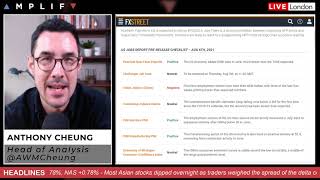
The S&P 500 is at record highs ahead of Friday's jobs report, which is expected to show 870,000 new positions and a 5.7% unemployment rate. Seasonal hiring in schools and leisure could artificially boost the number, so a surprise gain might not signal real strength. The Fed has tied interest rate decisions to two consecutive strong jobs reports, making this data critical for tapering plans.
Chapters
Okay, very good morning. Happy Friday, happy NFP day. And just to say, if you're watching this on YouTube, don't forget to hit that subscribe button, hit the bell icon when you can, and you'll be notified because I'll be going live to cover nonfarm payrolls from 1:15, so 15 minutes before the data hits the Later on today, I'll do a full rundown. I'll cover the release as it happens and look to analyze it in real time. So yeah, love to have you on board. Um, plenty of questions, I'm sure. Get them in and I look forward to seeing you guys online. But straight to it, let's have a quick review then of what to expect. I will go over it obviously in much more detail during that live session, but just wanted to give you a flavor of the type of things that we're looking at this morning. an overview for payrolls of what we can expect because there's a few things to be aware of. So first off, the close on Wall Street, and here we are, record highs again. So, uh, the S&P finished up 0.6%, the Dow and Nasdaq 100 were up both respectively 0.78%. So as you can see here in these major US index futures, the Nasdaq 100 getting a little ramp into the close, the final half an hour of trade just pushing us up. And then into the electronic trading hours, just peaking there before finding a bit of consolidation ahead of the payroll report. Similar kind of case with the S&P, and we had that trend line on from earlier this week going back to last Thursday. We failed to really break through that through most of the session, um, yesterday, but then into that final half an hour, real strong breakout on the upside, uh, and taking us back to that retest back to the all-time high levels and in fact just peeking its head above it last night. They have a fade after that strong bid that was seen into the close, which is not unusual. And then we've kind of drifted back up again in close proximity to those highs and going through the latter part of the Asian session. And that despite generally a little bit of a softer tone overnight in Asia, nothing too dramatic, nothing major on the Chinese front to report. In regards to what we had been seeing over the course of the last 2 weeks or so. Usual situation now is kind of just sitting and waiting and being patient and waiting for the jobs report to really dictate proceedings for how the, the end of the week will look. Elsewhere though, T-notes yields have continued to rise. And of course, we kind of peaked out here. This was ADP on the rise and then the Clarida hawkish comments. In combination with the ISM Services PMI that we had. We've just continued that move now, and we've backed off, back down toward the levels we were trading last Friday. So yeah, you know, despite COVID, which we'll talk about in America, still causing a degree of issue, and at this point in time a deteriorating situation, yields still on the front foot, just following some of those latter developments that we've had this week. But I do think, and I will talk about in a moment, this market positioning is quite key for determining the price reaction later when we do get payrolls hit. Elsewhere as well, oil. I was just having a quick look at that this morning, and I think it's quite important to look at it in context because obviously oil's seen— I think it's actually from a weekly performance one of the worst weeks that WTI crude has had this year, in fact. And that of course coming on the back of the just continued situation on COVID and, and what we're seeing globally. We've been tracking Australia, Japan, US, and so there has been a recalibration of sorts on the outlook for the rest of the second half of the year, somewhat then moderated by the fact that we had that recent latest US GDP figure last week, which was showing that, you know, compared to where we were a few months ago, where we were looking at very strong growth, that has been tempered somewhat by the persistency of COVID and the fact that, you know, this is very much a global issue and there's quite a lot of disconnect between countries like the UK, for example, comparative to particularly a lot of underdeveloped countries. And that just keeps then things like the Delta variant kind of in full circulation at the moment. So oil though, you know, when we've seen a market sell off to this degree, and so we've gone from a $74 handle down to really $67 over the course of the last week or so, finding a bit of some buyers coming in down at these lower levels. We've had here this morning a little bit of an extension on the move higher on the recovery through, as you can see, these previous areas on that low that we printed earlier in the week. Again, on some resistance on initial push through back on— this was Tuesday— and then yesterday's price action, that, that same point of resistance. So yeah, a bit of a break, Nice classic long entry there actually on that, the push-up. And so we're up about $0.50 or so this morning, just moving back into around $69.50 type area. On the upside, $70, quite interesting. Again, a previous point of technical support before the breakdown in price that we saw on Wednesday. As well, if you draw a Fib retracement from last Friday's high to the low of the week, comes in at roughly around the same type of price level. So worth keeping that in mind as well. FX markets relatively quiet, but we did see a decent dollar bid into the late US trading hours. Asia-Pac, it's faded a little bit, but that does mean that both major pairs are in just moderate negative territory here. Top left, EURUSD and cable down around 11 pips each respectively. The DAX, just quick word on the DAX because, um, technically as well, um, it's up about 26 points this morning, that in sympathy with the higher close on Wall Street. But on the daily chart, it is worth keeping in mind here, we are knocking on that door again as per the US indices on these record high levels. And so again, how payrolls comes out will likely dictate whether or not that level is going to hold today. So the daily close will be quite interesting to see how things finish up there for the German stock index. All right, well, let's talk about payrolls because, as I said, there's a few— there's a top-level thing I want you to be aware of essentially, then we'll talk a little bit about market reaction. But as I said, I'm not going to go into great depth right now. If you do want to go into and do some preparation yourself, then just check out my Twitter handle. I did share my morning notes, which covers things with a little bit more information. Essentially what we're looking out for here is the headline expectation is for 870,000. So this would be another fairly robust figure following on from last month and what had been then kind of an improving situation overall, which is kind of what we're, we're anticipating going forward in further economic improvements. The unemployment rate is expected to dip, so we're looking for a 5.7% number from the previous 5.9%. Now, in terms of, well, really two things. First, how are the pre-employment reports that are used as a precursor to try and better, more accurately define our expectations for payrolls look like? Well, generally fairly positive. I mean, from the ISM point of view, these figures have been, have been quite strong. The employment constituents in both readings have have been— I've seen a decent move. And so the employment section of the US main service sector survey recovered in July back into expansionary territory after dipping through that in the prior month. The manufacturing sector, US economy is also back on positive territory at 52.9, recovering from a contraction activity in June. So those quite closely followed ones have been, have been pretty decent. On the flip side though, the one that hasn't lived up in, in the same positive fashion has been ADP. You remember early in the week that came in at 330,000. That was well far below analysts' expectations of pretty much 700K. However, beyond these, these data points, there's kind of a more important thing, I think, to be aware of, which is the second point, which is these— the impact of of technical reasons. And what I mean by that are seasonal adjustments around really two main areas that could well give an upside boost to the numbers, which if you eliminate out, eliminate out the seasonal rationale behind that, the number might not be as good as then a topside surprise might suggest. And that's an important factor to determine when you might get a big explosive reaction in a positive fashion in an asset price, only then to fade quite quickly when people say, well, it's only strong because of XYZ, which is not a sustainable factor or truly reflecting the underlying employment situation. Now, what these things are are basically shifts in seasonal employment at schools caused by the pandemic, which could mask some softening in underlying labor market conditions. As the boost from fiscal stimulus and the economy's reopening fades. So what they're talking about here is— and I'm just going to bring it up— so prior to the COVID-19 pandemic, education employment normally declined by about 1 million jobs in July as schools closed. While as well, temporary plant shutdowns for the summer retooling has also typically weighed on automobile payrolls. So two key sections here: automobile employment and also schooling. But this year, of course, because of the disruptions that we've had because of the pandemic, there's a lot of summer schooling as students try to catch up, particularly now going from a virtual to back into in-person format as well. So those teachers, if you like, being kept employed rather than kind of dropping out of the calculation in that bets. The other thing is, is chip shortages that we're fully aware of. That's been a key component, of course, that's really fueled used car prices and, and really added to that upside inflationary pressures we've been seeing in the US. That's because chip shortages obviously has impacted on the ability to manufacture new automobiles. Well, that has also meant, those chip shortages, that a number of these automakers have had to change their normal production schedules. Now, that could have an impact on the timing of temporary retooling shutdowns, which could throw off the models that the government uses to strip out seasonal fluctuations from the payrolls data. There's also some seasonal factors that are also expected to boost leisure and hospitality jobs as well in this particular report. So with all this being said, the main thing I'm mindful of is, in short, the knee-jerk reaction particularly to an upside number, to not just hit it thinking, wow, this is really strong, because it might— the move might get faded quite quickly if it's evident that a lot of these— the strength in that report has come from these areas. The other thing though means is that typically then, looking at these technical reasons, the number should be an upside surprise, if anything, on the balance. So So if we get a low number and that's even with all of these additions, well then the underlying conditions are pretty bad. And if you think about a Fed member like Waller who's joined the likes of Bullard and Kaplan and really been banging the hawkish drum about potentially tapering as early as October, remember he said it's conditional. It's conditional on seeing the next two consecutive strong jobs reports. And obviously a downside number kind of eradicates that being a valid statement that he would follow through with that type of hawkish commitment. So in that scenario, I mean, one thing is when I'm talking this through, I'm thinking, okay, so in that scenario, he puts off tapering and the hawks have to kind of come back a little bit. Well, perhaps that's good for equities, but then if the number's good, I don't think it really deviates too much from the schedule. Where we've got Jackson Hole at the end of the month, and that was always tabled and penciled in as when they were going to talk about tapering anyway. We're almost there. And so again, we get a good number. Is that just good for equities again? So it could, could well be one of those where either way, um, it could be a good result to that respect. But one thing I'm mindful of, of course, is that, you know, equities are sat at a stretch point of being at its record high, but that doesn't mean we can't punch higher, of course. From a yield perspective, again, I do think that that's quite interesting because of the move that I mentioned. Yields have increased over the last 24 hours or so. So T-notes have gone from really a 1.3514 price down to 1.3407 or so at the low. So a downside surprise definitely gives this market a bit of room for, for a snap back higher at the moment. Because I think it's kind of positioned more for, for, for a consensus type view. So more like an 850, 900 type million print today. Anything short of that, ADP rerun, we might see some upside there. And obviously given the dollar bid that we saw late into yesterday's session, there's room for that to come under some pressure, which obviously is going to support the major pairs as well. So yeah, that's payrolls. I mean, hopefully makes, makes sense. But as I said, you can check out my notes, and otherwise I'll cover everything again in more detail at the live event. A few other things I wanted to share and quickly talk about. And to start with, going to talk about COVID I'm going to focus on the US this time. And daily new COVID-19 cases have climbed to a 6-month high in the US, with more than 100,000 infections reported nationwide, all very much driven by the Delta variant, as we know. The 7-day average of new reported cases has reached nearly 95,000, and to put that in a bit of context, that's a 5-fold increase in less than 1 month for the US. Florida, Texas, Missouri, Arkansas, Louisiana, Alabama, Mississippi account for half of the country's new cases and hospitalizations in the last week. And a lot of those specific areas starts to then go into how vaccinated people are on a state-by-state basis, and that obviously political evidence that shows then that a lot of these states more Republican-leaning have had a lesser take-up of the vaccines, and therefore the spread of the virus has been much more evident, and thus hospitalizations as well. What this is resulting in is although some of the big Wall Street banks continue to kind of you know, those old-school guys like Solomon at Goldman's or Jamie Dimon and so forth continue to kind of drag people back to the office. It's becoming a little bit problematic now at these levels, particularly in New York, obviously highly populous. And there's been reports, I think it was in JP's office, where people who are even— you have to be vaccinated to go to work, but even those guys are passing it on and, and so forth. Elsewhere, Wells Fargo, BlackRock, Amazon have all announced yesterday they're delaying plans for staff to come back to the office. I think Amazon is probably the most cautious with that. I don't think— I think what I read this morning is that they're, they're saying to people, we're not even going to have people back until January next year, and then they'll revisit and see what the situation is. So yeah, definitely Perhaps, um, the, you know, the return to normality, as we've seen the kind of slight adjustment in markets' perception about the second half of this year, um, is becoming a little bit more true at this point in terms of the, the lingering effects of the fact that this Delta variant is still very much present. Otherwise, the other thing to be aware of, and it's something that's been kind of dragging its heels, but I think that's pretty much as you would expect, is the US Senate They were unable to finalize a $1 trillion infrastructure bill yesterday, unsurprisingly, and they will try again on Saturday when it's scheduled to hold a vote on limiting debate and moving toward passage of the hard-fought legislation. The Senate is trying to wrap this up, of course, ahead of the scheduled 5-week summer recess, which is supposed to start next week. The House has already begun its summer recess. So if you think about it, this pushes us all the way into like pretty much mid-September And of course, given now the re-initiation of the debt ceiling rules in the US, this is getting ever closer to putting your feet on the fire now toward potential talking government shutdown again. And I have no doubt that now looking at this and given the summer recess, that politicians will use that as leverage to try and reshape some of the deal, I'm sure. Before it comes down to the wire on the, on the debt ceiling side and it still gets over the line. For the moment, is this a risk to markets? No, I don't think so. There's just bigger things in focus right now, specifically today with payrolls, but also the timing on tapering, the COVID situation. This infrastructure bill, I think, is just a bit of a side point for now at least. And that is pretty much all I wanted to cover at the moment. So this morning As is always the case, it's a pretty light calendar for the UK European morning. So main thing, if you're— if you are trading this and you're new to this environment, you know, not the time to be going gung-ho. It's really the time to be just patient, disciplined, sit on your hands and wait until this afternoon. The data obviously all coming out at 1:30. It's alongside some jobs data out of Canada as well, but obviously the US numbers will take precedence across the macro global environment. From a speaker point of view, Bank of England's Broadbent following the BoE decision yesterday, speaking just after midday. And that is it. So yeah, don't forget to subscribe to the channel and hopefully I'll see you online live later. Also, don't forget to check out— Piers and I have got a slot, I think at 5 PM today. So hopefully we'll be able to talk about payrolls, what happened, what does it mean, implications. So on and so forth. And we'll wrap up some of the highlights of the week in that podcast. So just search for Market Watch from Amplify on, on Spotify, Apple, and so forth. And yeah, I, I'll see you later. All right, thanks very much, guys.
More from Anthony


Inside the Biggest Banking Stories You Need to Know This Week (Anthropic, Diageo, Private Credit)


Inside the Biggest M&A Deals You Need to Know This Week (UniCredit, GameStop, eBay, Eli Lilly)







AI Breakthrough or Hype? Anthropic’s Claude Mythos, Tim Cook Steps Down & LIV Golf Collapse