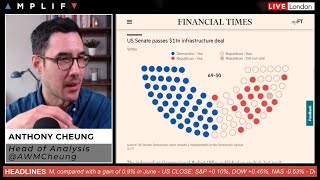
In this August 11, 2021 market briefing, the host reviews the immediate market reaction to the Senate’s passage of the bipartisan $1 trillion infrastructure bill, noting a modest gain in the Dow versus a lagging Nasdaq. He explains why the bill benefits capital‑intensive, domestically‑focused sectors (energy, industrials, materials, financials) more than high‑growth tech firms, and highlights the broader consensus vote (69‑30) and the upcoming $3.5 trillion “second‑track” package that remains contentious. The commentary then shifts to Federal Reserve policy, focusing on Chicago Fed President Austan G. Evans’s dovish stance that current inflation spikes do not warrant premature tightening and that more labor data are needed before any policy shift. The centerpiece of the day is the U.S. CPI release scheduled for 1:30 PM, with expectations of a slight moderation to 5.3% YoY (down 0.1 point) and a 0.5% MoM increase, signaling a possible inflation peak. The host dissects the components driving inflation—used‑car price gains, lingering chip shortages, shelter and energy costs—and warns traders to watch these sub‑indices for market direction. Technical analysis follows: the dollar index (DXY) is consolidating near a double‑top at 93.13, EUR/USD tests March‑31 lows, and U.S. 10‑year yields creep higher after the ISM Services PMI boost. Oil markets are discussed, with API inventory draws aligning with expectations, WTI holding above the $68 psychological level, and technical support around $65.50. The host also flags external factors—Tropical Storm Fred’s potential Gulf impact and a Goldman Sachs note that the Delta COVID variant will only modestly dent oil demand. A brief geopolitical note mentions heightened North Korean rhetoric around U.S.–South Korean drills but assesses low escalation risk. The briefing concludes with a cautious outlook, emphasizing the CPI as the key catalyst for the session and reiterating a strategic, longer‑term buying bias in oil at technical support levels.
Chapters
All right, very good morning folks. It is Wednesday, 11th of August. Hope you're doing well. Just going to talk about the close on Wall Street where we saw a record finish again for the likes of the Dow and the S&P 500 after the Senate passed the much-anticipated bipartisan infrastructure bill. That now progresses, but overall that did reflect in regard to an outperformance subtly in the likes of the Dow up about half a percent, whereas the NASDAQ was a laggard, about 0.53%. We're also going to talk about in the briefing some comments out of the latest Fed official, Evans, who's taken the other side, a much more dovish view, but in keeping with his general stance on policy last night against the usual chorus of hawks that we've been hearing of late. And then we're going to talk about US CPI, undoubtedly the most important release, not just of the session, but of the week. And actually looking at the markets then this morning, everything is in a little bit of a wait-and-see mode. Kind of feels like the morning of a non-farm payrolls release almost, because the CPI report, uh, does have the magnitude really to shake things up considerably later on today. And that was largely reflective in yesterday's session, um, which was relatively quiet. And, and it certainly is the case for that this morning. The dollar index perhaps just a touch firmer, but worth keeping an eye on the Dixie. We are retesting kind of a double top from yesterday and the overnight Asia-Pac session. And the DXY at the moment is trading at 93.13. So I'll bring up the currency pairs and we'll have a look at that overall in a moment. But otherwise, spot gold pretty flat, as too is oil, which made a nice recovery yesterday to reclaim a $68 handle to retrace some of its recent sell-off. Yields have continued to just creep higher. So the US 10-year down about 4 ticks this morning, just a continuation of the trend really initiated from midweek last week. Following the ISM Services PMI being the kind of kickstart of that latest move, but then obviously following through at payrolls on Friday leading into the CPI report. And as far as index futures are concerned, the DAX is pretty flat this morning, just hugging its pivot, and US futures as well, not too much going on in the overnight session. So let's get straight to it, talk about some of the news. So as I said, one of the main catalysts yesterday was the Senate passing the bipartisan $1 trillion infrastructure package. The Senate, as you know, is split evenly between Democrats and Republicans, but the actual vote this time on this particular bill was voted 69 to 30 in favor with only one Republican abstaining. So pretty good broad consensus there, but as you've probably read, this now looks to go down a two-track path where they're gonna try and force through an extra $3.5 trillion bolted on as a secondary package to this, which is going to be much more highly contested. So as Biden said in a speech last night, the real work is still yet to really be done. So I think the reaction we had yesterday, to be honest, I'm a little bit surprised that the market reacted the way it did. Perhaps it's kind of a lack of other catalysts ongoing at the moment. Otherwise, it was a quiet session waiting for today's inflation report. But I don't think that that bill passage last night really has much more legs in it to really impact markets at this particular point in time. The infrastructure bill, though, I mean, why does it create such disparity between lifting the Dow and almost counterproductive for technology? Well, the bill will disburse just over half a trillion dollars in federal spending over the next 5 years. And that includes things then like American roads, bridges, tunnels, airports, railway networks, power grids. So all very much things that would benefit the type of companies that would operate in that particular index. And, and certainly this is why you tend to see more national-based companies in the smaller market cap indices like the Russell, for example, tend to benefit under these types of proposals rather than big tech, for example. 9 of the 11 major S&P sectors rose. So energy, financials, industrials, materials, They all stand, of course, to benefit the most from an ongoing economic recovery, of which a bill like this would help secure, albeit it is stretched over a longer 5-year period. Asian indices overnight, mixed to pretty flat, not really too much to speak of, perhaps a touch of underperformance seen in the Korean KOSPI stock index. There's a lot of very aggressive rhetoric coming out of North Korea at the moment in regards to response to an annual US-South Korean military drills that they conduct, as I said, every year. And so it's not unusual at all. But again, when they ramp it up, um, you know, they're kind of saying things like, you know, South Korea is going to pay by the minute for what they're doing. Um, that doesn't really constitute into anything beyond just verbal threats more often than not. But obviously we'll keep a close eye on that. But again, it's very low probability that that would actually escalate, and this is quite common given the, the timing of those military annual drills. Otherwise, as I said, things are pretty quiet this morning as markets await the overall open. So other things to be aware of then is Fed's Evans. So remember the table, you know, you guys now all know of course your hawk-dove spectrum and Evans is a voter, and Evans is much more on the dovish side. So we've heard from a lot of kind of hawks outlying, so your Kaplan, your Bullards of the world, and Waller, where we've now heard from some of the more center-right-leaning ones or center-hawkish members like Bostic and some others. But this time Evans is right more on the, much more on the dovish end of the spectrum, and he said in fitting and in keeping with that philosophy that current inflation spikes should not push the Federal Reserve to tighten monetary policy prematurely, with more months of labor data needed before any changes, as well as more certainty that the pace of price increases will remain above the Fed's 2% target, according to the Chicago Fed president. So yeah, nothing really too surprising there, to be honest, but does show that there's still a divergence in views here at this point in time. And, and really, for me, it's really the center and kind of dovish-leaning members that we need to keep an eye on, because if they start moving much more towards this idea of heading toward the taper timeline, um, that definitely is a surefire sign that that, that definitely is coming sooner rather than later if they start to move. In terms of the main event of today though, this morning is very quiet. There's not a great deal coming out of UK, Europe, and the main focal point of course is US CPI at 1:30. The headline's expected to moderate ever so slightly to 5.3% from 5.4%. We have got a range of 5.1% to 5.5%. The month-on-month expected at 0.5%. Remember last month that figure came in at 0.9%. So yeah, increasing again, but of a much more slower pace than what we had last month, albeit the top end of the range is at 0.7%. If you remember then, and this is just a quick look at what it would look like, and again, the year on year, this is of the previous 12 readings. We are looking for a 5.3%, which doesn't sound like a great deal because it's only 0.1% lower than before. But what it does mark is the potential peak of inflation. And this is going to be quite key to determine, and again, the course of action that the Fed might take and this idea that it has been transitory. And on the transitory point, of course, a third of the increase in June, the last report, was attributed to price gains in used cars fueled by supply chain bottlenecks, of course, that have hampered new vehicle production. I did read quite an interesting stat coming out of Bloomberg this morning, and they said that chip shortages that have held back automakers and computer manufacturers are getting worse, in fact, and that chip lead times the gap between ordering a semiconductor and taking delivery has increased by more than 8 days to 20.2 weeks in July from the previous month. And that gap was already the longest waiting time since the firm began tracking data back in 2017. So shortages of microcontrollers, logic chips that control car control functions, industrial equipment, and home electronics have jumped in July. So Hence the reason why, although we're getting almost peak inflation at around this mid-5% area, um, the idea here being it's still elevated and not fading more quickly because of those aforementioned reasons. So for sure, these pandemic idiosyncrasies we'll be looking at in much greater detail. If you're going to be trading in day trading environment for CPI, 100% just be mindful of the underlying report and the contributing factors beyond used cars and trucks. Things like shelter, energy price contributions, these types of things as well are going to be meaningful to really determine the underlying state of inflation and therefore, um, the kind of consequence it can have on Fed thinking. Otherwise, a quick look at the potential market reaction. We were talking about the dollar index yesterday, so we're back on that daily chart again. Again. And the dollar index is kind of consolidating. If you look at it on the very short term, in fact, I'll just quickly drop this chart in. This is looking at the more, uh, the picture on a, on a much more shorter-dated time frame. This is on a 15-minute. So you can see the Dixie's just tapping on yesterday and the overnight APAC high. And on the daily chart, I think CPI is going to be quite key. Upside surprise, we might bust through then that prior high that was seen in July and then we're going to be targeting up around those April highs. And in fact, if I look at EURUSD on a daily chart in the FX major pairs, perhaps it'll make a bit more sense. Flipping over to it from a 60 to a daily chart, this is a daily in EURUSD futures. You can see here we've moved lower really since the payroll number came out, and that's given the greenback a bit of a, bit of a kickstart. And we're down here testing in EURUSD futures, the March 31st low. And we're just trading pretty much at that point this morning. You can see then technically, um, if we get a scenario that contributes to dollar strength, well then there's quite a big gap here down pretty much a full point to the next area of technical support, which wouldn't come in until the September-November kind of double bottom from last year. So definitely today is going to be pretty big. Either for seeing this materialize, or we get a much lower number and we see reversal on the fade of that dollar gain here, and we spring back up in the opposite direction. So yeah, technically quite key. The market as well, you know, is definitely looking at this for a key trigger for the rest of the session. So yeah, it's going to be, it's going to be a really interesting release later. Otherwise, kind of back to the calendar for a second. Beyond CPI, we've got the regular oil inventory numbers coming out later. In terms of some oil things to be aware of, we of course had the APIs last night, and they had a headline draw of 816,000, pretty much in line with the expected value of drawdown of 600K. Cushing draw 413,000, gasoline draw 1.114 million. If you actually look at WTI crude, absolutely no real reaction to this data. So again, it wasn't shocking in the slightest. And I think at the moment, if you're looking at WTI crude, it's really just more about the recovery at the moment. We found, you know, technically there's a pretty good area of support around the pivot today, which the market has responded to very nicely. You've kind of got 3 factors here, an inflection for price over the last 24 hours. In combination with the pivot and also the 68 psychological handle figure. And we've seen that's just acted quite nice in the late part of the Asia-Pac session to just move back up here going into the European Open. So yeah, the infrastructure bill definitely feeds into this, but I did think that the move last week was a little bit overdone, you know. And if you follow my daily emails that I put out on my distribution list, then, you know, these were a bigger, broader conversation that I was having in those emails, and I was talking about the fact that, look, even that seems quite dramatic in the pace of the sell-off in oil, I still feel pretty comfortable that the market remains pretty tight at this point. The economic expansion will continue irrespective of a slight moderation in how strong that growth will be in the second half. And so I still look to be a buyer of oil at any strategic point lower down at these bigger markers on the technical price developments that we've seen over the last couple of months. And certainly that has played out so far with the move on the break, accelerated on that initial trendline break, came down to that horizontal level around $65.50 area, which was around support. So 26th of May and also the, the bottom of the, um, the rout that we saw on mid part of July, and the markets just sprang back up again. So I do think with oil, um, you know, although there's COVID still to be monitored and be vigilant for. I still think at the level it's at at the moment, and all other variables considered, I'd still be a buyer anytime this market moves lower down at these, these levels on a, on a higher time frame, of course. Otherwise, in oil, to finish things off, the other thing to be aware of I have been commenting on a little bit is the fact that Tropical Storm Fred remains on course to impact Florida on Friday in the Keys, as you can see, spreading northward through portions of the the peninsula this weekend. But the NHC at the moment saying it's a little bit too difficult to get the exact timing, location, and magnitude of any potential impacts at the moment. Um, I guess the key thing we're looking out for here is does this start to drift more to the left, which would then constitute having a more direct path towards the Gulf of Mexico, of course, which would have more implications for the price of oil. So it has moved slightly more left than it was yesterday. So I definitely would just keep half an eye on that as well. And on the subject of oil, something else to be aware of, um, is a latest research note out of Goldman Sachs. They've said the net impact of oil from the Delta variant— so just talking about that broader context for a second— remains moderate in their view, and their base case remains that the Delta wave will impact oil demand, including China, for only 2 months, consistent with prior cycles. So again, fairly in keeping with that, that view that I just expressed, that the market remains supported on any particularly sizable drawdowns short term. All right, that is it. So hopefully that was useful. Any questions at all, as I always say, drop a comment. If you're watching this on YouTube, remember to subscribe, that would be much appreciated. And yeah, plenty more videos to come, and I'll catch you guys tomorrow. Take care.