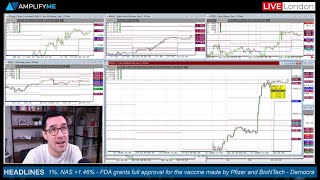
In this morning market briefing, Anthony Cheung reviews the strong equity rally on August 24, 2021, highlighting NASDAQ and S&P 500 futures breaking out of a tight Asian‑Pac range after a record‑high close the previous day. He links the rally to a combination of weaker-than‑expected US services PMI data and the FDA’s full approval of the Pfizer‑BioNTech COVID‑19 vaccine, discussing how the approval could boost vaccination rates among hesitant Hispanic and Black communities. Cheung examines the broader market backdrop: a weakening dollar, gold breaking above key resistance, oil recovering to $66, and the implications of the PMI miss for labor shortages, supply chain constraints, and Federal Reserve tapering expectations ahead of Jackson Hole. He also covers US political developments, noting the delayed $3.5 trillion budget vote, internal Democratic divisions, and the pending decision on extending the Afghanistan withdrawal deadline. The segment concludes with a brief calendar preview (US new‑home sales, European bond supply, a $60 billion US 2‑year note auction) and a plug for the AmplifyMe Instagram channel for daily market snippets.
Chapters
Okay, very good morning folks, it's Tuesday 24th of August, Anthony here, hope you're doing well. And what a day yesterday was, and in actuality as we come into the European Open I can see the NASDAQ and S&P 500 futures just breaking out of, or attempting to on the upside, what has been an incredibly tight range in the overnight Asia-Pac session following the big leap obviously in index futures that we saw from the cash open yesterday. Kind of a dual-fold combination of that market service PMI data coming out quite a bit lower than expected, and also the FDA granting full approval of the Pfizer-BioNTech vaccine, which I'll talk about why that's important potentially going forward. But NASDAQ future here just pushing up again, breaking out of the top side of that range, which really cap the close on Wall Street in the futures market and the Asia-Pac session. It's definitely worth keeping an eye on that this morning. And just having a look at the S&P, it's very similar. So Asian equities actually traded higher overnight, followed on from the higher, um, kind of positive handover from Wall Street, where the NASDAQ was the clear outperformer, up 1.5%. The S&P and Dow were up 1.9% and 1.6% each respectively. And so they're just breaking out of this Asian-Pac high as we just go into the European high in the S&P. So just keeping an eye on 85.75, which of course is the all-time record high that we saw yesterday. So a bit of a recap then on why equities performed so positively in that environment. And we have seen the dollar reverse course, and as such then yesterday, good gains seen top left in the euro-dollar and cable major pairs. Um, gold also saw a breakout to the upside. And if you're just looking on the daily chart in gold, we're back through quite a key inflection point, as you can see here from these three rectangles of price at around $1,791 in futures. So upside now, perhaps some clear air until we get further up towards $1,813.50 on the daily perspective. But gold, again, similar to equities, holding on to a lot of that move as the dollar remains a little bit weaker once again this morning. I'm definitely holding on to that downward trend we saw yesterday. So also oil managing to claw back its losses as well. So decent recovery here from some of the sell-off that we were seeing towards last week, and we're trading back to a $66 handle having traded a $61 handle, um, just a day or so ago. So pretty good recovery seen around markets. But why exactly was this happening and why Why was weak data good for general sentiment and equities in particular? And what is it about the FDA approval? Because, you know, you might think on the surface, well, what does it matter, the FDA approving the Pfizer-BioNTech vaccine? Because the Pfizer vaccine has been distributed for a long time, it's being administered for several months now. I myself am receiving my second jab of Pfizer in a few hours' time later on today. But the idea here I thought was quite interesting. There was a Bloomberg article talking about this, and actually if you look at the trajectory of vaccination rates in the US, they started very quickly in a similar vein to the UK. However, that really has plateaued quite a lot, and we've seen most mainland European countries which were very slow in the pickup or the rollout of the vaccine strategy have now superseded the, the States. As is the UK, Canada, and other countries as well. And part of the big thing here has been vaccine hesitancy, particularly around that of the Black and Hispanic communities in the US. And there was a very interesting study that came out from the Kaiser Family Foundation, and they give impartial kind of scientific— or research, I should say— and ask polling and things like that, particularly on healthcare issues in the US. And they had a survey from June shared with Bloomberg News that found that among unvaccinated respondents, 46% of Hispanic and 41% of Black people said the FDA approval would make them more likely to get a COVID-19 vaccine compared to 25% of white people in that survey. So a much more bigger proportional impact that the seal of approval stamping of the FDA would have on the potential for them to take up the vaccine. And so this definitely has been a kind of— if you splice down the demographics of those getting vaccinated, overlaying then political disposition in terms of area geographically in the US where you sit, and the US definitely needs to find ways of which to, to get that trajectory back on the ascent again. And this comes in the context, of course, with the 7-day average death rate in the US currently totting or topping 1,000 for 2 straight days. And that's the first time that that's happened since March. You remember, this is coming off then the peak that we saw through New Year of COVID in the US and other pockets around the world. The other thing, of course, that we had yesterday was the market services PMI, the flash number for, for August, and that came in at 55.2, and we were expecting just short of 60 at 59.5. This was a deceleration, in fact, from 59.9, so considerable slowdown in that figure, um, and growing— growth slowing to an 8-month low actually per that data, uh, in August against a backdrop of material shortages a lack of labor, and an upswing in coronavirus infections. And remember, a lot of this labor issue has been not a, a by-function of job availability, but getting people to do these jobs. But if you think about a lot of those jobs in leisure and hospitality, that type of industry, a lot of that is concentrated in the Hispanic and Black communities. But if they're the ones who are not willing or have had vaccine hesitancy, therein lies a bit of a problem, and hence why if they feel more confident now with FDA approval to take that vaccine, it actually could make a difference. So, you know, something to just, just think about. Obviously, with the data side of things on the services PMI, and another powerful catalyst for yesterday's response in market, particularly equities to surge up to record highs, is with such a big miss on that data, you know, the market really is showing signs of struggling to get back to a degree of normality because of the material shortages, chip shortages we know for auto manufacturing still being very problematic, and this lack of labor, and labor being one of the key components for the Fed's policy decision-making process alongside, of course, inflation. But the labor market, particularly an emphasis of the administration, of course, to get people back into work. And All of this then has an impact on the perceived timing of tapering. Not that tapering is going to be halted in its entirety, but the more hawkish calls for an announcement from, from Jackson Hole, from Jerome Powell to come on Friday, the formalization in September and the commencement in October, which would be more of the kind of Bullard hawkish disposition, but perhaps then much more measured in approach and following the idea that they still need to see some of this data come through and show a bit more consistency and robustness, particularly on the labor side, before they can make that definitive call. And perhaps now we're looking more towards the back end of Q4 rather than the front end of Q4 for the actual commencement of tapering. And so that taper thing is at the center of investors' attention, particularly in the context of this week in Jackson Hole. It is what is going to saturate a lot of the markets. Kind of thinking. And so yesterday definitely saw a response to that on the back of particularly that weak data as well. Otherwise, a quick look elsewhere, and having a look at the US budget plan, I think there's no surprises here really at all. The US budget plan, unsurprisingly, the Democrats who had voted to pass the $3.5 trillion budget plan last night got delayed. That vote got cancelled. Because they failed to overcome internal party divisions. So a bit of context here. Centrist Democrats want the House to move first on another Biden priority, which is that $1 trillion infrastructure bill, which has already, of course, won approval by Republicans and Democrats in the Senate. Democrats hold a narrow 220 to 212 majority in the House, and Republicans have said they would not support the budget plan. The setback, of course, comes as you've probably been seeing lots of conversations with heads of states at the moment about dealing with the withdrawal from Afghanistan. And Biden has been coming after— under some sharp criticism for how messy that exit from Afghanistan has been after that 20-year-long war. On that point, Biden is expected to decide within the next 24 hours on whether to extend the August 31st withdrawal deadline with Afghanistan and to provide Pentagon time to prepare, although some advisors oppose an extension due to security reasons. Biden's going to be speaking later on London time, it's going to be around 5 PM, so around midday New York time, where we're looking for an update on that Afghan withdrawal deadline. Otherwise, as far as the calendar is concerned, it's pretty quiet today, but before I do get to that just wanted to give a shout out to our team who run our Amplify Me Instagram account, really starting to up the ante with some of the content here. Definitely a lot more short form than I would cover on YouTube, and I know everyone's on Instagram, so we've just started doing some market-related reels from myself. And so lots of those coming out on a daily basis. As well as lots of other interesting polls and things like that. So feel free to, if you're on Instagram, if you want your little kind of key market nuggets on a daily basis, just search for AmplifyMe, one word, on Instagram and feel free to join that community. Be great to have you on board and engage and drop us a comment on there. Otherwise, yeah, for the calendar for today, it's pretty quiet. This morning is really not a lot going on at all until this afternoon when we're looking out for US new home sales. And then we're looking out for a couple of other things on the fixed income side— supply coming out of Germany, UK, and a 2-year note $60 billion auction in the US at 6 PM London time. But that is it really. So as far as this morning is concerned, in summary, we've kind of held on to a proportion of the moves from yesterday. Um, the dollar still remaining a touch weaker this morning, so worth keeping an eye on gold. On the upside for the top end of that late US-Asia-PAC range. Kind of a similar setup for the NASDAQ and S&P futures. And yeah, that is it from me. Have a good day. Any questions, feel free to drop me a comment, and I'll catch you tomorrow. Thanks very much.