What next for Brexit & Theresa May
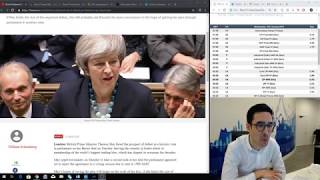
In this market briefing Anthony Cheung analyses the immediate fallout from Theresa May’s historic 230‑vote defeat on her Brexit deal and the subsequent confidence‑vote proceedings. He explains how the pound initially fell but quickly recovered as the DUP and ERG signalled continued support, and why an Article 50 extension appears likely, which would be a short‑term positive for GBP. He outlines possible political scenarios – May surviving, a renegotiated deal, a second referendum, or a general election – and assesses their market implications. The briefing also covers other macro themes: a technical level in S&P 500 futures, a record‑size liquidity injection by the People’s Bank of China ahead of the Lunar New Year, and the US federal government shutdown’s modest GDP and employment impact. Cheung reviews upcoming data releases (UK CPI, US retail sales) and earnings (major banks), noting that Brexit and the shutdown dominate market focus. Throughout, he provides chart analysis of GBP/USD (cable) and highlights key risk‑on/off drivers for traders.
Chapters
Very good morning, Wednesday the 16th of January. Hope everyone is well, and obviously only one major thing to really talk about this morning, and that is the, the failed Brexit plan vote that we had from Theresa May. Crushing defeat in Parliament, largely as expected, but the numbers certainly towards the most worst-case scenario for her. A very hefty defeat, as we're going to look at in a bit more detail shortly. Other things we're going to talk about are a really important technical area that the S&P 500 is approaching in the futures market, which we're certainly going to be keeping a very close eye on today. We're going to have a look at a Chinese liquidity injection of a record level overnight and the reasons why they've done that, and the reason why I think that that's relatively unimportant. And then we're going to have a look as well, a few details about the government shutdown in the US, because there's certainly As this goes on, the question marks start to arise now. At what point does it start to really impact the US economy? So that could be a real driving force, of course, in the ongoing negotiations. So let's kick it off. Let's talk about this lady right here, Theresa May. This was the actual vote, or the composition of it, last night. If I just make that a bit bigger so you can see everything quite clearly. MPs rejected Theresa May's deal by 230 votes. If you remember when we were looking at the FT analysis in the briefing from yesterday, they were going off the public statements that had been made in the, the few days leading up to this vote, and they were saying the worst case could have been around this figure, and they were right. It's the largest defeat in history. I was— I mean, I did watch this last night, and, you know, I guess it's the job of journalists to sensationalize this, and I think it's exactly that. My personal opinion is, is that what's the point of comparing this to history? We're in absolute unprecedented times, as we've already seen, um, the kind of, uh, lack of confidence in the government, and yet here she remains. You know, it's never been seen before. And so this defeat, as much as it is technically the worst in history, I don't really think that says a lot other than a headline to sell you some newspapers. Now, looking at a few other different things is the process of what was going to happen later on this evening. Now, a vote of no confidence has been called, and Theresa May I did the right thing. She actually gave a speech immediately after the failed vote, and she said, come on then, Corbyn, call your motion of no confidence, let's have it. And then of course Corbyn came up, and that has been put forward, and that will be debated and voted upon later on this evening, as we're going to look at the timestamps coming up. Now the point being here, and if you actually look at the performance of the pound Initially, we dipped. The initial knee-jerk reaction here, looking on a 5-minute candlestick, so the first couple of minutes was negative, which is kind of what we were thinking. As I said, a loss of the magnitude of 230 was right at the end of the spectrum of the worst possible outcome. And so, see, initial thoughts were, okay, this is pretty hefty, maybe she's gonna have to resign because of the magnitude of that defeat. However, it became pretty quickly quite clear the DUP came out within a matter of minutes and said they'll continue to support the May government. And then the ERG also came out, the European Research Group, and said they would support Theresa May. I don't know if you caught the Boris Johnson talking in the halls of Westminster shortly after the vote, and he finished his interview, and obviously a quite passionate delivery. He he always gives, and he said the very last line, "The one thing I don't want for sure in all this process is Jeremy Corbyn as Prime Minister." And so I think that's pretty telling about what's gonna happen with Labour's push and motion for no confidence in the May government this evening. We talk about how divisive the issue of Brexit has been. Well, okay, you could say that again for Theresa May within the Tories between the Remainers and the Brexiteers, but equally so for Jeremy Corbyn's leadership of the Labour Party. Because don't forget, in order for this to go through, if we go back to here, this is the process: a vote of no confidence is called, the government wins, the government presses on with plans. Now that would mean then that Theresa May kind of just goes forward with things. We'll get on to what route that could take us down in a second, but let's say the government loses, which is not expected this evening. Remember, Corbyn would need two-thirds of the lower house of Parliament in order for this to go through. And just given the numbers that have already been said by the DUP, the ERG, and probably even within the Labour Party itself, unlikely that that's going to happen. If she did lose and there's a clear alternative government— of which there isn't, is the point— because if you look at the average poll of polls, it's basically neck and neck. If anything, Conservatives are slightly in the lead. So really, there's no real point about this talking about a May resignation. I really think that that's such a low probability scenario for this evening. If she did lose and then there's no kind of direct alternative government, we go into a period where can any government win a confidence vote within 14 days? So then it's, okay, Jeremy, let's see what you can put together and whether you can get the backing then within Parliament to push forward with a cohesive government plan. The likelihood of that is no, and then we go down the general election route. So of those kind of different options—no deal, May's deal renegotiated, second referendum—this is the general election route, which is obviously a possible outcome that could materialize if we follow this chain of events down throughout tonight. Um, otherwise, if we go through this, can government win a confidence vote within 14 days? Uh, if it was a yes, then government continues perhaps with a modified policy, and that's when you start potentially then looking at this idea of a second referendum, uh, and so on. So timings-wise, this is what we're looking at for tonight. Um, so Obviously it's a Wednesday, you're gonna get the parliamentary debates happening. At 1 o'clock, Corbyn opens the debate with May also due to speak, and that's set to last for several hours up until 7 PM this evening. MPs will then vote on the motion at 7. Result should be a pretty quick turnaround like it was last night when it gets down to that actual procedure. And so by 7:15, we should know the outcome. Now, going back to the pound response, obviously we talked about the initial dip, but then we had the quite powerful rally. Now, you know, why did that occur? Well, as I said, it became quite clear that, you know, really Theresa May is not at a high degree of risk given those strategic kind of pockets supporting her government, whether within the Tory Party or more Brexiteer-minded people, or that in the Northern Ireland parties. But it was that kind of cross-party sentiment in order to push things forward that was kind of received more positively as we continue to go up. If May's to get something credible over the line that Parliament's going to support, is she going to have to make some kind of concessions to then bring this kind of across political party spectrum support in favor of her, which ultimately leads to a softer Brexit, if potentially any Brexit at all. If anything, you could say the outcome of this is that— and this was, you know, this has been the case all the way from the beginning, that certainly we've been saying for the last year— is that if Brexit happens, the only way it can happen is in an incredibly soft fashion, which ultimately, should we get into the transitionary phases, would be a strong pound positive because of the removal then of any near-term point of which we need to deliver anything. It just gets kicked down the road, so to speak, because undoubtedly a transition will lead to a transition. One of the main things of that is that I think the Canada-EU trade pact took the best part of, what, a decade the UK-European trade deal is so much more complex than that of Canada-EU because of the high dependency on financial services that we have here in Britain. So, you know, take that as a precedent or from a legal perspective on the timeline. So that being said, if we go start to go down that route and, you know, do we go down this second referendum and then opens up the question marks of can Brexit be delivered at all, i.e., reversed. And that would be ultimately the most pound positive under those circumstances. So yeah, pretty strong recovery. I mean, this hap— this materialized over really the course of an hour, and then we've consolidated. The one thing I wanted to do is jump to a 60-minute profile, because here what I'm looking at is this area. That was the vote last night. So look where we were to where we are, X-ing out the kind of 2-point move. We're absolutely nowhere, exactly where we were. So the show goes on for the time being. Importantly though, that kind of potential idea that, you know, catastrophic defeat, which technically it was last night for May, hasn't materialized into a, a further push to the downside. If anything, upon digestion, X-ing out the volatility, the market is actually seeing this as, well, the one outcome I think that we can, um, we can be assured of now is that Article 50 is going to need to be extended. And that again is a short-term positive because it removes then the risk of a no deal and secure some more time, potentially up until June, beyond March 29th deadline. Now, this is being echoed by other senior cabinet officials this morning. MPs preparing bid to delay Brexit. So this is, of course, is Philip Hammond, the Chancellor. Members of Parliament are preparing a motion to delay Article 50 process of leaving the EU. Government ministers told business leaders, according to sources, who are on the call. Now, what the reason why this is so important to business leaders, of course, is that they need some kind of reassurance and clarity well ahead of time. So Theresa May might want to politically leverage the position by pushing this up to the deadline, but that's very negative for, uh, big multinationals that operate out of the UK. They need that clarity, and hence the reason why if we are going to extend Article 50, you're probably likely to have that authorized or committed to within the coming week or weeks, I would imagine, well before the deadline. But as we've been saying in our briefings, this is our kind of base case scenario, and if that does occur, then we see that as a net positive. Now, the other thing is, if I flick back to the BBC website because the other thing we've not talked about yet, which we have to, is what do Europe think and how will Europe respond? And you probably saw a lot of the, the tweets last night. They weren't shy. Jean-Claude Juncker, Tusk, and Barnier were all quite critical of the situation, saying they're not willing to reopen negotiations on the existing May deal, and obviously all the journalists on BBC and Sky were making a big deal of that and criticising May. But from my point of view, what else would you do if you were Europe? Of course you would leverage that given moment in time against the government. I mean, if I was Europe, I would adopt exactly the same strategy. When someone's down, keep them down. Therefore, you leverage your own negotiation power. So will Europe come back to the table? I mean, last night they were quite resolute, no, and they're not willing to make any further tweaks. I can almost guarantee you that they will come back to the table and they will make some further tweaks. Let's not forget what's happening economically in Europe. The economies in the eurozone and individually, individually, whether it's political uncertainty emanating out of Italy, France, even Germany at the moment, and forward-looking indicators suggesting further weakness to come, there's a lot at risk here for Europe, not just for the UK. So there is, I think, political will both sides to get some kind of more acceptable deal done, and maybe this vote was just a necessary passage to secure that for Brexit to happen. So I personally would not read too much into Europe's tough talk right now. I would expect absolutely nothing less at this point. Okay, looking at then just quick look at cable technically before on a daily continuation chart before we move on. The one area that's looking a little bit more interesting then is that descending trend line coming in with the previous points where it's acted. It's been a little bit choppy around there, but that 130 handle is kind of where that comes in. Also with part of the fib retracement of the Q4 moving cable, worth keeping an eye on. How big is the move going to be tonight? It's pretty hard to say really, to commit to this. You've got to be a lot more agile to just interpret things as they happen. As I say, we're expecting Theresa May to survive. I think then the tail risk is what if she fails and there is a coordinated effort across Parliament to oust the government? Well, I think that would see, uh, not like yesterday with a spike lower. I think you would get a continuous move to the downside under those circumstances because then that opens the door to, um, a general election which carries the tail risk then of a Labour government. And so I think you definitely would see some quite aggressive downside if May wins as expected. I still think then you'll probably see volatility, but maybe a similar price activity to what we've had so far, which is largely consolidation. Once the swings are all done and the dust settles, and if anything, I'd say potentially then we continue an upside bias because the other side of this trade, of course, is when we're trading cable, we're also trading the dollar. And the government shutdown is still in effect at the moment. And the longer that goes on, the more dollar negative that should become. As the consequence on US growth starts to be factored in, and consequently for the Fed, what they're going to do with rates. So that with— if May survives, Article 50 gets extended, the talks go on and so on, and she gets to renegotiate what doesn't exist just yet, a Plan B, then I'd see that in the short term as a net positive for the pair pushing on. Okay, a few other headlines that do need to get you up to speed on, uh, and the first of which I just wanted to talk about was the government shutdown. Um, we've talked about this a couple of times. Uh, let me just run through— this is what I wanted to do is run through a couple of infographics of the current state of play and its impact on the US economy, because I think it's a really important point to see then all the different mechanisms of when potentially this could become more of a bigger factor for risk sentiment if you're trading intraday or in the short term. Now, this is a look at the, the longest government shutdowns in history by number of days is what you're looking at. And Trump, I'm sure he's, I'm sure he's secretly pleased with this. Trump actually leads the table. So of all the presidents, back in '95 was, was of course Clinton, Obama in 2013, the most recent outside of this current situation. But number of days now has hit 25. Now most immediate economic impact will stem from a reduction in the work performed by federal employees. So back in 2013, this is with Obama, and this was in the issue of Obamacare, in particular was that for 17 days, 800,000 federal workers were affected back in 2013. The Bureau of Economic Analysis, so basically who compiles all of the, the major data in the US, estimated the real gross domestic product growth was trimmed by 0.3 of a percentage point during this period of a shutdown. Now, White House economists suggest that the effect of work not being done by the 380,000 at the moment federal workers this time will shave about 0.08 percentage points of GDP every week that the government is shut down. So you're looking at just shy of 0.1 for every week this goes forward. Um, the shutdown may also have a sharp, if temporary, impact on US employment data. This is one thing to just be aware of from a from a statistical gathering process, the federal employees who are at home and not getting paid may temporarily be classified as unemployed in January jobs data by the BLS. That means that, that economic indicator that we've seen, which is a persistent path to lower unemployment in the US, which of course has been very much a real sticking point for Trump to use for his political agenda, well, actually, given this shutdown, payrolls could well be affected and you might see a temporary lift in unemployment. So be interested to see how the president kind of deals with that situation. Remember, the underlying situation hasn't changed. It will just be a one-off thing. So it's not going to be a situation where the Fed, on that figure alone, would become become concerned. There should be a brisk bounce back in those indicators as soon as government employees go back to work. So once it's done and a deal and compromise, which is inevitable at some point, is secured, then the unemployment, if it did blip up February, it will blip back down again. There's no two ways about it. Now, a few other things to have a look at here. Quite an interesting graphic. This was the 2013 shutdown and really just showing how a minor impact it has on the US economy. Um, this is the 16-day shutdown caused a temporary dip in the US job numbers. So this was the impact that it had. So this is kind of just graphically like what I'm saying could happen with January and February. Difference with this year is that you have the dip and then it comes bouncing back as soon as the deal is done. The overall annualized gross domestic product is largely unaffected during that period. One thing though you do need to be very mindful of is that outside of the kind of economic modeling, which is largely what we've talked about, what you have to take into consideration here is the individuals who are missing paychecks. Remember, it was last Friday was the first time that would have been the time of the month where people would have got paid and they didn't. So on top of the 800,000 government workers who are not receiving paychecks, hundreds of thousands of contractors net therefore also not being paid. So the number could well be higher than those that are kind of doing the rounds, if you like. Also, the longer this goes on, there's an increasing number of workers who will likely start to call up sick rather than turn into work, given the fact that they're not even getting paid for that work. So then, it almost exacerbates the conditions of the situation. If the government shutdown goes on long enough, one thing that you're probably likely to hear used as a bit of a political weapon in the negotiation is something called, in the US, the Supplemental Nutrition Assistance Program. It's kind of akin to food stamps. Food stamps, if you think of it from an English point of view. If the shutdown goes on long enough, that program gets brought into jeopardy, and that program is pivotal for more than 40 million Americans who buy groceries every month with those funds. So again, that— there is a, there is a milestone, if you like, coming up within how far Trump and the Democrats can force this negotiation before people's lives really do start to be affected. And then you would feel a deal will eventually get done. The other thing here that's very important is this, and this is a graphic of consumer sentiment and business— small business optimism. Now, if you think about current economic conditions in the US, We've had GDP that's growing but slowing. You've got trade wars. You've got policy tightening from the Fed. You've got, you know, lackluster earnings season that's been kicked off, defined by, say, JP Morgan, which pretty much missed on every metric and particularly disappointing trading numbers. So corporate America not particularly positive. And then you've had this recent stock market volatility that we've had through the back end of last year. So if you're a small business or you're a consumer, you know, how are you feeling at the moment? Then throw in not getting paid if you're a federal employee. You know, confidence will quickly start to erode, which means then the whole chain of the economic cycle starts to materially slow. And this could have quite a clear and significant impact on, um, the confidence measures. And so this again is something to monitor. Now, one thing we've been looking at is the S&P, and the one thing that has happened so far this week is, despite some of these negatives here that I've talked about, um, as I say, with the government shutdown, I'm still of the belief that you know, it's just a matter of time before this does start to be the main focal point. I think one thing that the trade war— or even the trade war, but the government shutdown— has got away with is that Brexit has superseded it on the hierarchy of the major intraday macro kind of drivers. That's likely to continue again, just given the fact we've got that motion of no confidence later this evening. The key thing here though is that, and it's a level that Sam and I have been looking at throughout the week, and I've still got it highlighted here, is that, uh, that colored spot here on my chart, that comprising of the 50% fib of the all-time high December low, the support points that were seen broadly over October and November before quite sharp bounces in price activity You've then got the trend channel, so support turn resistance at that level. Yeah, there's a number of technical indicators, 4 in fact, of which are all around that exact point of where we're coming up to. We're about 13 points shy of it at the moment. So that with— I think once this— if Theresa does survive tonight I think that then provides a little bit of relief, at least for then these talks to go on for another week or weeks, which then might turn focus and flip it back to the government shutdown situation, um, and its adverse impacts it could have on the US economy now that it is at record length. That with corporate earnings obviously still to keep a half an eye on. Means that I still see that as a real key decisive area. Where we finish the week and where we close for the week in the futures market will be very important, whether we close above or below that level. And I'm so— I'm sure Sam will keep you abreast of that on Twitter and in Trading Live. Final article I just wanted to, to quickly talk about was this, and this is China injects record funds to counter tax holiday cash demand. Now again, this is a little bit Bloomberg talking up their headline because ultimately, again, I don't think this is really that shocking a headline. The point being is, is that is that we're going into Chinese New Year, of course, in a couple of weeks. And Chinese New Year is basically across the country an absolute complete shutdown. Nothing happens. So therefore, what do you need? Well, you need to front-load this and provide additional liquidity ahead of the major holiday And also, given the time of the year, the central bank— it's not uncommon for them to increase liquidity injections via open market operations to meet seasonal demand for cash due to tax payments at the end of the year. So the banking system is at basically peak season for tax payments. So, you know, this does fit obviously the narrative of China looking to continue to support their economy. No doubt, of course, this is at record levels because they know that over that, that Chinese New Year period, they want to have ample liquidity just in case there is any adverse shocks globally that happen. But I don't see, really see this as anything that's really going to be tradable news, so to speak. More business as usual from a Chinese perspective I would classify this as. Okay, to finish things off, let's just have a look at the calendar and then I'll let you guys get on with things. Uh, we have two major real UK things happening, uh, coming up shortly. Half an hour's time, you've got UK CPI coming out. Now the year-on-year is expected to fall back to 2.1% from 2.3%. Quite a wide range actually for UK CPI. 1.8 to 2.5. I don't think I've seen it that wide for quite some time. What I'm looking at is, uh, this figure here. Um, what impact does this data point have on the Bank of England? Well, I believe if I scroll down, Mark Carney is speaking to the Treasury Select Committee hearing on the November Financial Stability Report. So this is one of those meetings that he has to have that supplements then a report was issued 2 months ago by the Bank of England. So he'll probably be questioned about the political uncertainty at the moment, but it's not his place to talk about politics which are outside of the control of the central bank. So I wouldn't be expecting really anything abnormal from Carney. I'm sure the press will jump on his back because he will look at the economic arguments of a no deal as a potential scenario, or political uncertainty, its impact on the economy, which undoubtedly is a negative one should it be prolonged period. As far as the CPI is concerned, whether it's weak or whether it's strong, I don't think it really makes a great deal of difference. It's being massively superseded by this political situation at the moment, and the likelihood is, is that inflation is going to remain at target. So it's right pretty much if it's in line with consensus at the Bank of England's 2% goal anyway. So not expecting, um, other than potentially a little flicker of movement, anything that's sustained, notwithstanding as well the fact that you still got that vote to come later. If there is any trade, it's going to be very short-lived. Now that comes alongside the usual inflation metrics in the UK— CPI, RPI, PPI. Um, Carney speaking as well at the same time. Now, other things to be aware of today, I think you can skip over this Italian data, that's not going to move markets or assets in Europe. Moving into the US session, we did have scheduled retail sales, but as you can see, a lot of the US data daily now has got these asterisks by them, so no denoting that because of the government shutdown it could well be delayed. So I guess we've got to play it by ear for exactly it is we're going to get during the afternoon. From an earnings perspective, who have we got today? Well, the rest of the bigger banks. You got Bank of America, Goldman Sachs, BlackRock, Bank of New York Mellon. Um, how much are these going to move the market? Well, I had a good question yesterday actually, which was why did JP Morgan move the market but Citi didn't? I thought the first in the sector acts as the bellwether, and I think this is really a byproduct of the fact that JP Morgan got going off the analyst expectations, was supposed to buck the trend and be a bit of a standout, a bit of a darling of Wall Street, Jamie Dimon. But that failed to materialize. And in fact, their results were even worse than Citi. Their FICC, so their kind of fixed income and commodity and currency trading division, was a huge miss on expectations. So how much of an impact the Bank of America Goldman is going to have now? I would say maybe not too much, but maybe just worth keeping an ear out when it does come out pre-market. Other things, of course, outside of Brexit, anything from Trump, trade war. It's amazing how the focus of politics and markets is so narrow, because if you think about it, with the government shutdown in the state it is at the moment, it's almost like we've forgotten about trade wars. It's almost like they don't exist. And this is just to kind of do a regular sequence of events where the market— as I'm saying, at the moment you've got Brexit, government shutdown, trade wars— has dropped to a distinct third place at the moment, but obviously subject to change as these situations evolve. All right, that is it. I will leave you to it. Have a good day. Sam and I available in the chat if you have any questions. Thanks very much.
More from Anthony


Inside the Biggest Banking Stories You Need to Know This Week (Anthropic, Diageo, Private Credit)


Inside the Biggest M&A Deals You Need to Know This Week (UniCredit, GameStop, eBay, Eli Lilly)







AI Breakthrough or Hype? Anthropic’s Claude Mythos, Tim Cook Steps Down & LIV Golf Collapse