What To Expect In Markets Today: US ADP, ISM & OPEC+ Meeting
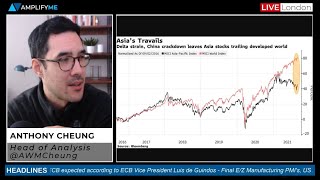
In this morning market briefing, the host provides a concise overview of recent equity performance, highlighting a modest dip in the US close but a seventh consecutive month of gains in August—the longest streak since early 2018. He notes weakening US consumer confidence and a measured tapering outlook for the Federal Reserve. The Asia‑Pacific session is examined, with the MSCI Asia‑Pac index reaching a one‑month high despite mixed Chinese manufacturing data (Caixin PMI contraction versus broader NBS PMI). The divergence is attributed to differing COVID‑19 vaccine rollouts across regions. The speaker then discusses dovish comments from BOJ Deputy Governor Wakatabe, indicating a possible downgrade of Japan’s economic outlook, and reviews ECB hawkish remarks on inflation and stimulus withdrawal. A statistical snapshot shows September historically being a weak month for the S&P 500, especially after recent all‑time highs and in the first year of a presidential term. Upcoming data releases are outlined: Eurozone final manufacturing PMIs, US ADP employment, ISM Manufacturing, and the OPEC+ meeting with associated oil inventory reports, with trading guidance to stay cautious around potential volatility. The briefing concludes with a promotion for the new AmplifyMe portal aimed at university students interested in finance.
Chapters
Okay, very good morning. It is Wednesday, the 1st of September. Hope you're doing well. In terms of the briefing for this morning, going to talk a little bit about the close on Wall Street, the performance overall for the month of August. We'll also have a look over what happened in the Asia-Pac session overnight, where despite the lower close on Wall Street, fairly moderate, around 1 to 2 tenths of 1% across the major 3 indices, the Asia-Pac region performing a little bit more positively. Some comments out of the BOJ deputy governor, some Chinese manufacturing PMI data as well to get you up to speed on. And then also I want to touch upon some statistics around how US stocks tend to perform in September, which you might find quite interesting. And then we've got some ECB commentary, and then quite a jam-packed day ahead. We've got the eurozone final manufacturing PMIs this morning, we've got US ADP, which will be closely watched as well later on this afternoon at 1:15. 16:00 London time, given the weighted factor of the labor market for the Fed's consideration around the timing and tapering. And then we've got the ISM US Manufacturing later on this afternoon, with as well the OPEC+ meeting, which I want to get you fully up to speed on as well. So quite a few things there that we're going to talk about the next 10 minutes or so. Remember, we've got the new AmplifyMe portal launch happening in 13 days, 16 hours, 48 minutes, and 28 seconds, as you can see. So, um, feel free to locate that link in the bottom of this video. I'll leave a comment with it. Again, just to recap, this is our brand new community that we're introducing specifically for university students. So if that is you and you're interested in finance, not quite sure yet what role you want to do Remember, this will give you free access to some of our leading simulation technology that we use at some of the world's biggest banks in the training that we do on the corporate side. So definitely worth checking out. Otherwise, let's get straight to it and let's have a look how markets are performing this morning. So overall, fairly quiet open. As I said, certainly there's a few things for me to update you on, but nothing of a great magnitude. Equity index futures this morning, as far as the DAX is already up 100 ticks. Equity index futures in the US as well, despite the slight dip in profit taking that we saw yesterday following the drive higher we had in the likes of the NASDAQ and S&P to record highs on Monday. That pullback has been recovered already, and the NASDAQ is printing session highs, as you can see in the center chart here, as we go into the European Open. The S&P also just a whisker away from reclaiming that all-time high, which does coincide that, um, peak that we saw at the open yesterday with the R1 today in the futures. So quite a decent clear area of resistance to tackle if we're going to continue the upward trend at 45, 42.25. But again, major US data looming, likely to keep a cap on price until we see the outcome of those metrics later on this afternoon. Otherwise, elsewhere, currency markets relatively quiet. Got a slight bid tone to the dollar in the overnight session, which trades up about 0.16%. So a little bit depressed in EURUSD and cable of around 15 pips each respectively. Gold pretty flat. Oil also just continuing a bit of recovery of late but still relatively range-bound. And obviously the OPEC meeting's coming. Short-term trend line just been keeping an eye on over the course of the last couple of sessions, going back to the overnight volatility at the reopening of Globex. Obviously we had a bit of a gap up following the Hurricane Ida situation. So taking that price point from that high and then the high from yesterday's session and also the Asia-Pac high, we're just having a look at that at the moment, just providing some short-term resistance. Again, probably going to see some uncommitted price action until we really start to get the OPEC meeting underway. And remember, usual rules of engagement with OPEC, just keep an eye out for all the source comments and oil ministers coming into the, the kind of virtual meetings making comments that can be contradictory and lead to price volatility. All right, well, look, let's get into a couple of things then. So for one, I'll just transition. I know this is talking about China here from the overnight data, but let me get you up to speed on, on Wall Street. So we had a slightly lower close on Wall Street, as they said, but actually for the month of August we were up again. And in fact, US equities have notched now their 7th straight monthly advance. So from a statistical point of view, that's the longest winning streak we've had since January of 2018. Yesterday, of course, we saw US consumer confidence drop in August to a 6-month low. This comes on the coattails of the University of Michigan's Consumer Sentiment Index plunging to its lowest level since 2011 in August. So, you know, interestingly, and probably a byproduct of what is supporting this equity market to these elevated all-time high levels, is there was a fear a few weeks ago about an acceleration of tapering. But it would seem then that we've already hit peak growth. US economic data continues to moderate. The labor market return has been fairly moderate in terms of its speed. But the consumer is being impacted by concerns over the spread of the Delta variant, of course, and elevated prices weighing on consumer confidence. And that as well, a key component for how that economy will perform in future. And that's meaning then that we're getting more of a measured response, that tapering is coming, but in a relatively controlled manner, not an accelerated one. And hence the reason why you're seeing the types of market moves, particularly in equities, that you have at the moment. Otherwise, in the Asia-Pac session, it did buck the trend a little bit. So beyond this kind of negative headline that you're seeing, and I'll explain why the market didn't react to this Chinese data, the MSCI Asia-Pac gauge hit its highest level in more than a month overnight. And actually, if I jump to here, perhaps then you can see a little bit. Here you're looking at the black line, which is the MSCI Asia-Pac index. And it's overlaid with the kind of orange line, which is the world index. So including the Western developed world, the US, European, UK equities, and so forth. And here you can see a very clear divergence, the narrative being obviously COVID vaccine related. And it's interesting, I was listening to a podcast yesterday talking about COVID and the long story short, they were saying that in China, given very onerous reactions that the government can take. They're very good at suppressing the virus and trying to control outbreaks, of which we are seeing a degree of at the moment in mainland China in certain provinces. But the rest of Asia, like South Korea, Hong Kong, these other spots were very quick to control the outbreak, whereas we had kind of the opposite in some other countries, particularly those in, say, South America, where vaccination rates have been very low. We saw a very rampant spread in some of those EM countries in particular, given the poor response from governments to really lock down and control the virus. But ultimately what that's led to then is particularly in South America, the immunity levels are generally much higher. So despite still low vaccination rates, you're seeing much lower general curves to the amount of case outbreaks. And the same can kind of be said for China to a certain extent. The analysis would show then that general populations are still somewhat exposed, if you like, to the increased risks, whereas in the Western world, obviously, we've got the benefit of a very rapid vaccine rollout strategy successfully deployed, particularly in the likes of Spain, for example, in Europe and other European nations, which have really picked up that pace despite the relatively lackluster performance seen at the beginning of the year. And what that's led to then is this divergence play. And what we're seeing then is UK economy has reopened, and some would say very successfully, because even though COVID cases did temporarily spike, uh, the vaccines seemingly doing their job, hospitalization rates have remained low, and thankfully so have deaths. And that's allowed the economy to continue to perform and continue to pick up a bit of traction And this compares to the opposite of what we're seeing in China, which is continued moderation in their data as they're still tackling the kind of COVID on the, on the kind of on the battlefront, if you like, at this point in time, whereas the UK seemingly has kind of moved and progressed on a little bit. And so there's a little bit of a disconnect in where they are in this journey of dealing with COVID at this point in time. Um, so yeah, overnight we had the latest Keqin manufacturing PMI, which did drop below 50, so in contractionary territory, 49.2 against 50.2. The data marked the first contraction for that number since April of 2020. Um, Chinese equities actually moved higher overnight, just broader tone in the region rather than this data. And why didn't it react to this? Well, we already saw the National Bureau of Statistics data from yesterday from the top-level manufacturing PMI, which had already moderated. So markets were well primed for this. If you're thinking, if you're new to markets, what's the difference between the NBS PMI data and the Keixin Market PMI data? The difference between conducted by the government or third-party data vendors, there is some nuance in how the data is calculated. The MBS one is generally a much broader survey, around 3,000 companies, where we're just talking about a handful of 100 companies or so in this Keqian reading. There's also a slight difference. The government one tends to encapsulate larger companies as well as small-medium sized, whereas the Keqian is more focused on those medium-smaller sized firms. And there's also a slight difference in the catchment areas of the type of companies geographically that they talk to. The Cajun one, a little bit more focused on some of the export regions on, I think, the eastern coast of China. So hence the reason why there are those two data points. How the market perceives these data points is they kind of take them in combination. But as you would imagine, the two generally are quite correlated. So hopefully that makes sense. Otherwise, other things that we've had overnight is Japan did outperform a little bit. There's some conversations about reports that the PM is to order the compiling of an economic package, an additional budget within the week. So something to keep an eye out for. And also supporting China a little bit is, you know, when the equity market gets, gets really hammered like it has done through the regulatory crackdown, a little bit of a bounce, some, you know, kind of value buying into the size of the sell-off being perhaps slightly overdone. The dust settling a little bit, the rhetoric out of the government seemingly has started to just ease in pace to a certain degree. And so some kind of moving back into Chinese technology stocks, given how beaten down they've been, and also with the perhaps vision that the worst of the regulatory crackdown has passed. Obviously, we're yet to be seen. The other thing as well that's probably worth commenting on from overnight is you had a comment out of the Bank Bank of Japan Deputy Governor Wakatabe signaled the central bank may revise down its economic assessment at this month's policy meeting after a record number of infection cases forced the expansion and extension of the state of emergency across Japan. The Japanese yen touched softer overnight. Obviously, it comes in a combination as well, as I mentioned before, of a generally firmer greenback. And so some dovish comments there or also helping assist the dollar-yen pair higher going into the European Open. And one thing I would say is, uh, just like we talk about the board with the Fed, um, the FOMC members, don't forget as well to be up to speed with your BOJ monetary policy board. So there was a good graphic that Bloomberg put out earlier this morning that I've shared on my Twitter handle if you'd like to kind of keep this as a crib sheet, because it's not often you get a BOJ kind of graphical breakdown like this. Wakatabe is definitely on the more dovish side of things, so to hear him talking a little bit more about the downgrading of economic assessment really isn't too surprising. But again, definitely worth keeping this, this crib sheet to hand for future reference. Not that the Bank of Japan is particularly exciting, but just to know your members and improve your knowledge for sure. Otherwise, a few other things. Just wanted to do a bit of a stats check on September very briefly. One of the things I wanted to mention, and perhaps I can leave this, this, this performance of the equity market the last few years and divergence geographically we're seeing, as I explained, but I guess just focus on the orange line because what we've had here is this phenomenal rally really since the, the bottom of the sell-off that we saw on 23rd of March of of 2020. Of course, we've had all kinds of things take place, predominantly, um, this rally underpinned by those two powerful forces of fiscal and monetary policy stimulus. And here we are, as I said, um, August finishing higher, the 7th straight monthly advance that we've had. That's the longest winning streak since January 2018. So what does September— now it's the 1st of September— what does that month generally look like. And I was having a look at some data from an independent research firm last night, and they basically said the S&P 500 has been positive just 45% of the time in September going back to the Second World War. So on the balance, generally it's a down month. Uh, the average 0.56% decline in the month is the worst actually of all months, with February the only other month with an average of negative performance. Um, so generally the statistical data shows that September is pretty weak. The decline is even worse in September when it falls in the first year of a presidential term. On average, the S&P 500 declined 0.73% in those years. And the data also found that in the years when the S&P 500 set new highs in both July and August which we have done, of course, like this year, the benchmark fell an average of 0.74% and rose only 43% of the time. So when it comes to this type of statistical analysis, I'm always kind of aware of it. I find it quite interesting, but I definitely do not then pin everything just on the fact that over these long-term data studies of 75 years, there has been these emerging patterns, because that would be not applying the relevant context to the situation of which we're talking to. So net-net, statistically speaking, September is one of the worst months for, for US stocks. It gets even worse when it's talking about, uh, it's hit recent all-time highs in the prior months and also in the first year of a presidential term. That doesn't make me think, right, I just need to be shorting every high that we see. It's just something to be aware of. And at this point, as we've discussed, with COVID still being a struggle, particularly in the likes of China and the Far East, um, then I still think at this point in time that coming alongside, um, still some challenges for Biden to push through some of the fiscal, um, proposals, the budget upcoming, the debt ceiling, um, and you've also got the, the next progression on policy normalization with tapering. Yeah, equities are susceptible to a bit of downside, whether that happens in September or not. I'd say most bank consensus view is that we probably will see a little bit of moderation in this rally, only then to push back higher towards the end of the year. And so timing is obviously going to be key. Could it be September? It possibly could be. And again, if we get really strong jobs data this Friday, that kind of rekindles that tapering idea, the closure of the gap in this, in this, in the workforce in the U— in the US. And then we get a further worsening of the COVID situation, particularly out of China, and also still impacting then the general consumer psyche and economic performance in the US. Perhaps September we do see a pullback just generally over the medium term. Again, that doesn't change my general view that equities will remain at elevated levels through to year end. But, you know, there's been some pretty bold calls. I think MS has talked about a 10% potential correction is looming. I see that as as a fair probability, I would say, at this point in time. All right, quick look at some final headline stories. Um, we had some hawkish comments obviously yesterday from Klaus Nott, the Dutch central banker in Europe, who said the euro area inflation may justify the end to ECB crisis mode. And then in Spanish newspaper overnight, you've had the vice president of the ECB, so about as closely aligned as you'll get with Christine Lagarde and seniority, spoke. And he said the eurozone economy is growing quicker than the ECB expected, paving the way for an eventual withdrawal of copious stimulus. Now, my interpretation of this is the euro is not moving on the back of these comments, but I would say that given the progression that's being made towards the hints for policy in the US and around tapering to be formally kind of more announced in September meeting, which is around 21 days from now. The idea is that I don't think the ECB want to be too caught too far behind in the divergence of their policy timing. So I think that's just what this is. I don't necessarily think that this is anything to get spooked about of an acceleration of tightening at this pace in Europe. But If you think about it, prospects in Europe are looking better, you know, and actually a predominant factor behind that has been the really successful acceleration of the vaccine rollout. And that has created then a slightly more positive outlook for what the, the economic area is going to look like going forward from, from where we were just several months ago when it was looking much more negative. And so improvements in growth I think are quite expected, and therefore this type of noise coming out of central bankers I don't think is too untoward at this point in time. All right, quick look elsewhere, and we'll have a look at the calendar and then we'll incorporate a quick preview for, for OPEC. So this morning you've got the final August manufacturing PMIs from Eurozone, UK. So not expecting a great deal of reaction to that given the final readings. Eurozone unemployment rate as well at 10 o'clock. Then in the US, you've got US ADP, which is expected— the headline to come in at 613,000, which is almost double of what we had last time. And you remember the last ADP print was pretty bad. In fact, it was the lowest reading that we had had since we printed around 180,000 in February. So a very fast deceleration that we had had from the peak that we got to 882 back in April. But the consensus reading would put us back up to that June area, and obviously seen as a strong precursor for the payrolls report we will get on Friday. You've then got the, um, Markit Manufacturing PMI number— not so much interest. The focus then will be on the ISM Manufacturing PMI, which is due at 3 o'clock, expected to still remain in firm expansionary territory, albeit a slight moderation from the prior reading in July. Headline expected at 58.6. Then you've got the OPEC meeting. And so the OPEC meeting, the JMMC is due to gather, the Joint Ministerial Monitoring Committee, at 3, with OPEC+ meeting penciled in for an hour after, so commencement at 4 PM London time. As I said, as usual, just be mindful of how you're managing your positions this morning going into that event. I would say you want to be very kind of mindful of whipsaw price action. So longevity of trade needs to be pretty prompt if you're going to trade at all. No harm sitting out the market waiting for clarity to emerge just in case OPEC come out with something. Unexpected. So probably going to trade fairly tight range until we get a bit more detail emerge from that gathering. OPEC and its allies, including Russia, are expected to ratify a plan to add 400,000 barrels a day in October, looking then at the fact that the market can absorb extra flows as demand recovers from the coronavirus pandemic and despite calls from the US for more production. I think at this point, you know, OPEC's ability to just bring more than what's already been tabled to the market is pretty much— their hands are tied by the ongoing COVID situation globally. So I don't see that as a real distinct risk factor for today. Then you've got the DOE oil inventory numbers later on this afternoon, so that's coming in the mix during the OPEC. So remember, if you're trading that data Today's a little bit more unique because it is combined with exact timing of the OPEC gathering. So I definitely keep that in mind. Reaction effect to the DOE is probably going to be decidedly short-lived, even on an outlying number, because no one's going to want to sit in a position of risk for too long at risk of some headline noise coming out and stopping them out of position or flipping the markets. So just worth keeping in mind. The APIs last night saw a headline crude drawdown of 4.1 million, which is a million deeper than expected, cushioning a build of 2.1 million. Gasoline was the surprise, a build of 2.7 million. Analysts were expecting a draw of around 1.6. Um, so we'll recap those later on this afternoon. Speaker-wise, you got Bostic, who is a voter, speaking, um, but more so about, um, bringing about inclusive inclusion in the economy. So perhaps slightly off topic, worth being aware of at 5 PM London time. Supply coming out the UK and Germany later on today. So that is it. Obviously quite a bit covered there, a little bit longer than normal. So hopefully it was all useful. Feel free to leave me any questions at all in the comment section below. Remember to check out the link as well for the Amplify Me registration for the launch in a couple of days' time. And yeah, have a great session ahead. Thanks very much.
More from Anthony


Inside the Biggest Banking Stories You Need to Know This Week (Anthropic, Diageo, Private Credit)


Inside the Biggest M&A Deals You Need to Know This Week (UniCredit, GameStop, eBay, Eli Lilly)







AI Breakthrough or Hype? Anthropic’s Claude Mythos, Tim Cook Steps Down & LIV Golf Collapse