Who will replace Bank of England Governor Mark Carney?
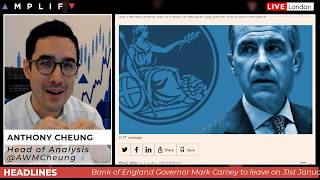
In this market commentary, Anthony Cheung outlines the upcoming selection process for the successor to Bank of England Governor Mark Carney, who will step down on 31 January 2020. He explains the six‑week application window, the short‑listing and interview phases, and the ultimate appointment by the Chancellor. Cheung then profiles the leading candidates—Andrew Bailey (FCA chief), Ben Broadbent (Deputy Governor), John Cunliffe (former Treasury official), Raghuram Rajan (ex‑RBI governor and IMF chief economist), Minouche Shafik (former BoE deputy governor and LSE director), and Shwetha Veddera (Chair of Santander). For each, he assesses background, policy leanings (hawk, dove, or “owl”), communication abilities, and potential political or diversity considerations. He also mentions speculative names such as Janet Yellen and Christine Lagarde, and notes why they are unlikely. Cheung concludes that markets are currently more driven by Brexit‑related uncertainty than by the governor succession, but the appointment could influence expectations once the process concludes.
Chapters
Okay, thank you very much for joining us. It's Anthony Cheung here from the trading floor Amplify in London. I'm going to have a quick short session about who could potentially take over from the Bank of England Governor Mark Carney now that he said he's going to finish at the bank on the 31st of January of 2020. One of the key things and the reason was why people are focusing and talking about this this morning is that financial markets move very much not on what's happening today, but future expectations. And whoever takes the helm at the, the small collection of people that form the Monetary Policy Committee or the MPC at the Bank of England is critical then for how they manage the UK economy going forward. And so identifying who are the potential candidates, What's their backgrounds? What's the likelihood of them being appointed? Are all key questions we're going to look at going forward. Now, key thing here is that the process has now begun, and how this works from a format point of view, there's basically a 6-week period where people have the opportunity to put forward their applications, just like any other job would be. Now, what happens from there then is a shortlist is drawn up and interviews will be conducted over this summer, the summer of 2019, in and then in the autumn, that's when the person's gonna be selected. Now, who, who compiles this shortlist? Who does the interviews and who in the end appoints the person? Well, actually it's the Chancellor. So Philip Hammond at this point of the Conservative Party. And even though the Bank of England and the Treasury in a sense should operate independently, the kind of reporting procedure though is that the Bank of England have a target, let's say an inflation target of 2%. And if they fail to hit that, he needs to report back to the Chancellor. So the relationship is, is even though Philip Hammond doesn't have day-to-day influence on the Bank of England, he does have it as part of his general oversight and his responsibilities of managing UK economy as the position of the Chancellor. And so going forward then, very important for us already to start looking ahead as to, as to who that person might be. Interesting thing from a market's point of view, of course, is that ECB President Mario Draghi is also due to finish his term in the latter part, the autumn of this year. So by autumn, Draghi's gonna have been replaced. We will know who that person is in the coming weeks and months. And also Mark Carney's person probably would have been chosen at that point, and he'll be conducting the handover then for taking over in Feb 2020. So who's on this shortlist? First off is the one that the bookies are assigning as the highest and most likely person to take over. This is a chap called Andrew Bailey, who is the existing chief executive of the FCA, the Financial Conduct Authority. Now, um, obviously he then is a highly qualified person to take— potentially take over the post. He has held several top banking jobs. He moved to the head of the FCA in 2016. He's got a global reputation in banking supervision and financial stability. However, he, in his FCA body, has come under some criticism about the management of internal procedures that have led to some criticism I think it was about a year ago, there was some talk about a firm called London Capital and Finance, which basically was a kind of almost like a fictitious company, which a lot of retail investors lost a lot of money, but it was an FCA-approved firm, and despite warnings, their lack of inaction drew a lot of criticism from the broader public. And so that's probably the one kind of slight shadow over him. Uh, the other one would be, of course, that even though he's highly qualified in financial stability and regulation, he isn't necessarily qualified to comment on monetary policy. So he nonetheless, though, is seen as the firm front-runner for this role, no doubt about it. The other person, of course, then, if we scroll through some of the other likely candidates, this person, Ben Broadbent. You may, may not have heard of him before. If you're in markets, you probably have. Because he used to be the European economist for Goldman Sachs, one of the major banks on Wall Street. And so that's how people really know him as an economist. So he definitely has come from not an academic background, but very much a private sector banking background. He though, although, well, the positives here are he is the deputy existing governor of monetary policy. Therefore, he is closely aligned with Mark Carney. He, as we'll see in a second, does sit very much in a neutral, as a centrist in terms of monetary policy view. The parameters here on the extreme being an outright hawk or an outright dove, he and Carney tend to sit in the middle, which you would usually see the governor, the president would have a similar type of neutral stance. So they're the positives. If you wanted continuity, if you wanted a guy who sat in all the meetings, who's been there when Carney's had to make the decisions, to kind of hand safely over the baton, to add this continuity, particularly through uncertainty of things like Brexit, which obviously will unfold in the coming months, could be a safe pair of hands. However, one thing that he has done in the past is he's made a a pretty shocking communication error. You might remember he described the UK economy as menopausal when he was asked about it, and he said it's past its best. I mean, my goodness, could you make any more of a PR blunder in a position of authority and in the public face? So I would say almost that blunder alone pretty much would make a lot of people nervous about him taking the, the helm in a world where communication is the strongest tool that a central bank has. And as we'll see from some of the other candidates, there's some really slick characters who could definitely outperform him in that particular arena. Now, this is another one, another monetary policy member that is existing at this present point in time, and and someone who served as a Deputy Governor at the bank for many years, I think 6 years now in total, and this is John Cunliffe. He's also previously served as a senior Treasury official, so he's been a member of the bank for a long time, he served at a high level in the Treasury, so he's definitely got the experience. The problem is, does he have the capability to perform as a leader? He's always kind of sat in the background, if you like, to that extent, he also does have a very extreme dovish view. And on that note, let's just jump over to this graphic here. This is looking at the spectrum between the most dovish monetary policy MPC members at the Bank of England to the most hawkish, and Cunliffe is the most dovish. So that could create some difficulties when someone is that outright kind of fixed in their view and perception of the world, that can severely alter then potentially the composition of the way of which meetings are chaired. You'd much rather, you would think on logic, have someone of a more neutral stance like Broadbent, for example. So Cunliffe is one. We'll move on from him, we'll look at someone else. And this, this is a really interesting chap. And actually, I was looking at some of the odds that the bookies are giving. And actually, uh, Raghuram Rajan is the second favorite behind, uh, Andrew Bailey. Now, for those who are not familiar with him, uh, he was the previous, uh, governor of the Reserve Bank of India, so essentially the Indian central bank, uh, a few years ago. He was also the former chief economist, uh, at the IMF. So he's definitely, uh, an economic a policymaking heavyweight in that respect. He, uh, by default then, dealing with a country like India, which is very volatile, not just economically but politically, which does carry maybe some credible skill set going into an era when we're heading into Brexit. He is a very articulated fellow, he's an adept communicator, and he's one of the lead front-running kind of the world's front-running economists. So he definitely has a lot going for him for this particular role. And if you think about it, Mark Carney was someone who ran the Bank of Canada before we drafted him in because he did a good job. Rajan here has served previously as governor of a major central bank, one of the biggest emerging markets in the world. Of course, you know, is this a, you know, quite a natural move into this type type of role. Definitely someone who would be seen as a, I would say, a fairly safe pair of hands. Question mark, is he a hawk or a dove? Well, this is when it gets a bit problematic. He actually said, I'm an owl. I mean, my goodness, again, we're going into this terminology. Obviously a hawk being the most prone to being inflation-focused and thinking about interest rates being higher, lesser accommodative monetary policy stance. The dove is obviously the opposite. So in the European example, that would be Greece, Ireland, Portugal. An owl, as he refers to it, is someone who's just willing to, to kind of sit back and assess the data and make decisions accordingly. An owl is one of wisdom. And so that's how he's kind of termed himself before. Other members are ones that could be quite interesting, and definitely there are two females on this list who are up there with the, the front runners for the potential role. And one is Minouche Fashik, or Shafik, who is a director of the London School of Economics. She is also a former deputy governor for banking and markets at the Bank of England. She served from the summer of 2014 up to February of 2017. So she definitely has experience, although she wasn't there for a particularly long period of time, and she did have some personality clashes with Mark Carney. Now remember, it's Haldane that picks this person, but the handover needs to come from Carney, so could be some issues there potentially. She is seen as someone who's a good, a good manager, great staff loyalty, a kind of people's person, you know. That could lend its hand very nicely to chairing some very important meetings that are probably going to have take place once the Brexit— if the Brexit situation has some type of solution, whether soft, whether hard, and/or, you know, no deal, whatever the case might be— there's going to be some real heated debate amongst what needs to happen. So could she be a good person to do that? The issue she has probably is that even when I remember when she was part of the MPC, I don't ever remember really speaking live in public that often. There's always quite predefined, preset speeches. So her communication of the bank's decisions and its policy and doing that effectively to the public, I think, would come under some question because she is really not that experienced in that department. And let's not forget, this is one of the most important roles that you can have globally, never mind just the Bank of England and the UK economy. The other person, of course, on the list is this person, the chair of Santander, Shwethi Veddera. If you're into your UK politics, you've probably heard of her before. She was part of the business minister team under the Gordon Brown-led Labour government of a few years ago. So she's definitely aligned in that political view. I do actually think, even though the chancellor has said that shouldn't be be a barrier. I think that that is a barrier, um, in that respect, and I think there'll be a lot of pushback on that. She has had a long career in the private sector. As I said, she's current chair of Santander Bank, so it definitely has some experience. Of course, the interesting thing, again, the Bank of England has come under some quite strong criticism about its lack of diversity, particularly the amount of females on the Monetary Policy Committee. I mean, I mean, if we go back to that board, Tinreiro is actually a female. Otherwise, she needs to sit in a boardroom and have these discussions as the sole female representative of the 9-person NPC. And last time I checked, there was not 9 women walking around the streets of London to every 1 male. So, yeah, definitely there is a lack of diversity. Argue quite strongly at the Bank of England. And is there a political push behind closed doors to have one of these female candidates come through? On that list, I have actually heard Janet Yellen has been put on the table. Now don't get me wrong, Janet Yellen is not going to do this job. I mean, poor Janet Yellen. Please, Janet, just take a break. 'Chill out, and just, you know, you've done a great job, you know, there's no need to get involved in this Brexit mess, you know, just go and have some, have a peaceful life.' Yeah, I think that the probability of Janet Yellen realistically doing this is incredibly low. People are just putting it out there, I think, because she's someone of magnitude, someone of weight, someone of substance, someone of experience. It makes sense. The other person, of course, and this person always comes up, and again, I don't think she's going to do the Bank of England role. I think she could definitely do other roles of influence, but not the Bank of England. And that's Christine Lagarde of the IMF. I'm not sure if she's even still part of the IMF these days, but she's another person, again, with a global reputation. But whether or not she has the monetary policy nous to to really take on a role like this. So I'm not so sure. My kind of base case here is that— well, finally, the other person that has been mentioned, if we go back, is this chap Andy Haldane, the chief economist existing at the Bank of England. But he is, he is kind of the opposite of Cunliffe. And for the same reasons that I think Cunliffe is a low probability replacement given his outlying stance, I say the same for Haldane. And probably Haldane even less, because he himself has been very bad at— or very good, you could say— at mimicking the unreliable boyfriend tag of Mark Carney, and that he changes his mind very often. And that has led often to misinterpretation and volatility in the markets, which is the complete opposite of the objective of the Bank of England. So all in all, to recap, the most popular or the favorite at the bookies at the moment is Andrew Bailey. The next then is actually the former RBI governor, Raghuram Rajan. Again, timeline of this, you're going to be looking out over the next 6 weeks. The first thing will be, or who actually applies, where all of this, what we're talking about, is hypothetical of potential candidates. Someone like Ben Broadbent has actually never said he he ever wants this role. We're just speculating that because he's the, the deputy governor, it makes sense because he's probably, apart from that, that PR blunder he made, the most natural replacement, you could say, for, for Mark Carney in terms of a like for like to some extent. Um, so yeah, things that we'll be looking at in the future. Um, at the moment, obviously, the pound from a financial markets trading point of view is being highly driven the pound, in terms of Brexit, I mean. And that will continue to do so over the coming weeks, particularly because there's a self-imposed deadline of May 22nd, of course, for May to get some kind of withdrawal bill in whatever shape or form and whatever amendment from the opposition party approved in the next basically 4 weeks, because she doesn't want to take part in the European elections. Otherwise, after that, we we could well see a switch to people focusing a little bit on this as the year goes on. All right, I hope that was useful, and thanks very much for listening.
More from Anthony


Inside the Biggest Banking Stories You Need to Know This Week (Anthropic, Diageo, Private Credit)


Inside the Biggest M&A Deals You Need to Know This Week (UniCredit, GameStop, eBay, Eli Lilly)







AI Breakthrough or Hype? Anthropic’s Claude Mythos, Tim Cook Steps Down & LIV Golf Collapse