Why rising US yields is a concern for markets
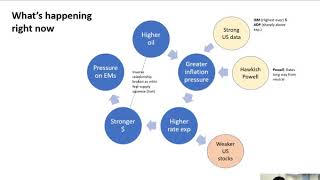
In this October 4, 2018 market briefing, the presenter walks traders through a chain of events that have pushed US Treasury yields higher and explains the knock‑on effects across currencies, equities, emerging markets and commodities. He starts by showing the recent dollar rally and the steepening of the US 10‑year yield, which has breached multi‑year technical resistance and is approaching the 3 %‑3.5 % zone that historically signals stress for US equities. The rise is attributed to two main inflation drivers: a surge in oil prices (breaking $75 and heading toward $80 amid Iranian sanctions) and surprisingly strong US labour‑market data (ADP hiring and a record‑high ISM non‑manufacturing PMI). Fed Chair Jerome Powell’s comment that rates are still far from a neutral level reinforces expectations of further hikes, pushing the neutral rate higher. The presenter links higher yields to a stronger dollar, which in turn pressures emerging‑market currencies (India, Indonesia, Brazil, Turkey, South Africa) and dents equity markets in the US and Europe. He illustrates the dynamics with a quick‑made chart that ties oil, US data, Fed stance, the dollar and EM stress together. The briefing also touches on Brexit, noting that UK Prime Minister Theresa May is racing to push a deal through Parliament before the October‑November deadline, offering little new market direction for GBP. An Italian budget concession that lowered the deficit target is highlighted as a catalyst for a short‑term USD/JPY rally, with a trade‑setup described in detail. Finally, the presenter lists upcoming calendar items (US jobless claims, factory orders, ECB and Fed speeches) that could further influence yields and currency moves. The overall message is that continued yield acceleration could trigger broader risk‑off sentiment, a stronger dollar, and heightened volatility in equities, EMs and the yen.
Chapters
Okay, very good morning, Thursday, 4th of October. Um, plenty of things for me to cover this morning, and lots of different moves are happening, quite a lot of different asset class movement, but all highly correlated as to why these things are occurring at the moment. So my objective in this specific briefing is, yes, I'll talk about the news, but for the benefit, I know there's a lot of people newer to the markets. I'll try and explain a little bit of reason on why the market's so yield-focused at the moment, what that means then for the dollar, how that's moving then the equity market in a negative fashion this morning. So hopefully we can make a bit more sense of, of the world as it, as it's unfolding this morning. So first things first, let's just have a look at this kind of mix of charts I've got on my screen here. So you can see quite clearly this persistent kind of move lower in both major pairs that was really underway from yesterday. So you've got a combination here of really dollar strength. We had an acceleration of dollar strength last night. Now Jerome Powell, the Fed chair, spoke. We're going to get to his comments in a second. But dollar strength, so the major pairs under a bit of pressure. Cables had a little bit of a recovery but found some resistance. You can see here in the center at pivot and the 130 handle. Elsewhere then, US yields are climbing. So the US 10-year is down 10 ticks. Now, for the US 10-year to be down 10 ticks at the European Open, that's, that's sizable. In sympathy then, the Bund market, the German bond market, is down about 75 ticks, just to put it in a little bit of like-for-like terms. And equity markets are under pressure. EM is under a little bit of pressure with the prevailing dollar strength. So let's try and talk this through and understand why this is happening. Now, one of the main things here that you're going to read a lot about today is, is U.S. yields. So this is the U.S. 10-year yield. The 10-year is kind of the benchmark that the market will look at, and speculative traders will look at day to day. And the Treasury route deepens the 10-year yield back up to the highest level since 2011. If you can see here, 20— kind of 2013, we got a bit of a peak. We got there earlier this year, and now if you remember, all the way back to 2011 is the last time we've really made a conscious move above 3%, a level what that I've been kind of thinking, well, the show kind of comes to a bit of an end for the US equity market bull kind of run is if this yield gets to 3.5%. I think that starts to become quite worrying for this idea of this cautious gradual rate hike cycle, accommodative environment, which has helped accelerate then this equity market over the kind of financial crisis era. This starts to become Now we've broken this technical point back to these multi-year highs, a very interesting area. Now yesterday, one thing I saw, this was the ticker tape on Reuters, and it was a bit of a highest-since fest in the sense that, you know, every one of these yields, doesn't matter what part of the curve you're looking at, the 2s, 3s, 10s, and 30-year, you know, we've got the highest yields here in, in the short end at least. If you're looking at US 3-year Treasury yields, highest in 11 years, 10 years for the 2-year. So what this is looking at then is that interest rates in the short term are anticipated to go higher. And we know this because the Fed have been telling us this. They're going to hike again in December. They're going to hike 3 more times in 2019. But one of the things that happened yesterday was our man Jerome Powell came out and he said rates probably are still a long way away from neutral. Now, as rates have got to 2% and now we've gone above that, a lot of people were thinking, you know, 12, 18 months ago that 2% was the neutral rate. The neutral rate being the perfect kind of interest rate in order to keep a nice stable rate of inflation. Now that it's back to target, the only problem is, is that inflation expectations are rising. Why are they rising? Well, two things. One, oil prices. I mean, oil continues to remain elevated, and the higher oil prices go, the more inflation pressures that adds to the kind of economic system. If we look at oil here, obviously we've broken only in the last few days a really important technical point of resistance at around the midsummer highs. And here we are, we've smashed $75. I'm pretty confident we're going to hit $80 in— wouldn't surprise me in a week, if not 2 weeks, because we've opened up some clean air technically here to the upside. And there's plenty here fundamentally to suggest, to support that directional narrative. By this, what I mean is that Iranian sanctions are going to hit, which is a chief reason why the prices are lifting at the moment. You know, kind of the inventory situation, although data yesterday, sure, but that's more of a day-to-day intraday move. The bigger picture here, as we've talked about before, from the market's underlying positioning, is that most big hedge funds are looking for, you know, further price rises to come. So this would add to those inflation pressures, which means on this side as well, then does the rate hike kind of sequence does the neutral rate need to be bumped up? Well, that's not the only thing that's going on here, because the other thing that's happening here is this. You had US data yesterday. It's a US ADP employment change. Private businesses in the United States of America hired 230,000 workers. Expectations were 185,000, and we also had an upwardly revised previous to 168,000. So if you're looking here at the ADP chart Here it is. It's the highest number that we've had here going back all the way to February of 2018. And, you know, really strong, nice recovery off that 168, fairly depressed figure. Not only that, check out and remember the ISM Non-Manufacturing PMI. I mean, this was outstanding, 61.6 above market expectations of 58. You know, you know, I've been watching markets now for more than 12 years, and I don't— I haven't often seen a beat of that magnitude very often, and I've definitely never seen 61.6. Why? Because look, you're getting up to territory where these numbers have never happened before. This reading pointed to a record growth in the service sector, so the US economy irrespective of the trade war tail risk, is on fire right now. And that again increases this demand and net then inflation expectation. So as a consequence, Powell's having to talk a more hawkish game. The neutral rate is getting higher, so that means that interest rate expectations are rising. So what does this mean then for the Treasury? Well, we looked at the yield What does it look like from a T-note point of view? Well, look at the move in the US 10-year through yesterday's session. I mean, this was the economic data here. ADP came out here. We broke, obviously in the short term, quite a key point of technical support over the course of the last 2 weeks or so. Broke that, that really opened up some aggressive selling to the downside. Broke the 118. These yields starting hitting across the the maturity curve, new multi-year highs. But check out the 10-year here. This is the US T-note on a daily continuation. That breach of that level just above the 118 was really important because look at where we're trading right now. That was the technical breach on that level that occurred yesterday and has been further accentuated by these comments from Powell its ongoing belief of inflationary pressures are picking up. So the question is then, well, now we've broken that level, and as you can quite clearly see here, this is— this bottom axis of my chart goes back to 2014. Well, let's put it on a weekly continuation. The last time we were down at these levels in the 10-year, we've got to go all the way back to 2011 here, and you can see how this is also been quite interesting. You got to go back to the early '00s last time we saw some resistance at these levels. So unsurprisingly, it's found some support, and we've had a bit of a hiatus in this sell-off right here. But if this breaks, well, then technically, looking at this chart of the US 10-year, we got a lot of open room here to the downside, and that's quite worrying for who? It's worrying for equity investors, because if interest rate rises have to be factored in more aggressively, well, what needs to happen then? Policy tightening is an equity negative. Remember, it's cautious gradual rate cycle hike that we've had from the Fed under Janet Yellen was, uh, very incredibly slow, coordinated, and gradual, and that helps then this kind of pull higher in the S&P price. But if what's happening at the moment starts to pick up further traction, well, as we've seen here from the initial high that was seen, uh, at the point of that 10-year break, you can see here in the evening equities have come under pressure, and that's in the States. How is it looking in Europe? It's a similar affair. The DAX opening up And obviously there was a holiday yesterday in Germany, but the reopening of trade, we come back down to test the lower bound of recent week's range. The Euro Stoxx likewise has come back down to also the weekly end of the range. One of the things here, of course, and the Euro Stoxx in particular could be quite interesting, but definitely for the currency markets as well is that what does— who disbenefits from a continually rising dollar? If the market starts getting excited again about inflation, increased policy tightening, yields start rising, the dollar starts strengthening, who's susceptible to more damage? Well, who's more susceptible is someone who's already in a very fragile state, and that's the emerging markets. because if you think it's the dollar strengthening and economically these emerging markets are already struggling— people like India, people like Indonesia, people like China, for example, not to mention Turkey and Brazil and South Africa— well, if the dollar starts surging and those respective currencies are already very weak, all of a sudden you've got an EM crisis back on your hands again. So you can see how really yields are the beginning of a sequence of what could be, if they start to really rocket to the upside, a real problem for global financial markets. Let me show you this. You'll have to excuse the crudeness of this chart because I knocked this up in about 5 minutes this morning on a PowerPoint. But I thought that this better brings everything together of what I've just discussed. So let's just say we start, and this is looking at just what's happening right now, and I've tried to explain it as to then the chain of events of why the market's doing what it is at the moment. So we've got higher oil at the moment, and we've, we talked about the situation. Remember, we had some headlines yesterday. Saudi and Russia said they're absolutely willing to add more supply to market. The only problem is they were talking about Russia, 200,000, 300,000 barrels per day. Now, what difference does that make to Iran, who's the third largest producer in the Gulf, and they're talking about, you know, multiple millions that might come off the market? Hence the reason why, even though we might get record supply from Saudi and increase from Russia, it doesn't detract from the fact that the price of oil is going higher. Because it's not enough supply to mitigate the squeeze. So oil prices are going higher. This is the key one here. I should really make that a different color because this is leading to greater inflationary pressures. You then throw in the ISM, the ADP, and the general health of the US economy. So strong data inputs to the greater inflation pressure. And then consequently, you get Jerome Powell saying rates are a long way from neutral. And so a hawkish Powell creates more than higher rate expectations. So really his arrow should be pointing down here. Higher rate expectations leads to, to the left, a stronger dollar, which then in turn, as I mentioned, pressures the EMs. But a higher rate also has a negative impact for US equity markets because of the removal then of this kind of gradual process to something more high-speed policy tightening, which the market's not prepared for at this point. So hopefully, um, this kind of graphically makes a little bit more sense perhaps to the discussion we've just had. Interesting thing here is that, you know, the classic kind of inverse relationship is that if there's a stronger dollar, oil should be down, right? They should be inverse, but that relationship is broke right now. And it's broke because of, a, the dollar strengthening on the reasons we've just discussed, and also the fundamentals. The supply situation is so strong at the moment. This looming November time frame around the Iran sanctions really kicking in. And coupled with, don't forget, the biggest economy in the world on fire at the moment. So you've got demand side increase supply-side cut, prices have got to go higher at this point. So, you know, looking for this traditional relationships, this is when you have to review things, you know, more objectively of what is the state of play right now. So hopefully that's a bit more useful of, you know, why things are happening like they are at the moment. So bit of risk-off overall, and it's kind of stemming from a little bit, I guess, of a rerun of what we had in February when the stock market in the US momentarily crashed on the back of fears of global synchronized tightening. This is more US-led at the moment, and, you know, this— these yields in the US need to be watched at the moment because if they continue to accelerate, and the closer we get to 3.5%, we're a long way from that at the moment. If we ever did, then, you know, with that technical setup with the US 10-year at the moment, there's plenty of room to fall. And if rate hike expectations start to accelerate, I'd be expecting equities to weaken, the dollar to rally, which might perpetuate the yen crisis even further. Okay, let's have a look at a few other things then. Moving on to other subjects, I cannot not mention this. The Maybot, of course, the dancing queen herself, managed to come out of yesterday unscathed, as I was expecting. I wasn't expecting anything else, actually. I think that she— I think she did a perfectly fine job, exactly in line with my expectations, because I think she's been talking up quite a stir turn game. She stuck to that, and, and that was that. I mean, if you look at the actual market reaction, when you actually look at the cable pair at the moment, I mean, this is cable on a week chart, and this was the comment which came out on Monday, which was talking about the Northern Ireland border issue. And just look at the size of the move comparative to this rectangle, which was the actual May speech bookending the Tory Party conference. So her reaction was absolutely zero, basically. And I think it's because everything that she said, it's very political. There's nothing really new developed here about Brexit and the negotiations on that front. So there's not really a great deal to add here. The one thing though, from a news perspective, that has been happening, this is Bloomberg's latest sources. They're suggesting that Theresa May essentially is planning to rush Brexit deal through Parliament. So there's obviously a lot of noise at the moment about potential leadership challenges, obviously BoJo being the number one candidate for that. But the Prime Minister— apparently officials are drawing up plans to rush her Brexit deal through Parliament in an attempt to head off that rebellion within her own party, according to undisclosed people familiar with the matter. Because don't forget then, the final withdrawal agreement does need to be signed or ratified by lawmakers within 2 weeks of signing the terms of the divorce in Brussels. So under these tight time frames, uh, you know, they are running out of time to some respect. And the longer she leaves it, the more chance then that it could be debated and voted against in Parliament. Key time frames to have a look out for are definitely October, November This is when it really starts to heat up. So here, May will meet with European leaders at a dinner in Brussels. October 17th, you need to put that in your diary because this is when it's expected to finalize her settlement with Brussels. The big one though, arguably, is this special gathering which is penciled in. You can scrub the pencil, it's gonna happen, I can almost assure you, because they're gonna need more time. That's for November 17th. Ministers are aiming for a breakthrough on the biggest sticking point, lo and behold, the Irish border. Can they compromise on this issue? Can Theresa May get the DUP to accept this kind of backstop to appease the European politicians is key. So not a great deal really, I'd say, for a directional bias for cable. It has come back a little bit this morning. Bit of reprieve for the dollar after such an aggressive surge that was seen overnight. And really, I'd be interested when the US come in to just monitor these yields and do they want to continue this kind of run that we saw yesterday. If that's the case, you might see the pairs come back under a little bit of pressure. If not, then certainly a bit of recovery, I guess, here looking at EURUSD in the short term. If we come back up towards the kind of Tuesday low, maybe an entry point if those yields start picking up again. The dollar starts strengthening to maybe enter, re-enter a short, let's just stop around the pivot looking to play the market back down lower. One nice trade that I was definitely watching yesterday was— this was USDJPY. Just to give you a quick skinny of what was going on here, this was Tuesday session, and well, really you've got a couple of things that are happening for the week. This was Monday's consolidation in USDJPY. You then had, uh, USDJPY tracking lower because if you remember through Monday, Tuesday session, this is when people were having a momentary panic about Italy as those Italian yields were going to multi-year highs. However, this particular area here, just highlighting now, that was when that overnight source report came out and Italy made a concession to then tweak and make more favorable to Europe their deficit budget terms, and risk-on returned. Now, what you had here then was a fast money move. This, this story actually broke after 2:30 AM in the morning, so no one's really there to trade that at that time. So the fast money overnight players kind of hit it in a fairly illiquid market. Quite a big spike in the dollar-yen pair here on the, the kind of risk-positive news. We then saw a quick exit on that trade at the bottom end of that consolidation range from Friday and Monday. Market then came back down, and this was the really interesting point, was right here, this square or rectangle here, because you've got this trend line lower from these, uh, the Monday, Tuesday move, and with the horizontal line of the previous resistance and support point And that, with the UK European entrance around 6 AM, was their interpretation then getting their teeth into this Italian compromise. And then the market moved nicely higher up, back into the overnight high range. You can see a couple people coming out the market there. Moves higher, back to the bottom of that Monday overnight range, breaks that, breaks the top end of the range, and that really accelerates price back higher. So quite a nice trade there for USDJPY on the back of the kind of sentiment change that was going on. And obviously this move yesterday was really helped as well late in the game, this kind of secondary phase to the USDJPY push on the upside, because the yen— or excuse me, the dollar— was strengthening so much. So you've got multiple reasons there to enter and maintain, scale out of that trade. You've got the good entry point, you can manage the risk quite nicely with the stop running the targets back higher from the overnight, the range low and highs. And then the US data comes in, fires up the dollar again. T-notes break the critical level, further dollar strength, more oil gains, further dollar strength, and the, the dollar-yen pair just keeps going higher at that that point. So, uh, nice setup there for the yen yesterday. All right, let's have a, a quick look then. Final headline, and then I'll go on to the calendar. Um, Italy offers to cut deficit from 2020 and peace offering to the EU. So this is the final kind of deal then. The populist government's deficit goal for next year, um, is triple that of the previous administration. We know this. But the government aims to reduce the shortfall to 2.1% in 2020 and 1.8% in 2021. So they've come down again. So basically they've said they're going to do 2.4%. Remember, on Monday it was 2.4% for 3 concurrent years. Now they're saying it's going to be 2.4 to 2.1 to 1.8. So this is another step back from the Italian administration. So as we're kind of talking and intonating towards the beginning of the week, somewhat inevitability that, you know, when economic damage is quite apparent like it was on Monday, that would be devastating for the Italian economy no matter what your political agenda is. And these politicians know that, and so they've kind of made their political point domestically. The coalition government, more popular than ever. By standing up to the EU, the EU get what they want in the end. It's a win-win situation for all parties involved as far as I see it. Okay, calendar. What have we got coming up? The, the morning is pretty quiet overall, but in the US afternoon, from a data perspective, you've got the weekly jobless claims. Not that I'm looking at that to be a particular game changer, I guess at least from the headline change in non-farm payrolls, that has now been elevated in terms of market expectations given the strength of ADP yesterday. The revisions to durable— so again, these are just revisions. Factory orders in the afternoon, this will be interesting just given how strong ISM Manufacturing was as well. How does factory orders stack up? If we get a particularly strong factory orders points of view. This just adds to the narrative we've been discussing in this briefing. Um, speakers-wise, uh, you've got, oh, ECB speakers through the morning. None of them have really said anything as yet. Couple coming up shortly. Uh, Fed's Quarley speaking, who is a voter. That could be quite interesting just given the market's perception having really jumped on top of this Powell comment about a neutral rate is possibly higher. Interested to see whether or not any of these Fed officials, particularly the voters who are neutral, so fairly aligned with Powell, do they come out and look to try and calm the market and reassure them that, you know, don't over-interpret what Powell said. So I'd say actually Fed commentary, given his recent speech, now becomes quite interesting, particularly given the setup of the market as it stands right now. Okay, that's it. Gonna let you guys get on with things. I hope that was useful. Any questions, just let me know in the chat room. Otherwise, I'll catch up with you throughout the day. Thank you very much.
More from Anthony


Inside the Biggest Banking Stories You Need to Know This Week (Anthropic, Diageo, Private Credit)


Inside the Biggest M&A Deals You Need to Know This Week (UniCredit, GameStop, eBay, Eli Lilly)







AI Breakthrough or Hype? Anthropic’s Claude Mythos, Tim Cook Steps Down & LIV Golf Collapse