Why The Fed Will Not Accelerate Taper Timeline
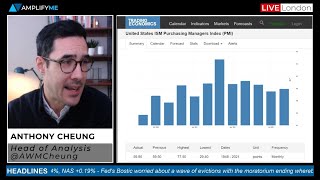
Anthony Cheung breaks down why Fed hawks won't rush to accelerate tapering despite mixed signals. ADP employment missed badly at 374k versus 600k expected, and manufacturing hiring contracted for the first time since November. Looming evictions of 750k households and rent arrears give the Fed reason to stay cautious.
Chapters
Okay, very good morning. It is Thursday the 2nd of September, so I hope you're doing well. I'm going to cover some quite interesting things actually in terms of what's in focus in markets for the moment. Nothing too much for the actual open here this morning. Just before I begin, the overall flavor for market sentiment at the European open is pretty flat. Equity index futures broadly unchanged as far as the US concerned. Not real any movement seen overnight. The DAX future perhaps a little bit more interesting, just in challenge of some near-term support as you can see here on the downside, which was the overnight APAC low yesterday afternoon low and the low from the 31st of this week as well. So worth just keeping an eye on that at the moment. FX markets, the dollar index pretty pretty much unchanged, and that's reflected in the major pairs in EURUSD and cable. Gold flat, oil down just a touch, $0.24 after some of the volatility seen yesterday amid the OPEC meeting and infantry data. And then US T-notes bottom right also toward unchanged. But the reason why I think there's a couple of interesting things to talk about is starting off with data. Um, yesterday obviously we got the things like ADP national employment, we had the ISM manufacturing PMI, but Both very important data points, not only for the overall assessment of the US economy, but of course, as we start to build out our expectations for the labor report, US nonfarm payrolls on Friday, of course. And ADP was a big miss, as you can see here, 374,000. Analysts were actually looking for this number to bounce back north of 600K. And that the July reading was somewhat of an anomaly and we had moved back up towards pretty decent and robust jobs gains over the last period in the month of August. But that didn't materialize. And that then came in combination with the latest ISM Manufacturing PMI, and that came in at 59.9, which on the actual surface seemed pretty decent. The expectation value there was at 58.6. So again, initial interpretation would be that's positive. But if you actually looked under the bonnet, importantly for payrolls at least, employment contracted. Remember, this is a diffusion index, and so sub-50 means contraction, and the number came in at 49, a fairly steep decrease from 52.9. In fact, that's the lowest in the manufacturing PMI employment component that we've had since November. So a long time ago. And so what did this mean for markets? Well, at the time, remember, the market trades this in a kind of monetary policy domino effect of what does this mean for tapering, essentially. And actually, at the time this data came out, as you can see here, probably most evident in the likes of the Nasdaq, which is particularly sensitive to the rate environment, i.e., big mega-cap tech generally liking any signs of delaying on tapering. And those that are more integrally tied to things like the economy, like the Dow, does the opposite. And what was quite interesting yesterday when these data points were coming out is the Nasdaq actually rallied at the time, particularly post-ADP at the open on Wall Street, and we actually touched all-time highs, albeit that, that then gave back those gains and we finished pretty much flat, marginally positive in Nasdaq, but outperforming the Dow. Uh, the Dow on the other hand, if I just switch over here, in fact we actually just saw selling pressure after ADP. So, um, the actual same time frame movements here, you've got the response to ADP in the Dow here, the response really to ADP coming out in the Nasdaq here. So very contrasting, um, here between the different equity sectors, i.e., the Nasdaq being proportionately technology-led the Dow carrying names that are more integral to that of overall economic performance. But beyond that point, though, the interesting thing for the Fed, of course, becomes this idea and notion about timing of a tapering. Yesterday, the dollar weakened post these data points as markets started to push back any idea of an accelerated taper program, as has been put forward by the likes of some of the Fed hawks like Bullard, Kaplan, Mester and others. And so that has led to a bit of a footing for these equity markets, albeit we did, as I said, just drift into the latter hours of Wall Street off those, those best levels. Another interesting thing I thought to talk about, and something which probably is not on your radar if you're not an economist or a more experienced market participant, is evictions and the risk that that carries in the US. And what I wanted to do is just give you a quick flavor. And really, this discussion point triggered by Fed's Bostic. Now, Bostic is a voter on the FOMC at the moment and also is of a slightly more hawkish disposition in terms of that spectrum between hawks and doves. So keeping that in mind of his general policy stance, he said he He's worried about a wave of evictions from the moratorium ending, whereby a surge would have a negative impact on the recovery. So obviously this is a little bit out of kilter from someone who typically would lean more on the hawkish side. And this definitely highlighting more downside risks to the economy, which would then result in having a more dovish spin to what he's saying. Now, what exactly is this and what is he referring to? Well, an interesting note came out of Goldman Sachs a few days ago, and it adds a bit of color. And let me give you the highlights. Essentially, landlords— this is in America— may evict roughly 750,000 US households by the end of the year as lapsing eviction bans and high demand for rental housing push property owners to remove tenants. Context. Currently, there's as many as 3.5 million households who are believed to be behind rent at the moment, with landlords owed as much as $17 billion. Remember, a lot of those jobs, things like leisure and hospitality, typically some of the lowest paid jobs in America, are the ones that have been hit most hard during the pandemic lockdown restrictions. Therefore haven't been able to pay their rent. They've fallen behind. And why this has come about is that delinquent renters have been able to remain in their homes during COVID-19, but the Supreme Court lifted a federal ban on evictions last week, and remaining state and local moratoriums are slated to expire later this year. So it's almost like these people have been given a bit of a break because of the COVID situation, but that won't last forever. And it just so happens that there's 3.5 million households who are behind on rent. And so this is again a key risk to think about, particularly if, as we have seen, the labor market recovery is being relatively slow. And so this idea of tapering, again, don't forget you've got fairly high COVID case rates at the moment, which is putting quite a lot of pressure on infrastructure in some of the more populous states in America recently, in the likes of Florida, for example. Although that's moderated a little bit more recently, COVID is still a real issue in certain hotspots in North America as well. So there's a number of things here which overall, I would say, in my view right now, would constitute the Fed taking a measured approach to tapering. Everything I've discussed are reasons for them to just coordinate policy normalization and commencement of that sequence of tightening in a very slow, very measured way. And that's why, for me, I don't buy into this accelerated format that's been put on the table by some of the hawks. So yeah, just a couple of things there to be, to be aware of. And again, rationale for why, even though we're tiptoeing into tapering, markets are not freaking out and equities still reside at around their best levels. Uh, the dollar's been a little bit weaker more recently. Again, a lot of the pressure point is going to come on to what's the quality of the labor report that we get from the Bureau of Labor Statistics on Friday, non-farm. At the moment, given the moderation we've had in the employment constituent moving into contraction in manufacturing, ADP big miss, worse in fact than the most pessimistic estimate on the street, I'd say expectations for payrolls are diminishing at this point in time. And if that is the case, well, that, that further cements that view that I've just discussed. So hopefully this all makes sense. Some other things to be aware of. Oil markets, we had a bit of a dip and recovery yesterday and really goes to show the volatility you typically see with a generally thinner market because no one really wants to step in intraday with a position of risk given the headline noise that can emerge out of an OPEC meeting. But it wasn't really anything too surprising, to be honest. OPEC+ this time, they said they would continue the policy of easing their production cuts. No additional requests were made from any of the OPEC+ states to change their quotas, which had been a bit of a headache. You remember before it was the UAE, before that it was Iraq, uh, and so on. Um, so no real complications at this point in time. The next meeting is planned for about a month from now, the 4th of October. So following that familiar routine of every month having a meeting. Separately, but related, Iranian oil minister has said that as soon as US unilateral legal sanctions are lifted, Iran is ready to increase its oil output to its highest possible level to compensate for losses caused by US sanctions. I thought that was quite interesting because I don't find it unsurprising what Iran are saying. They pretty much have stuck to that rhetoric from the beginning. Um, we've discussed before in previous briefings about it's not like Iran just turns the handle and then outcomes the, the, the new crude oil supply, because overall they've had a lack of real investment in the infrastructure. Turning the taps on like that will take a bit of time, amongst other issues as well. But don't forget, they can then bring back, say, stored oil in China, for example, if they really wanted to flood the market. So there is some credibility to the threats and the noises that they make. What I thought was quite interesting was the fact that if you remember, it's hard to remember it, but we were in several rounds of nuclear talks, the US-led, with Iran. What's happened to that? Well, as you can imagine, nothing. Um, I remember a few months ago oil was weakening. People were saying about this impending flood to the market. Iran were making similar types of noises to this. And we on the desk were saying at the time, we don't buy into that. Because the relationship that was broken down by the Trump administration, to reestablish that, I think was way underplayed by the market at the time. Hugely complicated in that region and with that particular relationship in question. And we're seeing this play out at the moment. So for now, I still see any type of nuclear accord return to that 2015 agreement as well off the table for the time being. And the predominant reason why I think that is because at the moment there's Biden dealing with a very messy exit from Afghanistan, and that has really dented his opinion ratings domestically. So further involvement into more foreign affairs-related issues, of which Iran would fit into that, that area, I think is the last thing Biden wants to do is waste time there. He still has an infrastructure bill to really see completely through Congress. He still has a looming large budget that needs to be negotiated and approved. And there's a looming debt ceiling issue as well on the agenda, all coming at a point where his, his ratings are declining. So the last thing he's going to want to do is start talking to Iran at this point in time. Iran's banging the drum, as I would do if I was Iran. Now's the time, you know, your opponent is in a fairly weaker position, holding a softer hand. I want to assert myself. And so rhetoric like this, I think, is to be expected. Overall though, connecting all these dots, I guess, with oil, um, OPEC supply I think will continue to come to market. I think Iran will talk. It won't make any difference, quite frankly. At least for now. COVID does present a little bit of a risk, particularly in areas like China, for example, as well as the US at the moment and other places. But overall, I think that areas like Western Europe and just generally that any weakness in that outlook generally would be mitigated by the ongoing improvements globally by demand. And I think that any dips into low 60s will be bought into as they were just a few weeks ago. So I still think WTI crude, there's enough to it in the kind of demand and supply dynamic to keep us at around the current levels that we're trading. We're trading 68 handle this morning. The other thing is China overnight, the latest kind of regulatory crackdown spooking markets is this: tech shares getting hit overnight in Hong Kong. They came off their highs after criticism of ride-hailing firms regulators alleged that services recruiting unapproved drivers and vehicles and highlighting the risks then from the nation's ongoing crackdown on private industries. However, the Chinese market actually traded higher despite the weakness in tech, and this is because they had their chance to react to that news that we saw yesterday's session, which was that, um, the PBOC is to supply cheap funding to banks in a dollar-related value just shy of $50 billion US dollars. To boost small-medium enterprise lending. Other measures announced included interest subsidies to firms hit by the pandemic and a bigger role for local special bonds in driving investment. So this is a bit of a softer touch approach than just outright RRR movement or more definitive action on a policy side, but nonetheless it's policy support into an economy that has been softening of late. And this is part of that reason why markets have kind of kept a degree of calm at the moment without freaking out about any, any weakening in the Chinese economy of late, and particularly there domestically as they continue to confront the ongoing COVID situation. Because of the fact that people are very much of the opinion that if things get worse, the state steps in. And as long as that is the relationship, there's not a great deal to fear on the downside, particularly then given the rhetoric they've been saying of late, given the rout that we saw in the tech sector in particular more recently. All right, to finish off in terms of the calendar for today, you've got eurozone PPI numbers coming out at 10. Not really looking for too much movement. I'm still not looking for too much movement on the back of that. Um, you've then got initial jobless claims happening at 1:30, expected at 345,000, pretty similar to the previous print of 353,000. Um, you've then got the durable goods, but these are revisions, so not too much interest there. And then US factory orders will be watched at 3 o'clock, expected at 0.3% for July month-on-month, down from 1.5% seen previously. Bostic speaks again at 6 PM. Fixed income supply coming out of Spain and France this morning with a 3, 10, 30-year note refunding announcement out of the US at 4 PM. And that is it. So hopefully that was useful. Again, this morning's open overall on the charts pretty flat. Most of the things I've discussed are more top-level macro ideas and thinking rather than implemental— implementable strategies for this morning, so to speak. But hopefully all of that made sense. If you need to see my notes, you can check them out on my Twitter. And if you're watching this on YouTube, don't forget to like and subscribe to the channel. All right guys, have a good day and I'll catch you tomorrow.
More from Anthony


Inside the Biggest Banking Stories You Need to Know This Week (Anthropic, Diageo, Private Credit)


Inside the Biggest M&A Deals You Need to Know This Week (UniCredit, GameStop, eBay, Eli Lilly)







AI Breakthrough or Hype? Anthropic’s Claude Mythos, Tim Cook Steps Down & LIV Golf Collapse