Why the Fed's change in tone is important for markets
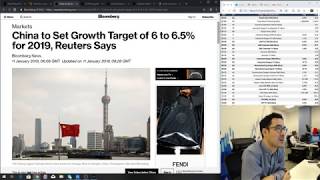
Jerome Powell and other Fed officials have signaled a more dovish stance, calming equity markets and weakening the dollar. Goldman Sachs forecasts gold at $1,425, up 10%, citing geopolitical tension and recession fears. China is targeting 6-6.5% growth in 2020 with fiscal and monetary stimulus to support it.
Chapters
Okay, very good morning. It is Friday the 11th of January. Hope you are well and welcome to the briefing for today. I'm going to talk about a few different things. One of the main topics, of course, is the Fed and this kind of new communication of sounding more dovish and the implications that's having on markets. Also going to talk about China and their new growth targets and what that could mean going forward. And then also Goldman Sachs have come out with a new pretty punchy call on gold that's going to make Will very happy, so we'll get to that last. But first of all, just having a look at the S&P 500, I was looking at my phone last night actually, just as I was on the way home, and I was kind of checking in to see I guess I'm a bit of a geek now because I've got— I've succumbed to Apple and I've got an iWatch where I can actually look at the stock market on my watch now, which is— I'm not sure if that's a good thing or a bad thing, to be honest with you. But I was looking at my watch and I saw that the major 3 indices were down about 3 or 4 tenths of 1%, and by the time I actually got home I was then looking and the stock market was up about half a percent. I was thinking, 'Wow, there's a percent swing in the market.' That's a fairly sizable move in current conditions. And the point I'm talking about here was really this was the area where the market was lower at the time. But then if you remember, one of the key things that the calendar offered us in the early part of the evening London time was a whole cluster of Fed speakers. And this really goes to show how they really are the core, really, that's driving market sentiment and price action at the moment. And obviously equity markets have been on the ascent, really. This chart I've got in front of— in front of me now, if I just tighten the shot a little bit here so you can see it, this encapsulates the, the 4th of January move, which was obviously that first Powell speech. And then the move we've had ever higher since then, despite now the government shutdown approaching a record-long period. So irrespective of that, here we are. So it just goes to show the powerful influence that the Fed has on, on markets. Now, what was exactly said? Well, just to give you the quick overview, this was the main headline. Jerome Powell said the Fed is waiting and watching with patience on interest rates. So did he really say anything new? Well, not really, but I guess it's the confirmation that, you know, that he didn't alter what the markets have now repriced in, which is this more dovish kind of view, which obviously has been a bit of a headwind as well for the dollar as the week's gone on and helped largely support those major currency pairs like cable and EUR/USD. He did say, indicated the balance sheet is likely to keep shrinking. So Obviously he wants to keep his options open. He's not saying that quantitative tightening is going to stop yet, but obviously the fact that he's willing to be flexible, building on the message that the Fed is absolutely happy to wait on the next rate hike should the incoming data warrant such action. So again, a very important thing that's happening here to stabilize what has been such a rocky period for the equity market over the last 2 months. Not only that, obviously there was a whole bunch of speakers coming out of the Fed last night, and Fed's Clarida, who's basically the Fed number 2 because it's the vice chair position, he came out and said US policy would react if crosswinds persist. This comes after another voting member, but a dove granted, Bostic, said about the idea of even rate cuts could be on the cards. So, you know, all of this is very much helping the situation of the equity movement. Not only that though, it's also helping stabilize markets in a sense that, you know, right at the heart of that big December correction in equities and also oil was based on this whole narrative of global growth slowdown. And the initiation of that, although there are external things like potential no deal with Brexit, European political issues, trade wars, right at the heart of this is undoubtedly the fact that the Fed are tightening. But now that they've stopped that, well, this is restoring some calm. And as global growth then can be managed, albeit slowed down, the aversion of a dramatic slowdown means then the oil is also bouncing. And I was just having a look at oil prices this morning, and this is not forgetting that obviously the Saudis have really taken action and, and delivered upon this OPEC+ agreement. But the price of oil now, I was just looking at the percent, we've rallied over 25%. In oil. It looks small because the sell-off that we had obviously was huge. I mean, we fell from peak all-time— well, not the all-time highs, but the high that we printed on the 2nd of October of 2018 at just short of $77 to the low, uh, down at the lower bound of $42. That was a 45% move. So, but 25% rally, that's pretty big actually, and it's creeping up, uh, still. So this kind of, uh, again, stabilization, if you like, of some of these key stories that were creating the negative spiral, if you like, are starting to dissipate slightly. The biggest one of this, obviously, that I think will start to creep up the pecking order and have a greater influence, as if it is not resolved by the second half of next week, is the government shutdown. At the moment, the market seems to be willing to accept the status quo at the moment, but as we move into record territory for a length of a government shutdown, which will be next week if it continues, I think then it starts to become more and more problematic. We were talking about this yesterday. That not just the delay from a trader's point of view of economic data, but there's a whole other host of regulatory side of things that can be delayed and have an adverse economic reaction. And that's not even talking about the consumers and these people who are not even getting paid and the knock-on effects that can have on the economy in itself. One thing here, and I was just thinking, um, and I've been criticized in the office quite a lot recently for commentary of Trump's strategy is being misconstrued as a secret love for Trump. That's definitely not the case, I can assure you that. But the point here is that I was thinking, well, Trump— Trump's tried to criticize Powell. That hasn't worked. How about you prolong a government shutdown that at the moment the markets are willing to look beyond, and you start pushing people like Powell, who explicitly said yesterday that the government shutdown poses a risk that he is monitoring? So could you force the hand of the Fed to become more dovish and not hike rates anymore by standing pat and not negotiating with the Democrats and keeping the government shut. He's almost achieved that. And yes, there's other things that are going on, of course, but Powell has now— and the Fed has completely changed course from where we were just a couple of weeks ago. So has Trump done it again? And has he used the, the kind of situation of the shutdown to force the Fed Fed covertly rather than explicitly, which he had attempted to do before. Because with that being said, I would think that it would be unsurprising to see this government shutdown issue resolved sometime next week before the market starts to see it as a real credible threat. At that point, Trump's done his job. He's appeased his main core base. By standing firm on immigration and the border wall, and he's forced the Fed to change direction. I don't want to get too— read into it too much, but, you know, that's how I kind of see the way that Trump's playing this at the moment. And if he has, well, again, he's managed to get away with it. Oil's recovering, uh, and equity markets are also recovering at this point. The other thing, of course, that this does the net domino effect of if you were to, uh, I mean, this was the, the oil chart that I was looking at here. This was that big move lower, the 45% sell-off, the 25% or so recovery that we've had. But if the Fed turned dovish, obviously that does mean as well a weaker dollar. So that sees the Chinese renminbi appreciate, which takes that away from critical areas of weakness at that 7 level, which has been protected so far during the China rout of 2018. And the other thing I think that's a positive as well, we were mentioning this yesterday, but you had a source report come out on Reuters overnight, and this comes ahead of more official confirmation that we're going to get in March when they have a high-level Congress meeting, uh, but it is believed that in the powers that be at top level in China that they're going to set their growth target of 6 to 6.5%. Uh, their current growth target of course is at the upper bound of that. It's an explicit 6.5%. So they are tipping their hat towards the fact that yes, they are going to go through a period of a slowdown But I actually think that this is a positive, even though, yes, China is slowing. Actually, the omission of the fact that it is indeed slowing means that they're only going to put a halt to any of this deleveraging process, and they're going to ramp up their growth-related policies and stimulus. And the fact that now, uh, their currency is appreciating because of dollar weakness and inflation, CPI and PPI, is weakening in China, well, that means all the more monetary policy maneuver they've got to the downside, and also fiscally to support the economy. Meaning then, if you think about it, what caused the November-December collapse, which was Fed tightening, which was trade wars, which was China concerns, well, looking at all these variables, The Fed have become dovish. Trade wars is making some progress, albeit yet to be resolved. And China is seeing some stabilization and providing quite severe firepower to monetary and fiscal stimulus. The only other big thing here is— well, two that we need to keep an eye on before we start, you know, kind of breaking into chorus that more positive days are ahead— is obviously Brexit. We've not yet officially averted this no deal, and obviously lots of complications to come, I'm sure, in coming weeks of the vote next Tuesday. But then also Europe— still issues in Italy, of course, unresolved, and France remains fairly precarious politically. So definitely risks out there, but I think already second week or so of January, we are in quite a different place to where we were just a few weeks ago. You know, when the markets were under real kind of growing negative sentiment. Yeah, this was the, the oil. Oil is actually the winning streak that it's on at the moment, uh, is the longest since 2010. In fact, WTI closes higher for a 9th straight day as the Fed vows patience. One thing that you'll see, and this is why Amplify, you know, we put such great focus on the, the kind of global macro narrative and, and the importance of monetary policy if you read any article this morning, every asset class is looking at the Fed decisions because it's the Fed then that will carry course of what the future direction of, of markets could be. And obviously things like the dollar, when it comes to commodities, this is very key. With that being said, well, this is what Goldman Sachs believe. Goldman Sachs have put out a new 12-month price forecast for gold, and they anticipate that gold in 12 months will be trading at $1,425. Just to look at that on a chart, here's a— let me flip over. This is the gold future. This is the last 3 years of price activity, and up here is where Goldman Sachs think we will be in 12 months. That's a 10% appreciation from where we are on current price. So if we just stretch it up here, just short of 10% from where we are now. Reasoning for that, because there's plenty of other big players in the market that are thinking that gold certainly is going to see some upside, um, the yellow metal benefiting of rising geopolitical tensions fueling central bank purchases. Fears of a recession have helped boost demand from investors seeking defensive assets. And then obviously the Fed mounting speculation they're going to pause, which has weakened the dollar, and so on and so forth. So yeah, there's still potentially, you know, a lot of gold bulls out there, and $1,300 remains the near-term significant uh, kind of make or break for the near term. That $1,300 level has proven a fairly strong level of resistance so far. Uh, one would think though a breach of that would well open up another decent and quick run to the upside. Okay, um, looking at the calendar because I don't want to spend too much time. Well, before I do that, I just wanted to have a quick look at cable, uh, in fact, because we did have some comments out of, uh, Jeremy Hunt, UK Foreign Secretary. Um, he came out this morning with some quite unusual comments, actually, I thought. Um, he was talking— let me just quickly find them. Uh, he was basically mentioning that there is another possibility coming into sight— no Brexit. He said there could be Brexit paralysis leading to no Brexit. Alternative forms of Brexit may not be as plentiful as many think. So I can kind of see what he's trying to do here. He's kind of trying to kind of force the issue that, look, you— we voted as a public for a Brexit, there's a possibility that the Democratic vote might not be delivered. So look, let's, let's get back on track. The problem is here he's talking about no Brexit, and when you start putting seeds in people's mind, certainly someone so close to Theresa May in the cabinet, I think that's pretty surprising. And I'm not sure he would have got the sign-off from May to be using the word no Brexit. So I'd be interested to see if we do get any other kind of journalist tweets on the issue where May kind of in the indirect, indirect communication method of using a source tries to realign the balance a little bit. We did see a brief break of that trend line in play throughout the, this week really in cable. Overall, cable has really lacked any real firm concrete direction just given the fact that as we've kind of said through the week, you know, people are looking for much more to come, come Tuesday. One thing to say, obviously it's Friday, over the weekend you're going to get a lot of press attention towards what the potential outcome could be on Tuesday. You're probably going to get a pretty big tip-off of what the outcome will be. And remember, at the moment at least, the base case scenario is Theresa May's current plan fails in the vote. So what are the potential alternatives thereafter is going to be key, and that's what we could get some suggestions of in the weekend's press. All right, quick look at the calendar then, then we'll wrap things up. So let me just flip my screen. What have we got? Well, this morning you do get some UK numbers. GDP coming out, um, that will be at 9:30 alongside industrial manufacturing output. So, you know, very short-term, maybe just worth just keeping an eye on, but ultimately there's a much bigger story going on here, that being the one of Brexit. Um, so a whole cluster of data here for, for the UK at 9:30. Yeah, I would still though not be in a position of risk over the release and look to if there is any potential trade to get in there after. In the afternoon, you do have some US data that could be as well quite interesting. That's been the CPI print, so that'll be at 1:30. And then that pretty much wraps things up really. Um, you do have some Italian auctions coming out, which I don't think Italy, despite its political tensions, has any real issue in selling its debt, but it might capture a few headlines. So just so you're aware of that, that'll be happening in about an hour or so time. Okay, so that is it. Finally finishing on some sad news you might have read this morning. Andy Murray, the Wimbledon champion of 2 times and US Open champion, double Olympic gold, double Olympic gold medalist, world— previous world number 1, uh, has unfortunately said because of injury, uh, he's gonna retire. So he's playing in Australia next week. It could be that's his last tournament, and he's aiming to finish his career at Wimbledon. What a Wimbledon that will be if he does make it to that point. So just wanted to say, Andy Murray, I know you're a big fan of the Morning Briefing. We're a big fan of your work. You know, you've given us so many highlights and memories over the years. I was there when you won Wimbledon in 2013. I was very fortunate to be there. So a little bit of man love going out to Andy. We're thinking of you. And let's stay strong and let's get to Wimbledon. Let's finish on a high. On that note, have a good weekend.
More from Anthony


Inside the Biggest Banking Stories You Need to Know This Week (Anthropic, Diageo, Private Credit)


Inside the Biggest M&A Deals You Need to Know This Week (UniCredit, GameStop, eBay, Eli Lilly)







AI Breakthrough or Hype? Anthropic’s Claude Mythos, Tim Cook Steps Down & LIV Golf Collapse