YouTube Live Q&A - 21st August 2019
In this live YouTube session hosted by Anthony Cheung, head of market analysis at Amplify, with senior trader Sam North and support from Eddie Donmez, the presenters provided a macro market briefing and answered audience questions. The session began with a quick sound check and a brief overview of current market conditions, noting modest equity recovery, oil volatility, and the impact of recent oil inventory data. The discussion then moved to several key topics: the unprecedented prevalence of negative-yielding sovereign debt and the flattening/inversion of the 2‑year/10‑year yield curve, its historical recession‑predictive significance, and the massive growth of negative‑yield debt (from $8 trillion to $16.5 trillion). They examined the implications for bond markets, equity flows, and safe‑haven assets such as gold, outlining fundamental drivers (trade‑war risk, Brexit uncertainty, low inflation) and technical price levels. The presenters analyzed Brexit developments, including Boris Johnson’s negotiations with Merkel and Macron, and technical levels for GBP/USD, emphasizing the risk of a no‑deal outcome and its impact on the pound. They also reviewed the Italian 10‑year BTP versus German Bund spread, showing how political events (e.g., Italian coalition changes) widen the spread and signal market stress. A preview of the upcoming FOMC minutes was provided, highlighting the Fed’s “mid‑cycle adjustment” language, the possibility of further rate cuts, and the importance of the minutes versus Jerome Powell’s upcoming Jackson Hole speech. Throughout, the hosts emphasized the value of a real‑time “squawk box” for news monitoring, risk‑management practices, and disciplined trade execution. Audience Q&A covered practical trader concerns: where to view spread charts, gold price targets, risk‑reward ratios for retail traders, handling sudden news breakouts, and daily routine preparation. The session concluded with reminders about Amplify’s training resources and a final invitation for questions.
Chapters
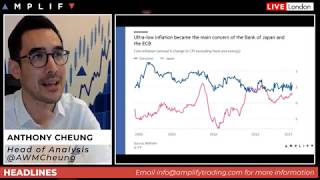
Okay, testing out the mic. Hello everyone, I'm just doing a quick sound check before we commence our session at 6 PM London time, so about 5 minutes. So just, yeah, sound check. Let me know in the chat whether you can see and hear everything okay. Vitaly, hello, thank you for joining us. Andrew Drew, I hope you're well, always a pleasure. Everyone else, can you hear and see everything okay? Session's going to begin in about 5 minutes from now. Okay, just while we're waiting for everyone else to join us and we're going to kick off the session, just having a quick look at the charts to make use of the time. So just having a look at things at the moment, relatively quiet, obviously a bit of movement in oil. That we've had pick up in volatility since we've had the, the oil inventory data from earlier. Otherwise, equity markets positive after the down day that was yesterday, so a bit of an added recovery. We're gonna have plenty of time for you guys to ask questions, and so at that point, um, we go into that more detail. Sam, of course, the chap you can see if I transition my screens for a second. Sam is one of our senior traders. He's going to be joining us, of course. You probably recognize him from the briefings that we do together in the morning. He can review all the charts from that perspective. I was just crossing my eye over the headlines that have come out, and obviously Boris Johnson, the UK leader, has been meeting with Angela Merkel earlier today. Merkel said she would welcome a negotiated Brexit deal but is ready for all outcomes. European offer stands to negotiate a deal after Brexit, as their goal is to continue having tight relations with Britain post-Brexit. Johnson reiterates the UK wants a deal with the EU and believes the UK can get a deal but cannot accept the current withdrawal agreement. We do need the backstop removed. If it is removed, we can move forward. So all in all, just looking at those two comments there, and they're the last two that came out within the last half an hour. Basically, there's not a great deal of movement. Merkel: as soon as there is a solution to the Irish border, then there will not be a need for the backstop. So Merkel pretty friendly actually to Boris overall, and you would probably anticipate that to be the case just given the fact that the Germans under such economic pressure at the moment. I think it's quite understandable that, that Merkel is warming to the idea of doing whatever is possible to try and secure a deal to eliminate the amount of disruption potentially on the German economy. Tomorrow, of course, Boris heads to France meeting Macron. So he's a bit more of a tricky character to handle given how harsh he's been so far about not making a special case for Britain, given that he's kind of the linchpin of European ideology. So Yeah, definitely going to be, be interesting to see how that shapes up tomorrow. And of course, this comes ahead of the G7 in Biarritz, uh, starting on Friday and over the weekend. But all right, we've got another couple of minutes, about 2 minutes, and then we will formally begin the session. Um, so just having a quick shout out to a couple of people. Um, so Dipu, hi. Augustinus, Robert, Jim, thank you very much for following us. For people in the— people who are joining us, just so you're aware, Eddie is actually— works here at Amplify. So Eddie Donmez, you can see there on the right-hand side, he's more than happy to help answer your questions. If at the beginning of the chat, Sam— so while I'm on the mic, Sam is in the chat, so any questions If you guys are familiar with Sam, feel free to, to drop them in the chat room now and he can type and pick them up. And then him and I are going to swap roles. Well, we're going to interchange. I'm going to explain everything we're going to cover as soon as we begin at 6 o'clock. I've got an agenda. There's a couple of slides that I'm going to run you through. Then we're going to take your questions live. And then we're going to cover, of course, the FOMC minutes, which are coming out in about 1 hour's time. So we'll kick off in about 1 minute. I'll come back on and begin then. 6 o'clock. Thank you very much for joining us, everyone. I hope you are well. Thank you for giving up a bit of your evening, Wednesday night. Hopefully we can add some value about a couple of different topics we're going to discuss, and then the main reason, as you can see from the title of this session, is a question and answer, so absolutely willing to, to go a little bit on the fly for me and Sam to talk about anything you want to talk about. I'll introduce our backgrounds, which will give you a bit of context to what we're going to be able to answer. So we'll start with that, and then I'll run through an agenda of what it is we're going to cover. So to start things off, who are me and Sam? And I'll give you a very short overview of who Amplify is, and then we'll go into Amplify at the end of the session. But who am I? Firstly, I'm the chap on the, on the right-hand side. So my name is Anthony Cheung. I started my career back in 2006 working as a junior market analyst at a company called Realtime News and Analysis, otherwise known as Ranswalk. I worked there there from 2006 all the way up to— I'm just trying to think when I left— 2015. So the best part of about 10 years. I actually ended leaving that, that firm as the global head of market analysis. The job I did there was to basically run a real-time squawk box where we covered multi-asset commenting in real time over news-driven events, news, rumors, flow, that type of thing. I did that for 10 years, my specialism then being in global macro analysis in short-term intraday markets. And now I joined Amplify in 2015 where I head up our trading division. I'm quite heavily involved in now teaching a lot of my experience from my previous career into now people who are learning to trade, and also those who are traders but looking to refine their expertise in fundamental kind of analysis. I'm going to be joined tonight by Sam North. It's the other chap you can see in the photo. He's going to be on the mic sharing it with me. Sam actually came through the back door, if you like, into proprietary trading because he undertook our futures trading course about 5 years ago, I think it is. He then successfully completed that, traded for us for a period of time, then went to trade in a different firm, more systematic trading, but then came back to join us the last couple of years. And he, he now trades for us but then also helps mentor and risk manage a number of the live traders. Sam, much more a, let's say, a technician in terms of technical analysis, is his kind of skill and forte. Mine, very much down the fundamental analysis route. So hopefully between the two of us, we can, we can get a decent amount covered with you guys. The agenda for tonight, what are we going to cover? So a couple of different things. So this is just a welcome introduction, you know, thank you to joining us, who we are. So we've pretty much wrapped that up. What we're going to do then going forward is I did put a few questions on our YouTube channel and on our Instagram account a few days ago asking ahead of this event what it is that you'd like us to cover. And undoubtedly the, the kind of resounding response was more in information about negative yields and the obsession at the moment that people have with the, the inversion of the yield curve. So I've got about a 15-minute window. I've got a sequence of slides I'm going to run you through, and I'm going to talk and explain that in a bit more detail. Then aiming for between 20 past, 45 past, going to take some questions from you guys. So we've got the live chat up at the moment. Absolutely happy to answer anything and everything that you've got for us. Then at 6:45, I'm going to do about a 10-minute preview of what we're anticipating and looking for in the FOMC minutes. So it'll be a good chance, an opportunity for you guys to see how we would prepare from a fundamental perspective, but then also from a trade execution and risk management perspective from Sam about how he would tackle that type of release. We'll then look at that in real time I'll play it through the Squawk live and then we can see and analyze that as it happens. And then following that, we're going to take some final questions and I'll talk a little bit more about Amplify and what we do and so on. So that's what's on the agenda. So any questions? Sam is there in the chat manning it at the moment. Eddie's there as well. I'm just going to crack on and get the first session underway, which is a bit of a look about this current topic in vogue in the last week or so, which is the yield curve. And why is that such a hot topic? So that's what we're going to get into. Before I do, uh, one thing I wanted to mention now, and I'll mention again at the end, is Sam's going to put a link into the chat room now. And what that link is, is to this page I'm showing on my screen. So here you've got basically a description where you need to put in your name, your personal details, and hit subscribe. What this will allow you is Sam shot a short video about 10-15 minutes long last week of his preparation of the process he goes through every morning before he trades. So you've got that video we want to share with you It's kind of exclusive content in that respect. If you put in your details, we'll send that to you, as well as also a unique discount code if you were to undertake any of our training programs in future. So the link's there, it's in the chat room, and all you need to do is just input your details and you'll have access to that. Okay, let's, let's move on. Let's have a look at the inversion of the yield curve. Few things then I want to run through. And so this is going to be the only part where I'm lecturing almost to you. The rest is going to be more interactive between you and us. So here are a couple of things to think about. Now, we are in a very unprecedented era when it comes to financial markets. Why? Because the aftermath of the financial crisis has led to only a very small period of what would be more formally known as normalization of these unconventional emergency policies that were deployed in the wake of the financial crisis. What this means then is going back, say, 10 years to the subprime crisis or to the dot-com crisis that we had before that, interest rates were way higher, meaning that what happened was then you you had this mechanism to stimulate an economy by moving purely interest rates. The problem that you've got now is that interest rates continue to remain low, and if anything, in these countries, as we can see, you've got negative interest rates. So Japan, uh, if we look at central bank policy percentage, um, Eurozone, the deposit rate of course is at -0.4. You've got Denmark, Switzerland, Sweden. I mean, negative 1, it's been negative 1.2%. I think I read the other week, Sam, correct me if I'm wrong, but in Denmark I think you can get a mortgage, right, where actually it's a, it's a negative interest rate on your mortgage. So, you know, I'd love to swap mine for that if that was the case. Um, the point being then is it leads us on to this idea of, well, why are interest rates So low. And one of the things here is that ultra-low inflation has become quite a key concern. One of the biggest original fears about something like quantitative easing, which is kind of adding to the money supply, is that it could have stoked then inflation. But that didn't really materialize. And if anything, inflation has been incredibly benign in the recovery of the financial crisis. Irrespective of these measures to try and stimulate an economy, what's happened is, is that inflation really hasn't budged at all. And so in order to stoke inflation, then the monetary response would be you want to try and re-stimulate the economy, increase demand so that the cost of goods rises and inflation moves back to what is hypothetically a Western central banking target of 2%. But as you can see here, we're looking at the core inflation annual percentage change in CPI. So the core, that Xs out things like food and energy, and the eurozone really has gone nowhere over the last few years. And in Japan, you know, we've almost got into deflationary territory, which we did, um, in the initial post-financial crisis era, but we flirted with that again in the recent few years. And it's really been such a, a non-event, if you like. It hasn't really recovered, hence the reason why Japanese policy really is going nowhere anytime soon in that respect. Now, what this is leading to then is the share of world GDP as market prices percentage. Now, the blue line is the percentage, if you like, central banks countries covering almost a quarter of the global economy now have negative rates, um, by default. And that then by consequence means that negative 10-year government bond yields now, um, covers approximately 20% of the entire global economy. Now, what does this look like? Well, this is a look at the, uh, Bloomberg Barclays Global Aggregate negative yielding debt by market value. So if you were to look at the nominal value of the amount of debt that's now, uh, negative yielding, the shocking thing that's happened here is if you look at the access at the bottom, this has exploded since the beginning of the year. It's in fact doubled. It's gone from roughly $8 trillion to to now north of $16.5 trillion. So there's a phenomenal amount of negative yielding debt that's accumulating at the moment. And so again, let me just explain here. Let me— if I transition my screen to this, so hopefully you can see. I'm going to write out— I'm going to draw something here for you. So this is, let's say this is 2 years and this is, this is 10 years. So what would happen— this is the percent of the yield going from low to high. Now, a normal yield curve, of course, in terms of your kind of normal economics lesson, would normally take a shape like this, i.e., the longer the time that you wanted to hold a bond, well then the higher yield you need to be paid or needs to be paid out. Meaning that the further you go in the future, the more it has to account for then the uncertainties that the future might hold in that respect. So the yield is going to have to be higher. So in this case, let's say 5% comparative to much lower in the short end at 2%, for example. Now, what has been happening is this. If we look at the global economy at the moment and how things are performing— so let me just move over my slide. This is the JP Morgan Global Manufacturing PMI. So of course, the PMI data is some of the most important that we get out of all the economic data. PMI data is Purchasers' Managers Index. It allows us as a soft indicator to see about the perception about the future, how the purchaser managers think or feel in the manufacturing, the service sector. And then by looking at the manufacturing here, you can see that we are dipping at the moment to the weakest reading we've had since October of 2012. So people's perception about the future is that the global economy, at least on this measure of manufacturing globally, is weakening to its, its lowest point in several years. The way the PMI works is that any number below 50 would be indicative of a contraction, above an expansion. So at the moment, this area is contracting, and hence the reason why global economic risks are manifesting because people are getting more unsure about the future. Now what tends to happen then is this— if I flick back over to this— as people get more unsure about the future, then they start to buy government bonds in protection of the fact that actually that would be a safer investment over the long term. And so they rotate cap or cash out of something like equities, for example. And if you look at the, the COT reports from the CFTC, the futures positioning is— although we're trading higher in equities, there's an accumulation of short positioning. So the fact that equities are up at highs is a lot of it is a byproduct of the fact that it's shorts getting squeezed that's creating these meaningful new all-time highs. Ultimately people are positioning, or the highs are getting less supported by genuine longs, if that makes sense. So people start to move their cash, they start to move out of things like equities and moving to things like gold. We've seen gold at a multi-year high very recently, and we've also seen then bonds going bid. As bonds go bid, the price of the bond increases. There's an inverse relationship with the yield. So now we start to see the long end of the curve, the 10-year, starts to move lower, and this then starts to create— the curve starts to flatten in this sense. So here you've got the movement in the long end where yields are decreasing because in the future people are thinking that the economic environment will mean that rates interest rates will be lower tomorrow in the future than they are today. So the curve starts to flatten to the point where the curve in fact starts to invert. Now this inversion, which would be the 10-year is now trading lower than the 2-year, means that people start to think that actually potentially there is a recession coming in the near term. Now flicking back my charts to look at a few other graphics here, this is what's been happening over the last week or so. So basically taking that idea about that inversion of the yield curve, this is looking at that basis point spread. So again, going back to here to make sense of this, if you measured the distance between the 2s and the 10s, this distance is the spread. So here, if we go back, the spread— if we went back to 2013, this spread was 250 basis points. So this spread here, 250. So if we go back, that was a nice normal looking curve. Now though, given that The trade war, the no-deal Brexit, the populism in Europe, the threat of a global slowdown overall has meant that the long end is decreasing, causing this curve inversion which we're happening here. The spread has gone to effectively zero, if not now negative. Now, this hasn't just happened in the UK, this has happened in the US, it's happening globally. Now, the reason why people start to get apprehensive about this type of signal is that this is looking at a graphic of going back to 1980 on the left-hand side. Now what we're looking at here are the 2s-10s spread. That's the one, or the part of the curve, that has the most influence, or at least that market participants will look at most closely. And as you can see here, the— this is zero, so this would be negative on i.e., inversion. This would be more in normal situations where the spread is wider. So here the red areas are where we've had recessions. So the dot-com bust, or dot-com bubble being burst here, the global financial crisis here. Inversion happened just before then the recession. Inversion happened, recession. If we go back to the late '80s inversion, recession, and so on, repeat. So the reason why people get so caught up in this idea of an inversion is that history tells us when that happens, there is normally an 18 to 22 month period on average of when then we move into that, that technical recession— two back-to-back or longer periods of negative growth. Now the The signs are then, or what can happen, is a behavioral trade. Do then people start to trade this as a self-fulfilling prophecy, irrespective of the fact of what underlying this move? Now, this is where it starts to get quite interesting. This was the global financial crisis. So this again is zooming in on that chart. This is looking at the 2s-10s spread, and you can see the financial crisis— we didn't actually move into a recession until well into 2007, but the curve actually inverted right at the beginning of 2005. So it's not as if a curve inversion means an immediate recession. It takes some time for that to play out. And in fact, the thing that I think makes this time very different is that in the last two significant recessions we've had globally, one was sparked as a catalyst by then, or accelerated by an unforeseen circumstance like the blowup of the subprime crisis, the other one by the dot-com bubble. So at the moment, yes, there's a trade war that could carry significant tail risk of the same magnitude, but I do see this time is very different. The other thing as well is the fact that the yield curve, according according to some people, is becoming less and less a credible, accurate indicator like it has done before. Why? Because 2019 is a completely different monetary era where we've had a humongous amount of quantitative easing, an unconventional tool that has never been used in these prior occasions. And so by default, QE means buying bonds, which has suppressed yields and means that the yield curve is artificially influenced by these unconventional tools where it wasn't before. So the fact then that yields were already suppressed and now we're having an economic downturn on the horizon, it's of no surprise, I feel, of an inversion to happen. Just my opinion. So again, do I— do we think that this is just a slam dunk, that this is the case? Absolutely not. I don't think that is the case, but it needs to be monitored. The final thing I'm going to say before we move on, because this is our only fixed part of the, the session, this is a look at the Italian 10-year bond yield. And what we're looking at here is the spread between the Italian and the benchmark German spread. So the one way to look at this, if we go back to the chart, if I was mapping out, let's say, German 10-year yields, you know, they go through their ups and downs given the economic and political situation. But then, then you've got Italy. And if I use this orange pen, Italy is seeing big spikes, comes back, and then we have another spike like this. Sure, if you can quite make that orange pen out. Hopefully you can. Now the point being here is that what we're measuring is the difference between, at any point in time, the difference between where we're trading in the German to the Italian. So here it's tighter and here it's much larger. This is the, what's called the, the spread. So this would be the BTP Italian bond and against the Bund, the German 10-year spread. The wider the spread, the more the Italian yield is moving higher away from the benchmark German yield. The wider the spread, the more negative that translates into the way markets trade. Yeah, spread widening would be indicative of the fact that people are getting nervous, are panicking. So if Italy wants to come to market, it now needs to start paying out a yield of high proportion levels— 5, 6, 7%. That means it's going to cost the government more to fund itself by paying a higher coupon for those who would hold those bonds. Here, the interesting thing you can see is, you know, when the first political crisis sparked a bond rout, you can see yields exploded higher. They fluctuated. We've had Salvini pull the plug on the existing coalition, and that's what's created that that last little blip higher here on the far right-hand side. So this is another way of which, yes, you can trade Italian bonds, BTP futures. Yes, you can have a read across into trading Bund, German Bund futures. But importantly, even if you are a Euro trader or a European equity trader, if you're trading the FTSE MIB or the Euro Stoxx, for example, then understand understanding these spreads is very beneficial for you to get an insight as to market sentiment to these very important topics. Okay, so that I feel is enough of me talking for the moment. We are now open for questions. So what I'm going to do is I'm going to transition my screens. Sam is going to wheel himself over.
Hi guys.
So again, just to be clear so everyone knows who Sam and I are, I am head of market analysis. My forte is global macro intraday kind of dynamics from a fundamental perspective. Sam is very much more technical analysis and he trades full-time. So he's a trader, I'm the analyst in that type of relationship. So just to set the tone. So any questions you have for us, fire away. We are happy to take those now for the next 20, 25 minutes. So Joel, Glenn, go for it. What have you got for us?
Keep it clean.
Keep it clean. These are a couple, I've got a few sheets here. Here of a few questions that you guys left us on, on YouTube. Okay, so I'll kick it off. Ali's asking, is there anywhere to see these spreads live on a chart? If you have— so we use a platform called CQG integrated client. It's otherwise known as IC. So if I quickly just change over my— well, actually, you're able to put up the BTP over the Bund on a double chart, and I can see. So depending on your platform, the more sophisticated ones, the more expensive ones, you can monitor these things. If you have a Bloomberg terminal, very easy to monitor these types of things. But as you've probably encountered Bloomberg terminal is very expensive, but what I'll do is I'll show you like something I can look at here which pretty much says the same thing. If we transition my screens, so here you can see, so I've got— this is the, the BTP. So I'll get Sam to run the mouse over so I can talk you through the BTP. You can see— well, he's going to mark it up. You can overlay it over one of the other charts. So basically, I can see the price performance of one asset over another, which can be quite useful. You can see at the moment there's a bit of— there's been fluctuations where the tightness of the correlation, they've moved. You can see during the period of even the last— this is looking at the last days, it's been quite close. So that's when there's spread tightening. You remember yesterday when we had the news that Conte, the Prime Minister of Italy, had resigned. Actually, that's put off the probability of a snap election. That's a positive. So what we've had is BTP prices have fallen and brought it closer to the German Bund. Then you've had new episodes of uncertainty and the spread re-widens and so on. So yeah, it's not the most accessible thing, I would say, though, if you were looking at it from a retail trading point of view. We're going to talk about the FOMC minutes shortly, so I'll answer that later. Where do we see gold in the next 12 months? Well, Sam, I'll bring you in on this. Let's get gold up, let's have a look on a long-term chart, and let's have a talk about gold. So if you mark it up with of what you feel are a couple key levels, Sam, and I can talk through the fundamentals while you do that. So with gold, obviously it's broken a very significant technical range actually more recently, and these renewed concerns about a new economic downturn, the inversion of the yield curve, the threats through things like the global trade war through US protectionism, the fallout and lack of a disagreement between the US and China and the escalation of tariffs have all been positive catalysts certainly to lift fundamentally the price of gold. People rotating into these, these safe haven assets. So from my point of view, what are the risks? Well, the key risks if I was trading more medium-long term for gold would be what is the outcome of the trade war, what are the near-term horizon risks to that, Do you believe that Trump needs to manage this process accordingly, that he does strike a deal so that he supports the stock market in the run-up to 2020 elections? The other risks are, do we have a no deal? Does Boris actually deliver a disorderly, non-transitional, worst-case scenario Brexit? That's a positive for gold. So there's a big risk event looming in only a couple of months. Then you've got this economic slowdown happening in the eurozone. Then you've got geopolitical tensions in the Persian Gulf. These are all reasons to support gold. So this recent rally we've had, I absolutely think it's a valid move from a fundamental perspective. In 12 months, I guess all of those subjects is about working through the timeline and the milestones of any of those deadlines, and what do you think the outcomes are, to ascertain then how far do you think this gold bid can go. Certainly looking at this chart, I mean, gold was trading north of $1,900. So can we go higher? Sure we can, under the right circumstances. But Sam, what do you reckon from a technical point of view?
Yeah, well, Technically, you can see just where we're trading now, just above where the camera is, this area that I'll just— I'll shade it in to leave it on— is massive. And you can see the first real test of that. And this is the weekly chart in the future, so price might look a slight bit different when you're looking on that lower time frame. But just the whole key point of the high of the year is going to be going back to lows here from 2011 and '12. That we broke through back in 2013. So that's massive. Above there, then you've almost got a bit of free room to go to the next key level, and then people will be talking about 1600. And then it's, you know, just like a, like a magnet above that, and it will get drawn towards it. It's a really, really key point. Can we go this year? I don't know. It'd be interesting to see what happens with the, with the Fed. And how weak the dollar could become if they were to cut more than expected. And that would be, you know, perhaps another reason we could get there this year. But technically, I think 1600 is something possible if we can get through— if we make a new high for the year and close above there, then I think we push to 1600.
Yeah, I mean, one of the guys just asking of what, you know, what would it take to get to 1900? Like, just to be clear, I think to get to 1900 you do need a lot of these topics we've just discussed to play out in the worst possible case. Now what we do and what we train all of our traders to do is not just have one base case scenario that they're looking to trade. They should have multiple scenarios. They should have alternate planning. Now then, it's just about assigning a, a kind of hierarchy to what you think is going to be the most highest probability of an event unfolding. To get to 1900, given we're a long way from that, you would basically need to get to the point of full-on confrontation between US to China, to the threat of not just stopping but maybe potentially doing something with the Treasury market and their debt holdings of the US, as complicated as that can get. You would need to have a continuation and a more significant recession across the eurozone. You would need to see Salvini become the leader of Italy and for that to reignite new populism and nationalism across Europe. Macron would need to be then under pressure new protests to happen in France, but again, higher level, more escalation. You would need the Chinese military to enter full-handedly into Hong Kong to address those protests that have been happening. You would need the Fed to restart QE, cut rates to zero, possibly negative. That's what you would need for 1900 to happen. and as unlikely as that sounds, it could happen. But as a trader, you've got to think in the law of probabilities. The likelihood of that happening— we've not even mentioned military intervention of allied Western forces into Iran— the probability of all of those things happening is very low. Like Bruno's saying, you need some sort of almost Armageddon-ish scenario to get us up that high in that kind of time frame. Could it happen? Sure, it could happen. Is it going to happen? Highly unlikely to happen. So just to kind of make that, that crystal clear. Um, okay, let's, uh, have a look at a few other questions. What have we got? Hey guys, what's your opinion regarding the 31st of October and no-deal Brexit? Are we heading towards a recession? How bad would it be for both sides? Um, okay, uh, what do we think about October 31st? Well, do you want to bring up the sterling chart, Sam, and then we'll have a, we'll have a look at the pound. From a fundamental perspective, definitely Boris is pursuing this tactic, whether bluffing or not, of really putting on the table a credible threat of having and executing a a disorderly no-deal Brexit. Now, the question mark there gets quite complicated because then it comes down to, can UK Parliament block what it is that Boris is trying to do? Now, we know from the recent loss in a Welsh by-election that the majority for the Conservative ruling government at the moment is incredibly slim. In fact, it's only one. So hence the strategy why Boris is probably lining up a general election because he wants to create a larger majority for him to negotiate better with, with Brussels. Now, a couple things to be aware of here then is making sense of why Boris has been so vocal to talk about more police on the streets, more money for the NHS, more spending for infrastructure, and everything in between. There isn't really much detail about how on where this money and the timeline is gonna be implemented, but that's not the point. This is what happens generally before a general election. Politicians will start promising through their new wishes of what they want in order to increase popularity. And we had a, I saw a poll Westminster earlier today. Conservatives under Boris have had a real bump in popularity. Why? Because Boris is saying he's gonna deliver what people want and really talking about it in a way that resonates with people, which is people are exhausted and tired of talking about Brexit. I think we all share that mentality. So yeah, will there be a general election? I absolutely think there will be a general election. The key is the timing, and the risks are then, does Boris come out more on top do people buy into this narrative and communication that he's been delivering, or do we get a combination of Remain-allied parties such as the Liberal Democrats, the Greens, the Welsh Party, the SNP, and whoever— if they all came together and you had the now very much sectioned-off pro-Remain Conservatives conservatives who formed the previous cabinet under May, technically speaking, they could themselves take control. The one problem is there is Jeremy Corbyn. You'd have to remove Jeremy Corbyn, and how that would happen, I see that as highly unlikely. So this is the, this is the problem. Boris could actually come out with a strategy where he delivers a messy Brexit, we actually leave the EU, and and then the day after, literally the 1st of November, he calls a general election. You can imagine he would be, I feel, in quite a powerful position because then he can say, Parliament blocked me, Parliament tried to block me, look at what they're trying to do. I want to deliver you Brexit, and I delivered Brexit. Now vote for me and let me get the job done and secure a deal. And in Europe, we'll also be pressured by the fact that economically they will suffer just as much as we will suffer in a messy Brexit situation. So let's look at the chart. Let's, let's let— I'll let Sam talk over the chart and what he thinks really, and the different outcomes and how it might move.
Yeah, well, you can see the, the EU referendum, it seems so far away from where we're trading now and so long ago. And then we made that, of course, the 35-year low, January 2017, and 1.20 pretty much to the tick. I've got it marked up there. I think we get a test of that. I think the no deal— you see every sort of couple hours Boris Johnson's tweeting saying we're leaving on the 31st of October, and he's got to, you know, got to go through with that, I feel, which means I do think we will we push low. I think we get another test of, uh, the low of the year, and with that comes 120. And what happens there is massively important. Where we close, say, the week or the day will be crucial for where we then go. If we were to, say, pop below here and stay below, well, you've also got to imagine that the news isn't still looking that great, and I can see us down to, say, 115 pretty quick. Quick after, uh, if we were to close below that. However, if we were to test it, bounce higher, finish above, well, listen, I reckon we get 124 quite quick. So the reaction around here psychologically will be so crucial. You can just see how technical this market has been on many, uh, many times. The first low we had, failure to, to close below, we then push higher. And then the recent highs we had in January, uh, January '18 and May, couldn't close it low. We come all the way down and same again not too long ago. It was actually looking pretty good for the pound, and then suddenly March, April, and then obviously May when, uh, Theresa May was resigning, you can see what's happened. We then break the lows, and that's a reaction here that I would expect to see, that we saw middle of July, to happen around that 120, and then 115 can come pretty quickly. So I think we get another test of the low. What happening— what is happening around Brexit then will be obviously massively significant. If we close below 120, I think it's goodbye for now. We close above after a little false break, then suddenly the market only cares about the positive news and we can drift back higher. It's going to be sort of in no man's land at the moment, which summarizes the situation right now. 120 is massive.
Yeah, I think that last point for Sam is absolutely spot on, actually. We are in no man's land. And, and really, I think if you were talking about a medium-term position here, really, the pound's— we're not going to see any definitive— even though Boris Johnson is meeting with Merkel today, Macron tomorrow, G7 at the weekend, there's not going to be any meaningful movement from either side. If you think about it, that's not how negotiation works. You don't cut a deal when there's still 2 months worth of time left on the timeline. You cut deals at the last possible moment. That's how you get concessions, and that's how you get a better deal for your own country. And so the point being is, is that I feel that downside level will be the one that comes in focus because that timeline as we've seen with everything Brexit-related, will diminish. That will put increased risk of a no deal. But like we've seen so many times before, I would not be surprised in the slightest that October 31st gets delayed to March 2020. And if that happens, what will happen in the pound is we rally. Not that we rally because the problem is solved, we rally because because the inevitable, the no deal, is delayed for another day. And so that's definitely what's happened before. I don't think it'd be a shock if it happened again. If that does happen though, and as Sam rightly said, Boris Johnson has played this completely wrong, and he's put his neck on the line now for October 31st. But he wouldn't be the first or the last politician to promise something and then do something completely completely different. Let's not forget, we are talking about politicians, not central bankers. Two very different things. Okay, going back to the chat, I did see, um, SMB Futures. So, Merritt, is that you? If it is, type a message in the chat. Very good to, uh, to have you with us. I did talk about the inversion of the yield curve earlier, but in short, if you missed it, merit. My belief is, like what's happening this week, I think the move, the inversion last week was massively overhyped. I thought that back in March. I still kind of think that. I do— I am in the camp where I feel that now is a different context to what we've had before, so I don't give it the same credibility in regards to what has happened in the past necessarily is going to exactly repeat like it is this time around. Okay, Sam, you had a question there. Okay, Jaron, I'm a day trader, how should I prepare myself for the next trading day fundamentally and technically? Well, rather than actually tell you now, again, I will get Sam to quickly pop the link back into the chat room. We've got a page here if I transition my screens, give me one second. So there's a page here that Sam's gonna put the link into the chat. If you put in your details, Sam has recorded a special kind of video of him going through his daily routine. And so it's about 10-15 minutes long. He shot it just a few days ago. It's a really nice way of him— the first thing he does when he gets into the office, how he checks the news, how he goes through the different charts, how he looks at the correlations, how he basically starts his day, how he gains the fundamentals, the technicals, the sentiment, everything. So just pop your details in there and you will get sent tomorrow that exclusive video. Okay, let me just transition back to the charts. Any more questions? Let's have the final few and then we'll do a preview for the FOMC minutes. So any more questions, guys? Just put them in the chat now.
Okay, let's have a look.
Okay, how So Peter asking the question, how do you deal with the risks of a sudden news breakout when you're in holding a position that could be affected? Well, for us, this is the job I used to do, was, was working on the squawk box. For us, you cannot trade without a squawk. Now, a squawk, what it is and what I used to do is there's 15— I used to be supported by 15 other guys. We would have literally 60 screens we would look at monitoring every single financial news source that we could get our hands on. We would talk to journalists, talk to traders, try and ascertain market rumors, market flow. Our job was basically to make sure that if anything happened, we can alert you guys in the intraday environment, the futures market, before it might disrupt a trade that you're currently in. So for us, a squawk isn't just about alerting you to potential news and opportunities to trade, it's equally just as important as capital preservation. If the trade— if a piece of news breaks and it goes against you, you might have your stop-loss in place and so on, but you can almost get out of trades quicker should you be alerted to it before it hits the mainstream kind of traditional media. The other thing is, a good trader— if you are trading the global macro environment, and certainly in the intraday environment where it's very receptive or responsive to short-term news and volatility, other than the scheduled events within a trading day, other than your economic data, your central bank government speakers, your corporate earnings, your bond auctions— start to think about what are the other potential potential risks that could happen on that given day which could be disruptive to the trade that you are contemplating. What I mean by this is, if I was to ask you the question of what could be a hypothetical piece of information that could move the markets, you could say a Trump tweet. So then start thinking about it. What time does Trump tweet? How often does he tweet? What does he tweet on? What is his geographic location so I can ascertain what the likely timing of his tweets are? You know, try to be as effective as possible at calculating the risks surrounded with your trade. If Boris Johnson is meeting Macron tomorrow, what time, where, when, Q&A, who's in the press, are they tweeting, where can I obtain this information to have best clarity to control the situation as much as possible. So these are the things I would do if you're serious about monitoring the news flow, which is why it sounds like a hell of a lot of an undertaking for a trader. It is. That's why you would use Squawk Box with dedicated analysts doing this job. All right, what I'm going to do now is I'm going to transition my screens again, and we're going to do a preview now for the FOMC minutes. I'm gonna, I'm gonna talk about the fundamentals, what we're looking out for, and then Sam's going to jump on and look at the technical setup and some key levels to look out for. And then we're going to listen to the release live as it happens. So switching over, let's just quickly talk about the FOMC. What is the situation? Well, here's the order of play. 7 o'clock London time, 12 minutes, we're we're going to get the latest FOMC minutes. What are we looking out for? Remember, it's the statement— it's just the minutes, it's just the minutes only. This isn't an actual, um, new fresh release. And it does also always need to be taken into context when you're trading these types of events. Remember, this is a documentation of the discussions that happened a long time ago. You know, this is a number of weeks ago, so the information is almost old. There isn't any projections. There's no rate announcement. All of this is happening on the 18th of September at the next Fed meeting. The focus is going to be on the reasons behind their recent cut in interest rates and specifically why did they use the phrase a mid-cycle adjustment. Very rare. There's only been a set few circumstances in the history of U.S. rate policy where you've increased rates, you make a slight adjustment on that path, and then you continue to increase rates. Interest rate cycles tend to go in a hiking uniform cycle and a decreasing rate cutting cycle. Very rare to have any interim change. That's surprised a lot of people. So These minutes, what I'm concerned about is looking for clarity of what is the reasoning behind that. Importantly, these minutes are definitely going to be overshadowed by Jerome Powell speaking at the Jackson Hole Symposium on Friday. Friday's speech from Powell, so we're all on the same page, is way more significant than these dated minutes. These minutes by nature are old, and the inversion of the yield curve happened after this. And so given in light of those developments, I want to know from Powell, does he still really stick to this mid-cycle adjustment, or is— does he add more to give indications about potentially further easing in the future? The context, well, the last meeting uh, that we had in July most recently from the Fed. This is that mid-cycle cut. The last time, uh, that they did something similar, it equated to 3 25 basis point cuts in the period of '95 to '98, to give you a reference. So it hasn't happened in a long time. The talk at the time was about an insurance cut. Now, this is one of the things that I looked at this morning, uh, on my Twitter feed, and And actually, I'll quickly show you because it's a really interesting graphic. This was— this is something that people refer to as the adverse feedback loop between the Fed and trade policy. And this is why a lot of people think that basically Trump has got Fed in his pocket, because Trump does tariffs like he has done on China. That creates pessimism about global growth potential in the future. That then weakens the economy and the market moves lower in the equity space. Therefore, if that gets bad enough, the Fed eases policy, which then restrengthens the economy, makes market conditions more positive, which allows then Trump to add more tariffs. The point being, it's an adverse feedback loop. Which is lose-lose for the Fed, and you could argue win-win for Trump in, in that scenario. Now, the reason why I point that out is because the terminology that was used before was this idea of it an insurance cut due to trade uncertainty. I think it's a bad move for Powell to suggest that the reason for cutting is due to the trade war, because if I'm Donald Trump, I know the exact buttons to push to get Powell to do what I want. Remember, Powell doesn't necessarily listen to the criticism from Trump, but if the economy weakens enough and the stock market sells off enough, Powell doesn't have an option. He has to act. And so Trump knows that, and he can play that cycle. The other thing that happened in the recent Fed meeting, they, they drew an early close to the balance sheet normalization process. So this non-reinvestment of the principal for maturing bonds as part of their QE program, uh, the Fed were winding down their balance sheet through quantitative tightening, and they basically have ended that. So instead of subtracting out QE from the system, which is a form of policy tightening, they've basically stopped that earlier than expected. So they've cut rates, little little positive here for addressing the market's downturn, but they've also stopped the quantitative tightening, a dual-fold process. We did have dissidents though. There are people who didn't agree. Feds George and Rosengren, typically some of the most hawkish members of the FOMC, were not into the fact that they should be cutting rates at this point. And we've heard that from Rosengren in the Wall Street Journal just the other day. The Jackson Hole Symposium is more important. Um, why Jackson Hole? Well, Jackson Hole is one of the staging kind of platforms historically, became very famous under Benjamin Bernanke during the financial crisis era, where outside of the 8 formal Federal Reserve policy meetings, Jackson Hole provides another alternative platform for the Fed to convey their latest assessment of economic conditions and their thinking about future monetary policy in the future. And given the fact that we're so unsure about what does this mid-cycle adjustment mean for future rate hikes from the Fed, we're looking for clarity for what does he mean. So that's the key thing from Jackson Hole, but we'll cover that more on Friday. Um, at the moment, this is what the short end Federal Funds futures are pricing in for September, there is a 100% pricing of markets at the moment that the Fed will cut rates again on the 18th of September. So this is certainly not a situation of one and done. This is a case of we're cutting. The question: how far and how quickly do we cut? And that's what will influence asset prices across different asset classes. At the moment, the market is almost entirely priced for a 25 basis point rate cut. Remember, for the same reasons we on the desk were always favorable that the Fed would never cut 50, is that they want to keep options open. And very much the same case here, they only have a limited amount of policy rate maneuver. What is the market pricing? I know this is a little bit small for you to see, but this is the, the probabilities for the October meeting and then the December meeting. There's only 3 more meetings left this year. So very much so, we expect them to cut in September. They're likely then to cut again in October and potentially again in December, as far as markets are priced. So the market is looking for a continuation of this pattern going forward. Expectations on the street— some of the bigger names, UBS, they expect these minutes coming out shortly to show a reluctancy to commit to further rate hikes. Given Powell has framed the July cut as a mid-cycle adjustment. ING looking at something similar, and we're basically looking for the same type of thing. We think these minutes will reflect the fact that the doves may be disappointed in that sense of that he's going to stick to the idea that this is a tweak in order to accommodate economic conditions that have changed slightly negatively and the risks associated on the trade war. But actually this isn't a commitment to lead to further rate cuts necessarily in the future, but they would be open to doing that should incoming data support that reasoning. Bottom line, although this is going to cause market fluctuation and price activity, Powell is far more influential and going to have a much larger impact on markets than what we're about to see from the minutes. Okay, Sam, do you want to jump on and give a quick technical review. We've got a couple minutes until it comes out, and then we'll listen in live to the release.
Yeah, absolutely. Um, wait to see the pound here. We're not going to get any of those levels tested, uh, today, uh, without, uh, a big comment coming through. We have a quick look over, uh, actually just how we're standing just coming into this 7 PM UK time. You are starting to see the dollar just pick up a touch. So worth having a quick look over at the euro. And really, when we started the morning briefing this morning, we were saying how we're stuck within a new range in the pivot. When we were talking that in the previous level high from yesterday is going to be the midpoint, and we could just never get below that. But we also couldn't even get up to test the, the R1 point. So much like the buildup in waiting for a Fed interest rate decision, the market is on edge waiting for perhaps a new direction. So the euro, I put it down to almost 3 levels of interest. The pivot, if you like, i.e., the low of the day, and you can see why that's important. And also up towards the, the high end of this is today's R1, which is the Monday high. That's your other key level. And then the lower part of the range just the low from yesterday. And just scooting back to have a look previous in the euro, it's quite similar to how we were just in this range before, you know, a big break that we saw on the 14th. So it wouldn't surprise me if that we just stay within this today. However, um, you know, if we can close, say, and I'll make it a circle above that top end of the range or below, then I would expect to see a further move and then euro, suddenly you're looking at that low of the year again. I don't expect it to be a massive move today, so I would expect price within this range that we're talking about to be contained. But those are the important levels, I'd say, for, for the euro as well. I mean, a quick look over at stocks, which had a lovely start to today and pushed higher, and you can see just how good the previous high of the day was. Once we came back, as people that have done the course, you know, we'd like to call that the Amplify Classic resistance turning into support, and a great opportunity there to get back to that high of the day. What do I think for stocks? Well, you've got an important— let me just— well, important level from today being that R1. That's your line in the sand, but also it's kind of trend line just starting to, to form here. And we're actually getting that third test of that now. So, you know, if there was to be some hawkishness, then sure, break of that, and then suddenly, uh, we'd be looking down towards 2916.5, which would be pretty, uh, pretty key. Certainly on that longer term chart, if I just put the, the S&P on, on the daily, I really like the look of us making all-time highs if— and of course it's a big if at the moment— we can get above this trend here. You know, got already one test, two, three, four today. If we close above that trend, then I think we make it to $29.50 pretty quick. Obviously there's a couple of hurdles before that as well, but for me that's, that's really important. So part of what we do at Amplify— I know I've only got a minute here as We'll start longer term, draw it into, uh, then say an hourly chart, 15-minute, do the analysis from then. But just even intraday, you can see how well that's been respected. This is the point where we put the pivots on, and if we were to get a dovish reaction, a break above there, you already have your areas you could target up towards what is a massive level today up at the R2. Got about 1 minute, so I'll swap over with Anthony Cheung. But you know, listen, we'll come back on if if there is decent enough movement.
Okay, cool. Thank you, Sam. What I'll do is I'm going to change my charts so you can see a little bit broader picture of things that are going on. Just quickly before the announcement, I'll turn on— I'll leave my mic on and I'll let the squawkers cover the news as it comes out live so you can also hear it. So you'll hear them come on in a second and they will announce the news live. It should be about 10 seconds.
10 seconds. A couple of policymakers would have preferred a 50 basis point rate cut rather than 25. A couple. Most viewed 25 basis points as part of a recalibration of policy stance or a mid-cycle adjustment in response to the recent changes in the outlook. Several favor maintaining the same target range at the July meeting. Policymakers generally were favoring an approach that avoided any appearance of the Fed being on a preset course. Policymakers who favored rate cuts pointed to decelerating economy, elevated risks including global economic outlook, international trade, and the outlook for US inflation. A few policymakers expressed concern over persistent inversion of the 3-month, 10-year part of the yield curve. Policymakers discussed the monetary policy framework. They agreed current framework has served the central bank well. And the rest of the minutes, just the headlines seem to give discussion to the framework. So just to recap on the main ones again, a couple of policymakers would have preferred a 50 basis point rate cut rather than a 25 basis point move. This is in order to address the low inflation. It doesn't say who they are, but we suspect that one of those was probably Bullard. Most policymakers viewed a 25 basis point cut as part of the recalibration of policy stance or mid-cycle adjustment, as Powell said in the post-meeting press conference, and that's in response to recent changes in the outlook. Several favored maintaining the same target range at the July meeting, generally favored an approach that avoided giving the impression that the Fed is on a preset course. And the policymakers who did favor a rate cut pointed to decelerating economy, elevated risks including the global economic outlook, international trade, and the US inflation outlook. A few policymakers expressed concern over persistent inversion of the 3-month, 10-year 10-year part of the curve. And policymakers also discussed the monetary policy framework, agreed the current framework had served the Fed well. Just a quick look at asset prices in wait of those minutes. Not too much change net-net over here. Uh, the E-mini at 2924. This is the region we're at before the release of those minutes. DX, that's trading on ICE currently at 98085.
We were—
okay, I'll turn the squawk off, but Um, there is really nothing there that's surprising at all, really. You can see though how markets tend to react. You get this short-term volatility, which for any of you guys who are new to trading, ahead of a big macro event, what you tend to see is liquidity is withdrawn out of the market. No one wants to hold a position over that type of release, and as a byproduct, what tends to happen is on the initial flurry, that's when you get the kind of high-frequency firms hitting market, big order flow comes in almost instantaneous. The point being is though, if I just run through some of the headline ones Sam's been sharing them, is that July minutes stress flexibility, incoming information for future rate moves. Most Fed officials saw July rate cuts, a mid-cycle adjustment or recalibration of policy policy. Trade policy uncertainty seen as elevated and likely to persist. If there is an interesting one, perhaps it was two officials would have preferred to cut rates by 50 basis points. Now, if you remember, the two people who dissented were hawks talking about they don't want to cut. The actual fact that there were two people talking about let's not go 25, let's go big time, let's go 50, maybe that's a bit of surprise. But all in all, the price movement really reflects the fact that none of those comments I've really read out are particularly unknown or surprising. So this is the type of one where I think the way to trade these types of macro events is you've got to be really disciplined. And there's a couple things you've got to learn to trade these types of events, and one is you've got to be very familiar with Federal Reserve monetary policy language. If you're not a master of a language like that, then you've really got not a great hope of trying to successfully navigate these types of high volatility events. Now here, what they're saying is, well, trade policy uncertainty is increased, so we think we should cut, but it's a mid-cycle adjustment or recalibration of policy. Policy. Would we do more? Well, incoming information is what we'll look at for flexibility for any future rate moves. That is 101 classic central banking language. What it means is basically that, um, yes, we could cut more, but it depends on data dependency, in a sense, the kind of famous Fed phrasing. So all in all, as we were anticipating, anticipating these FOMC minutes are largely a non-event. Any market movement you've seen is high, incredibly high risk if you were going to trade that type of event. That certainly isn't a way that we would trade. Perhaps if you were looking at some of the order flow, trying to trade some of the market, there might be opportunity, but for us there is nothing there that would, would have made any of our traders want to jump in the market. So discipline always obviously key in that respect. All right, really isn't much to add. There's no point Sam coming back on to talk about technicals in, or how he might have, how he's traded that event, because I'm already sure that he wouldn't have traded that as an opportunity. Is that right?
Absolutely.
Yeah, so again, one of the biggest lessons— and I know Sam, you know, Sam's the trader here, he can re-emphasize this— one of the biggest lessons to be, I think, an effective trader is learning when not to trade. And these big high volatility events for new traders can be always quite a temptation because of the this idea that volatility means opportunity, but unless managed effectively, um, and which takes a lot of time, because if you think about it, you heard the squawk, there's a lot of information and there's a lot of market movement and flow happening at that point. You need to remain in control of your decision-making, and that doesn't happen when you're new. You need time in front of the screens You need to watch, learn why did it do what it did, and review, and then apply the next time, and again, and repeat, and you go from there, really. So yeah, trading these news-driven events certainly is something that really you will not be able to do until you're more experienced, is the, the recommendation. Recommendation I would suggest for you guys. But as you rightly said, Glenn, there's no way I would say I could do that without having that team of analysts there squawking out the news as they, as they see it. I find it incredibly helpful. A good squawker, if there was a massive headline contained within those minutes, he should have been pinpointing it out by the volume, pitch, and tone of his voice, drawing our attention to it as the trading floor so that we know that we can jump all over it. And that's the skill of the analyst, having him there. He's the expert, or in this case, that would be my role. All right, so, um, what I'm gonna do is I'll take a few more questions now if you have any. Sam's here as well, don't forget. And then I'm gonna answer a couple of other common questions that we get at Amplify about trading in general, about us at Amplify. So fire away, any more questions? Sam is here as well, so let me know. How does the Squawk extract so much so quickly from such a long document? Well, this is where Um, say the Squawk will have a Reuters terminal, for example, and what they'll be doing is on the Reuters terminal— this is how the accredited news agencies work, like Bloomberg, Wall Street Journal, FT, and so on— they get taken into the lockup as an accredited member of the press. So what would have happened here if we were talking London time, half an hour, half past 6 PM London time, you would go into the lockup as the accredited news official. You then are given the minutes 30 minutes before the legal embargo time of release at 7 PM. Now, the journalist in question, whatever financial news publication he represents, has access to that report, but he is legally, um, has to adhere by the rules, otherwise he's committing a legal if he breaks the story early. What happens is, in technicality, you go into a room, they take your phone off you, you cannot contact the outside world. What you do then is you pick out the main headlines from that minutes, and you condense a minutes report that could be 10,000 words into 10 headlines that would fit on a terminal scroll. Now, if you've ever seen a Bloomberg terminal, for example, what Bloomberg do is they will pick maybe 1 or 2 headlines that people call or refer to as stickies. So when the 10 headlines drop at 7 PM on the deadline, you get all these comments, but they've isolated and color-coded in bright red in uppercase the main headlines. So there you can see and you can react to them very quickly and you can just read out the comments or trade them if that was the case and you were looking at them yourselves. So that's how it works in reality. So they're not skim reading the minutes. What they're relying on is that these journalists at the media agencies have done that job, and then they're— they've isolated and pinpointed out the main comments. The news terminals drop the comments and the market reacts accordingly. Now, one of the benefits of having a squawk is that they have eyes on multiple news agencies, not just one, you know, because if you just have— and this has happened before in my experience, I've seen it— the Reuters guy might take a different interpretation of what he thinks is important to the Bloomberg guy. And therefore, if everyone's looking at Bloomberg, you might get a pop, but then it gets out around the market that Reuters are saying something else and the market comes back down again. If you have full visibility, you're in the best possible position from an information point of view, and that's what the squawk's there to do. Okay, anything else that we can help with? Just going to scroll in the chat. Um, Scott, what time does volatility usually die down? London time. Very much dependent on what product you're trading. If I was going to draw you out the kind of day, as it were— let me just do that actually, let me switch over my screen. So let's say we're going to take London time, 6 AM, let's say 9:30 AM, 12, 1:30, and then let's take it all the way up to 4 PM. So hopefully you can, you can make that out. So here, let me talk first of all, um, let's say we're talking about the forex market. So if you're trading EUR/USD cable, USD/JPY, these types of products, now what you tend to see is London, there's a lot of order flow, uh, volume from institutional players, global markets that comes in, and it picks up really when UK come into market. Why? Because we're not just the UK, we're also the European continent, so there's a large proportion of the market coming in. So what tends to happen is that at 6:00, 6:30, volumes in the FX market start to surge, really pick up. Now, if you ever look at things like EURUSD, you'll see this pretty sideways contained price action during the overnight Asia-Pacific session. Then it really starts to kick off at about 6:30-ish. The other thing that happens there is that there's an over— there's a morning interpretation of the overnight news. What's happened on the close of Wall Street? How did it finish? What was the news flow? What was the price activity overnight in the Asia-Pacific Pacific session, and therefore what do we think about the day ahead. We then get at 7, 10 o'clock sometimes, but also 9:30, you get European and major UK data comes out of course at 9:30, other European data at 10 o'clock. So in the FX market, volume very much picks up early and then kind of peaks around the point of which data is coming out, and then you get a bit of a lull in volume and consequently price movement and volatility as we go through then into 10:30, 11, 12. Why that time? Why this kind of period here is quite quiet? Well, much of the morning's business, all the transactions on the institutional level, have been executed. And given the fact that there's very rarely any scheduled economic data events of significance coming out. Data is done, markets have already priced in new information that's happened overnight. Basically, people don't trade and it becomes self-fulfilling. People leave the desk, people get coffee, go for lunch, hit the gym, whatever the case might be. And then remember, given applying North American trading hours, people in America aren't in work at that point. It's still too early, majority of the time speaking. Then the US starts come in because once it gets to about 11:30 our time, it then starts to get early morning New York, Chicago, and the volume starts to pick up again. It then starts to peak at around 1:30 in the FX market, stays pretty consistent, and then drops off very sharply from around 4 PM. 3 PM is the New York FX fix, 4 PM is the London fix. Once that happens that's pretty much the day is done in terms of a volume perspective. Now, from a speculative proprietary trader, could you trade thereafter? Sure you can, but from a volume point of view, there's a big change at that period of the day. If you were trading equity markets, slightly different timing, um, because the cash equity market obviously opens at 8. So what you tend to see in the futures market, if you were trading EUR/USD, say the German DAX for example, is very quiet, and then we hit the cash open and you get a massive spike in volume almost immediately. We then get the same profile except a little bit more staggered. Why? You get the pickup on the data, but then you get the open on Wall Street, and then that continues on until what would be basically 9 PM, which would be further kind of out in the timeframe. So it really depends on what asset you're trading as to how the day's kind of set up from that perspective. If you're in the FX market, I'd say it can be most fruitful often to trade very early in the morning to capture the best moves. In the equity market, depends how you're trading and what your strategies are, but certainly around the periods of the open and the close close is where you tend to see heightened volume and volatility in that respect. Okay, any other questions? Just trying to have a look. Yeah, Sam, maybe you can answer that question. It's a little bit more trading-oriented, the risk-reward principle for a retail trader, just generally Speaking.
Yep. Okay. Yeah, so say you have— and the question here, I'm sure you guys can see it— see the retail traders, for example, £1,000 CFD account, uh, the risk-reward side of things. And my, my advice to anyone, uh, would be not to risk more of a maximum 2% of that at a time. 1% is, is fine. I would I wouldn't go more than that, to be honest. You want to build it up slowly. And to be honest, trading a CFD or spot account or spread betting account to begin with is what I would recommend before building it up. So if you can, you know, keep risk consistent at say 2% of your account size per trade as a starting point, that's, you know, what I would go for. Targets-wise, you know, if you can get consistent, then you're starting to look to maybe make 4-5% on average, say, a week, 20% a month, you know, over the course of the year would be what I would sort of be aiming for. But, you know, risk-wise, between 1% and 2%. The important point being that your risk, that you— for each of your trades that you're taking is consistent. It should be no more than whatever number number, no more than whatever number, and then obviously work on that reward side of things to always try and be better than that. So never, you know, depending on what markets you trade, let's just say the most you're risking is say $20, make sure that it's $20 maximum for any trade that you take that you're willing to risk, and then try and look to double that, and it will come down to You know, trading will come down to a large number of trades at the end of the day, not just 2 or 3. So keep it consistent. Discipline is obviously going to be the most important thing.
Okay, all right, well, what I'll do is there's a couple of other questions that we, we always get to the, to the, to the desk, so I'm gonna run through a couple of those. If you guys continue to put your questions into the chat, what we can do is I'll run through a couple of these. These are ones of which people have asked us many times, and then at the end we'll take any more of your questions and then we'll wrap things up. So a couple of common questions that we often get to the desk. First one is, what do we trade? So here are Amplify Trading, we, we take all of our traders, they have to have gone through our training program. It's our way of almost, if you like, stress testing that they're the right caliber people that we would want to be trading our funds. So what do we trade? Well, when they go through the training program, we are, we are a global macro strategy trading firm. So that means we look at the kind of top-down approach, looking at fundamental direction derived from global macro, then using technical analysis to create the strategy of how we're going to execute and manage that trade. Now we trade multi-asset, so we trade fixed income, FX, equities, and commodities. Now the part of the way that we look at markets the way that our guys are taught to trade is by utilizing correlations, understanding the price pattern movement in other markets that might not necessarily be the ones that they're trading. Like that we discussed earlier, looking at the Italian Bund, the BTP Bund spread, for example, of an indicative kind of measurement, as you might look at the domestic Italian FTSE currency, MIB stock market, as to then your fundamental reasoning behind the euro's price movement for that day, amongst other things that you would consider. So again, we trade multi-asset. That gives our guys, we feel, a lot of flexibility. It also means that it's great for their understanding and learning of markets, which means that beyond trading, they're very much then have an ability to transfer these skills into the workplace if they ever wanted to get a job in financial markets, definitely acts as an opportunity. In the training phase, they trade micro futures. We want them to get a flavor of trading live, so we put them into from a simulated to live environment pretty quick. That happens on week 7 of their trading. They're not trading any particularly large size. The account size is equivalent of about $1,500 $100, but what we want them to do is just for those who've never traded is just to feel what it's like and for us to assess what they and how they behave under live conditions. Then those who show the right, let's say, credentials and performance, we then back and they go on to trade an increasing account and further products over time before then transitioning to full futures. Is the intention. Do we have full-time traders? Yes. So Sam, the guy who's been talking, trades full-time. He trades intraday but also medium-term, so he definitely helps with our guys who go beyond learning in the intraday environment, who might, might want to apply their newfound knowledge and skills into potentially not being a slave to the screens and just wanting to hold longer-term positions in that respect. So he does that both with the two co-founders of Amplify, not with us tonight, but those two guys have been trading in the prop world for the last 17 years. They both cut their teeth trading in the German bond market, trading Bund, Bobble, Schatz, in government— German government bonds. On spreads, but have gone on to then trade outright across pretty much every other futures market. Then we have our junior guys who range in experience that really go from pretty fresh to a couple of years expertise. What type of training do we do? Our company is divided really very much into two parts. I'm very much, and Sam, involved in the trading arm of Amplify, but we also have a technology arm which is very much financial market education. It's proprietary software that we've created to allow people to experience roles within financial markets ranging from investment bank sales trading to the process of conducting an IPO to mergers and acquisitions to broking, to risk managing, compliance. So basically we've created this technology where people can, instead of theoretically learning about these roles, they can do them in reality without actually— then before they get employed. This allows us to work with a lot of the big banks, institutions, where they want to improve the quality of their workforce, the diversity, having people who are best built for performance rather than on paper academically qualified to do the, do the job. So that's the technology arm, and we run the trading arm. On the trading arm, we have various different programs that we run. One is a 1-week intensive course where we basically give people a very concise but informative kind of— this is what you need to really learn if you want to take trading seriously. Now, by no means is a week enough to get anywhere near the finished article, but it will 100% allow you to explore and understand what it is to trade and what it is you're getting into. So we'd cover all things from trading psychology and behavioral finance to macroeconomics, to the fixed income markets if you've never looked at them before, to commodity markets, to technical analysis, and everything in between. The other program that we do is our kind of one that leads into how we recruit our traders, which is our career program, and that's 9 weeks of intensive trading on the trading floor here in London. But I can give you some information about that later. What's our relationship with various investment banks? So as I just mentioned, we work very closely with a number of big banks including likes of Morgan Stanley, BNP, Citi, HSBC. Again, they use our technology that we've created, which I mentioned, because it allows them to recruit more effectively the right people for the right role, essentially. That does mean we also have a lot of relationships with— we work with 65% of all universities in Britain, including Oxford, Cambridge, LSE, Imperial, all the kind of very top-level finance-related universities, typically in the form of LSE and UCL, for example. The reason why they do that is that the These big banks want to recruit the best possible talent and get ahead of the rest of the others to try and pick up the relevant people that they, that they want. And for the students, it's a great way for them to experience what is it like to work in that type of role, in that type of environment, before they invest the rest of their future down that career path. So twofold. What's the cost of the training? Again, so we work with business schools, and corporates, that's very different. For the trading that we do here, our 1-week intensive program is £950 plus VAT. That's if you were going to do the 1-week intense program in London. It's only done in London, but you technically could do it remotely and get a video link to listen into the content that we share. The same case goes for our career programme. Our career programme is divided into 3 stages of 3 weeks, and the cost of that is £1,600 per stage. 1, 2, 3, so times 3 plus VAT is how it would work. The other thing that you get on the back of our training is our course. The long course is accredited by the London Institute of Banking and Finance, which is one of the oldest financial industry bodies in the City of London. It means that the qualification, not only from a trading point of view, but the formal qualification earned at the end of the 9-week training period is a Level 6 diploma. And if you're not aware of the UK educational system, you have the, the hierarchy of higher education, which would be doing a university degree, a master's, a PhD, which be the ultimate top. Then you have the professional qualification system, and they run side by side. And a Level 6 diploma that we get— our traders earn, all of them, when they complete our initial training phase— is equivalent to the higher education level of learning of an undergraduate bachelor's degree, to give you some idea. So it's quite an undertaking. It means that you do undergo writing reports, taking tests, as well as trading, which is all beneficial net-net for your trading, enhancing your knowledge. Final few ones in these preset questions: What happens when we— when they finish the course? As I said, some of them, and I would say on an average out of a group of 10 individuals, let's say in one group that we take, I would say an average would be possibly 3 would make the cut, so to speak, because it's not just about P&L. That is one consideration, of course, because that would be reflective of their performance, but we take into account a lot of other things if we're going to invest our, our time and our capital into these people long-term. The other thing is we have relationships with a lot of other senior traders, and that gives them the ability to we can connect them and they can have one-to-one or small group mentoring going into more advanced techniques like looking at order flow, market profile, reading the tape. These are things where we don't typically do that day to day because, as I said, we're more focused on the global macro picture, but we do have experienced traders that can offer that. To develop further technical abilities. The final other thing that people do when they finish the course is really two main things. One, they go away and trade their own capital more effectively than what they were doing before, now that they've been more taught in a strong framework and way to formulate, then execute and manage their trades. And then two, some of them go into the workplace. We've had people before transition, pivoting from back to front office if they're already in a bank. And we've had people who— the furthest extreme to that would be someone who came here instead of going to university but now managed to secure a job working in the City as a broker, for example. Yeah, so helping people with their careers is a big part of what we also do. We have often gone on as well people who've traded with us, we've managed to place them in much bigger proprietary trading firms for them to really fully realize their potential. We're always more than happy to do that. We've had very good trainees go on to work at some of the biggest prop firms in Europe, and we are absolutely happy to be part of their development phase. But for them to really realize that potential and trade much larger size, you know, we can can also facilitate those types of introductions and relationships. Okay, so are there any more questions? If not, we're going to wrap things up. So last chance saloon, any more questions for us? Let me just go all the way back to the beginning and— Actually, let me do this. If you don't already do so, um, you can follow me and Sam on Twitter. So this is my Twitter account. If you don't already follow me, my name again, full name Anthony Cheung, my handle is @awmcheung. And again, these are just useful graphics that I see, like this morning that Bank of America part of the research note that I see, quite happy to share. Um, these are the historical patterns of every yield curve inversion that we've had as the prelude to then the Fed changing rate policy, going back through the last 4 economic downturns. Comments out of JP Morgan's head of quant strategy yesterday about what he thinks for equities. So anything that's interesting basically for markets I'll be sharing. And so feel free to, to follow me for those types of insights. Uh, Sam, Sam is very different to me because obviously his forte is technical analysis. So this is Sam, Sam North, uh, his handle @snorth19, and he puts out technical charts. You can see much more than, say, I would. He looks at you know, sharing his key levels, what he's looking at during the day, the odd GIF from time to time, of course, keep things interesting. So, um, yeah, that can be particularly useful. The Amplify one, pretty simple to find, just type in Amplify Trading. And the Amplify Trading one, every morning on my commute into the office I will be tweeting some of the main stories of that morning. So for example, what I do is I'll go through myself. So here, a wrap-up of the Asian session. What did the RBA minutes say overnight? What are interesting articles on the FT talking about the next policy decisions from the ECB? So quite a nice way to keep on top of relevant and interesting news stories. By following us on the Amplify main account. Again, our handle, straightforward, @AmplifyTrading. Okay, um, if that's it, unless there's any more questions, we're going to wrap things up. Any questions that you have, you can see at the bottom of my screen on the red bar it's got an email address. That email address allows you to be able to email us and the team can pick it up tomorrow. So any other questions you have, then feel free to email us at info@amplifytrading.com. Last question I'll answer before we wrap up. Rafael Anthony: As I'm overseas, I've got to travel my way to London to attend the Amplify course. Do you help trainees for the visa. Yes, because we're an accredited company when it comes to our training course, and because of the status of which it holds, we do have the ability to issue short-term study visas which would cover the period of you coming to London to train with us. So yes, absolutely, we can do that. Just as a little future heads up, we are also working on a fully online school that you'll be able to do if you're placed outside of Britain and you didn't have the opportunity to commit to coming to London or you have a full-time job. There's going to be an online school which is going to be incredibly thorough, 100 hours hour plus of content which we're going to be releasing towards the end of the year. So as well, that could be particularly useful for some of you guys if you're based outside in the US or geographically anywhere else in the world. Okay, as I said, any other questions you have, email at the bottom, info@amphitrading.com. That is it from me and Sam. So once again, I thank you very much for joining us. It's always a pleasure. You are on our YouTube channel obviously at the moment. If you're not subscribed, then absolutely please do subscribe. We would love to grow our community, and if anything, it's absolutely great if you guys leave comments. We can increase the engagement of what we do. Let me just quickly show you to finish. This is the Amplify YouTube channel. So every morning I deliver a briefing to our traders internally, and then it goes up slightly delayed by about 9 AM London time. Here, this is the morning briefing. This is a daily insight to the fundamental and technicals that we're looking out for, for the session ahead. On a Monday, we do a weekly one on a Monday looking ahead for the entire trading week. So it's a good place to come as your first kind of thing to start your, start your trading day. So yeah, please do feel free. So say like on the weekly one here, if I scroll down, you know, people leave comments. We will absolutely, as I've done here, I'll respond always to people's comments on our YouTube video. So even on this live video, once it goes up, feel free to leave a comment and Sam and I will reply. All right, thank you very much, guys. Have a fantastic evening, and I'll see you tomorrow morning. Take care. Thanks.
More from Anthony


Inside the Biggest Banking Stories You Need to Know This Week (Anthropic, Diageo, Private Credit)


Inside the Biggest M&A Deals You Need to Know This Week (UniCredit, GameStop, eBay, Eli Lilly)







AI Breakthrough or Hype? Anthropic’s Claude Mythos, Tim Cook Steps Down & LIV Golf Collapse