NEW YORK CHRO FORUM - IS HR ALREADY BEHIND IN THE AI REVOLUTION?
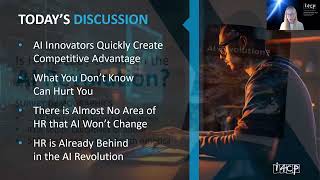
Katherine Brecken and Ellie Judd from i4CP present research on generative AI adoption in HR across 1,500 respondents in 62 countries. Two-thirds of companies believe employees use public AI tools at work without permission, and 55% have no AI policies yet. Early adopters report productivity gains and position HR to gain influence by owning AI strategy and governance.
Questions this video answers
As of July 21 (survey data collected that summer).
66%.
55%.
About 5% reported already using generative AI in certain HR functions; 17% were experimenting (≈23% combined).
Next forum: Wednesday, February 7; Next Practices conference: March 25–28 (register before March 8 to avoid a $300 price increase).
Chapters
My name is Larry Fisher. I am the Vice President and practice leader for the AERS Group and as always, we are thrilled to be here participating with our partners at i4CP and we've got a great program for you today around artificial intelligence and human resources. Just a quick reminder, the Ayres Group, part of Kelly OCG Kelly Services and our specialty is in leadership development and executive coaching as well as a very strong practice in career transition and outplacement. And as we look at how artificial intelligence is impacting hr, it's certainly having a big change on our practice as well as we've incorporated the use of AI into supporting outplacement candidates and building out a solution around micro coaching on the leadership development side. So really excited to have everyone here with us today and join us for this program and this topic. It's a great conversation to be having at this point. I'd like to hand it over to my colleague ellie Judd at i4cp who will introduce today's program. So Ellie, good morning.
Good morning Larry.
Thanks everyone. It's great to see some familiar faces and new faces. Not surprising, as you said, the topic is top of mind for, for many, especially in HR and definitely for our members. So excited to have the conversation today and share some of the key findings from our new study. I know that most of you know who i4CP is, but for those of you that don't, I thought I'd share a little bit about us. I4CP stands for the Institute for Corporate Productivity. We're a member driven human capital research organization with the purpose to discover and advance the next practices in human capital. We're always looking at HR through a business lens so that we can help our members, you know, stay ahead of the of the curve and really stay laser focused on those NEXT practices that drive the strategy and make the biggest impact on business outcomes. Next slide data. So I think it's important to kind of lay some groundwork and context to the conversation that's coming up with Katherine and Anthony. Our research is always uncovering and calls out what high performing organizations are doing differently than their low profound performing counterparts when it comes to their people practices. And we define high performance as those organizations that are excelling in the key four areas of revenue growth, market share, profitability and customer satisfaction over a five year period. And we call those out as next practices because they correlate to market performance. But not many organizations have implemented them yet or instituted them at their organization. Next slide. This is a sampling of some of our members as you can see, we support some of the most prominent and leading organizations and HR leaders who choose to partner with the i4CP to better capitalize on those next practices that I mentioned in HR and really look at the emerging workforce trends. And now I'm going to introduce our two speakers. Very excited to have the conversation today around our new generative AI study in hr. Anthony Ernesto is the Chief People Officer of Suzy. He's a visionary business leader with an intimate understanding of people, products, markets and dedicated his career to empowering startups and tech companies of all sizes. Anthony founded kieai. It's an innovative AI based HR platform to revolutionize the fabric of work. He's also deeply dedicated to enriching STEM education, materializing in the creation of Ella the Engineer. It was inspired initiative created to ignite a passion within young girls and propel them toward fulfilling STEM careers. Also joining us is my colleague Katherine Brecken. She's our senior Research analyst who actually led this study for i4cp. She also serves as a lecturer at the University of Nevada Las Vegas School of Public Policy and leadership. She has 15 years of experience in public affairs developing and evaluating policies and programs and and has testified before legislative bodies on matters of higher education and workforce policy. So as you can see, we've got some AI experts on the line. Lots of interviews have happened to build the study out and bring it to life. So excited for the conversation and I will let Katherine and Anthony take it from here. And please don't hesitate to put questions in the in the chat. I will be monitoring them and Larry will be monitoring them and we'll break in between conversations to really dig into the conversation. So really want this to be participative conversation. Thanks.
Thanks Ellie for the really warm introduction. I'm excited to be here with you all today and with Anthony, a great co host here. Anthony, I would love to just start out before we lay out the agenda today, can you give us just a little insight into your background and interests in AI?
Sure. Thanks everyone for having me. Really humbled to be here and excited to learn from all of you as well as talk about AI. So I've been in HR 20 plus years. You can probably tell by the gray hair. I like to say I have a PhD in startup so most of my career in New York has been in startups when everyone went into finance. So definitely a contrarian from the very start. I'm a failed accountant. I have a degree in accounting and realized I wasn't really good with the numbers. Piece of it, which sounds kind of silly and got into hr, into the startup space and been building HR companies, been doing a lot of side gigs, as Ellie said, and doing a bunch of different stuff. And to me, I read a book years ago, it was about 10 or 12 years ago, so at the time IBM, Watson beat Ken Jennings in jeopardy and everyone freaked out. So this AI thing has been around for quite a while. And two MIT professors decided to write a book called Race against the Machine to understand is it going to be humans, Is it going to be machines? And we'll tell you a little bit about the result of that book if you haven't read it in a couple of minutes here. So we'll leave that hanging there. But that inspired my love for hr, my love for AI, for technology. And so, yeah, I'm excited to be here. Thanks for having me.
Yeah, pumped to be here with you today. And we know you're kind of touching on the fact that this is changing so quickly. I mean, I do remember that was a huge seminal moment when Watson beat the human. And this is just changing so quickly. So this is today we're going to be talking about i4CP's latest study on this very topic. We're going to go over our four key findings. You can see here today, AI innovators quickly create competitive advantage. And we're going to explain what we mean by AI innovators. We're going to talk about what is the risks and the liabilities associated with artificial intelligence. And then we're going to talk about how HR is adopting artificial intelligence now and what we expect to see in the future based on our data and interviews. And finally, we're going to talk about an answer to this study. HR is already behind in the AI revolution. And we'll explain what we mean about that. There is hope. We have some great ideas too on how to get ahead. This study is again, it's our latest and it's based on approximately a survey of 1500 individuals from roughly 62 countries. Specifically, 41% of those were senior executives or above. 57% are based outside of North America. HR professional are who we survey and cater our research to. And then lastly, this study was informed by over 100 interviews and conversations that our research team has had with HR leaders on this very topic. So first, just a little level set on what artificial intelligence is, because this term does get thrown around quite a bit. And let's talk about why generative AI is different and new and why everyone is talking about it. First, there is artificial intelligence which just very broadly means computer based approaches to what would normally be human activities. A subset of artificial intelligence is machine learning and that's basically using algorithms to make predictions. Lastly, we have. Or not lastly, but a subset of machine learning is then deep learning, just like the human brain. And we have neural pathways that allow us to learn new information and secure it in memory. This is a computer based approach that allows the platform to do the same thing to learn. It doesn't have to be pre programmed. And then a subset of deep learning is generative AI which uses deep learning to pour through data and lots of lots and lots of data to make predictions about the next word, the next pixel, the next waveform, to create content. Lastly, this little guy over here, I love to just call out the separation of automation, which is one of our oldest processes, one of our oldest tools as humans. And really what that is when we're talking about computers is that is pre programmed code. Automated technology cannot do anything it wasn't coded to do. And so when you think about sort of the hands or the wrists of the robot, right, it can go like this and it could go like this, but it's actually the brain where you have the mainframe, that's AI and that is learning. So automation is sort of that, the hands and the AI is what, you know, what is allowing it to take in new information and respond. Put more simply, in the history of the Internet we've used search engines to find stuff. We've got traditional AI machine learning that does stuff. That's the AI we interact with on a day to day basis, that's your applicant, tracking systems and so forth. And then we have generative AI that makes stuff and really made headlines when OpenAI released ChatGPT 3.5 almost a year ago. And look how far we've come. So as part of our study we looked at, you know, all of those survey responses. Correct. And we looked at the patterns within there and in terms of executive leaders position on AI use within the workforce. And then we looked at the talent practices that they had in place and we were able to create what this, what you see here, this AI maturity model, where on the far left you've got AI laggards and these were organizations where leaders have yet to provide a point of view on AI's use within the workforce. They have very few parameters in place and to safeguard intellectual property and sensitive data. In the middle here you've got AI inquirers. These are cautious folks, these are organizations where leaders are exploring its use, but are Largely in a wait and see mode. They have very few parameters in place. Their HR is statistically unlikely to be using or experimenting with AI. And then lastly, over here on the right, we have our smallest group, which is AI Innovators. These are organizations that have thoughtfully and fully embraced AI. They have ample parameters in place to provide guardrails for employees on how and where to use AI. You're statistically more likely to have an HR that is using or experimenting with AI. And they are also statistically more likely to have their own internal instances and organization, which is. You think about it, it's like having chatgpt within your firewall, trained on your data, large language models. And so I would love to get your perspective here, Anthony. You know, where is Suzy? And you know, where do you think most HR organizations are today? I did forget to mention that this survey data was collected this summer as of July 21st. And this is changing so much. So I'd love to get your perspective on what's happening today.
It's probably likely already stale data because the world is changing. Yeah, I mean, I think just to give you an idea of where Suzy is, I mean, I would say when this first came out, and again you talked about OpenAI and ChatGPT just for record keeping. It's the largest expansion of any technology ever. So they got to 100 million in users in a record amount of time, more so than Facebook and other platforms. So it's definitely here, it's definitely putting, putting the technology right in front of us. And I think the major, the major thing that happened with ChatGPT wasn't only about the AI. The AI, of course, was interesting. It was a new way to interact with software. Where we're going from years ago we used to type things in. Again, gray hair. We've all been there. Then we pointed and clicked at things. And now we're having chat experiences with software. And I think that is one of the fundamental byproducts of what we're going to see is that you're going to start interacting with tools in a chat like interface. Moving forward, I think there's going to be a proliferation of that. But at Suzy, we kind of took a, we jumped into the deep part of the pool without our swimmies on. And we did that in two ways, one, externally and internally. So Suzy is a market research platform, if you're familiar with Qualtrics and SurveyMonkey. So we saw the immediate need to really think about AI within our platform. We're dealing with data constantly. That's Basically our oil, so to speak. And so we really needed to think about AI and how it was going to impact our world. And so we dove into that. But what we started realizing is that we were working with a lot of enterprise clients that were very cautious, I would say not laggards. I think laggards has a negative connotation to it. But I think, you know, inquirers where they were kind of waiting, let's see, let's not just jump in without our swimmies. Let's just get, let's see what happens first. There are a couple of our enterprise clients that are our beta users on the on. But we've seen it tremendously change. So the hardest part of creating a survey is launching a survey, is creating it right. What questions do I ask in hr? It's been a struggle for us too. AI is helping with the, okay, what are you trying to get at? What are the insights or story you're trying to tell? And it's been incredibly helpful putting AI within our platform, within our software platform internally. Same thing. Now we, we, we jumped in and then of course legal came in and said hold up, we need you to put on those swimmies. Right. Like we, we. So we, we jumped in and, and I just saw the, the, the opportunity because in 20 plus years we've gone from faxes and paper to digital resumes to ATS systems. I just see that this is going to change the game in hr. I think all those things we hate doing manually, all that manual tasks, looking at all this data, you know, benefits all the, all elements of hr, I see the opportunity to either automate that or have that done through some sort of AI technology that then lends us to sit at that seat at the table. We're not worrying about the operations too much. We're actually thinking more strategically. So for me, and I've said this in a couple of different places, I think we are at a pivot point in human resources. I don't think we have a greater opportunity to shift our focus from the operational side of the house. It's not going to be easy, it's not going to be tomorrow to the strategic side. And I think AI is going to be a co pilot for us. So we've been, I've been diving in deep and I see the impact of this internally at Suzy. I think it's going to impact how organizations are built in the future. And by the way, if you haven't realized it yet, I am an optimist, but I do know the downside I read a book called Weapons of Math Destruction by Kathy o'. Neill. So I definitely try to look at both sides of this equation, but we are deep. I would say we're AI innovators at Suzy, both on the product side and internally.
Well, I love the optimism and I think it is such an exciting time. This is also a great time to sort of level set with all of you and tell us where you think your organization is currently, whether you're in the laggards group and that's okay. There's lots. There's good company there and we're all working on this together. Inquires and then, you know, whether you're with Anthony and Susie and an innovator. So much exciting stuff that's going on, Anthony. And I love just, I love hearing your perspective on how quickly this is changing. I love that. Yes, this is a pivot point in hr and I can't sort of wait to see these poll results. Zeta as soon as they're available. Where do you think the bulk of the group's going to be, Anthony?
So don't throw tomatoes. I think you're probably going to see laggards and inquirers. I think hr, traditionally the profile, there have been folks that are really innovators, but I think majority of HR folks are a wait and see. Like if I think of the adoption curve of any new technology, if you think of the curve going up and coming back down, I think a lot of HR folks are on the other side of that. They're going to wait, they're going to see are other companies doing this and that's not a negative thing. That's okay. Like that, that, that works. And so, yeah, there you go. It's sort of the bell curve. They're kind of at that top of all Right. I'm looking at this. I'm not necessarily using it, so it's interesting to see that. But yeah, I expected that in terms of, in terms of the profiles and I think that's. That's the right thing.
Yeah. What is really exciting for me is I've been talking about this research across the country and with global audiences as well is like when we started out in like August, September, the AI Laggards was by far the biggest group and you didn't have so much of a rounded curve. Now I'm starting to see the AI innovators group grow as well. And I think, you know, this just speaks to how quickly everything is changing. And it's a great time for me to also sort of promo highlight preview that i4CP will be publishing a new survey today on this very topic just so that we can get the pulse of what's happening on the ground and how quickly this is changing. So keep an eye out for that link and please take the survey. It'll take less than five minutes and well worth your time because you'll get the results, you get instant results, and then you'll get the aggregate as soon as the survey closes. So just make sure you keep an eye out for that link to help us with our research here. So the next slide I'm going to go to real quickly is going to talk about what sort of makes those AI innovators special. There are certain talent strategies and practices that we saw that AI innovators had in place to help their workforce safely and effectively leverage generative AI. So we noticed that to start, these organizations had AI strategic plans or frameworks that often involved the release of a publicly facing AI tool or model like Anthony suggested, and then an internal one as well as and the sort of ecosystem they had a very specific plan for and they had a business case there was an outcome or many outcomes that they were looking to get in exchange for disrupting their workflow and their work processes and implementing AI. So they defined those metrics up front. And it really also helped make the case from top to bottom, side to side across the organization about why we're doing this, because as this one points out, technology can be scary. And we noticed that AI innovators were communicating about generative AI to reduce fear and uncertainty, fear of becoming obsolete. FOBO is a real issue. And workforces, there's a good chunk of every workforce that's got that. So making sure that you're communicating about generative AI and not only the policies and practices you have in place, but the optimism that Anthony was just expressing. These organizations are excited about how AI is going to impact work and improve work, remove drudgery, right? So they have a very, very positive message, embracing change. They were also very likely to have a, you know, a very strategic development plan in place. So AI innovators often have sort of an AI 101, which is for everybody within the organization. Again, it also that helps with reducing fobo, but also provides the basic security and safety practices that need to be in place. And we'll definitely tell you why those need to be in place. Safety needs to be part of your messaging and your culture in order to avoid risky digital behaviors. So development is a huge part of that. I should also Mention too, they're much more likely to go deep as well with sort of badging or other types of programs that allow people to explore more about maybe prompt engineering or AI ethics. AI innovators are also much more likely, statistically more likely to have a number of policies and guardrails in place so that again, those safe behaviors are happening. And we'll talk about what those are and what those look like. They're encouraging employees to identify use cases. A number of organizations we spoke to did crowdsourcing because it's often not the executive level. Those top leaders that have the best idea for how AI can be used for the biggest roi and so they would crowdsource across the organization. A great example is GE Appliances. Their CEO sent out a message asking for ideas in use cases and they got 300 or 400 responses across the company. They used very specific criteria to their mission and purpose and what they hope to get out of AI to winnow those down and take three or four to pilot. So that's something AI innovators are doing. And you can do that at the department level and at the enterprise level to get all kinds of ideas and get people engaged. The next one is ensuring employees have a secure environment for experimentation. I mentioned that AI innovators are statistically more likely to have what's called an internal instance. OpenAI, for instance, has models available at the enterprise level that can be implemented within the organization behind the firewall. So the information, the prompting is safe. It can access your data in order to provide employees with, you know, easy to understand language, you know, really easy to find information. And all you have to do is sort of just query it like you would in a message or a chat. They can also these organizations, there are many that don't have internal instances, but are allowing their employees, or maybe even paying for the subscription fees to use ChatGPT or Bing or Claude. And they're telling them where specifically they can play in a safe space because there are a number of bad actors that are that are out there. There are large language models that are supposedly replicas or similar to these other more big companies that have produced large language models. And basically it's to gain information so that it opens your organization to phishing and other things. So being specific about where employees can play and how they can play safely is really important. Deconstructing job roles impacted by generative AI. We'll talk a little bit more about that shortly. But that's sort of that John Boudreaux, you know, idea he recently had it has a great book out about how to do this, but looking at the, the job and the tasks involved in that job and understanding which ones are going to be offloaded to technology and what to do with the time saved. And lastly, AI innovators are statistically more likely to be hiring for AI specific roles in HR or AI specific skills within HR positions like their HRIs, specialists and analysts now are having AI skills. Prompt engineering is a term that's making its way into job descriptions for HR leaders. So we're starting to see a lot more of that happen. I'm going to go back actually real quickly. Anthony would love to hear from the audience right now. Which ones of these do you have in place? And if you have other ideas or other practices you think AI innovators might have or that you have at your organization that have really helped you create a workforce that can safely and effectively leverage AI, what do you, what are you guys seeing out there? Which ones do you have? And then what's not on this list, Anthony, do you have any, any suggestions or feedback on that? You know, which among these really stick out to you as, as most important?
All the above. It's, you know, when we just to tell a story about this here at, at suzy, of course, ChatGPT was the proliferation of, of all of this in the interest. So it was from that point forward where we said, okay, what does this look like for Suzy internally? And we did the same things that the GE did. We set some guidelines like this is what we're trying to do. We have to do it thoughtfully, we have to do it within the confines of, of our data security practices, all that sort of stuff. But we want you to experiment. And we actually created, we use a tool called Slack, which is very similar to Microsoft Teams where we created a channel called AI first because we wanted the organizational organization culturally to think, all right, this is actually a pretty, you know, tentpole event in technology, in the workplace. We want this to be a core of what we do at the organization. We know it's going to impact. But like you said, you know, there's a great thing called the Hippo. The highest paid person's opinion doesn't always start at the executive level or the highest paid person. It's really the people on the ground that are going to use this. And it's interesting because I saw some organizations just completely blanket, not, you know, deny people access to these tools. And what you're finding is people are actually using their personal computers to use the tool for work purposes. So Your intent of trying to lock things down. Actually now your data and stuff is getting done through a computer you can't control. So I think it's all the above. I think having that cultural line in the sand or the CEO or supporting it in that way, but also having the community say, hey, this is what we're seeing. And we started originally with a lot of prompts, right? What are the prompts that you use? I think over time ChatGPT is going to get smart enough. You don't necessarily have to be a prompt engineer. I think that was kind of a blip and now it's going to be a lot smarter. You're going to be able to work with it. But all of these things. The only thing I could say is the last one, hiring for AI specific roles in hr. I haven't seen that specifically, but I'm in a small organization that may be more relevant in a large organization. I think what companies are doing is bringing. Because AI is so new, they're bringing it into what I'll call a center of excellence. So not necessarily like almost like a spoke model where you have this centralized hub of AI knowledge and expertise that's going out into the organization. I will say the caveat there is, and a lot of HR folks are on this call. We're always the tertiary choice and priority with anything like that. Usually it's business focused. So it could make sense to think about what is the AI hiring in your department. But even so, I personally use ChatGPT as a data analyst. Like I don't have enough budget to hire a people analytics person. I now use AI to support some of that stuff. So I think, like I said all the above, but the real important ones and then the only thing I'm questioning is the one in the corner there about hiring.
Yeah, it's interesting in our interviews with folks, especially some of the larger, more advanced companies, they're finding an individual or hiring an individual to sort of be the point person on all the AI within hr. So we've seen some of that, but we've also seen just again, more of those sort of AI specific skills come, you know, and be part of the HR job description within AI innovator organizations. We have a fantastic article actually coming out shortly on this very topic. I4CP partnered with a company called Revelio which does Internet scraping of LinkedIn and Glassdoor and a couple of other sources. And they looked at our data and they looked at the differences between what skills AI laggards versus AI innovators. Are hiring for within the organization and within hr and really found these specific differences in terms of also just AI innovators are hiring for far more sort of digital critical thinking type skills, very specific. Whereas AI laggards are hiring for a lot more of the, you know, traditional hr, you know, skills, communication, you know, collaboration, all of those are good things, right? But, but different from sort of the network skills and other, you know, digital skills that AI innovators are hiring for. So. Interesting. So we have sort of a quiet group out there today that didn't answer my prompts and my questions in the chat. So I'm hoping you guys are waking up and getting some coffee so we'll get some, some more interaction and dialogue out of you all today. Because I love to say this, sharing is caring. You know, part of the reason we're in these groups, we join these calls is to learn from each other. And so I'm hoping that we'll, we'll get some of you guys more feverishly typing in the, in the quick future here. So this example IKEA is one that I love to talk about. So when we talked about job deconstructing job roles, and I mentioned John, John Boudreau's book, in 2021, Ikea released its chatbot called Billy, named after its famous bookcase that no one apparently can put together. And Billy is just traditional AI. It's not generative AI, but they knew over time it would answer more and more customer, which would really affect the call center role. And so they, they looked at the tasks, they looked at the skills of the car call center role and found there were a variety of skill adjacencies, a lot of them to the new interior designer role that they wanted to grow. As you might have noticed, a number of furniture companies out there now have interior design services. And so this spring, IKEA announced that it had trained 8,500 approximate call center workers who are now interior designers, where in the US they can command anywhere between $30 and $160 per customer call to help you sort of design and, you know, fix your room for people like me who have no idea like how to match colors and deal with window dressing. So a really great example of how they've really deconstructed the role and looked at skill adjacencies and tasks to figure out those sort of adjacencies and good complementary roles. It's just positive workforce planning and very, very strategic forward thinking. Right. So Anthony, what are you hearing on the ground in terms of how AI is impacting workforce planning. Are you hearing about layoffs or freezes?
So just a quick comment, I think on the chatbot experience here. I think this is one of the great examples of the capabilities, but also the downfalls. If you've ever been on a customer support line and you yell operator or hit that zero, right, like, zip, get me a live person. Right. So I think there's a balance here where maybe a lot of things can be handled by a chatbot, but I think we've all been on a customer service line where we're like, just get me a live person. So I think there's about, there's absolutely balance here. That said, I mean, we're at record unemployment. I think it's, I read something this morning in The Financial Times, 21 months of 4%. Like, we've never seen this kind of unemployment. So I, I don't see it naturally impacting. And I listen, there's a, I'll go met on this for a little bit, but there's an author, Peter Zion, who talks about demographic issues across the globe. I think we're, we're going to be seeing a lot of talent focused market markets going forward. So I don't see layoffs. I think the layoffs you saw, we had a tech recession or what. I listened to a podcast called Pivot. Professor Galloway called it the, the Patagonia Recession. So all the folks that were Patagonian tech, we saw that because they think what happened is we overhiered in tech specifically, and there was a correction there. But I haven't seen, and there's so many studies, every day something comes out where it's like, no one's going to lose their job. Everyone's going to lose their job. Like, it's such a wide range of different things. But I think like you saw at Ikea, what's going to happen because unemployment is so low is that you don't want to lose those resources. You're going to reallocate those resources. And I think the task analysis is a great example. And we've been doing this forever in HR where we looked at a job and said, okay, what are the tasks that need to be done? Can we, how do we, how do we get them done? Okay, in, in, in the 90s, or I would say late 90s, early 2000s, it was all about offshore offshoring. Now it's near shoring. Now we're thinking of AI, right? So this is nothing new for us. But I haven't seen the impact around layoffs. I think Job freezes, possibly. I think what you're. Also, what I've seen personally on the ground is the contractors. So a lot of the stuff we would normally look at a project base and a lot of it is around creative. You know, where I can now go into chatbots and pull together an image. I don't, I don't have to go to a designer to get that done. I could do it in Canva, I could do it in Adobe, all these different tools. So I think there's going to be a shift, shift, but not necessarily an overhaul of layoffs now over time. Yes, of course. And there's, you know, there's plenty, plenty of studies in the book I talked about before, Race against the Machines, they talked about so that the, the equation at the end of the book is humans and machines. Right? It's not humans, it's not machines. Humans are going to be good at one thing, machines are going to be good at something. It's the combination of the two that's going to be the ultimate power. You're going to see that in, in different ways. And you saw it at Amazon. Amazon started retraining their warehouse workers and started training them in medical type of tasks. And everyone was like, what the heck is going on at Amazon? And then they buy one medical. Right. So you're going to see this shift, I think, and that could result in layoffs, but I think it's going to shift the workforce. And again, we have to be prepared around learning and development. How do we retrain folks? And that has been traditionally the hardest part in the United States is retraining folks as these shifts happen.
Yeah, I mean, such a, It's a wonder, I think, you know, it's like economists, right? If you ask about the state of the economy, it's usually like 50, 50, like predicting the weather kind of thing. And how different researchers and analysts are looking at this and saying, well, I think it's going to affect this population this way and so forth. So we want to hear from you all what's happening in your organization related to AI. Do you, you know, have you experienced, you know, are you hiring more? Are you seeing a decrease in headcount, no significant change yet, or, you know, maybe you're like, like me and you're just not sure, you're not sure how this is going to play out. So where do you think the biggest, biggest group's going to be, Anthony?
No significant change.
I'm with you there. I think it's too soon to tell. Like IBM, right? They announced this spring that they were going to pause 7,000 plus back office roles, many of which were HR and just it's a hiring freeze like you said. And the CEO was recently talking, I think it was, to Fortune and said months later after that announcement to say no one's been fired. But this is the sort of humane approach that you're going to start seeing as we look at how our AI strategy is going to impact our workforce. We're not sure yet, so can't wait to hear the results. And I saw. Larry, you had your hand up.
Yeah. So Anthony, quick question because you talked.
About.
No, not necessarily having layoffs, but more redeployment of resources. What impact or how do you think AI will be utilized to upskill or reskill people to be able to accommodate that in a time frame that will allow organizations not to have to make people redundant or replace them with resources that are already skilled in that area?
So it's a great question. So I, I've been, you know, learning and development and upskilling employees has been a thing that I've been thinking about a lot lately because, you know, doing this for 20 plus years, we had CD Rom. CD Roms, I can't believe I'm saying that. We had CD Roms of training and development, then we had in person, then we have E learning. And frankly, one thing that I constantly see is I don't get enough training. But a lot of folks don't show up for training. I don't have time for training. So it's this conundrum that exists in Lear development that still exists today even with bite sized learning. And then everyone's questioning whether that has an impact. And then I read a study that said most of the learning happens on the job anyway. So I think AI, to answer your question more succinctly, is going to have an incredible impact on upskilling folks. And I'll give you an example. So like I said, I'm a failed accountant, which means that I, you know, I, I go into Excel spreadsheets. When I'm forced to go into Excel spreadsheets and I was thinking about running a formula, I'm like, I really need to run this formula. And what I would do before ChatGPT is I would go to Google and I would, I would trudge through at least two or three pages of someone trying to sell me Excel training. And at that moment I couldn't go and listen to someone pontificate about Excel for an hour. I just don't have the time I needed A formula. I go into ChatGPT, I say I want to do this in Excel or you know, we use Google sheets. And it not only tells me the formula and what to do, it gives me an opportunity to copy the formula into my Excel spreadsheet. So things like that, where we need to retrain folks, I think AI and the tools in AR are going to have an incredible impact to get people what they need in the moment. Burson talks about in the flow of work, AI is actually the tools that's going to help us. Is it perfect? Absolutely not. But it's a lot better than trolling through 30 Google links to sell me Excel training. So to answer your question, I think it's have. It's going to have an incredible impact on how to upskill and retrain folks. It just depends on what you're training them on. Right. Because I think leadership skills and other things AI will impact, but there'll always be room for an instructor led type of training there.
You bring up an interesting point too, that one thing I'm struggling with and I use, I use large language models almost on a daily basis as I struggle to remember to include it, to put it in my process, right. To start my research process out by asking questions to Bing or now called Copilot or to go to ChatGPT and start there and then look at sources and so forth. It's like a hard thing to readjust your processes if you're sort of an old researcher like me looking at this data though, this is interesting. So no significant change in headcount is clearly the majority. 5% said increased headcount. I would love to hear from someone who selected that. What's going on in your organization where you've seen an increased headcount due to the impact of AI. I'm going to start calling out Bueller in a minute. All right. We got a shy group today, so we'll move on for time's sake. So there's a lot we don't know about AI and we hear about it kind of all the time in the news media. What we don't know. Right. But in terms of the risks and liabilities, there is a lot that we do know that if we inventory correctly, we can account for and protect the organization's sensitive data better by just thinking about these ahead of time. Why it's important to think about, you know, all of the, the risks and liabilities associated with, with AI is because, because of this stat here. So 66% of our survey participants said that it's very likely. Or they are certain that employees are using publicly available generative AI platforms like ChatGPT at work without the organizations that knowledge. When we looked at organizations where the leadership had forbidden employees from using generative AI or ChatGPT, over 30% said they were certain employees were using it anyway. Even if you're allowing employees to go and use your internal instance that you paid a lot of money for as a large language model, you're still going to have employees who are going to go outside your firewall and use generative AI models either because they forget or because they're curious. And so that is another reason why it's really important to think about policies and the safeguards that your organization has in place. Samsung is a wonderful example and role model in this. So when ChatGPT came out, they were all in. They encouraged their employees to use and take advantage of of ChatGPT and other publicly available models. But after several months in surveillance and surveys, they found that employees were copying and pasting proprietary code and in some cases uploading very juicy, salacious internal emails into ChatGPT. And because there is still a lot unknown about what ChatGPT really does with those conversations and your data, this was of course, you know, a minor heart attack for the board and executive leadership. And so this spring they did a 180 and they forbid employees from using ChatGPT and other publicly available models and basically hitting the pause button. But because they knew and understood the gains in productivity that especially coders within Samsung were getting out of this, they began the contracted building their own internal instance so that they could, you know, continue to see and reap the benefits of these new tools. Right. So where are the guardrails? Right. 55% of our survey participants said they had no policies or guidelines in place specific to the use of AI. Of the 45% that said they did have guardrails and policies in place related to AI, you can see 37% of those have data security or protection policies. So this is the big one, right? 26% have proper usage guidelines. 22% have ethics guidelines or policies. 16% have fact checking requirements. So like I said, like, if you get an answer when you're researching ChatGPT, you go and you make sure that you get the footnotes that you go to those sources to see where they're pulling that information from. Because oftentimes it can be a really old press release that's no longer viable. I've noticed, anyway, 15% have established governance structures. 12% have data curation and origination policies and 11% have policies ensuring transparency when AI is used. And this is a really important last one that I'm bringing up because this is going to create all kinds of conundrums within your culture. I have a story of an international retailer. The Chro was retiring. The CEO sent out a company wide email about her service and all that she had done for the organization. It was beautiful. And then they found out that ChatGPT wrote it. And so what does that do to authenticity in relationships? What does that do to trust? Thinking about like you get a scathing performance review from your boss only to find out that she didn't write it, that there was an AI that looked at all the data and put out this draft that she accepted, clicked and sent to you. Again, trust is going to be a really big issue. And how much we disclose, they're having sort of like parenthetical expression at the bottom of an email saying AI contributed to this content or a watermark within an image saying that AI created this image. How much of that are you going to adopt and when is it appropriate and when is it not? Right. What are your thoughts on disclosure and transparency? Anthony, where do you stand? How much should we disclose about our AI use?
Yeah, it's a good topic and we can definitely debate about it. When the Internet, Internet came along and I would Google search something, I never disclosed the fact that I Google searched something. Right. So I think, you know, this is a little bit different because it's creating content and other things. I think the, the, the technologies should do a good job of like you said, footnoting where things are coming from or even putting watermarks on certain things. I know I've, you know, for images that I've created because I just have a, a love for all things creative. I think when people create things from nothing, it's, it's a brilliance, it's a human brilliance that, that I want to make sure they get credit for. So if I use an image from like an unsplash, a free site and there's an artist that took or a photographer, I give them credit. If it's something I did via GPT, I give that, you know, an original via chat GPT credit to it. But it varies, it definitely varies. And I have to say that I would, you know, you know, it's like giving your MacBook credit for doing work. It's like, it is the tool that you're using and you have to assume that most people are now using it. So anything that you read New York Times runs, it runs titles of articles through AI as I understand it. So everyone's using it. So if we could just assume everyone's using it, then there are pieces that definitely need to be credited in, in a certain way. But in totality, you're having a conversation with the, you're co creating something, you know, blog posts. Like you, like you're doing research, you're, you're prompting it, you're having a conversation, you're tweaking things. It is co creation. Right. And so would you give your MacBook credit? Would you give Google credit? So I'm on the, on the side of. I don't think you necessarily have like in that email with the CEO, that was great. Like the intention there was like, hey, I want, I could imagine the prompt, my chro is leaving. I want a warm, you know, heartfelt message. And maybe the CEO is just not the most heartfelt, warm person. And so great. That's great steps, like knowing that you're not is a great first step. And then using a tool like this. So I, I feel bad that that person got called out, but maybe what they did is they just copied the whole thing and sent an email where I think you can, you know, it's an editor now. You're now an editor. So look at it. Add some stuff that you want to add. I've been using, by the way, Grammarly forever before even AI and it was like having an English teacher sitting over my, my chair as I typed, which was awful because it would like redline everything because I'm a middle class kid from New York. So it would be like, that's not how you say things. And so it's, it's been helpful. I didn't give Grammarly credit, so I'm on both sides of these things. I think it depends on the content you're creating and then what should be disclosed. In that CEO example, I don't know if I necessarily would have said, hey, I wrote this email via AI. I, I don't think that that would have made sense.
And I, I took it and then I asked ChatGPT to make me even more likable. Right, right, right.
And yeah. And Radina put in the comments, job descriptions. It's a great example. Like, you know, we used to toil over putting job descriptions together 30 minutes. Right. At least now we throw it in chat again. It's not perfect. There's biases in there. We have to be cautious. But you should think of yourself now as an editor. You're not Necessarily the writer or the creator, you're the editor. The creator is going to be chatgpt. Don't just copy and paste it. And in hr, by the way, we've been doing this forever. A little secret is we're all in these email lists, right? And we're like, what's your policy on travel? What's your policy on this? And then we take it and we make it. Same thing. It's the same. We're, we're just doing it now with technology and Chat GPT. So we've been doing this for, for quite a while in hr. And in fact, I knew somebody that, speaking of job descriptions, copy the job description and, and if you've ever done this, it's pretty horrific. And you like the company name. You, you missed, like the other company's name in your job description and then you publish it and it has their name on it. It's. It's horrific and. But it happened. So we've been, we've been doing this kind of collective knowledge sharing for a while in hr and now we're using it, you know, Chat GPT to help us out.
Yeah, it is fascinating and interesting. This is a kind of similar example. So our CEO, Kevin Oaks, who was on this call, I don't know if you're still on Kevin, if you want to come out and talk a little bit more about this, but we met Brett at HR Tech in one of the sessions that we were doing, and Brett told us that he used ChatGPT to create his company's AI use policy. And he told us what he did, and he gave the policy at the end of the day to legal counsel and didn't tell them that Chachi PT had written it. He wanted to see what they would say. So he got the policy back and it was a few minor corrections. This is great. This is good to go. And so he likes to joke that he said, I told them that they were going to be out of a job because this was written by ChatGPT. But the funny thing is, is that when I asked Brett later if I could share his story and his prompts, which I'll show you in the next slide here, he was really specific. He's like, you have to make sure you emphasize that I had to send that legal counsel has to be part of this process because I'm not an expert, you know, in policies and all the, you know, the protocols and requirements and laws and so forth that we have to adhere to. They are. And it just really emphasizes those technical skills, those Specialized skills that we worked so hard to develop, you know, in our profession, they're still incredibly valuable and necessary as part of the process because sort of, as you were talking about when, when we used to, like, copy and paste other people's policies, it could happen then and it can happen now, where mistakes slip. If we're not vigilant in checking what the model is putting out, if we're not, you know, putting on our critical thinking caps and looking at what is being put out, is it appropriate to scale? Is it, Is it, you know, in compliance, we have to have that sort of editor. That's part of it. These are Brett's prompts. You can see there are eight of them. And they're pretty technical. And prompting is getting easier and easier. As Anthony, as you pointed out, it doesn't have to be so specific now. The models are getting so much better. But you'll be able to get the deck and take a look at this too. And if you want to reach out to me, if you want to see the actual policy that Brett used ChatGPT to produce, I'm happy to share that as well as a PDF. It just doesn't fit in the slide. So send me an email if you'd like to see that later. Our third key finding, and I realized we are close to getting out of time, is just. So I'm going to breeze through some of these real quickly, is that almost no area of HR isn't, you know, is immune to this. We looked on the, on the left here, you see, this is how HR leaders, according to our survey data, this is where they're using generative AI today. On the right is what you care about. This is how AI innovators plan to use it. Next. This is what the future looks like, right? And if you look at the difference between the two, you really start to see sort of this, you know, personalization of the employee experience that technology is going to enable. You know, you're going to be able to create customized job descriptions and then an onboarding plan specific to the individual you hired and that job description, and then compensation and benefit packages that are really meeting the needs of that individual and in line with the market. Right? Because AI is really good at synthesizing data. And so you're going to again, see sort of just like we used to have to go to a record store to buy a CD to get a song we like. Now we can go to Apple Music or other places and just purchase a song. That sort of individual customization that's been Occurring over time is really going to take root now because technology is going to allow us to do that at scale. We did have a poll question here. Would love to just quickly get anybody any feedback that people have. Which purposes do you use generative AI specifically? If you can take a moment to click on which ones you use generative AI for, we would love to get some information from you on how you're using it. So take a moment to do that. What do you think is going to be the most popular one, Anthony?
Personal productivity.
Okay, I agree, I agree. Because, I mean, whether your organization has an internal instance or not, you don't need, you know, you can still use ChatGPT for a lot. As you can see here. That is, that is the top. And 33% are using it for analyzing or displaying data. That's, that's another great use of AI. It creates wonderful code that you can populate, you know, charts and graphs beautifully with. So that's awesome here. I'm going to get through this one. Right, right. We have some use cases that we surfaced in our, in our research for all of the different HR functions. This one specifically for learning and development. And Anthony touched on a lot of the uses of AI in this specifically, but we have others. And if you use this QR code again, you're going to get the deck later. You can go and see all of the use cases for the different functions that we've surfaced through the research. Of those who are using AI and HR, they are already experiencing wonderful outcomes here. There were 29% who said it's too soon to tell, but, you know, you've got 56% saying they're already seeing time savings and increased productivity. This is a leading edge tool. So this is, you know, if you're, if you've got AI, you're using AI. This is putting you ahead of your competitors. You all told us a little bit about how you're using generative AI. These are how individual participants in our survey said they are using generative AI for work. 39% said they're not. That's not in this chart. But of those who are, this is what they're doing and how they're getting an edge over their competitor or over their peers. Right. And then our final key finding is that, yes, HR is behind. You can see here that only 5% told us this summer that they were already using AI in certain functions. 17% were experimenting. So you've got 23% or so this summer saying that they're experimenting or using generative AI in hr. What we found through our data analysis here is this, this model. When you have an organization where leaders are thoughtfully embracing AI, they're communicating that they embrace change. HR is much more likely to be ready to experiment or use generative AI. And that readiness speaks to whether they're at the governance table and helping to influence decisions within the workforce or decisions about AI that impact the workforce. Right. And so we see this as a real, as a real lever of HR to get ahead. We need to make sure that our teams are ready to lead strategic conversations about AI in the workforce. They understand and know how to use the technology, they get, how it can impact different HR functions and processes and workflows. So if we want to be leaders and at the table making, you know, those huge decisions about how AI is going to be employed, how it's going to affect the workforce, we need to do our due diligence to make sure that we're prepared. And it's statistically we found that you can do that. The rest of the stuff happens, right. You're much more likely to be at the governance table. And those nine talent strategies that we went through at the beginning are much more likely to be in place in the organization which has a direct impact on market performance. So with that, I'm going to turn it back to Larry and Ellie to wrap us up.
Excellent. So thank you, Katherine. Thank you, Anthony. That was really great insights and we appreciate you taking the time today. Lots of really good material, lots of good thought here, lots of great research and certainly a conversation that's going to continue on going forward as technology continues to dive deeper into and integrate into human resources throughout the organizations that you're in and as we see in the marketplace. Again, thanks everyone for joining us. Our next forum will be on Wednesday, February 7th, so please keep the date for that and we will have more information coming out around our topic and speakers. And Ellie, if you want to briefly talk about your next practices conference.
Sure, yeah. Thanks Anthony. Thanks Catherine. Always great insights in the conversation and we'll add some coffee and send it out before the next session to, to get some interaction. But yeah, our next practice is now conference. It's the highest rated HR conference out there. Just like our research. There's no consultants, no vendors at the conference, no booths, just practitioners like yourself. It's in Scottsdale, Arizona, which is always nice after the cold weather that we're currently experiencing now, which is I guess, projected to get worse. So it's going to be on March 25th through the 28th. And if you'd like to attend, check it out. I think Zeta is going to put the link in the, in the chat, but be sure to sign up before the 8th. After the 8th, it goes up by $300. So we've got a great lineup of speakers, more to come. This is how you can contact us. And we appreciate you. We appreciate you joining us. Happy holidays to everyone, and we will see you in February.
Great.
Thanks, everyone. Happy holidays.
Thank you.
Thank you for joining us.










