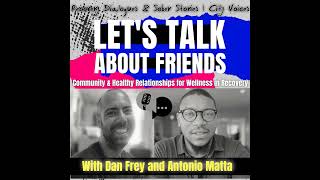
In this special bonus episode of the podcast Recovery Dialogues and Sober Stories, host Antonio Matta interviews Dan Frey, executive director of City Voices, about the organization’s Friendship Squad (TFS) – a peer‑matching, mental‑health buddy program designed to combat loneliness and support recovery from mental‑health challenges, addiction, and homelessness. The conversation begins by emphasizing the scientific and experiential importance of friendships in fostering resilience, life satisfaction, and recovery outcomes. Dan explains TFS’s intentional matching process (shared passions, age, sexual identity, lived experience) and shares a concrete success story of Karen, a single mother caring for neurodivergent children, and Mary, a supportive grandmother, illustrating how peer connection can alleviate acute stress. The interview then explores volunteer experiences, presenting several heartfelt testimonials that highlight benefits such as reduced isolation, structured social contact, and renewed faith in humanity. Dan outlines the program’s core principles – communication, commitment, and companionship – and how they address isolation among people with mental‑health, addiction, or housing instability. When asked about measurable impact, Dan admits the evidence is primarily qualitative, noting anecdotal reductions in suicidal thoughts but no formal data on hospitalizations or addiction outcomes. The discussion turns to future growth, covering possibilities like hiring dedicated friendship coordinators (including international pilots), language expansion, and partnerships with nonprofits, while acknowledging funding constraints and liability concerns. Finally, Dan articulates why volunteers should join TFS: they gain personal growth, learn adult‑friendship skills, and experience the reciprocal gift of giving and receiving friendship, thereby contributing to a broader culture of connection. The episode closes with calls to action for listeners to register, volunteer, and support the podcast.
Chapters
Recovery is possible. Recovery is possible. Recovery is possible.
Recovery is possible.
Recovery is possible.
Recovery Dialogues and Sober Stories.
Welcome back to a special bonus episode of Recovery Dialogues and Sober Stories. I'm your host, Antonio Mata, and I want to take a moment to express my deepest gratitude to City Voices for sponsoring the last two episodes of the show. The response has been overwhelming. So many of you have reached out, sharing how these conversations resonate with your own journeys. It's a testament to the critical importance of peer support, community, and advocacy in the broader mental health and recovery discourse. City Voices has been an influential force in the mental health and recovery community for 30 years, offering peer-led support programs that break down isolation and uplift individuals through connection, creativity, and empowerment. Today, we're shining a spotlight on one of their most innovative initiatives, the Friendship Squad. If you've ever struggled with mental health challenges or addiction, you know that loneliness can be just as devastating as the condition itself. Recovery isn't merely about abstinence or symptom management; it's about rebuilding a life filled with meaning, connection, and support. And science backs this up. Studies show that friendships and peer-based communities play a profound role in fostering resilience, increasing life satisfaction, and even improving recovery outcomes. Research indicates that sustained friendships can counteract loneliness and enhance well-being, especially for those navigating navigating mental health struggles. Likewise, peer support programs, particularly in environments where recovery is a daily challenge, help maintain sobriety and provide a sense of continuity in healing. But not all friendships are created equal. Some bonds strengthen us, while others, particularly those rooted in codependency or unhealthy patterns, can do more harm than good. That's why initiatives like the Friendship Squad, TFS, are so vital. This program isn't just about socializing, it's about intentional, meaningful connection. Through structured friend matching, engaging activities, and ongoing peer support, TFS helps individuals form relationships that are genuinely beneficial to their recovery. Friendship in recovery is about more than companionship. It's an integral part of holistic wellness. When trust has been shattered by trauma or addiction, learning to connect can be daunting, TFS provides a safe environment for reconnecting with others and strengthening social skills, whether through phone calls, virtual chats, or in-person meetups. It ensures that no one has to walk this road alone. To delve deeper into the impact of the Friendship Squad, I'm honored to welcome today's guest, Dan Frey, the executive director of City Voices. Dan is a passionate mental health advocate and writer. Leading this grassroots organization on a minimal budget, Dan has dedicated himself to creating authentic, tangible support networks for individuals facing life's toughest challenges. Through programs like the Friendship Squad, Dan and his team have helped over 100 people annually find meaningful companionship, combat isolation, and reclaim a sense of belonging. Dan, welcome to the show. The Friendship Squad uses a unique matching process to pair individuals based on shared passions, age, sexual identity, and life experiences. Could you share a particularly successful pairing story that demonstrates how this thoughtful matching approach has transformed someone's mental health journey?
We have had quite a few successful stories of friends making friends through the project and keeping those friends past the 6-month period. There are two folks right now, Karen and Mary, who were recently paired together. They're doing really well. In fact, I think Karen was having some really painful struggles with her family. She's a single mother with a son who has schizophrenia, and her son was forcibly hospitalized.. And so the whole family is going through a hard time. Her daughter has autism, and so the whole family is neurodivergent and also experiencing challenges. It's hard for a single mother to not only be the breadwinner, but also make sure the kids are doing okay. And so she was crying to Mary, and Mary is a grandmother and was really providing excellent peer support, beautiful support. To her. They're both peers because they both have mental health challenges. And, and Mary supported Karen, continues to support her through this difficult phase. I don't know if— I think if Karen's son came back from the hospital is very recent, and today is the 26th of February, 2025.
Your website states that volunteers are the lifeblood of TFS. What concrete benefits have volunteers reported reaping from their involvement? And in your view, how has this peer-led approach produced results that conventional mental health services may not accomplish.
Here are some testimonials. Mary says, I've been chatting with my Squad friends since November 2021. I am an introvert and tend to isolate, so it's been helpful to have structure and commitment. I now look forward to our conversations, and I am so happy to have a lovely new friend. Caitlin said, 'the Friendship Squad model works. It is written in our DNA to be social creatures. We thrive on the bonds we have with one another, and I didn't get the weight of this knowledge until COVID isolated me from my fellow counterparts. The Friendship Squad brought the reality of what connections mean full circle to me, and for that I am simply grateful.' Philip said, 'The Friendship Squad offers a chance for me and a peer from a different way of life or geographic area to connect in ways that are different from a telehealth call from a therapist or a psychiatrist. No therapy, just two people sharing their pains, joys, tribulations, successes, missteps, hopes, fears, and dreams. Uh, so Amanda said, being a part of the Friendship Squad allowed me to meet some strong women that I may not have met otherwise. Who I can learn from. We can talk about struggles we are going through and work together to lift ourselves up. Being a part of this group helps me open myself up to understanding myself and the world around me. Yeah, that, that says it all, those 3 testimonials. And we have more. It's not even peer support. It's definitely not therapy. It's friendship. It's people just being friends to each other, supporting each other, listening to each other, offering empathy and advice if it's warranted, if it's asked for. It's just like you have a friend, I have a friend, some of our friends we've had for many years. And that's the idea. We want to take the magic of what kept our long-term friendships together in our personal lives, learn from it, and apply that magic to this project so that the strangers who are becoming friends will build a bedrock. And upon that foundation, the friendship will last long into the future.
The program appears to be built around the 3 C's: communication, commitment, and companionship. How do these principles specifically address the isolation challenges faced by people with mental health struggles, addiction issues, or those experiencing homelessness?
Community because it's about people, people connecting with people in a way that feels safe, right, helpful, supportive, friendly, and loving. The love and support and connection is community is through the ideal community. So we're trying to make an ideal community. People feel a part of an ideal community, a community that provides support, love, and friendship. Those three things that are tremendous healing benefits of the connections we're creating. And that's good for someone who's mentally ill, who's struggling with addiction, who's someone— that's good for a lawyer who had a bad day at court. That's good for a nurse coming home with sore feet. That's good for anybody. That's good for a mentally ill person, a person without a mental illness, a person with an addiction. It's good for human beings. And although we particularly focus on people with mental health and addiction challenges, and occasionally someone who's homeless and also experiencing these challenges. We focus on them because according to the Surgeon General's report on loneliness, the general public's lonely and suffering, but people with these other challenges are suffering. I wouldn't say even more, but they're suffering at a higher rate. There's more loneliness and isolation among people with these specific challenges than there is among the general public, even though already The general public has a great issue with loneliness and isolation. It's even greater with this population that we serve and we're serving.
Several testimonials on your site mentioned the transformative power of the Friendship Squad. Could you quantify some of the measurable impacts you've seen, perhaps changes in participants' recovery outcomes, reduced hospitalizations, or improved social functioning?
Other than people telling me I was suicidal and going through a hard time with those thoughts and feelings and participating in the squad helped me to get past that and find my balance. Someone did tell me that. Also, we have the testimonials from people. We have qualitative, not quantitative, evidence of being effective. People saying that it helped them with isolation, loneliness, helped them feel connected, helped some people have more faith in humanity. But as far as reducing hospitalization, I don't know. And reducing addiction, I don't know. I was addicted to several different things. You could be addicted to a lot of different things. I had my own share of addictions and I found that feeling connected, loved, and finding joy helped me personally to overcome those addictions that were decreasing my life satisfaction, my happiness, and everything. And so we try to— and so this project is— the ideals are to bring joy and community and support and love into people's lives. When people feel those things as often as possible, I believe It can help them with addictions and mental health challenges and reduce hospitalizations, but we don't have any quantitative evidence of this.
As mental health remains a significant public concern, how do you see the Friendship Squad model expanding or evolving in the future? Are there creative approaches or partnerships you are considering that could help the program connect with more people in need of meaningful relationships?
We could do it a couple of ways. I either, we make a lot of money and we invest the money into training friendship coordinators to do what I've been doing, which is to find volunteers and find the people who are lonely and isolated, match them and cultivate the friendships and work out any challenges to those friendships. And really it's like gardening and create a vibrant flowering garden of friendships. And that's the friendship coordinator's responsibility. With more money, we can hire friendship coordinators from all over the world. I was considering hiring a friendship coordinator from Nigeria to explore the possibility of a Friendship Squad in Africa. That friendship coordinator would be responsible for finding volunteers and the friends who need friends and making the matches and doing everything a friendship coordinator would do. I would train them through WhatsApp, Zoom, or wherever we can meet despite the timeframe difference. Unfortunately, right now we're limited to the language of English because I don't speak any other languages. But if I can train someone who's bilingual to work in their country with folks in their native language, I'm open to that too. These are all possibilities and it requires a bunch of money. If we did it without money, maybe organizations could start Friendship Squads, nonprofits could start them. But I've had very little luck with nonprofits. They're all concerned about liability and people committing suicide and the liability from that and homicide and liability from that. Hey, I've been doing this for 3, 4 years now. There have been some people experiencing suicidal feelings, but no one committed suicide or blamed the friends through the Friendship Squad for— we vet the volunteers, make sure they're compassionate people and have lived experience. We maintain contact and work through all the challenges, maintaining contact weekly, biweekly, however we can, making sure no one ghosts anybody and that arguments or disputes are handled in a way where everyone feels heard and respected. You've had a friend for many years. It hasn't always been hunky-dory. Maybe you had a bitter argument and then wouldn't talk to each other for a year, but then reconciled because you missed each other. These things happen in friendships. Expanding it without money would probably mean convincing nonprofits, other organizations, or independent folks. I'm an independent person. Strictly affiliated with any organization. I started this project independently. I thought it was a good idea during COVID where people could meet each other through phone and text because we weren't allowed to meet anyone in COVID. We were all isolated from each other, but we can connect through the phone and Zoom and all this stuff. And that was the idea. And I just started on my own. If I can convince other people to do it on their own with my support, They can do it on their own with our outline for how it's done, because now we have an outline of how it's done. It's a lot of work, so it's unlikely someone's going to do it without getting paid because it's not their brainchild and they're not passionate about it. Unless we spread the word wide with a lot of press and say, hey, if you want to do this in your community, I'll train you. If we get enough press. And let's say 100,000 people are reading or watching or listening to it, then maybe 1% of 100,000 is like 100 people. And then if out of the 100, maybe 10% of that, and then that would be 10 people. If we get 10 people out of the 100,000 to do it without getting paid, that would be fantastic too. So there's a number of ways we can expand, but None of them are easy. It's not easy to raise money and it's not easy to get press.
Lastly, in a time when people face numerous competing demands for their time and energy, why should someone choose to volunteer with the Friendship Squad specifically? What unique impact might they have that extends beyond just the individual relationship they form with their buddy?
Good. Very good. I think we dealt with this a little bit in previous answers, and I will be happy to explain again. That volunteers will have a renewed faith in humanity, a renewed faith in the possibility of adult friendships. When we're children, it's so easy to make a friend. We're playing in the sandbox and there's another kid playing in the sandbox and he builds a little castle and you build a little castle near him. And then you start saying, hi, what's your name? And he says, hi, I'm— this is me and I like playing. Or it's complete silence and nothing but construction of sandcastles and digging holes. But the vibe is so beautiful and peaceful and energetic when we're children that next thing you know, after about an hour playing together, Kid A goes back to his mommy and says, Mommy, I made a new best friend. And Kid B goes to his mommy and says, I made a new best friend. Unfortunately, as we grow up, friendships aren't made quite that easily, especially best friends. In volunteering with this project, you learn to connect in unique ways. Volunteers are matched based on their applications and what they say in the applications. And there's a bunch of questions there about who the person is and what they're looking for in a friend and their hobbies, personal experience, whatever baggage they carry. And we make friendships based on that. And the volunteer is going to get an education in how to make friends as an adult with someone new that they've never met. Strangers making friends with strangers. And they'll witness the miracle of bonding with another adult and learning about another life story and sharing their own life story, perhaps, and just witnessing how with enough watering and nutrients that the friendship can grow and it can last. It can be built to last. A number of our friendships have outlasted the 6-month period. Not only do they get the reward and renewed faith in humanity and the ability of adults to make friendships, but they actually receive a friend, which is a great gift. The volunteer receives a friend and the participant receives a friend. And that's perhaps the best part.
Dan, thank you for sharing your insights and for the fantastic work you and City Voices are doing. The Friendship Squad is genuinely transforming lives, demonstrating that friendship and peer support can be powerful forces in recovery. If today's conversation resonated with you, I encourage you to take action. Whether you're seeking support or want to be the reason someone feels seen and valued, consider signing up or volunteering for the Friendship Squad. You can find more information and register at www.cityvoicesonline.org. Your involvement can make a real difference. And if you appreciate the conversations we bring to Recovery Dialogues and Sober Stories, please support the show. Every contribution helps us continue these important discussions. The link to our GoFundMe campaign is in the episode description. Remember, recovery is not just about overcoming challenges,. It's about thriving, connecting, and reclaiming your best life. Keep pushing forward, stay connected, and until next time, take care and be well. Recovery is possible. Recovery is possible. Recovery is possible. Recovery is possible. Recovery is possible. Recovery Dialogues and Sober Stories.