In this interview, Altimeter Capital partner Apoorv Agrawal discusses the recent $150 billion valuation of OpenAI and places it within the broader context of an emerging AI supercycle. He argues that past technology supercycles (Internet, Mobile) produced trillion‑dollar monopolies and expects the AI supercycle to generate businesses worth well over $100 billion, with OpenAI as the likely leader. Agrawal emphasizes that value is created not at the model layer but in the application layer—consumer products like ChatGPT and enterprise solutions—citing OpenAI’s 200 million weekly active users and a $3‑4 billion revenue run‑rate achieved in under two years. He evaluates the competitive landscape, noting that while big‑tech firms (Google, Meta, Amazon, Apple) have formidable resources, OpenAI’s rapid product iteration and pricing strategy give it a decisive edge, and the combined revenue of AI startups is a fraction of OpenAI’s. The conversation also touches on OpenAI’s hybrid nonprofit/for‑profit structure, suggesting a future alignment with investor interests and possible liquidity mechanisms similar to SpaceX. Finally, Agrawal shares his investment perspective, viewing OpenAI as the clear winner in the AI race while acknowledging ongoing competition and partnership opportunities with big tech.
Chapters
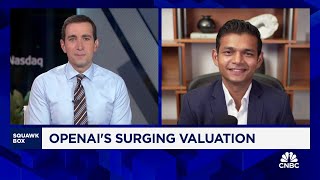
More deep-pocketed investors lining up to get in on the latest OpenAI funding round, which would value the company— ChatGPT, of course, the maker of— for $150 billion. Joining us right now to talk more about it is Upur Agarwal. He's the Altimeter Capital partner. He leads investments in private AI companies. You look at $150 billion valuation, you look at the losses on the other side. You look at the revenue potential and you say this makes a lot of sense. This makes no sense. What do you, what do you think?
Thanks for having me, Andrew. It's good to be here. Look, the past technology supercycles have produced large outcomes. The internet supercycle produced a $2 trillion monopoly in Google. The mobile supercycle produced a $3 trillion business in Apple. Do we believe that the AI supercycle will produce a business that is worth more than $100 or $150 billion? We think so. And so the second question is, is OpenAI the winner of that AI supercycle? And look, that's where there's a lot of debate, a lot of competition, a lot of burn, as you said, expensive valuations. And we might be in the minority of believers who think that OpenAI is the indisputable leader in the AI supercycle. I'd be happy to walk you through my thesis.
I don't think you're in the minority there. I think ChatGPT is clearly from a product perspective clearly ahead of the rest. The question that I would ask, and maybe it's an unfair question, but long term, do we believe that these models become commoditized? And how much money is OpenAI going to be able to capture relative to a Google or an Amazon or a Facebook, who's obviously with Llama Llama is an open model and free. You know what happens long term in that regard?
Definitely. Look, I'll be the first to tell you, Andrew, I don't think it's the model layer at which the value accrues. It's the application layer above the models, the consumer applications like ChatGPT and the enterprise applications that will accrue the value. And so if you look at each of those two, right on the consumer leaderboard, ChatGPT today is clearly the leader, right? They've got 200 million weekly active users. They've got, you know, $3-4 billion of revenue run rate. And let me point out that 2 years ago there was none of this. There was no ChatGPT. Most people had not heard of OpenAI and they've gotten here in less than 2 years. This is despite all the noise, you know, Sam Altman being let go, a lot of management turnover, competition, as you said. And so all this has happened amidst turmoil, which gives us a lot more faith in this leadership team to execute. On the enterprise side, you know, as Jensen said in the earnings call last, last week, the first company to get to the next frontier of AI gets to introduce a revolutionary level of AI. They get to be the leader, not the second one who gets there. And OpenAI has consistently and systematically delivered both leadership in terms of performance, as you saw with the Strawberry-01 model last, last week, and price. Every couple of weeks they have dropped the price of their models. And so, look, you know, huge kudos to the team there. Sam Altman, Noam Brown, who led the research here. And while there's a lot of competition, we believe that OpenAI is delivering.
Do you think that leadership, do you think that OpenAI long term is going to have to fundamentally change the company structure? Obviously, there's a not-for-profit entity and then this for-profit part that has this valuation, but that ultimately it's going to have to get wrapped together. And does that then create any kind of liability for the company as well in terms of some of the early folks who either funded it— we can call them funders or we could call them investors. I'm talking about Elon Musk and some others— how that changes things.
Well, I think they will get to a point where the company structure is aligned with investors. I don't— I can't speak to that right this moment, but I think it's an important one. What I can say is there have been companies that have got into a structure such that they allow liquidity for early investors and early funders. As you said, you know, we've seen this model at SpaceX, Andrew. Every year they have some kind of a tender. And so, you know, we could expect some kind of that structure going forward with OpenAI if they decide to stay private longer.
What is your sense about investing in some of these other companies, an Amazon, an Alphabet, a Meta, for example?
Right. Look, I think competition for OpenAI is at those levels, right? One is the big tech, is the ones that you mentioned, and startups. I would say on the startup layer, If you combine the revenue of all these startups together, it's less than a tenth of OpenAI's revenue. So I think OpenAI has emerged as the winner there. In big tech, I think they've got formidable competition, as you said, right? Meta, Mark Zuckerberg at the top of his game, formidable consumer brand. Google, Sundar, deploying their amazing resources. But we think the age of 10 blue links is over. People are looking for answers, not search. And Apple, you know, one of the most formidable consumer brands. I'm not saying it's a total layup for OpenAI, but from our perspective, OpenAI has threaded that needle. Perfectly in partnering with, with the big tech that matters and competing with others who are formidable.
Does that mean Apple wins or Apple loses at $218 a share?
You know, we are, we are very optimistic about Apple. You know, there's a lot of great products coming down the road with Apple and we're excited to use them.