TBPN with Apoorv Agrawal - March 11, 2026
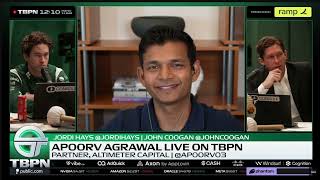
In this episode of TBPN, host(s) interview Apoorv Agrawal, a partner at Altimeter, about the current state and future of consumer AI. Agrawal outlines how consumer technology markets have historically followed a winner‑take‑most pattern—citing Google, Apple, Meta, and ride‑hailing—as a lens to understand ChatGPT’s rapid rise and its likely dominance. He discusses the competitive dynamics with Bing, the value of search APIs, and the importance of feedback loops (thumbs‑up/down) that create a powerful flywheel similar to Google’s autocomplete. The conversation moves to monetization, contrasting subscription pricing with ad‑based models, and highlights the stark revenue per‑user gap between OpenAI and the larger “Mag‑7” firms. Agrawal shares metrics on user engagement (weekly active users, DAU/MAU ratios) and notes that ChatGPT shows a “smile curve” of retention unlike Gemini or Claude. He identifies coding and video as the two biggest AI token consumption drivers, while acknowledging a long tail of enterprise use cases. The hosts explore product ideas—vertical video reels, integrated multimodal interfaces—and the challenges startups face breaking into a market with strong network effects and a dominant flywheel. Agrawal introduces a three‑innings framework for private‑market companies (sub‑billion, $1‑10 B, $10 B+ valuations) and stresses durability as the key investment criterion. Finally, he comments on public‑market skepticism toward SaaS‑style AI businesses, the rapid pace of change, and the role of seasonal marketing spikes in user acquisition. Throughout, he balances optimism about startup innovation with realistic assessments of market concentration and the difficulty of displacing entrenched platforms.
Chapters
Without further ado, I believe we have our first guest, Apoorv Agarwal from Altimeter in the Restream waiting room. Let's bring him into the TVC Notch Realm. How are you doing?
Great, guys.
How are you doing? Thank you so much for taking the time to come chat with us. Welcome to the show.
Great to finally have you on the show.
Obviously, I want to jump straight into consumer AI, but maybe you could, since this is the first time on the show, give us a little bit of intro on your role, your background, what you like to focus on.
Awesome. Well, I'm a partner here at Altimeter. I help lead some of our AI investments in companies like OpenAI and Glean and Barlowe and Expo. And excited to be here. Thanks for having me.
Yeah. You also did Redis, right? Is that correct?
Back in the day.
I love that company. I'm such a fan. I met maybe the co-founder, maybe just one of the creator of the original project, like the the, the engineer behind it, and he taught me a lot about, about software development, which was very helpful earlier in my career. Anyway, how are you thinking about the state of consumer AI? Who's winning? What are the narratives that are being discounted because of the vibe war and just all the different takes that surface every single day on the internet?
Yeah, look, I, I'll start at the top. You know, history has shown us that these consumer markets have been winner take most, sometimes winner take all, honestly. Right. You look at the biggest technology market, start at the internet. We got Google out of there for search, 90% plus market share, 3.5, 4 trillion in market cap.
Yeah.
Mobile, the next big supercycle led to the birth of Apple, you know, 3.5, 4 trillion in market cap. Another winner take most dynamic. Take social, the next one, Meta, 1.5, 2 trillion in market cap across WhatsApp, Facebook, Instagram. They've got majority market share. And so, you know, keep going down this list, ride-hailing, food delivery, You know, I think consumer AI, I suspect, will be similar. And I think that's what's going on with ChatGPT. You know, it got lightning in a bottle 3 years ago. It continues to— they continue to work hard, ship features, improve models, memory, voice, image, and now Sora you saw yesterday. And each of that is adding to the S-curve. And, you know, lo and behold, ChatGPT is doing pretty well despite the vibes.
Yeah, yeah, I know. Totally. I heard a stat where my jaw hit the floor, which is that Bing is profitable and growing. It's much smaller than Google, but it's a very interesting thing that even in something that feels like a winner-take-all market, the second, third player can still be like reasonable businesses where Satya Nadella doesn't need to say, oh, we got to shut this down. It's not working. It's like it is working. It's not winning, but it's working and it adds value to the ecosystem. And so I think that there's these There's these interesting things there.
Has anyone ever tried to clock what the actual enterprise value of Bing would be today if we were to use it?
I think it's in the billions. I think it's definitely in the billions.
Definitely.
Yeah.
I mean, search is a valuable thing for agents more than humans, right? Oh yeah.
True.
Particularly because the Google API is no longer available as an API. So Bing's API is actually very valuable, maybe even more than the Bing consumer product.
Yeah. And I mean, Google for a long time has always said, you know, competition is only a click away. Sundar Pichai has said this. And it's interesting how, how sticky consumer habits can be in a world where in tech we often optimize for the benchmarks and the latest features. And I'm jump— I got every app on my phone. I will switch day to day. I will export. I'll jump through all these hoops to use the latest and greatest for 2 weeks and then go back to the old thing. But when I just talk to random people in the world, it's like they're like, oh, the funny one is like Jordy was talking to somebody who was like, He was like, do you use any of these AI tools? And then the guy was like, no, not really. And then he was like, have you ever heard of ChatGPT? He's like, yeah, I use that every day. And it's like, it's not even like he doesn't even think of it as AI because the news, when the news talks about AI, it's like a data center or like the robot. And like he just thinks about like, oh yeah, that's the, that's the text box that answers my questions.
That I can do stuff with.
Yeah, yeah, yeah.
Yeah.
How about what's your decisions outside of ChatGPT? Like if I'm buying something, you know, I got a button dedicated to it on my phone. Like it's a habit now.
Yeah. Yeah, exactly, it's a habit, and that's powerful.
What's your framework for trying to understand the present through history? How much do you look towards the dynamics that were unfolding during the dot-com cycle, different consumer internet players? How much does that matter to you? How much do you obsess over that versus obsessing over the data today and trying to predict the future?
Yeah, look, I think in the moment, if you're sort of living day to day and observing what's happening in the news, it feels a little bit like there's 4 seasons to the year. It's called OpenAI, Google, Anthropic, and China, maybe. Those are the 4 seasons. And depending on what season you're in, like, that's the news cycle. That's the vibe cycle. But I think to your question, you know, I try to zoom out of that. And so when you're running that concentrated and, you know, putting your money where your mouth is, you have to zoom out. History certainly rhymes in this case. You know, one of the things that I had written about, I'd say 2, 3 years ago was, look, there's two big conglomerates in technology, Meta and Google. Meta's got 3 billion users and their phones in their pocket across WhatsApp, Facebook, Instagram. And Alphabet's got that with Google and Gmail and YouTube. And I said, hey, these guys are most likely to deliver the AI that everybody's going to use. I was wrong. That's not how it happened.
Yeah.
ChatGPT turns out got magic in a bottle and continues to grind up now just under a billion, I think 900 million weekly active users reported, over a billion monthly active.
How do you think about pattern matching against previous capital wars? I was loosely thinking about the Lyft versus Uber fight that happened. And I don't know, it's always hard to overfit on previous cycles, but I'm wondering how you process that capital fight. I'm not exactly sure where you were in your investing career at that time, but you clearly lived through it. So I was wondering about lessons from that era and just, and maybe if there's a different scenario where capital fights can result in oligopolies, that's the interesting narrative that I feel like might be playing out at least in some sub-markets.
I was a young engineer at Palantir at the time. And I remember the, Uber rides in SF and Palo Alto here, what we call the Shire, got so cheap you were almost better off taking them than walking.
Yeah.
And, you know, I think it is not too dissimilar right now, right? Like, I'm sure you guys are on ChatGPT and like you said, it's a habit and certainly getting more than $20 of value on this per month, right? Maybe hundreds. For some people, it's thousands. The folks who are coding, maybe tens of thousands. And I think we are in this era, folks, that the price discrimination has not stuck. Right. It's, it's still $20 a month for basically everybody.
Yeah.
Right. And, you know, I'm actually, I'm going to talk to Nick Turley, head of ChatGPT, later today about all of that. And this is one of my questions is like, for folks who are getting thousands or tens of thousands of dollars value out of this product, how do we make sure we capture that, what I call the expand the ceiling on the top? But then also, you know, there's the vast majority of the billions of users that Joe Schmill they don't want ChatGPT to book their flights for them because they're not booking 10 flights a month. They're booking 10 flights a year. Yeah, they're deliberate about it. And so for them, how to get them on an easy ramp, how to lower the, lower the floor and maybe ads is the way to go. Yeah, sure. And, you know, the Meta properties have done a great job. They've got 3 or 4 billion users. They monetize at about $60 per user per year globally. Alphabet has a similar number. It's about 3 or 4 billion active users monetized at about $70 a user per year globally. And, you know, OpenAI is at, you know, $10, $15 per user per year across about 1 billion users. And both have got to go up over time.
Yeah. How do you think about squaring this idea that at least among the Mag Seven, maybe you take out Tesla and Nvidia, but basically every company competes with everyone and everything. It feels like I've always, always, always, always laughing about 6 out of the 7 Mag Seven CEOs own or control social media properties, whether you include LinkedIn, Twitch for Amazon, X for Elon, iMessage for Apple is sort of a social network now. And, you know, YouTube directly competes with Instagram. The Shorts product is the same. And it feels like over time some of these develop oligopolies, some of them, you know, monopoly sticks. But how much do you think we can learn from the way the previous era of the the Mag-7 boom played out in terms of how the leading labs might compete over the next decade?
100%. I mean, it's happening right now. I mean, you saw what happened and they call it you get cloud-coated. It's like Coursera got cloud-coated. I think it's the biggest narrative violation. I was with Michael Trolle over the weekend. They're crushing it.
Oh, yeah.
They're absolutely crushing it. And it's what you said, maybe to give a historical example, Databricks and Snowflake, they were both built on the top of the three hyperscalers, AWS, GCP, and Azure, while them having their 1P products, Redshift, BigQuery, and with Fabric, right? And it's a little bit of what's going on right now with Cursor. You've got Anthropic and OpenAI who've got their models that Cursor buys and They've got their 1P products called Codex and Cloud Code that compete with Cursor. And, you know, look, if you're a developer, if you're a customer, an enterprise customer who cares about the resilience and the multimodality and the option of having this choice, you will probably pick something horizontal across them. And so I think, as you said, everybody's competing with everybody. And what a time to be observing this. But I think the fog of war will get clearer as we go into the second inning and the third inning.
Yeah, you mentioned that flight booking might not be the major driver of consumer growth this year, maybe. I sort of agree with that, but I'm wondering, like, I was talking to Olivia Moore at Andreessen yesterday about the value that might come from integrating image video generation and reasoning models and deep research models all into one consumer interface. So you have this idea for this, like, essentially vertical video reel and you can actually like, like plan out, generate images and wind up with a much more full-featured product. What else are you tracking in terms of like consumer use cases that you think might unlock this year?
Yeah, look, I think the, you know, we are investors in a couple of these inference platforms. So we see the traffic of AI tokens. I would say the two biggest sources of the uses for AI tokens is coding and video.
Yeah.
Right. And then there's like a long tail of customer service and legal and office of the CFO and so on. And obviously chat is, you know, I forgot to say chat, but chat's one of the big ones. I think for the average consumer, the beauty of having it all in one place and why I had wished Sora would have been in ChatGPT since day one is just so high. You know, I, I'm not a professional video editor or image editor. I make that one card on my kid's birthday, and that might be it. Maybe two, and the second one on my anniversary someday. And so, you know, I think I just, I would just like it to be there.
Yeah.
But, but, and that's the vast majority of Joe Schmo. Now, obviously the 1%, you know, like Dan, our producer, he's gonna make that 30 times a day, and he might, you know, go find the best in breed there. But I think for a vast majority, having the one throat to choke is the way to go.
How do you think marketing and customer acquisition will change in the future with regard to consumer AI? We're seeing Super Bowl ads now. I haven't seen a ton of direct response, but maybe I've just missed that. Maybe Meta's like, hey, we're not going to let someone run these ads.
But in some ways, I'm sure Meta is funding their AI strategy through how much other AI companies are spending on the platform.
Yeah, certainly on the long tail, you know, you see a lot of ads for like point solution AI apps for, you know, try on clothes digitally or create a custom avatar. And you see those apps sort of climb up the app charts on the back of Meta ads. But what do you think the shape of like customer acquisition looks like over the next couple years?
It is such a good question. Because, you know, as I said, there's 4 seasons to the year, but turns out in those 4 seasons, it's like 16 mini seasons where one of these apps will go through like a marketing surge.
Some people might even say 365 mini seasons if you're running a daily technology and business news show. We're fully employed over here.
Exactly, exactly. And so, you know, we see, we observe these spikes. And so there'll be a new app, you know, I mean, not to dunk on Deepseek, but like Deepseek had a huge spike at the start of last year. And it was so hard to explain. Like, I don't know if anybody uses it anymore.
I just, I just assumed that was bought. They just bought, they just bought it their way up the chart.
No, I don't know. I think, I think I downloaded the app. A lot of people were interested.
You downloaded it because you saw it on the top of the charts?
No, no, no. I saw it on Twitter. There you go. People were saying like, this is the first way that you can see the, the new user interface for what watching an LLM reason. And you could see the token streaming in, you could see the internal reasoning logic, and then you get the output. And that was a remarkable UI pattern that then was quickly ported back to ChatGPT. And the ChatGPT client base and customer base and user base was very happy about that. And they still are because you see the little like thinking about this. Okay, I'm going to search this and everyone's happy.
Yeah. One thing that's surprising looking at the the App Store charts right now, you have ChatGPT, Claude, Gemini, and 123, but then there's no other new apps in the whole top 25. And it's so interesting thinking if you could rewind 2, 3 years ago and you knew how much acceleration, how much progress we were going to see in AI, you would assume that there would be like 5, 6, 7, maybe more of these new entrants. But I think it's it just, even with the technological shift, it's just proving that it is so hard to actually break out in consumer. And in some ways, it's going to— the tools, the AI tools just make it harder to actually break out and chart because you're not competing with 2 or 3 other companies. You're maybe competing with 200 or 300 at some point.
The flywheel is too good. It's too efficient. The more users you have, The more feedback you have, you know, the thumbs up, thumbs down at the bottom of your ChatGPT prompt, and they make the next answer better. And it's just that flywheel is so— has gotten so good. It's a little bit like what happened in search.
Sure.
After a certain point, it's just so hard to deliver a better search than Google. Yeah. And which is why these consumer markets, as we discussed, I think are going to be winner take most.
Have you guys heard the story of how Google built their spell checker autocomplete. It's a— I think I've told this, but they basically, they just look through the records and they said, if someone spells a word that we don't know, just look at whatever they search next because they will likely go do the work for you and actually figure out the correct word that they were thinking of. And then so they just had this massive dataset and so they just had the best autocomplete and that stuff compounds all the time. The leaving the thumbs up, thumbs down, that's the version of like tipping in the consumer AI era. Like if you're If you're not doing that at home, if you're not tipping ChatGPT with some feedback, you got to get the flywheel going. This is important. That's exactly right. Okay, prediction time. Do you think any Neo Labs will try and jump into consumer or are they more interested in playing in like the more oligopolistic B2B point solution enterprise where you could potentially farm out?
Yeah, or just intelligence as a service.
Look, I'm a forever optimist on startups. So I hope they take a crack at it. And at the very minimum, we will learn something that one of the big platforms will get, like what you just told us about Deep Seek. I thought that was a good feature and we got it on the main app. So at the very minimum, we will have that happen. And at the very maximum, we'll have a new product and ChatGPT will be the Yahoo. But obviously that's a harder hill to climb.
Yeah.
What about— I've been talking to a few investors about where they sit versus where the timeline sits, where they're thinking in much longer timelines than what X is going back and forth on who's the hot company of the day, the seasons as you put it. What do you think about this idea of tall poppy syndrome that the tech community seems to like to punch upwards, not punch downwards? And so no one wants to beat up on a company that launched and then never really got to escape velocity and is sort of like languishing. But if you're at the top, it's game on, we're coming for you. And we are gonna find every problem and make it very well known and it's over, it's over. What do you think about that?
Well, when you're the underdog, you gotta pick a fight with a winner. You gotta bring the fight to you.
This is alpha.
Not the other way. So I think that's what's going on. People wanna pick a fight with a winner.
Yeah, yeah, that happens, that happens at times.
Bring the game to you.
Bring the game to you. What else are you tracking in the AI buildout? What else is important in understanding, like, can consumer AI continue to ramp? You mentioned ads, you mentioned continued retention and growth, but more deeper in the supply chain. How are you feeling? We just looked at Oracle earnings. It seemed very positive. But what are, what are you reading?
You know, the number one thing at this game, like, you know, 3 years in that we obsess about is durability. Yeah, durability is the number one question. And we have this like panel of things that we look at. I've been publishing some of that is, hey, is this thing, you know, users show up, that is step number one. Users stay there. That's step number two. And the way we measure that is daily active users divided by monthly active users. And, you know, I was fully expecting that to tell us a lot. And it does actually. The dispersion of the leading AI apps, the three that you mentioned that are leading, you know, ChatGPT, Gemini and Claude is actually quite wide. ChatGPT's daily active usage over monthly active usage is about 45-50%. Gemini is at 22%.
Wow.
Meaning that the number of times people are showing up in a month is like twice as much more on ChatGPT, which means it's—
so they're still like— they're still retained on Gemini. It's just a much less valuable user because they're not using the app as much.
That's right.
That's right.
The usage is far less frequent on Gemini. And then, you know, the third thing that we look at is, hey, has this turned into a habit or is it still a curiosity? And that we look at, you know, using a standard retention chart, which is over 12 months, how many users retained. And, you know, the dispersion is quite wide there as well. In fact, the only 3 apps that show what we call a smile curve, meaning that users come back over time after having churned. The only one of them in AI is ChatGPT. The other two are Chrome and WhatsApp, meaning that the utility is so high that even if you made the mistake of churning, you find your way back.
I mean, that happened to me, not with Chrome, but with WhatsApp. I had it for one group of friends, dropped off, then eventually there's a new group chat and you got to become a DA.
Chrome seems like a better kind of comp for LLMs because it's more of a single-player experience. As like WhatsApp. I'm the same way. I'm not a heavy WhatsApp user, but then every once in a while I'm like, well, there's two people I message on WhatsApp. I haven't gotten back to them or whatever. So I'll come back. But Chrome is probably more relevant to—
It's a great point. You know, it's a great point because, you know, WhatsApp has network effects. You know, if my friends Jordy and John are on WhatsApp, I'm more likely to be there. ChatGPT doesn't have that. If you guys are on ChatGPT, I'm not more likely to be there.
Yeah.
The same thing with Chrome.
Yeah, exactly.
Yeah.
And the other effect that I think about a lot is the dopamine, doom scrolling through cat videos, like TikTok, Instagram, all have this dopamine, this addictive effect. That's why there are 3, 4 billion users. ChatGPT doesn't have that.
Yeah.
You are there for some kind of a knowledge workflow.
Yeah. They also have the— TikTok, I haven't had TikTok installed for years, but occasionally people will send me a TikTok and I will try and open it and it'll just ask me to install the app. It won't even play for me in the web browser and it's very difficult. But that is another viral flywheel that people often will generate something, but they'll send me a screenshot from their ChatGPT results. It's pretty rare that someone actually sends me a full link to their deep research report. I think that might happen more. I've said for a long time, like I want to just I want to have a feed of whatever Tyler Cowen is deep researching. I want to just read through the results of that because I think that would be interesting without him needing to like publish it and then everyone be like, this is AI generated. It's like, no, I want to be able to follow people that are doing interesting research. And then when they do some interesting research, they can just share that on the network. I think that could be cool as a feed, but again, very knowledge-based, not nearly as brain rotty as TikTok. So different, different source strength.
Building on what you said, here's a prediction. I think the next phase of utility, guys, we are at like a billion users on this consumer thing. The next billion, I think, will come from these proactive, proactive work like you described. It's like, hey, I don't— right now I've got to go log on to ChatGPT or Gemini or Anthropic to like engage with it. But hey, what if you like— you were like, hey, this is what Jordy said, or this is what Tyler Cohen said. You got to check it out.
Yep.
You know, I know you think about a lot about this company, OpenAI. You think a lot about this company, Revolut. This is what somebody smart said about it. Or, hey, they got a UK banking license. You gotta check it out and here's why it matters.
Yeah, Pulse was like a glimmer of that, but I felt like the daily functionality on Pulse was too much for me. What I'm actually looking for in a world that has slightly different economics, slightly different business incentives, is something more like, I like movies. I like a certain type of movie. I want you to actually get through to me when there's a new Christopher Nolan movie. Or a new Denis Villeneuve movie. And I want you to tell me about it, but only when that happens. And I don't want a weekly newsletter of all the movies. And that doesn't make any business sense. Like you would never be like, I'm starting a Substack. I'll post it whenever something interesting happens. It's like, it's gotta be daily, it's gotta be weekly. We have a daily show. We couldn't just do just emergency pods. Like that doesn't make sense. But with AI, you can.
Yeah, you might appreciate this 'cause you brought up Redis. These weekly reports are like, they were like cron jobs back in the day.
Exactly.
Who knew cron jobs would be so valuable?
But I want the cron job to run and then the AI agent to filter and be like, does this actually pass the quality bar? If not, let's just not annoy this guy. And then if it is, if we got something good going on, let's let them know. So tons of interesting things. What a fun time to be a product manager at OpenAI. It's got to be a great time.
I think about the private markets in 3 innings right now, guys. It's like You've got the early stage stuff that's like, you know, sub-a-billion market cap, right? The second call it stage is the $1 to $10 billion market cap. And the third one is the $10 to call it wherever you're staying private forever. This is, these are, this is what I call like quasi-publics. You could go public. You just choose to stay private. I would put OpenAI, Anthropic, Revolut, uh, Ramp in this bucket. The second bucket, which is the $1 to $10, I think is the part where there is the most dispersion, and it's probably the place I see the most fog of war and hardest to figure out whether they have the durability. And, you know, the early stage business will always be there. There'll always be great founders starting. I know you guys had, I think you call it the Gupta-nator.
Yeah, right. Yeah. I'm glad you caught that.
Hindu crush.
Yeah, Hindu crush.
Last question, then we'll let you go. How are you processing the disconnect between public SaaS-pocalypse, people concerned around SaaS as a business model, and then what's happening in the actual early stage with the— there's so many companies that may position themselves as something other than SaaS, but functionally they are SaaS. Like you could just take, if they say agents, you could just replace it with workflows. And it would sound exactly like a SaaS business. And it's just like very interesting time where you just have all this funding activity early, early, early, and then public investors are saying, hey, we want to put a huge discount on all these businesses because we just don't know what is going to happen in 10 years. Do you find that a bit strange?
Look, I have tremendous respect for the public markets. They are a very efficient mechanism for repricing but I think they're not hyper-efficient in, in times like now when the, when the change is so fast. And so I think it's a, there's a, there's a spectrum, you know, uh, I'll give you, I'll ask you a provocative question. Why couldn't you VibeGo ChatGPT? You could. And by the way, when you VibeGo'd it and you come back—
We did. We launched Claude with ads.
Claude with ads.
With Claude. Oh, wow. We, ClaudeWithAds.com was up for one day during the Super Bowl. And it gave you intelligence too cheap to meter, sponsored by all of our sponsors. And it served you an ad before delivering a query from Opus 4.6 or something like that. It was a lot of fun.
Yeah.
But yes, of course it was not a real product and it would never have legs.
But I think that's the state of a lot of, a lot of live coding right now. You know, you go build cloudwithads.com, you try it out for a day and then you're like, oh man, that real cloud was, was a lot better.
Yeah.
And then, and then by the way, because, because you realize the staying power of some of that software. Yeah, I wouldn't say that for everybody, right? Like, there's a lot of stuff that we have on our list that is truly endangered in the public market. So I think it's, it's pretty case by case, but some of that's pretty good.
Yeah, that makes a ton of sense. Well, thank you so much for taking the time to come chat with us. Have a great rest of your day. Safe travels. We'll talk to you soon.
Cheers.
Goodbye.
More from Apoorv
ChatGPT's growth has been unassailed and looks set to continue: Altimeter's Apoorv Agrawal

OpenAI is the indisputable leader in the AI supercycle, says Altimeter Capital's Apoorv Agrawal