Discover how Zainul dropped his body fat percentage from 34% to 14% and dropped 23 Kg of body weight
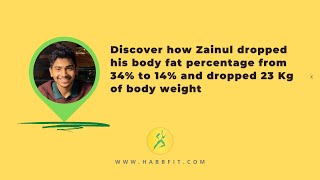
Zainul dropped from 92 kg and 34% body fat to 69 kg and 14% body fat by eating familiar foods like rice and biryani in controlled portions instead of extreme diets. His coach Aravind Padmaraju emphasized consistency and macro tracking over restriction, which stuck even while ordering from restaurants in Canada.
Chapters
Hi guys, uh, good evening. So this is Arvind, um, this is Arvind here, fitness coach, and I founded Haffit. As part of this, we do coaching and help people to get fit physically and mentally. So along with me, Mr. Jainul is there. So he's, uh, he's one of our client. and he did amazing transformation. And I think, um, he lost— he started his journey around 92 kgs and with the body fat percentage of 34%, if I'm not wrong. And then, um, I think now he's around 68 or 69 kgs with, uh, 15 to 14% body fat. So that's, uh, Jai, uh, Jai Noor's transformation. And we just wanted to see how was his journey and how he transformed himself, what were the struggles he faced before starting a fitness journey, and how did he actually overcome, and how did overall journey has been. So we're going to start. So hi, Zainul, how are you?
Uh, I'm good. Hi. Uh, well, I could just give a short introduction about myself. Um, my name is Zainul. Um, I'm from India. But like, I grew up in Dubai and now I'm just, I'm in university in Canada studying fine arts. That's great.
That's great. Then, yeah. So before you started, I still remember some of the questions which you asked during the journey before you started. That's when I was, when we were talking about, our main focus is going to be simply keep it simple as, as simple as possible. And you can continue to eat what you are eating and you continue to do, uh, you don't need to sacrifice anything. I still remember that, uh, you asked me a question, is it true? So, uh, is, uh, when, when you said that, uh, when you asked me that, you know, can I eat anything and still get fit? I said, yes, you can. So it's all about the reusing a science, uh, behind the weight loss or fat loss, we mainly call it as. And, uh, I just wanted to ask you, what was the main challenges you faced before starting a journey with Hapfit? So can you just give us a little, uh, what was your pain points? And yeah, of course.
I think, um, I think one of the, like, I was just in a misconception, I'd say, before I actually joined like Hapfit and started like the proper training program. I used to play sports before. I used to play cricket a lot before. And I think that's when I was fit because, I mean, that's just consistently playing every day. So just sort of makes you fit. And I never really thought about like diet and training at then because I just used to have fun playing cricket. But I'd say into the pandemic when like I stopped playing anything and I was just like stuck at home, I used to, when I eased down, I used to go to gym. And I think that was one of the biggest problems I had was consistency. And having a misconception of what I'm meant to eat. I used to try keto diets or like whatever I saw online, and I don't know, I think just in the inconsistency and the misconception that I need to stop eating certain things like didn't help me, uh, particularly. So I think that was one of the biggest problems I had. But I guess once like I realized that it's, it's about the right quantities and the right amount in the mix of the diet that matters more than what like specifically you eat, and also just being consistent with that diet and also consistent with the gym and with the other training that you're taking on. I think that was the most important part to actually seeing change. And I think I'd probably say the consistency and just the misconception of what to eat was probably what was— I was struggling with before I joined Hapfit.
That's, that's amazing. Yeah, I think most of the people actually go through this. Uh, they say that the moment, uh, We say that, you know, I need to start a fitness journey. They feel that they need to give up all the foods and, you know, your routine has to be 360 degrees different. So that's absolutely wrong. So what we did with Ajay Nool's transformation is we started focusing on small steps at a time. So first week, I think we focused on diet more and then slowly, slowly we introduced all the 6 simple steps. So, and he's been consistent. And I still remember when the first time I gave a diet, I said that you can still eat your rice, you can eat your mother cooked dal and all kind of chapati and other ones. So he, I still remember that you asked, can I eat rice? Can I eat ice cream part of my diet? I said, yes, you can still enjoy it. And can you just share your experience about that? And I know you, you are stretching me on this. Then I said, you can go ahead and eat. And still, can you just give me the introduction, uh, your experience about first few days, the few weeks? I think you were eating more, so much, but still you're losing. And I still remember, I don't know how it is happening. It's a kind of a magic you mentioned when we started.
Yeah, I think it was, it was just very surprising because I wasn't Uh, sort of, I think it was the perfect amount of food because I think what I used to do, at least before, or what I've seen in like the Indian culture is that you eat, you eat food, you eat a lot of food and like you eat to the point where you like go into like a, like you're just tired afterwards and you don't feel like doing anything. So what I, what I first realized from like the diet was it was the perfect amount of food. It wasn't too less that you were still hungry and it wasn't too much that like your stomach extremely full. You're bloated and you just want to go to sleep. So I think that's the one thing I felt, because it was actually energizing, the amount of food you eat. You felt healthy afterwards as well, and like, you just, you just felt better for the rest of the day. I think that was, that was a, like, a big change from my previous diets of, like, how I used to eat, like, maybe skip meals and then, like, eat a lot in one meal, which is obviously, like, very unhealthy. So, uh, this was, uh, in, in that sense, I'd say it was a big change. But one thing I noticed personally in Like, again, my dad, because like I used to eat, uh, properly at a, like, in an, in, in an Indian home was use a lot of oil in our food.
Yeah.
So that change was actually a big difference because it was the same exact food I would eat just with lesser oil. So you wouldn't even miss much of a change. You could, you could have like biryani. I remember, uh, because I was leaving for university, my mom would make biryani, but she could, she would just put less oil. So it would be the same amount of protein, the correct amount of rice. It's less oil, so it would still be like the same amount of healthy. Yeah. So I think just that was, that was a big difference that I could still eat whatever I wanted to eat, uh, just in the right quantities. And in that sense, it would also taste good, it would feel healthy, and you just feel energized for the rest of the day.
Yeah. And I think you, you mentioned the right point, uh, the taste. So most of the people thinks when they start a diet they have to eat the tasteless food. I think that is the biggest misconception. As long as you're eating within your calories, you can eat biryani, you pizza. I think you can even eat pasta. I still remember one week you asked about, can I eat a pasta? Then you had a good amount of pasta that week.
Pasta was a change. Yeah, pasta was really nice to eat. I had it a lot, a few times there.
Yeah. Yes. And another thing I wanted to ask you, uh, Jenu, is I think during this journey, I think you had a lot of travel between— I know you joined a new university and you had to travel. Uh, you have— I think this is the first time you are going out of your, uh, home, right? You all that, all, all these years you are with your family and you are able to prepare it. Your mother used to prepare the meals. So how would, how was your experience and how were you able to continue your still journey? I think I remember when you left in last December, you were around 80, somewhere I think 80 kg something, and but you still progressed a long journey from that time. So how, how we used to manage your food and even away from the home?
Yeah, I think that was a, that was one thing I was like very like worried about because I left, I left one month into when I started half fit. And in that one month itself, I'd seen like change because I'd lost like 4 to 5 kgs, I think. And like I was feeling healthy, but what I was worried about was as soon as I leave from here, like there's not gonna be home cooked food anymore. So like that's gonna be a struggle to deal with. Yeah, but sort of what I realized was, uh, when I came here was it doesn't have to be perfect. Like, I know it would be best if it was perfect, but like, it doesn't always work out. And like, my situation right now, I'm living alone. Yeah, I don't have enough time to sort of go cook the correct amount of food for everything. So certain days, I mean, breakfast is always easy, you just have eggs for breakfast, but for the rest of the meals, I wouldn't really have the time to cook. So I think if you, if you eat around the right ballpark, and generally here they put calories on every single thing that you order, and although they don't tell you the ingredients, you can sort of make out from what you eat, uh, how, how good it is in terms of how much protein it would have, how much oil it would have, and all those ingredients. So I think what I just did was rather than trying to be perfect with what I eat I just sort of went around the right area, and when I was doing that, I kept seeing change. So that's what I continued to do. And I think another thing that I did was I also, uh, in the middle for certain months, I would subscribe for these Indian restaurants that would, uh, that would do home delivery, different services. So they would send food every day, and just based on that, I would eat the right amount of like chapatis, the right amount of curry to eat with that. and I just try to follow it that way. And I focus more on the total number of calories rather than the each percent, like the each number of grams that I would have. So I think just as long as you're in the right, like, like ballpark, in the right area around what diet you should have, uh, it should be like, it should be all right from there.
Yeah, that's, that's awesome. Uh, I think you mentioned the right point. Uh, it's not about the perfection, it's about the progress. So that, that's one of the The right word you used. People, most of the times, they wait for the perfect time. And for example, there are some of the days if you go off track, they lose everything because I was not being perfect for the 2 days. It's not about perfection all the time. And first of all, there's no perfection. That's what you proved with your journey. As long as you be consistent, even if you are at 70%, 80% near to your plan, you can still see the result. So that's what happened with your journey as well. And also, I wanted to touch base one more point. I think one of the important points we also mentioned started during the— before we started our journey, I spoke about the mindset, and I remember you followed very strictly. And I think you wrote down that goal, and you also told me that day that our goal has been achieved whatever I have written is coming true. So can you just explain me about that and how would your overall journey has changed your mind and especially about your mindset and other stuff?
Yeah, so I think, um, that was a good day when we achieved the goal because I— when I wrote it down, to be honest, that was at the start of the journey, I'd say maybe the first, the first week. Yeah, and, uh, to be honest, I, I was still very unsure about like a training program. I wasn't sure how effective it would be, how it would work. So actually, when it, when it happened, it was, it was, it wasn't surprising because obviously I could see the progress till that day. But, uh, it was, it was good. Like, it felt, it felt great, obviously. I mean, you have a goal and you actually work to achieve the goal. Like, the entire process is there, so it's a nice It's a nice feeling. But, uh, in terms of mindset, I think at least I had this problem as well, and, uh, I think a lot of people have this problem, is that they focus too much on, uh, like the image of, of looking good as someone like they're working out. I think that's— even I had this problem. I would try to focus on how I look, how other people like see me, and I don't— I just realized after after you start to lose like the weight, or after you come closer to your goal, you start to realize that it isn't as important. Like, more important is what, what's your goal of how you want to look. And I think that's what people need to focus on more. It'll allow them to achieve their goals more. But also, just in terms of like mindset, again, I'd say is, um, you gotta just— it shows you what, like, if you eventually are able to like do this consistently and lose, like, uh, lose weight or achieve your goal. It shows you that you can do anything. And I think that it sort of makes you more confident even in your other— in all the other activities of your life, in your professional career, in your careers, whatever you're trying to achieve in the rest of your life. It just makes you more confident that if there's a process, if you stick to the process, uh, keep following it, then eventually everything will work out and you will be in the— like, you will achieve whatever your goal is. So I think it's just helped me be more— increase my own self-confidence and also, uh, just, just keep working. Like, I always have faith that if you just keep working, I will eventually, like, reach my goal and achieve whatever I want to in any part of my life.
That's awesome. That's awesome. I think you started using, uh, goal setting in other parts of your life as well. I think all the best for you. and I wish you to reach each and every goal. I think that is one of the biggest things we cover is a mindset. So if you see any kind of a fitness program, most of the times people talk about diet and exercise. Those are important, but without your mind set, nothing is going to work. So your mind is very powerful. What is the image in your mind actually dictates where you want to reach. So that's what exactly happened. And continue to use that in other parts of your life, I think you will grow to the bigger and bigger levels in your career and wherever you go. And apart from that, what is other things you learned during this journey? I think we certain point of time you started creating your own diet. I remember that, you know, right now you know how many, what is the macros, what is the proteins, and how is that is exactly helping you to, you know, continue your journey.
I think it's good, like, obviously in situations like these, since, uh, like, at least when you— maybe when you don't— when you don't know how to cook or you don't have like someone at home to cook you food like your mom, um, I think it's good in those situations because, uh, since I've almost— it's almost, almost been a year. I think it'll be a year next month in August that we started, so, um it, you, you just keep following it so much. Like, I, I know on the, on the diet sheet, at least now, now that it's been a year, like, I, I've almost stopped updating it on the diet sheet there because I just sort of do it in my head. But, uh, you remember exactly how much protein you're meant to have. And I think, at least for my diet, that was the most important thing, is the amount of protein I have, yeah, uh, matches like my strength training. But even the other ingredients, I think just Uh, if you know what, how much to have of each item, then it doesn't really matter what dish you have or what someone else tells you to have. You can, if, if you, if your entire diet and the dishes you have are mixed of all those, all those different ingredients, like a certain amount of protein, a certain amount of fat, a certain amount of carbs, if it's a mix of all of those, then it's fine as long as whatever you have. So yeah, I think that's what I did. I had a, I had a weighing scale for like my, like my food, a food weighing scale. I would pay the amount for each one and I would, I would have it based on that. So sometimes when I do have time, I actually try to cook and I focus on trying to make my own meals that can be my diet. But otherwise, otherwise I try to order from outside and sort of figure out my diet from there.
Yeah, I think it gives a lot of flexibility. So that's what, uh, as a half-fit, we— what we do is along with the journey, we also teach, um, what is most important for for you to continue it because I know you've been traveling and you're still able to consistently see the progress. That is, that has happened because you had that interest and you started, you know, doing that little extra effort to understand these macros and you're able to continue it. I'm really glad that, you know, you had, you actually understood what exactly it is and you took it as a challenge to learn. Uh, that. And what— how you are feeling right now? I think, I think it's one of the biggest achievement, and I'm really proud of you.
The, the way you actually—
your journey is something like, you know, it gives me goosebumps because I never saw, uh, especially with this teenage age, uh, you know, there are a lot of, uh, emotions and other, uh, you know, party, social life, all this comes into the picture. But you've been consistent and you're able to follow the plan and you achieved it. It's, I think, a remarkable achievement what you did. And I just wanted to understand what was your response around you and your family and what was their response when they saw your transformation? Maybe because a lot of people will like saw you before and now, right?
So Yeah, I think, uh, I think a lot of it is also just balance, like, in terms of the parts of your life. As long as you balance it equally, it should be fine. Uh, if you focus on one thing too much, obviously it'll be a little bit— it won't work. I, I— at least I don't believe it will work out well. Um, in terms of how I'm feeling now, uh, I feel like— obviously I feel, I feel good, like, in terms of how far I've come. But, uh, of course, I mean, uh, Arvind, he knows that there's, there's more of a goal, uh, we still have to work towards the final goal. So yeah, I guess still I'm still in the mood, like I'm still, I'm still sort of like, I just want to keep working, yeah, like improve my strength training, improve my body however I want to, reduce my body fat percentage. So, uh, yeah, still, still looking forward to achieving those goals. I'm still in that mindset, which is, uh, good. Uh, in terms of like how the reactions— I'd probably say it's a little bit annoying. Yeah, it gets, it gets too much when every single person— like, you go back, I go back to Dubai, and I— because I went back— when I left Dubai, I was still, I was still about 85 kgs, and when I went back the first time, I think I dropped to 70. Yeah, so that was good for a change there. And, uh, every single person I meet, my friends, my family my, like, family, friends, just any, any single person I met would be the same thing of just, uh, uh, oh, you've changed so much. Uh, how, how? And I'm just like, I don't know, just diet, gym. Like, what would you, what are you meant to say to that?
Unless—
because no one's willing to actually sit and take on an entire process of what you did. But yeah, I'd say it's nice at first, like, people can notice the change But after one point it does get a little annoying. But yeah, it's all— it's all— it's still nice. Everyone, everyone's still like appreciating what happened, what have you changed. So in that sense, it is nice.
Yeah, I think it gives you a lot of confidence and, you know, that happiness, right? So you really did something great. And that too because, um, one thing is very important is, uh, our body and our mind is the most important thing, uh, because these two are in your control. Every part of your life will be in control. I think, uh, that's that you are, that maybe you experienced it, that I experienced with my journey. That's how I started giving back to the people, and I want them to experience it. And, uh, yeah, I think that's, uh, about it. And I wanted to ask you one last question. Uh, I know we've gone into stages. I think, uh, what is— if you see the overall, uh, the way we focused is we focused on sustainable habits. So I know that right now most of your routine has been automatically happening. So what was your take on it and how you're going to take it forward? I think you already mentioned that you want to continue it, and I just wanted to ask you like how you want to do— how you want to continue it and what you want to tell the age on you or the people who are about to start their journey. So if you want to just say something so that it will help them to, you know, start their journey, and also it will give them a kind of a motivation. Definitely your story is very inspiring, and that will definitely help other people to also take it.
I think it's just a matter of time. I think the most important thing is if you stay consistent with it, at least for me, after like 2 months of consistently going gym and consistently following my diet, it sort of just becomes a habit for you. Like, till this date, if I, if I don't go gym for 2 days in a row, it feels like— sorry, in certain sense, if I miss gym 2 days in a row, yeah, that feels weird to me. Yeah. And like, I don't like— I feel agitated with that feeling, and I feel— I don't, I don't like it. So I think that's just a habit that gets built into you. And that's also with your diet. The day sort of if one day you sort of like let go. And I mean, this is kind of, this is kind of personally for me is at least when I let go and maybe I have one night I'd have like pizza or maybe I'd have like something unhealthy that I could have had something else that would be healthier. Uh, I feel a bit, a bit of guilt obviously. Uh, and I think that's just another thing as to your, how your habits change and you sort of then, although those, those things are tasty or you might like them, it gets to the point where you're actually not— like, like, you're not that— you're not craving it that much anymore, which is, which is good. Uh, at certain days, I guess having a pizza here or there, having ice cream here, there is obviously fine, uh, if you can control it within your diet. But, um, yeah, I think just if you do it consistently enough, it will turn into a habit, and it will— you'll, you'll see that it becomes a habit, at least with the gym. I think is a, is a big thing there is And even with your diet, I think if you have it for so long consistently, it doesn't— it can't just automatically change that your body just doesn't want to do it. Like, your body's stuck with that. It likes that because you're, you're making yourself healthier, you're becoming more energized. So you just tend to like that feeling more. And I think that's, that's what you push yourself to keep doing. So I think just having that consistency at the start to keep going. Yeah, because you won't see any changes at the start, but when you do start seeing changes that's when you'll be like, oh, this is actually working, so I should continue to do this. And then it'll eventually form into a habit, which is good. I think just sticking it out through the start and then finally making it to the end, I think that's the difficult part about forming it into a habit.
That's great, Jainul. And what is next? What is your next goal so that, you know, maybe a year later, I think we'll have one more interview, and maybe that time we will know, as I always say, that, you know, whatever we say, it will happen. So I just want to hit that and then we'll end the call.
What was, uh, you said my body fat percentage is 14 to 15%, right? Yeah, single digit body fat percentage, cool. Under 10%, I think that would be a good goal to set.
Awesome, awesome.
Yeah.
Okay, thank you, Jainul. Thank you so much for this time and, uh, keep inspiring. And, uh, I know, uh, your transformation is going to inspire millions and millions of people. So keep doing all the work and keep, keep writing down all your goals. And we, we, uh, during this journey, I think along with the fitness goal, I, I wish you to, um, reach each and every goal you write down will come true. And all my blessings and all my gratitude is with you. And take care and have a great day.
Thank you. Thank you very much. Yeah, I just want to say thank you as well. I mean Uh, you could say blessings and everything, but yeah, I gotta attribute it to you as well. Like, uh, thank you for like getting me into it and starting, because I guess if I didn't like meet you or start with you, that I wouldn't have seen any change. So thank you for that.
No problem. I think it's a pleasure. I think it's, uh, I think one of you have been one of most consistent, and, uh, the one, uh, great thing is it always gives me more happiness that, you know, You understood what exactly it is and you cracked the code. So that's what I can say. So keep continuing it and we're going to go much, much higher levels and keep progressing in our journey.
Yeah, thank you.
Take care. Take care, Jainul, and have a great day.
You too.
More from Dr.



Manifestation may feel less like chasing what you want and more like becoming the person....