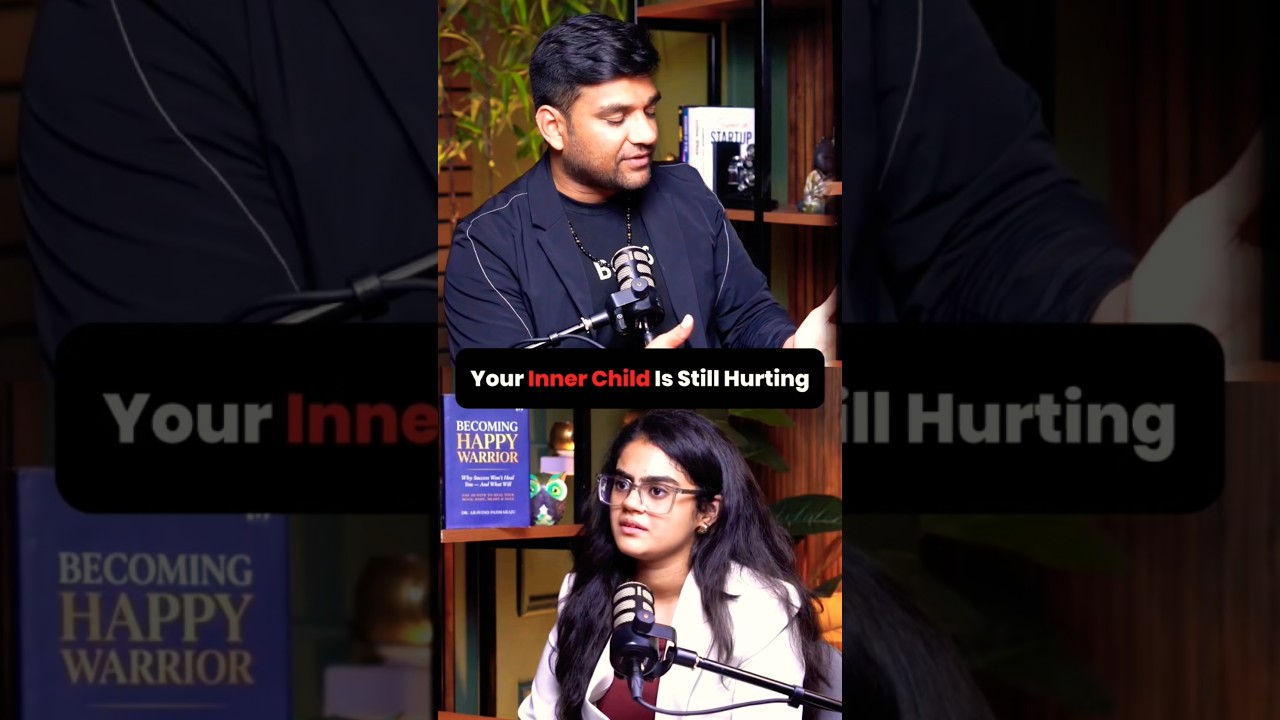
Effortless Weight Loss: Farooq's Journey to Losing 14Kgs with His Busy Schedule

In this interview, Dr. Aravind Padmaraju (host) talks with Sheikh Farooq, a mechanical engineer with a desk‑job, about his long‑standing struggle with weight gain and the successful transformation he achieved through the HAFIT (Hapfit) program. Farooq describes his previous unsustainable approaches—very low‑calorie meals, excessive cardio, and frequent weight regain—before discovering HAFIT via an online ad. He was attracted by the program’s promise that one can eat favorite foods while losing weight, which was explained through energy‑balance science. Over a three‑month structured course and subsequent self‑guided months, he lost a total of about 13–14 kg, dropping from 102 kg to 88–89 kg. The program emphasized small, daily “audibles” (short habit reminders), habit stacking, and flexible time‑management strategies (10,000 steps integrated into daily activities, short strength‑training sessions, water‑intake cues, sleep hygiene). Farooq highlights myth‑busting insights: weight loss does not require food deprivation or cardio‑only; instead, balanced nutrition, strength training, adequate sleep, and movement are key. He credits the community for positive competition and ongoing motivation. The interview concludes with a call to action for viewers to join a free workshop and adopt the HAFIT lifestyle, emphasizing that knowledge about one’s body is the true power for sustainable health.
Chapters
So welcome everyone once again, uh, for, um, HAFIT Lifestyle, um, the family. And we have one more amazing person with us, um, is Sheikh Farooq, and we're going to interview him about how journey and, um, how he transformed himself being overweight to, um, coming back to ideal weight, and, uh, that too by eating all his favorite foods. Having a busy working schedule and also going through all his family, along with the family commitments and other stuff. So without further ado, let's welcome Farooq. Welcome Farooq for this interview.
And I'm— Hi, hi, hi, Erwin.
Yes, so just Farooq, could you please little give your introduction about what you do and sort But then we will take it forward, this interview, further.
Yeah, yeah, definitely. Yeah, myself, Sheikh Farooq, and I'm a mechanical engineer, but I do a computer job. I'm a design engineer, so I have to be with the computer. So my job is some completely desk job. Hardly I travel, uh, or more of office. So being sitting, as you all know, that it helps you put a lot of weight. So I had to do something to oppose these things. So that's when I thought of half fit. Actually, because I'm doing this kind of these jobs, my job for the past 15 years, and in the past 15 years I I have gained my weight many times and then I, I tried to lose it again. But whenever I have lost my weight for 4 times before, but, uh, every time when I lose, I have to do a lot of hard work. I have to give up my food, I have to go on the excessive cardio, I have to, uh, literally it, it, it was like a punishment mode, huh, that you give to your body after every 2-3 this. So actually, I got fed up of that process. And then, um, yeah, so let me, uh, let me stop you there.
Uh, yeah, so I, I know that, um, I think, uh, I still remember when we had our first call, when we had a sales call and discovery. And I do remember some of the pain points you just now, whatever you mentioned. So basically, um, Farooq just came up, um, he always struggled almost like last 15 years, he's been struggling with gaining and losing weight. And finally, so how would you come across HAFIT? And could you please give us, before we get into the HAFIT, um, you came across, but what are some of the challenges you faced previously and, um, with your weight loss journey?
Yeah, so what I used to do is, um, because with my little knowledge, how, what I have, or, or with the surrounding, with the friends, what they suggested, what I used to do is like I, I Actually, I have a very small breakfast and lunch with the fruits, and then dinner— I had to skip the dinner. So this is my daily pattern. So when I do this for 3-4 months, I would see a 10 kg reduction. That too, with excessive cardio in the evening. I'm like, every day I had to do like 1-1.5 hours cardio. That's when I reached Like, I reach a reduction of like 10 kgs every time. But this last, uh, in the past 3 years, again the weight has gone up, but my mind was not accepting to do it again because every time you do the same, every time you lose it, like, uh, every time you gain your weight. So every time, um, uh, you work hard, but, but all your work hard goes to win because you stop it. And I, I kind of figure out that this is not sustainable. Then think it is not sustainable, how, how I can like do it? And again I go to the process. And the thing is, I, I used to hate doing that. That's great. So, so the, the first time my weight went above 100 kgs, so it went to 102 kgs. And I was like fed up because all my clothes were like not fitting me. And the COVID helped me, helped the weight gain again because I was sitting at home. And like, because of COVID I was not wearing my dress because I was working from home. One sudden day, I was like, I had to go for a meeting after the COVID and I tried all my pants and then no pants fitting me. So I was like very fed up with that situation. So that's when I said, okay, enough is enough, I have to do something, but I don't know what to do. So whenever I get a Humla La La like pop-up or whenever I get an advertisement in Facebook, I just go through it before happening. Uh, to be frank, like, uh, in 2-3 months I was looking for many such advertisements. Like, uh, some were convincing, some weren't convincing, convincing somewhere, some looks very easy, some doesn't look very easy. But one fine day, I saw Arvind's advertisement where I like— I don't know how it somehow connected. I thought, okay, this guy is talking something logic. And I thought, okay, let me just go through his process and understand how, what he could do. So that's when I signed up. And then, and then we had that call and then we started.
Yes. So yeah, um, I think, um, this is the normally a lot of people go through it, um, as Farooq has just mentioned. Even my journey was similar to what Farooq was saying, that, you know, every time you follow a diet, you get a result. The moment you achieve your goal, then you go back to your old habits and then you gain back again. So this cycle continues until and unless You need sustainability, as you rightly mentioned, Farooq. Sustainability will only come when you have the right approach. So what happened after we had a first call? So what made you to enroll for the program and what made you to take that decision?
Yeah, the decision-making point, to be frank, was that Arvind said that, huh, you can eat everything.
Yeah.
And then you can still lose the weight. So I was like, um, a little bit taken aback, but then he explained me the science, he explained me the energy balance. I, I thought, okay, um, this actually, huh, talks logic, so let me try. Because I somehow realized that, yes, we overeat a lot of time. But when he says that this is the science behind the gaining of weight and losing the weight, so I thought, okay, why not? It's just like you have to eat one plate less biryani than what you used to, but you can still eat it. So that actually was like, okay, I could do this. And to be frank, for the first 3 months of the journey, I always used to say to my wife that this is something that I can do it for my life, because this is not hard. This is very easy. It's easy, but it's completely fine. I can do this because I don't have to give up my food. But to be frank, it worked after I stopped. Like, we took the 3-month course, and after that also I still, every time I eat over it, I think like, okay, the next 2 meals I have to drop. If I like, uh, I'm always on a balanced diet, uh, as, as we always talk, like on a daily basis or on a weekly basis. I used to control my calorie like every, uh, on average every day I used to make sure that I'm below 2,000 calories consumption. So Uh, the mindset actually got developed through the entire process.
Okay, great. That's great. So the one of the main point which has attracted you is you can eat. I know that when you asked me a couple of times, even, uh, so I can really eat whatever I want and still lose weight, I said yes. I think now you can believe that you can, you can still eat whatever you want and lose weight, right? So what is one of the biggest change you saw? I know that you followed multiple clients and you followed our methodology of the overall pattern of what the process, what we have kept it, what we follow in Happeo. What is the main difference you saw in overall journey?
See, the difference what I will say is like, um, as I said, I could eat and then the losing of weight started happening with the mindset. Uh, there is like, um, good thing with Habit Happened is like every day, um, I used to get, uh, the messages and the, uh, what do you say, uh, the, the messages, audibles. Those things actually help because there are several days that you could go off because of your work, because of many situations. But, but the— your messages, your, your daily audibles kept me on. That never let me out of the track. And still I listen to the audibles, and then I feel like, um, I should, I should do this, I should do this, I should do this. Though we cannot do 100% everything, but we could still do, um, so what I thought good was like, I, I'm, uh, yesterday I was not doing anything, today I'm doing better. And like this feeling had gave me, um, a positive approach to do more, uh, uh, what do you say, um, the more habits to follow.
Yes.
So up until now I, I follow how almost most of the habits, um, yeah, some of them goes off, uh Some of them I couldn't follow due to my work load, but, but most of the habits I still follow and I still feel good. My body feels good because everything what I'm doing, it's helping my body.
That's great. So what was your starting weight and what was your journey so far? I think you are there with our 3 months transformation program.
So yes, I was there in the 3 months. Yeah, yeah. Yeah, so I started in last November. The first week of November is when I started my journey. Yeah, so when I started, I was around 102 kgs. Yeah, and the 3 months after the completion of my 3 months, I lost— I was at 93 kg. So in, in the— in that 3 months, I lost 9 kgs. Then I still continued that process. I continued, uh, like, um, until April, I lost, uh, uh, 5 more kgs. I was at 88 kgs. And after that, actually Ramadan came. So, um, Ramadan, um, in our home, um, every Muslim's home, they can relate to it. Um, you, you can't control yourself. But still, after that also, I'm, I'm following everything, uh, uh, as per, uh, the, the Hapfit rules, like the Hapfit habits. So I'm following most of them, and I'm still, uh, at 89 kg. So if you see, the net loss is around 13 kgs, which I feel like it's impressive.
Yeah, that's, that's amazing job. Um, the one interesting thing which I, which, um, whenever, when I created the whole system, the one thing is, um, you, you are with us during that time, you lost only 9 kgs, but beyond that you did it your own and still you lost additional 4 to 5 kgs with your own. That's a remarkable achievement, I can say. That's what we really wanted when we said that building habits is all about building the fitness and also taking fitness as a lifestyle. These are the two major principles where we work on, and I really, really need to appreciate the efforts. So as I always say, it's always a teamwork, and you just surrendered and you committed and just followed the system. And I really, really glad, and I appreciate your overall commitment towards the program. And first of all, congratulations for that amazing transformation.
And thank you, thank you. I should really thank you and Sushmita for this, for this, because it would have been very difficult without your advice and without your, what do you say, the training.
Yes. So what is, what is one of the, uh, some of the myths you had previously which is broken? Or if you say, um, what are the main key takeaways with this program? And do you have a confidence that you're going to manage or maintain your healthy and fit lifestyle for rest of your life? You got that confidence after the program?
Yes, definitely, definitely. Uh, the myth, what I would say is I had 2-3 myths actually before joining HAFIT. The first myth is, if you have to lose weight, you have to give up the food. That was the first myth. That was the most difficult.
That's common for most of the people. People think that they have to torture themselves.
Then the second one was, you have to do cardio. You have to do only cardio. That's when you lose— you have to sweat, then that's when you lose weight. Then I got to understand the science behind the energy balance. Then the other things which helps your body improve the your sleep quality, your water intake, then your steps. Actually, steps is, uh, it's, it's, it's a lighter version of cardio, but that helps. So those are the things actually I understood that how your energy balance work. Um, whatever you work, whenever you work, you're actually how your blood pumping is more. So how your body requires more energy, and for that more energy you need to give more food. So that concept I, I really understood. And then, then the, uh, strength training on the other side to improve your muscle mass, those, those were also very helpful to say.
That's great.
That's so, so the myths were those, but now I'm more clear about what I should do if I have to be healthy.
That's great, that's great, that's great, Farooq. And, uh, one more thing which I wanted to ask is, um, would you felt any time the overall process was too difficult to follow? Or, uh, because a lot of people thinks that, uh, being a working professional, being— I think you're a father too, and you have your own responsibilities at office, family. And I, I do understand that you, you even work long hours in your work, but how would you able to manage, uh, with this routine and how easy it was to follow even with this busy schedule.
Yeah, actually, I should say it wasn't difficult at all because what I got from Arvind is because he is also a working professional, he gives the idea what he follows. So those are the things that helped actually. The main thing here is the time management. If you could manage your time, you can do everything better. And then every, what I say, twice a week you will get audibles which would talk about time management, which will say that if you are skipping a day, no problem, fall back. Yeah. And what you should do to improve your steps in your available time. If you want to do your fitness training, like strength training, what you have to do in your available time. You have to do in your available time. Like, there were many examples that I could give. Like, Arvind always says that steps— you have to do 10,000 steps. Like, you don't have to dedicate a time for that. Just whenever you are browsing, just start walking. Whenever you are talking on a phone, just walk. So those kind of small, small ideas, yeah, really help you. Normally we don't drink water. Especially I was— I don't use to drink water. So he said, keep a bottle of water in front of you in the desk desk of your office. And then every now and then keep an alarm and then have a sip. So you complete your, um, like quantities of water that you should consume. Sleep, uh, how you should sleep, like how you have to, um, uh, keep your room completely dark, no screen timing during the sleeping hours, like before sleeping hours or after the, uh, immediately after the waking up. So those kind of things help the sleeping quality. Apart from that, like, calm, the strength training. Strength training, to be frank, he said that do it 3 days, do it 4 days. If you can't do it 3 days, then split it for this, for daily, for 10, 10, 15, 15 minutes. So you have all the flexibility. It's just you need to give that small extra effort to do it. The only thing that I, that I, I thought that we need to dedicate the time is for that strength training, like a small timing, uh, like 3, 3 days a week or 4 days a week. That normally how I, I normally used to plan on the weekdays, sorry, weekends. Uh, so 2 days comes in weekends and any of the 2 days from the weekdays. So, uh, not everyone is like busy for entire 5 days, so you get that half an hour time somewhere from your working slot. So those kind of time management tips have helped a lot to keep the entire process into the track, on the track. And to be frank, I follow the same now. Even now I get a call, I start walking. I don't dedicate my time to walk actually. Yeah, I, if I want to browse, I walk. If I want to read anything on my mobile phone, If I read Quran, I walk and read. So this is like, uh, uh, really help.
Small, small habits, which is—
yes, what you have to do when traveling. Uh, so if you're traveling, if you— if you— so how to maintain your calories, all those things that helped a lot. So every now and then, when I— when I— like, if a day goes bad, I used to, um, who have those audibles remembered that, yeah, I can do this, I can do this, how to fall back. So it really helps me up until now. I hope I listen to these audibles every now and then so I don't get out of the track.
Yeah, that's great, Farooq. So just to explain you, the people who are watching this interview, so audibles is kind of 6 to 7 minutes hacks where on a day-to-day people go through a lot of challenges as a working professional. And based on my own experience, how the things work for me, I created them and I give them as part of my, as part of my, the program. You be part of it. So if you are really wanted to understand whatever hacks and whatever the things which is Farooq has just mentioned, I am doing a workshop on coming Saturday. Around 10 AM. So it happens every Saturday. I want you to attend that and see how you can make fitness as a lifestyle, like how Farooq has made. And it is just a beginning, and, um, and you have so much of potential, and you can, you can literally eat whatever you can and still lose weight and maintain your health and fitness for rest of your life. So coming back to the interview, um, yes, Farooq, and So one thing, if I ask you, I think you always had that belief, right? I still remember that doing hard work is what gets results. But after attending the overall program, what is your belief right now?
See, that's what, the biggest success I would say here is Even after stopping the program, I could still maintain it. I could still manage everything by myself. That is the biggest achievement, I would say. That is the biggest takeaway from this program, I would say, because it has inculcated now. It became my lifestyle, I would say. Frankly speaking, if I can't follow everything, but I follow 60 to 70% of the thing, and 60 to 70% of the thing is also, uh, very good because I was at zero. I don't use to do anything after I stopped the workout. Now, after— even after stopping, I could do it because, uh, I have that knowledge. And that knowledge is power, I always say. So this is helping a lot. I know how the body works, how my body reacts, how— what I should eat, what I should not, what gives what gives me protein, what gives me fibers, all those things, you know. So it's, it's, it's like conscious eating now.
Yes.
And apart from that, there are other habits which are still being followed by me. Uh, some goes here and there, but, but most of them I still follow.
Yes, that's great, Farooq. And thank you for sharing all your experience. And I'm, um, it was, it was amazing journey to see your progress and see your success story. And, um, so before we conclude, um, I just wanted to know, like, what you want to tell the people who are there, who are working professionals, who are struggling like, uh, you, or, you know, like us previously. So what are the message you want to give it to them, and how would, uh, what, what is your last words to say to them?
Uh, my last word would be, uh, it's, it's As I said, um, in my last sentence, that knowledge is power. It's just we don't have the knowledge of how our body works. So once we understand it, we will definitely follow it. And then the understanding comes from learning, and Hapfit is that learning. So Hapfit is that school for you to learn about your body, about how the body works, how the energy balance work in your body, how you have to keep your body fit without much, uh, what do you say, um, effort, uh, without much, uh, hectic effort. It's, it's, it's, it's an easy thing. Um, we, we are doing this, uh, from our— you know, we used to do this in our childhood. It's, it's just now, um, we just lost in between in our life. So we, we can, we can bring that easily back. It's, it's It's just we need to understand our body. So you need to have that knowledge and Hapfit will definitely give you that knowledge.
Thank you. Thank you, Farooq, for— that's amazing. And keep continuing with the journey. And also the one last word, I think you're part of the new community, which is— so how was the community is helping you in overall? I know that beyond the program, you are— you, you, you used to— you still go through the courses and the knowledge mindset and the community engagement. So how would that is helping you in overall?
See, community actually— when I say community, community creates competition.
Yeah.
And in any competition, you always want to win. So, uh, this is also a community where everyone, when they post their progress, it definitely helps you. It definitely helps you to also break the barriers or achieve your goals. And also you want to post your success stories in those communities. So it really helps you in that way. And then this is a, what do you say, a positive competition. So you should all connect to that community and everyone around there helps each and everyone. So it's a very good thing to have.
That's amazing. So one last thing, so I forgot to ask you is how was your— I know that you are, you focused on fixing, getting into the ideal body fat and coming back to your best version of yourself. So how would it is impacting in all other areas of your life, your professional, personal life? Do you see any changes the way you— the way day goes? And is there any changes into your life?
See, it definitely helps. It definitely helps because as I said, your look When you look good, people compliment you, and when people compliment you, that gives you a lot of confidence. And then, uh, in the past 6 months, I have got a lot of compliments that you have lost a lot of weight, how you look good now. So that really helps, and then it would help anyone and everyone because everyone wants this compliment. So that has helped a lot personally. Yeah, uh I should say, from the past 6 months, I'm going to play cricket and that I can run as much as I can. I can be on the crease pitch to play for more 20 overs also, and I don't get, what do you say, tired, because the process has helped a lot. That otherwise, I'm like in 2-3 runs I normally get tired, but now it's very, very good. And also I go for running with my friends in my apartment. I can run for like 4.5 kilometers without stopping. So that has helped. Earlier I can't even run for a kilometer. Now, because I was doing with the habit, these things, so I can do this. And steps I can do this every day. And then it actually gives a lot of positive things in your body, consciously or unconsciously.
That's great, that's great. Thank you so much, Farooq, and thank you for taking time and giving this, your journey and your struggle. And I am sure this is going to inspire many people around there who was going through the kind of a journey or what you had. And, uh, so that's, that's all for, uh, today's, uh, the interview, guys. And, and what I wanted to just to share is, so I'm going to drop the link below, and there is a webinar which is happening on coming Saturday, 10 AM. If you think that you are struggling with your weight loss journey or health and your fitness, or you have any kind of challenges you're going through with your current health and fitness. So that is a workshop for you, and come and attend and see what is possible and what you can do by just simplifying the whole journey. So with that, we are ending this interview, and thanks once again, Farooq. And I want each one of you to type in, in the chat box, that more power to Farooq for giving, sharing his own experience and inspiring each one of you. So thank you for—
thank you, thank you. It was great talking to you after a long time. I wish I talked to you every now and then. And I really thank— should thank you and Sushmita for what I am now, and I hope to be like this always.
Okay, thank you guys, and I'll see you again in one more new interview soon. Till then, bye-bye, take care.
More from Dr.



Manifestation may feel less like chasing what you want and more like becoming the person....