How to Kickstart Your Health Transformation: Step-by-Step Guide!
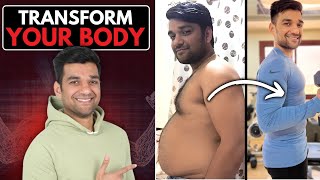
Aravind Padmaraju, Ph.D., walks through a six-step framework for health transformation: set a goal, calculate maintenance calories using body weight multipliers, create a 20-30% deficit for weight loss, eat 1.2g protein per kilogram of body weight, do strength training and 7,000-10,000 daily steps, and track weight and measurements weekly.
Chapters
Have you been struggling to start your health journey? Or you started your weight loss journey but you're never able to understand how exactly you can create and you can follow that for rest of your life? Or even if you lost your weight and you feel that is best, and finally you are totally confused how to start your fitness journey and how to start your health transformation journey, then if you watch this video, I'm gonna give you 6 to 7 simple steps a step-by-step approach how you can take your own health in a step-by-step manner video. And I want you to watch till the end and take every single step to get you transformed. Hi, my name is Arvind Padmaraju. I'm a health and wellness coach on a mission to transform every single parent to live a healthier and fitter life, holistic— holistically in every part of their life— physical, mental, emotional, and spiritual health. That's what you're going through. So what is the first step? First and foremost step you need to understand is you need to understand what is your goal. The first step is identify your goal, whether you are in excess weight or whether you are in a lower weight. According to that, your first goal to, um, for your first goal is to bringing back your— based on your height, you take that and multiply minus your current weight with your ideal weight. And if it is coming excess, then your goal should be a weight loss. If it is coming, uh, if you are staying lower than your ideal body weight, then your goal should be a weight gain. Okay, so once you identify the goal, the next importance you require to maintain your current weight. For example, you've been consistently on certain kind of a weight, that means you're currently— whatever you have, the food what you're taking and all the activities what you're doing, those all are getting balanced and you are able to maintain the same weight. If you are maintaining the same weight from say last 5 months or workout, you don't do any workout, you can multiply by 26. If you are doing some kind of a workout for 3 days or 4 days, at least 30 minutes every single day, you can multiply by 28. For example, uh, take example of a person who is 100 kgs. What is his maintenance calories? If he's not doing any workout, his maintenance is whatever it comes— it comes to, I think, around 1800 calories. If I don't mind, um, if I don't— if I'm, if I'm doing it correctly, it's around 1800 calories, and that would be your maintenance calories. What you need to do once you identify your maintenance calories, that step number 3 is identify excess weight. So the— if you are in a weight loss, so you can start with anywhere between 20 to 30% less than your maintenance calories. For example, if your calories are, say, 2,000 is your maintenance calories, you can start anywhere between 300 to 500, uh, the calories you can start the deficit with. But always start— your weight loss happens is When you start giving less than your energy requirement for your body, that is also called as a calorie deficit. That excess energy what your body is required, that energy what is you require, you're not giving it, that energy will be taken from your body fat. But how that body fat, I will explain you in the following video. It's— and you need to be in a calorie deficit. Once you start creating calorie deficit, the next step would be creating a balanced nutrition. Whatever that 2,000 calories what you want to consume You need to have distribute into all, all kind of nutrition. There are mainly 3 kind of nutrition what your body is— what is your body is required. So let's note down what is exactly you require. The protein minimum required is 1.2 grams into your current body weight. So 1.2 grams into— if you are 80 kgs, that means at least 100 grams of a protein you need to do a basic, uh, to maintain difficult for you to maintain your satiety levels. And the last but not the least is the carbohydrates. The rest of the calories you can take it from the calories, as long as your protein in check. And also make sure that you add fiber. Fiber is, um, which is very important for your gut health. Make sure that at least 25 to 30 grams. So still within the calories, you can literally eat carbs and still lose weight. There is a biggest misconception that losing, uh, if you eat carbs, you can't lose weight. It's all our BS. Okay, so once you distribute whatever that calories, uh, your calorie deficient diet calories into, uh, first thing. The second important thing is make sure that you have some kind of an activity so that you will be able to burn more calories. So significantly, scientifically, if you want to lose 1 kg of weight, you need to create 7,700 calories of deficit. That means if you're creating, say, 500 calories of mathematical calculation for your weight loss. And the second important thing, once you add your strength training and having at least a good amount of steps, like 7K to 10K steps, where you will, you will be burning somewhere around 200 to 300 calories by only you, because your hydration is very important. The second important thing is take care of your sleep. The sleep is very, very essential during the whole journey. If you don't sleep properly, you cannot adhere to your diet, and it also creates a craving It creates a cortisol, it creates a stress, and a lot of other things. So make sure that you sleep adequately at least week on week. So what you need to do every week when you're reducing, um, your weight, or period of a month, every month start recalculating what is your maintenance calories. What is the formula I told you? Your body weight into 26 if you are not working out, if your body weight into 28 if you're working out. By not only checking weight, also your body measurements, especially your waist measurements is one of the best way to see whether you are losing a fat. And also some of the other body parts like your chest, your hips, and your hands. And also see what are the other changes you're seeing. Your energy is increasing and you're feeling more energetic, you're feeling more strength. While your weight is stuck for more than 2 weeks of not— it is not going down, that means you are again hit into a maintenance calories. You readjust your calories by calculating your maintenance calories and do the 20% of that less and keep continuing. Doing it. So don't keep cutting down the calories because you cannot cut them to zero. This is the step-by-step process. What is the step 1? Create a clear-cut goal. What is your goal based on your current weight? Is it a weight loss or weight gain? The step 2 is identify your maintenance calories. So how is, uh, easy calculation? Your weight into 26 if you are not working out. If your weight into 20, less than your current body weight calories. Once you create your calorie deficient, uh, diet calories, the next step is creating the macronutrients within that calories. Okay, so what is, uh, important 3 macronutrients? Your proteins, fats, and carbohydrates. Protein should be at that calorie limit. So once you're done, the next 3 important things is make sure that you include strength training so that you don't lose muscle during the weight loss journey. The second important thing, make sure that you include steps so that you can burn little more calories so that you can lose at least 0.5 to 1 kg every week by using this formula. And progress should be checked in every single aspect, like your weight, your body measurements, your pictures, and your— the overall energy improvement and stamina improvement. Okay. And once you keep doing it, so when, when you keep on checking the progress, the moment when you see a week or 2 weeks you're not seeing any changes into your cut idea, so don't just blindly follow it. There is again the 3 important principles which I will tell you. The diet which you cannot sustain, which is not simple, which is not flexible, you cannot sustain, you cannot make that as a lifestyle. And the diet which is not sustainable, that means you have been eating the foods that should be there in this particular diet. Okay, so make sure that you're going to achieve it. So hope this particular thing, hope this video is useful. And I want you to identify what is your maintenance calories, what is your calorie split you're going to do, the proteins, your fats, and carbohydrates, and what is the water intake you're doing. So put that details in the below description. Also share in the below description. And I have an amazing gift, as I told you, and I am doing a 30-day daily warrior practice, which is basically to recondition your brain every single day and energize your mind, body, soul every single day. I am doing a 30-day challenge, so you can click on— you can— yeah. And the second thing, if you want a detailed thing, you want to work with me in this, I'm doing a free masterclass where I'm going to share 3 secrets where you're going to understand how you can maintain your ideal weight for rest of your life and lose it once and maintain it for rest of your life. So that I'm going to tell you, are 3 secrets. Are there 3 secrets? Uh, link also I have given you in the below, the webinar link. So click on that and register. And that's all from my side, guys. If you're still new to our channel, click on the subscribe button. And if you want this kind of value content keep coming to you, click on the bell icon. And I— you will be notified when I post my new video. And keep following and keep sharing this information because there are a lot of, um, information is not right. The people are following left and right center. Let them— by sharing this video to your friends and family members, let them also have a clear-cut idea how to— how they can maintain their weight in a step-by-step approach and how they can transform their health by using a step-by-step approach. Okay, so follow it, and if you need any help, also put it in the description. I will— I wanted to see your transformations, uh, starting by using this video. Take care, guys. Bye-bye. Love you all. Have a great day. I'll come back with one more new video. Take care.
More from Dr.






Manifestation may feel less like chasing what you want and more like becoming the person....