Perplexity Computer: The Tool That Does the Work For You

Ben Mills and Ary Aranguiz demo Perplexity Computer, an AI tool that automates professional work through reusable skills and connectors to services like HubSpot and Google Drive. A skill can research tools, build websites, and create marketing assets in minutes. They stress journaling daily tasks to find what to automate.
Chapters
It's not showing up.
Hey, welcome everybody. Thank you for joining us today. We have a jam-packed show today. We have a lot that we're covering with Perplexity, and we're so glad you can join us. My name is Ben Mills. I'm one of the co-founders of the AI Ready Business, and we— where we are committed to breaking down AI topics, uh, challenging topics, show you how to use AI more efficiently and effectively in both your personal and your business life. And for small business owners, how you can get your teams working together and how you can make it seamless. But get started right away. I'd also like to introduce my partner and co-founder, Ary Aranguiz.
Hey everybody, welcome, welcome! Let us know where you are calling from. Very happy to see everyone. Thanks for joining. We're gonna go ahead and get started with our usual disclaimer. As a reminder, this presentation is for informational purposes only, and participants are responsible for conducting their own independent assessment before adopting or relying on any AI tools or recommendations discussed. Attendees should carefully review each AI provider's confidentiality, data security, and privacy policies to ensure compliance with their organization's legal and regulatory requirements. Now that we have that out of the way, please say hello in the chat. Let us know where you're calling from and share your questions. We want to make this interactive as we've been doing every week. This is our 9th AI Power Lunch. Can you believe it? We are so excited to be here with you today and continue the conversation from last week about perplexity. So we'd love your questions. If we don't get to your questions, during our session, we will definitely DM you and post some answers on the, on the page, on the event page. Also, we would love it if you followed our LinkedIn page. We post all different kinds of resources. And on Saturdays, we're going to be sharing AI in the News to keep you updated on everything that's transpired regarding AI during the week. And that is a great way to stay informed and be prepared for all of the changes that are happening in our work life and in our personal life.
All right, Ary, before we get started, one question that keeps coming up that I get asked all the time, I get messages and emails and I have it when I'm at meetings, is that AI and AI is going to wipe their job away. and the world is changing real fast. Yes, it is changing fast, but we're a big believer is AI will not necessarily replace your job, but the person that knows AI could replace your job. And the way you gotta look at AI, it's not like just learning Excel and you're gonna be good then after a 3-hour seminar. You have to view AI now as a journey, an educational journey, probably for the rest of your life, that you're gonna continually have to keep up to date on AI. It's changing very quick. Since we started these Lunch and Learns 7, 8, 9 weeks ago, there's been significant changes to them as well, and they're constantly changing. That was behind our creation of the AI Ready Business. It helped people understand, break down the AI topics into bite-sized pieces that they could understand and use in their daily business and personal life. People need to know AI. You're going to learn AI and how it can help you in your business. And, and make things, uh, faster speed and delegate tasks and delegate skills and, and the everyday tasks to free up more time so you can stay focused. Because AI is a fast-changing world and it's a journey now. And if you're not devoting a couple hours a week, uh, several hours a month, you're gonna fall behind. And employers are looking at who knows AI and how it can be implemented from those that don't. And if you have no interest in learning AI, I think you will struggle in the workforce in the future, because there's not an industry or a job at any level of an organization that will not be in some way impacted by AI and all the different things AI can do. Yes, some are impacted more than others, but every company, every job, every position will be impacted by AI. So if you think you can put your head in the sand and forget about it, I would not recommend that. Embrace it and start learning. But with that said, I don't think you have to dedicate your whole life and be a coder and an AI tech person, eat, sleep, and drink it 24 hours a day. But you have to start getting comfortable with it. You have to start learning it. You have to start building it into your everyday tasks, work systems, and processes.
Yep, absolutely. And we wanted to take some time today before we dive into Perplexity, We wanted to share some of the most recent news, and we're going to start here. And again, this is not fearmongering. This is not to scare you. This is to help you prepare and to keep you informed. So you've probably seen— let me bring up the screen here. You've probably seen these announcements of different layoffs. For example, a couple of— like a week or so ago, Oracle, uh, had massive layoffs of over 30,000. And, uh, basically what they said is, uh, it's not that these 30,000 people have been replaced by AI, but all of the billions that they're saving in the labor is what they're going to be using now to build AI. And we also saw last week this blog post from Jack Dorsey. Jack Dorsey is the former CEO of Twitter, and, uh, he is now the CEO of Block, which is the financial technology that operates, um, apps like Square and Cash App. And basically, he is outlining in this blog post from Hierarchy to intelligence. He is proposing a completely different organizational structure that is based on intelligence, and they've laid off over 4,000, 4,000 employees to increase efficiency. He believes that our existing organizational structures are antiquated. They are centuries old. Very interesting history that he provides if you haven't read it yet. I highly recommend that you read it. I've also shared different posts where I've summarized it, so you can check out our post on our page where I'm summarizing. And I've condensed this into different videos and different posts. But he basically is proposing that there is an intelligence level, and at the core of a company, there is this— the intelligence lives in the AI systems and that the people are on the edge. He proposes 3 different roles. He calls these the individual contributor, who is the deep domain expertise, that person that has the deep expertise, who does the work, who can train the models, refine the models. Then there's the directly responsible individual, and that is equivalent to the manager, and that's the person who can oversee these systems, oversee the outcome of these models, and oversee the workflow from end to end. And then the player coaches, and the player coaches, he— that's almost like the senior, senior manager who will unblock the team and work with the system without adding extra layers, because in the new— in the age of AI, if we have these tools that make us faster, but we still have all of these handoffs and bottlenecks and layers of, uh, stuck-in approvals, then it's not— it— the AI is still not making us as efficient as it could be. So, uh, Jack Dorsey is proposing that there will be this huge transformation, that other organizations are also going to be redesigning their org structures based on intelligence with people on the edge in these types of different roles. Then just 2 days ago, we have Sam Altman's manifesto here that basically he is outlining his vision for redesigning and rebuilding society completely around AI and the need for government intervention. And he talks about how capitalism is no longer going to work and we're going to need public welfare, and there will be, uh, risk and concentration of power, and we need to address all these things, and, uh, we need to prepare for the gradual disruption. So they're building all of these tech giants. If you notice, there's the announcements of the layoffs And then there are these playbooks and manifestos that are published right after. So they're telling us, you know, they're showing us that they're building the infrastructure, they're positioning themselves and admitting that there are disruptions coming and letting us know that we need government interventions and we need to prepare ourselves. And Again, we at the AI Ready Business, this is why we built this business, this community, so that we can prepare for this future. I wanted to— any other thoughts? That's our soapbox there that we both got on, but I think it's important to keep people informed and that's why we're doing this. Any thoughts, Ben, before we jump into—
No, that's why we're doing these Lunch and Learns. That's why we're bringing awareness AI, that it's a journey, that you start— have to start learning it. Even if it's— if you don't love computers and love technology, it's a necessary skill set that's going to be looked upon. There's now articles out there that are saying AI skill sets are more valuable than an MBA skill set. It's worth a lot more to the business community. So it's something that I think everyone needs to embrace at all levels of the company, because the whole business model and organizational structures of how companies operate are being turned upside down and intro— with the introduction of AI. And, and roles are changing and the workforce is changing, and the workforce in the future is going to look different than the workforce that, that exists today. Uh, time will tell. Is it a year, 2 years, 5 years out? That can be debated. But I don't think anyone's going to debate that AI is not coming, AI is not changing, and AI is not going to up overdue or turn upside down the current business model. Maybe the speed can be debated, but it is coming. So the faster you can start learning, the faster you can start embracing. I think your marketability and your opportunity to have a job will stay and grow.
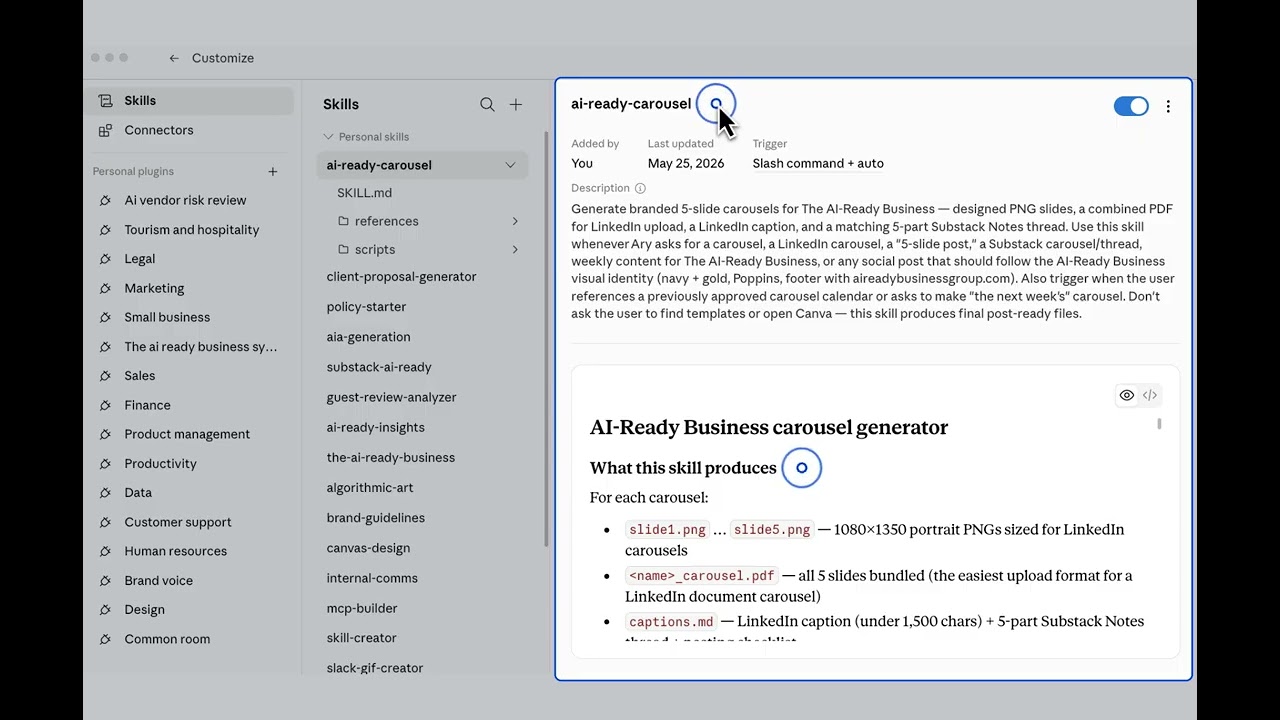
Yep, that's right. That's right. So diving into Perplexity and speaking about skills, when we look at— and this is Perplexity here, I'm on the When you go to Perplexity, perplexity.ai, and then you click on where it says computer, and you go down here to skills. When you look at a page like this, where you have skills, and this is very similar to what exists also in Claude Cowork, you need to stop thinking about this as features and start looking at these skills as people. These are the— this is the domain expertise that used to take people days, weeks, months to carry out all these different tasks. And now with AI, we can take our domain expertise, we can package those skills, that expertise, and scale it and be able to have anyone take advantage of it, leverage it use it, redefine it, repurpose it. And so the question is no longer, do you have the skill, but can you now upload that skill to AI, work with AI, and be able to build with AI and amplify your skills so that you're working with AI? So for example, in Perplexity Computer, I've built some skills. For example, we have built a skill that helps us build our webinar packages for the AI Power Lunch. You have here, you have some defaults here where you can prepare for sales calls, you can, uh, research competitors. We shared that with you, we shared that example last week. We also shared the example, the social listening example. You have sales drafting, researching a prospect, What used to take a paralegal days, weeks, months is now built in here and also in Claude CoWork, the legal compliance.
Mm-hmm.
Finance, what finance individuals, analysts used to be able to do, now this is packaged here as well as a skill. So you have all these examples and you can create your own. So I'm gonna show you a couple here that we created. Um, one of the skills that we created here was the— we use the skill of creating, um, and now this doesn't seem to be— let's see, there we go, perfect. We use the skill of being able to create a website to be able to do deep research And it created this website that compares project management tools. And I'll go ahead and enlarge it here so everybody could see. Project management tools compared. So the first thing that it did is we asked it to do some research on project management tools and then to create a comparison. It did research on that, and then we asked it to create this website. And it created this page here where then we can do our own analysis. So another thing that is changing is we need to start thinking in terms of how we analyze the input. We provide the input, it does the analysis for us, it does the interpretation, then it's up to us to validate that information, communicate that information, make decisions on it, and allow it to amplify our existing expertise, and then act on those insights. So now we could take this information, and it created this landing page for us in probably less than 5 minutes. Now we can act on it. We can either outsource whatever decision we want to as far as like if we decide whatever tool we want to use, we can outsource the action to AI and continue to have that conversation, or then we act on, on it ourselves. So those types of universal, um, workflow operations are, uh, part of, of the changes that are taking place. So another one that we want to show you is Let me come up here. We also created a marketing skill here where we leverage the existing marketing skill and we created our own that, uh, allows us to create all different types of marketing assets. So it's not just about the fact that we can now create the marketing assets, but the reason we're sharing this with you is again, so that you understand that whatever task, whatever knowledge work, institutional knowledge, with perplexity, you have the ability to create that skill. And Ben, I know that you had some additional information that you wanted to share regarding this.
Yeah, there's, there's all different things that you can generate with these skills. So what we often have people do is we often will ask them, break down your daily routine, your weekly routine, because the first thing I often and hear from people is, uh, AI can't do what I do every day. And so I said, well, keep a journal of what you do every day and what you do every week. Not because you're not working hard and you're not doing stuff, but what we have found is once you keep a journal, you find a lot of those routine, mundane, everyday administrative type tasks that can get automated with AI. And what does that do for you? That frees you up to get more focused on, on prospecting, get you more focused on dealing higher level issues. Because you're not, you know, you're not tied down to 2, 3 hours a day of administrative work. So what these skills and tasks can do is they can automate some of the mundane tasks, take them off your plate, and they free you up.
Yep, absolutely. And so another thing to think about, and again, I'm hearing computer, and here the computer has the list of tasks. These are all the tasks that I've carried out And you can even use the audio version here. So instead of— you can dictate what you want it to do, and it'll have all the files that it— all the outputs will be saved here so that you can search for them and the different formats. So reports, documents, spreadsheets, apps, presentations, images, because it even creates videos as well. Then connectors. Connectors are really important because again, it's creating your own mini AGI for yourself. Referring back to that Jack Dorsey model of the intelligence core, if you use these connectors, you are connecting your intelligence, your sources to Perplexity, and you can also do this in ChatGPT. You can also do this in Claude. And then you are creating a system for yourself. You are— you can— it's a force multiplier because this is where the intelligence lives, in these connectors here, the, the source material. And then you can assign it to do all different kinds of, of tasks on your behalf. So for example, you can connect it to HubSpot, and then Have it analyze your leads, have it generate, um, emails to follow up or thank-yous or any type of communication with your leads. You can have it research your Google Drive and search for specific documents, uh, categorize your documents. You can have it, uh, organize your Gmail, uh, your Outlook. Um, and an interesting one is with finance, for example. They're all diff— there are over 400 different connectors. So for example, you can connect it to QuickBooks. You can upload, for example, your input could be an expense report, um, a P&L, and then it can identify trends, anomalies It can help you with identifying where there's overspending, and then you can provide a summary or a report depending on, you know, who the audience is— your clients, your customer, your CFO, whomever. And then it can help you identify strategies for cutting costs or renegotiating with vendors. So There's so many different workflows, and the core here is creating, connecting it to these third-party tools and creating a workflow for yourself to, uh, be able to be more efficient, more productive, more creative, more innovative. So Ben, any other thoughts there?
No, I mean, these are all— these are the mundane tasks that I think anyone that's worked in the business community knows they can take a lot of time out of your day. And while they seem simple and easy, they— 2 or 3 hours can take, can blow by, and you're still looking at your expense reports, or you're still trying to figure out how to reach out to the 30 customers in your CRM system, and you're still trying to do these things. And the beauty of these tools is that they work behind the scenes, and they work 24 hours a day, 7 days a week. So they're very effective, and they can save you time. And save you time not because they're going to get rid of you, but it frees you up to spend more time focused on higher-level stuff. the higher priority stuff where you can really use your skill set. That's the workforce of the future, is using these tools to enhance the institutional knowledge that you have and the experience you have, away from a lot of the mundane tasks and more to the higher-level thought tasks that your experience in your career can bring.
That's right, that's right. And as you can see here, there's also different tools that many of you already use for sales, And you can connect it there as well. So with that, we are going to come back here and talk about our community and why our— with our community, you can have conversations with other professionals. small business owners who are facing the same challenges as you, and you can ask questions. We work with you to ensure you understand how to set up these tools. And as Ben has mentioned and I have mentioned, this is a journey. This is an ongoing process. This is not just one and done, but an ongoing journey. And working in community is the best way to be successful and to Keep— stay up to date with all of the changes that are coming at us so, so fast.
And then one thing I would add, whatever, wherever you look to get your AI knowledge, your AI information, if you're taking webinars, seminars on AI, look for the ones that are in small groups, more focused, more, more, less on theory, where you're actually going to work away with hands-on tools you can implement right away. Ary and I come across a lot of different— these communities where you log on and you're one of 200 or 300 people, and within the first 15 minutes of the seminar, you're, you know, people already lost. And then you'll never get that hour back of your life, and you didn't really learn anything. One thing we're focused on with our community is that our tutorials, our seminars, our events are capped at small numbers. When we do live events, and even some of them online, we require people to log on with computers, bring their computers Because the whole goal is that you leave with questions answered and tools that you can implement, implement it, implement immediately in your business, in your personal life. Um, that's the driver behind this. So the way you get access to all these different tools is through the newsletter. Subscribe to the newsletter and you instantly were going to become access to the tutorials, the AI community. And Ari just put up a sample of the newsletter that comes out, uh, the 1st and the 15th of every month. The issue that we had this past week highlighted Claude and some of the things that people use Claude for and Claude Cowork. And one of the examples that we talked about was how if you get a vendor contract, a vendor agreement, how AI can help you review the agreement for any clauses that you should be concerned about or that bring risk. It can compare it to the agreement that you've signed in prior years to see if any of the Any of the changes into the terms. And it also compares it to your industry. Is paying a vendor, you know, 40% of the contract industry standard on the high level? True story, we had a client who got an agreement, and the agreement said that it's a contingency that they only have to pay for the services if the consultant finds something, and the consultant wanted 50% of whatever he finds. Well, we ran it through AI. We found that that's very high for that industry and 40 is normal. 35 is even more normal. We went back and we were able to save the client, save 10% on the agreement of whatever the person found. That was real money. It was a couple thousand dollars at the end of the day simply by using the AI tool, simply by taking 4 or 5 minutes and running it through the AI tool. And it also highlighted some of the riskier parts of the agreement. And, you know, then you make business decisions, but at least they brought it to your attention. And this was all done without hiring a lawyer, without hiring any other external, uh, advisors to review the documents. It was done instantly through AI. But this newsletter, that's just one example, and every issue comes out with some quick wins, some quick hits, things you can implement right away. It's also linked to tutorials. It's also linked to a lot of different concerns and questions that Ari and I are constantly, uh, hearing. My background is a CPA, fractional CFO, so I work with a lot of small and mid-sized businesses. I see the challenges that they're facing. I see how AI is starting to impact their businesses. So everything that we're doing is to bring an awareness and help educate the team. I think Ari would agree, one of the biggest things that why AI fails in implementation, it's not because the tools don't work. It's a lot of times because of the training and the humans are behind the tools, or the data is not that good, or the processes are not that good. So we work hard to bring real results that can be acted on with AI, real results that you can use. I never advise to jump into the deep end of the pool with AI. We always say start slow, start learn, get comfortable, and grow with AI. And as your experience grows, you take on more and you implement more within the company. But it's definitely coming and changing. And that, you know, Yeah. And that's why we created this company to start your journey that you can tap in every week to Lunch and Learns. You have access to the newsletter, access to all the different AI tools, because there's a lot going on in the AI world. And it can be very overwhelming and very confusing. There's so many different tools. As we highlighted in one of our Lunch and Learns, every AI tool, while they all can do similar things, they all have strengths and weaknesses. Some are better at some things than others, and we try to break all this down for you in one convenient place. The other thing that we focus on is if there's a specific concern or question you have, let us know, and that's what the community does. It'll tackle that, or if you're having a problem or if you have a task or something within the company you would like AI to handle, share with the community because what we find is a lot of the people in the community, you're not alone and we're all facing the similar issues within our companies and how people are solving it. We're sharing all that information together.
Yep, that's right. Thank you, Ben. Ladies and gentlemen, thank you again for joining us this week. Next week we're going to dive into Gemini and some tools there that will again help you with productivity and efficiency and creativity. We thank you for your time, and we will see you next week. Thanks again, everyone.
More from Ary




Create and Automate a Scheduled Task in Claude that Scans for YouTube Videos about AI for SMBs