A New Way To Reverse Aging
NewLimit, a biotech startup founded in 2021, is using epigenetic reprogramming to reverse aging in cells. The company resets chemical marks on DNA to make old cells behave young again without changing their type, building on Shinya Yamanaka's earlier work. They test factor combinations on 7,500 frozen blood samples and use AI to predict which ones might work.
Chapters
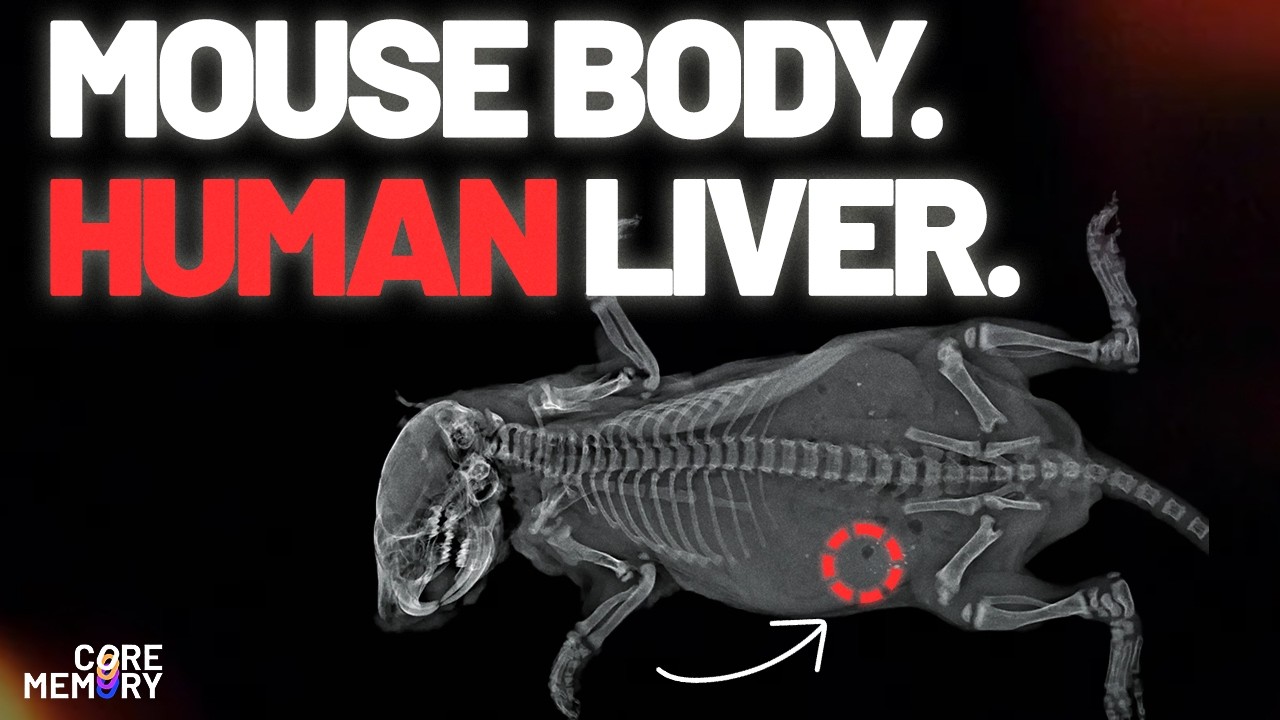
I'm going to tell you something about this mouse that's going to be hard to believe. This mouse has a human liver inside of it. Bit by bit, scientists killed off the mouse's liver cells and replaced them with human liver cells. And the point of this exercise is to try and engineer livers that stay younger and healthier for much longer than normal. Binge drinkers everywhere, rejoice! The science is being done here by a company called NewLimit. It's backed by billionaires, and it's attempting to reprogram life. NewLimit is hunting for proteins that can make not just livers, but brains, hearts, and other organs young again. And rather shockingly, it's making actual progress on this quest. Our guide for this episode will be this man, Jacob Kimmel. He's the president of NewLimit and one of its co-founders. And we're lucky because he's quite good at explaining complicated things. I've been here once before, it was probably like 18 months ago.
And for people who haven't learned about this technology, can you give us the overview of what you're trying to do?
So we work on a new technology called epigenetic reprogramming, and we're trying to make new types of medicines based on this tool that will allow us to treat age-related diseases and eventually the aging that occurs in every single person. Epigenetic reprogramming is a very weighty set of syllables, but it describes a pretty simple concept. All of the cells in your body have the exact same DNA code. Turns out that's controlled by a set of chemical modifications on top of the DNA, which basically tell each cell which genes to use and when. The tools we're using actually try and rewrite that code back to the way it was when you were young. So your old cells use the right genes at the right time and ideally behave a bit more like their younger selves and to eventually address the challenges that emerge as each of us get older.
That's wild.
I mean, I know we've talked about it, but this is helping wrap my head. I mean, so the cell's just sitting there and you're just reminding it to go flip some other switches back on.
You're just kind of reminding it the way you might have to remind yourself every once in a while with your to-do list. What's a high priority? What's not?
Nulimit started in 2021. One of its co-founders and biggest backers was Brian Armstrong, the CEO and co-founder of Coinbase. Recently, the company raised more than $100 million from Josh Kushner and Patrick Collison and a number of other rich people. And this big investment makes some sense. NuLimit is basically trying to become a pharmaceutical company that can defeat aging.
I think a lot of people have the intuition that aging has to happen or is in some way necessary for biology. Humans haven't, like, aged into extinction yet. So we know somewhere in this process there is a rejuvenation event occurring. And so whether we can make a medicine from it is a totally different question. And we hope to one day answer that in the affirmative, but we at least know it's possible. You know, in physics you'd call this, or mathematics, you'd call it an existence proof. We know what we're trying to do is not entirely crazy, maybe just crazy enough.
At the most basic level, NewLimit hopes to do two things. It wants to figure out the differences between young and old cells. And then it wants to find the right combination of proteins that can make old cells look and behave more like younger ones. It's akin to a giant math puzzle.
There's some science about 15 years ago from a remarkable scientist named Shinya Yamanaka, where he discovered that whole complex process could be achieved just by turning on a set of 4 genes at the same time. And so these genes are now known eponymously as the Yamanaka factors. And he won the Nobel Prize in 2012. You know, one of the quickest Nobel Prizes. I might add, because it's so profound, such an advance in the field. Yamanaka showed you can reprogram a cell's age while changing its cell type at the same time. So I take an old cell from an old mouse on death's door, turn it into a young stem cell. So it's both young, that's one big difference, the age changed, and it's now a stem cell, so the type changed at the same time. So somebody's shown you can break apart cell age and type reprogramming. Can we reprogram age without reprogramming type? To make a medicine for you, I don't want to turn you into a bag of stem cells. That would actually be really bad. What I want to do is take your old skin cells, your old liver cells, your old immune cells, and turn them into young versions of themselves. Prior belief was that this would just be way more complicated. You know, there are tens of thousands of genes in the genome, millions of molecular interactions. There's no way we could reset a cell from its developed adult age state back to this youthful embryonic one in a really simple activation of just 4 genes. And so his result, I think, really broke down a lot of the cognitive biases And so those genes are really special. They're called transcription factors. And I like to think of them as sort of like orchestra conductors in the genome. They don't really do much themselves, but they can point at other genes effectively and tell them when to play, when to turn on, when to turn off. I think of epi-reprogramming, the ability to turn on these combinations of transcription factors and see changes in cell state, be that cell age or cell type, it's really the most powerful change in cell function we've ever been able to evoke in biology. Biology.
To do its blood research, New Limit gets samples of old and young blood from humans and processes the samples here.
Okay, sweet box.
Our blood boy is Wes McKeithen, a senior scientist at the company. Super bright, huh?
Super bright. And it's just frozen, frozen, frozen blood.
Like a popsicle.
Yep.
Like, what counts as old and what counts as young?
Less than 30 is what we consider young. Older than 60, we're considering old. Okay. So we're all pretty disappointed to know that we're no longer young by our own criteria.
Yeah.
That was a bit eye-opening, I would say.
I know I am.
We have a blood sample here.
Okay.
First you get the blood.
That's a serious pipette. It's like a pipe.
So we're actually trying to get what are called the PBMCs, primary blood mononuclear cells.
Right, right.
So these are like the immune cells of your circulatory system.
This is kind of like the foundation cell for all the work that you're going to be doing.
All the research starts right here.
Yeah. Okay.
Little tagline for you there. I'm going to trademark that one.
Then you centrifuge the blood to get the exact cells you need.
Come on, boys. Going on a centrifuge hunt.
I think I can do it in here. I'm not sure. Oh, we moved the centrifuge.
Centrifuge.
Okay.
I swear they used to be in here. We might not have a centrifuge in here, actually.
What about— is this one?
Oh yeah, there you go. You know the lab better than I do.
I'm an all-purpose host, man.
But you'll have to picture the spinning in your head because we couldn't find an empty centrifuge.
We can't use this. This is actually in use. Okay, we gotta find a new centrifuge. Sorry.
It happens to the best of us.
Exactly.
Then you categorize and store the blood somewhere really cold.
Let's do it.
So that you can run experiments on it later.
Now, yeah, this is basically our biorepository.
It's like the donor library.
This is the donor library.
Okay.
It's about 7,500 vials that we've made since we started the company.
Each vial's a different donor?
Correct. So this is an example. So PBMC, there's 30 million cells in this vial. This is a unique moniker, and this is from a 64-year-old male.
Okay. Wow. That's cool.
And this blood work has Nulimit encouraged.
We think it's still very early days, but for a drug development program, this is pretty promising. You know, it's as fast as I've seen a program move because of some of the technology we built in T cells enabling us to move really quickly across cell types.
Basically what we're doing here is we have what are called microtiter plates. So each individual well becomes a different experiment. And so we'll put like some combination of a given donor and a transcription factor set. We co-culture those with cancer cells. Each of these red dots is the nucleus of a cancer cell.
Okay.
And so as we add T cells, it's this battle between the cancer cells trying to grow and the T cells trying to kill them. In this case, we're trying to test whether it's made the cells act younger. So we know that when we set this Ashlee Vance, that the young donors kill the cancer cells much more efficiently than the old donors. So we're now trying to see if these transcription factor sets can make those old donors kill to the same level as the young donors.
Yeah.
And so after, you know, a 72-hour period, if you look at like the whole plate level, we're able to measure like in these columns you have a lot more killing than you have in these columns here.
Yeah.
Reprogramming cell age, I think for a long time, it was difficult to even think about how you would find another set of factors. The tools didn't really exist. When Yamanaka found his first 4 factors, one of the reasons he was able to discover those was because he was changing the cell type at the same time. And so it was really easy to know when you had achieved the goal. You could just look at the cells under a microscope and you could see visually, these are a very different cell type than they started out as. And I think that's why finding these factors that reprogram age alone has been so tricky. Until recently, The difference between an old and a young liver cell, an old and a young skin cell, is not as apparent. And so we needed technologies like the ones we employ here at Near Limit where we can measure every gene that's being used in an old and a young cell at the level of each individual cell. This is called single-cell genomics. In order to be able to even ask if the experiment worked, if I test a set of factors, did I even make the old ones look younger? We needed tools that were high enough resolution that had the complexity to actually enable us to cancer in.
The single-cell inspections take place in here, in the DNA lab. This is where the samples are treated with different transcription factors and then analyzed by scientists like Tyler here.
I love it.
Nothing I do is very visually appealing.
No, no, that's good.
I just wanted to know your job is processing this stuff.
Exactly. So I'm given cells and then my job is to and turn them into machine-readable format.
Okay.
Yeah.
To do this, the scientists have to treat the cells and sift through them to get to the good stuff they actually care about.
So this is a 10x genomics machine. Mm-hmm.
So what this box does is that we use microfluidic chips, and what it'll do is actually it'll encapsulate approximately one cell with this thing called a gel bead. Proprietary technology that 10x uses.
It's like a barcode, essentially.
Yeah, a cell barcode. Yeah, that tags all the RNA within the cell with a unique identifier that we can read out later on using the sequencer.
Look at that, these things have gotten fancy. Before, we have to look at clumps of cells, clumps of DNA, right? And it's only the last like 5 to 10 years, really, 10-ish years. Yeah, like more mainstream.
So I think that the big benefit of it is it really allows you to just like snapshot a single cell in a single moment in time. So when you can kind of use that to see how, for example, like one of the transcription factors that we're applying to the cells affects the cell across its entire life cycle, as opposed to on average what all the cells in an individual sample are doing.
Yeah, so before it's like this big broad—
you know, the bulk on average trends, exactly. When you actually can know what individual cells are doing, it's looking at a an individual person, an individual house versus the whole neighborhood at the same time.
That's much better.
You've done this—
You know, I'm really proud of how many experiments we can do, but we've also got to be really clever about picking which questions do we even ask before we start trying to get an answer in the lab. And because of this AI revolution that's come to pass, now if we're able to gather a sample of that data, we can train AI models that are able to predict what might happen for a new combo of trends transcription factors that we've never tested before in the lab. And for us, those models don't even need to be perfect. We're not trying to get the model to answer the question necessarily. We're trying to get it to tell us if the question is even interesting to go ask. Yeah, limit the scope of what we're gonna do.
By far the weirdest part of NewLimit's work takes place in here.
My name's Yuxuan. I'm the scientist in the NewLimit. And here we study aging. And I'm in charge of the vivarium.
For these are the mice that have human livers inside of them.
Do you want to see some of them?
Yes.
But before I could learn everything about the mice, I needed to be humbled.
These ones are a lot smaller.
Yeah, that's how we ate and we gained weight. They accumulate a lot of fat on their belly. Does that sound like you?
Yes, it does.
This is the old mice. And then these are the young animals.
Like, how young would these be?
So these are the 3-month animal, and this is more than 2 years old.
More than 2 years. And mice live like 3 years, right?
Yeah. Almost on their like 70.
Yeah. I heard you talking about this mouse with the human liver on your—
on this presentation.
It's so crazy this works. It's so crazy this works. So we can't take credit for the idea that this works. Like, I can tell you a little about what we've innovated on, but These mice were actually invented by a member of our scientific advisory board called Marcus Grompe.
Okay.
So what we've been working on, and this is sort of where we started to introduce innovations on top of what our SAP member Marcus invented, is we've started working on actually building those livers with mixes of young and old cells rather than like one donor liver at a time. And then we can use genomics to actually ask what happened in the liver cells of each individual person. So rather than testing our medicines effectively in one human being who might be weak weird and idiosyncratic in their own way, we can mix cells from a bunch of people together and say, okay, which interventions that we try actually work in everybody? Because what we're trying to do is make medicines for everybody, not like donor number 6, which is what a lot of firms end up doing.
Here is our mouse facility, our vivarium. This is our mouse colony looks like. We put our most important mice in front. We transplant this mouse around 2 weeks ago. They are like genetic modified.
So this has human cells growing inside its liver. Okay.
So it's a kind of competition between the mouse cells and human cells. So you can still see some patch there.
What does the metal clip do?
The clip close the skin. It's already one week, so we can remove the clip right now. Oh my God. Okay.
And so over the course of a few months, what you end up with is a mouse that has very few mouse liver cells left. Mostly human liver cells. That's kind of crazy to think about, but you're holding a mouse that has basically a human tissue in it. And all of that circuitry, all of those genetic signals, are actually conserved across a lot of species. Yeah. And so these mice can actually live reasonably long periods of time with human liver cells in them, and they function just fine.
Well, that was less traumatic than I thought it was going to be.
No, no, no, no, no. It's very easy. They are working pretty well. Like, they were sick before, but because of the support from those human cells, they are now getting better and better. It can add up really quickly. Okay.
But like, other than that, there's no way to tell it as a human liver. No, of course not.
Old liver cells get way more damage than young cells do. Like, it's so dramatic you don't even need statistics. Many of us probably believe that because we've run the experiment in our own lives. So, you know, some personal— distributed replication, I should say, has been performed in this case. And we can put some of these sets of transcription factors in and dramatically reduce the amount of damage these cells experience. It's not a perfect model. Again, these mice aren't that big. They weigh about 30 grams, so I'm not gonna claim it predicts exactly what will happen in a human in the clinic. But it's a lot closer probably than what happens in a normal mouse and probably about as close as you can get before you get into human beings.
If you think back to something like antibiotics or penicillin being invented, if these guys get this right, the equivalent of that is happening in this lab right here in South San Francisco. So, early days. Long way to go, but if you're into this and you believe in it, this could be some pretty historic stuff.
Unlike many people in the biotech field, Jacob does not tend to overhype his company's progress. That said, he's confident that NuLimit is seeing positive results from its work.
You know, people hear we're trying to make you live longer, and then they get like 10 minutes into us talking and it's like, oh, it's all about livers, about these, like, tiny little 30-gram animals. Like, how much does this actually matter? We think where we're at today is that the results we have in animals using reprogramming are as strong as what some companies have used to go into the clinic and actually run human trials. We're not going to do that next year, and I don't want to overstate or overpromise there. But just to give you a sense of scale, the way we thought about this at NewLimit is that you need to start somewhere. If you spend your entire time on whiteboards trying to find to find what the perfect plan is that takes you to immortality from today, and you don't do anything until you find that perfect plan? Well, people have been whiteboarding around for a few hundred years and haven't found the perfect plan yet. And I think we've got the chance here with epiReprogramming. I really believe in sort of a bias for action that produces new information in the world. And I think the path we're on has the potential to add decades of healthy life every person. And so while yes, it may not be the solution to all problems, it's a big enough solution that it's worth working on.










