How Telescope Rancher Became The Hot New Job
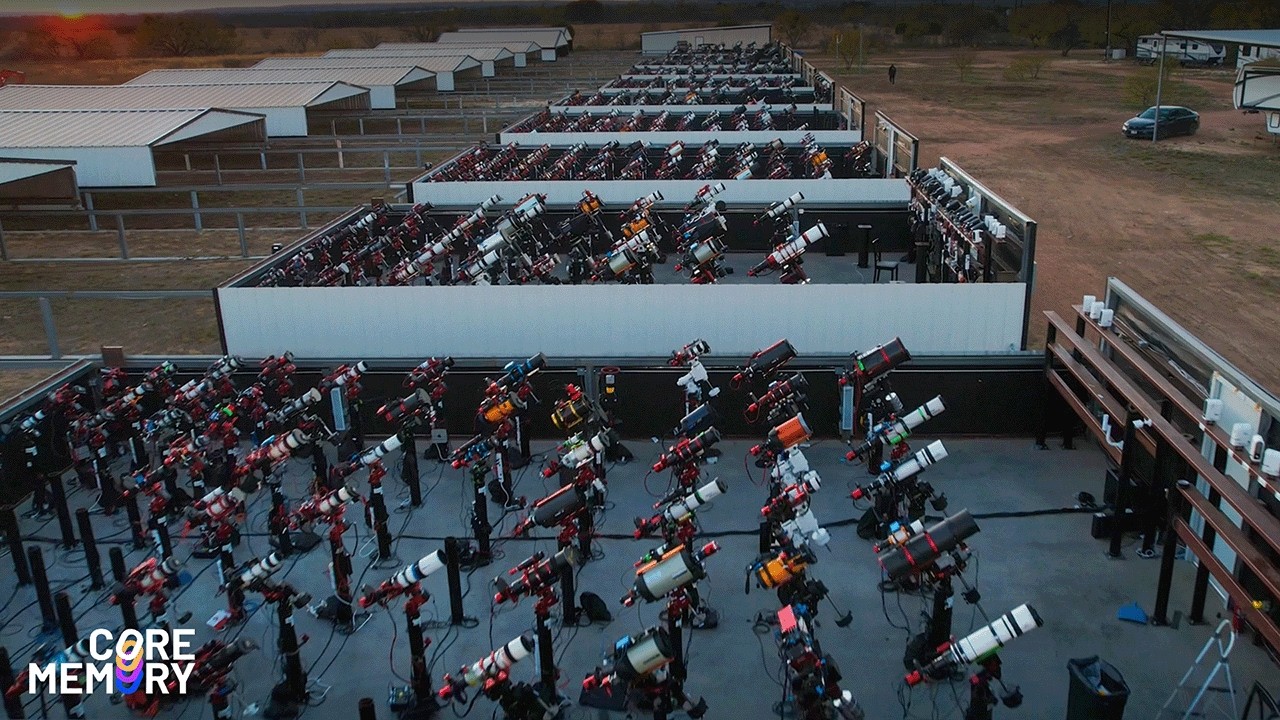
Ashlee Vance visits Starfront Observatories in Texas, a "telescope ranch" where customers store hundreds of their own telescopes on dark-sky land and control them remotely for $99 to $400 a month. The ranch hosts about 550 telescopes and adds a few daily, letting amateur astronomers see things like comet Lemon without leaving home.
Chapters
I'm a non-believer, but I'm not an absolute heathen. And as soon as I arrive in Texas, I try to find the best possible church of meat. In this case, the famed Cooper's Barbecue located in Llano, which should really be pronounced Yano, but remember the Alamo and all that. Here you can look at your meat and then select exactly what you desire. Beef brisket, of course. And then your meat follows you on a field trip through the sides and all them fixins. Ooh, we're gonna have a lot of fixins. Then you thank God and Cal for their inspiration and sacrifice. You eat, you thrive. But we're not really here to film me eating barbecue, for our mission is much more heavenly. I love this town. Look at it. It's perfect. Drove through so many of these when I was a kid. Every time I come back to Texas, I just feel normal. This is how I grew up. Feels right. It's like the right speed. Nice people. Free living. Good. We are on the outskirts of Brady, Texas now, which they like to say is the heart of Texas. Not because really it's the soul of Texas, but because it's the geographic center of Texas. I respect their big claims. Come see some telescopes, of all things. All the best shoots involve a dirt road. This is the entrance to Starfront Observatories. This is Sophie the duck. What do you think will be the next major advance that takes us to superintelligence? And this is Bray Falls, which sounds like a city in Texas.
I am one of the co-founders of Starfront Observatories, and what this place is is a remote observatory. It's in the middle of nowhere. There's no city lights. People from all around the world send their telescopes here to observe the night sky from this place with no light pollution. We set them up and they can all access their stuff through a computer remotely and then use their telescope to actually do observations or take photos. All right, this is the inside of building number 2.
What we have here is a very, very weird way to make a living. People send Bray their telescopes and he houses them in these buildings. And they're all just like starting out pointing this way. Yeah. Yeah.
Mm-hmm. This is the standard park position for all the mounts and they're all pointed north. At Polaris, or the North Celestial Pole.
Okay.
'Cause all of these have to be aligned, like, with the Earth's rotation, so everyone is gonna be at the exact same spot.
I try not to anthropomorphize things too much. There's something funny about them all sitting here waiting to do something.
I anthropomorphize all of them too. Like, these are all people, as well as scopes. Having your telescope in person, there's a whole host of logistical battles that you have to deal with. Like, one, you have to drive a far distance to even get out of the light pollution to be able to use your scope. And then you might not be able to guarantee that it's clear. You're going to have to pay for gas, a hotel, food. There's a whole costly adventure, and it leads people to not being able to do astronomy as much as they like. And so people have these whole setups that don't actually get utilized. But when you take it remote, there's no painful setup and logistical battle every single time you want to do astronomy. Everything is fastened with concrete anchors here into the floor. These are like solidly locked in here. And then this is the equatorial mount that tracks the motion of the sky, and it follows from east to west as the Earth rotates. So you can do like a long exposure super accurately, and it also lets you point everywhere around in the night sky you want to look at.
They almost all have these?
Yeah, basically everyone has one of these in one form or another. We try to make it as easy as possible to like get in the door, like So we have everything you need to get it running remotely.
Does any one of these jump out as this is an awesome telescope that everybody would really want?
Yours? Mine's the coolest one in here. It's intended for very fast photography. Each of these lenses is f/2, and so with 3 of them, I can get 3 times the exposure in a given amount of time, which lets me collect a ton of light. Super, super quickly.
Cool. How much did this cost?
Maybe all in like $20K with the filters and everything else.
So it's like a— it's an investment, man.
Yeah, but I do it professionally, so I was like, yeah, why not? I'm living here, I might as well.
You need an extra ballast.
Yeah, that's how you know I could afford the setup, but I couldn't afford to do the finishing touches like a nice counterweight. I just duct tape water bottles.
It is said that the stars at night are big and bright deep in the heart of Texas, and that is the point here. Stargazers want access to clear dark skies, and Bray gives them a chance to rent this slice of the heavens.
We broke ground here in May of 2024, so it's been about a year and 6 months since we started.
And how many telescopes?
550, I think, right now. We put in like 2 or 3 every day, so it's constantly growing. It's not a novel idea. There's a number of remote observatories throughout the world, but what we did here is opened it up to the broader market of consumers.
People pay— it's like a lease?
It's a monthly subscription. So our lowest cost is all the way down to like $99 a month, and at most it's $400 a month. Other observatories around the world have, you know, been like $3K per month.
You got 40 acres, and then if you expand, you just— you'll just build more of these behind each other.
Yeah, exactly. We're going to keep building until we presumably run out of space.
You're just going to be a telescope magnate. You already are.
Yeah. Telescope tycoon. I like tycoon better.
Bray is, in effect, some kind of modern shepherd, a herder and caretaker of telescopes out on ranch land. It's an odd real estate business, but a real estate business nonetheless. And it's one that we adore because it has science and curiosity and great imagery at its core. I feel like people have an emotional bond with their machines.
They do.
And it must be sort of sad to just Yeah, send it off to you and you tend it. Yeah, then you must feel pressure not to fuck it up.
Very. Yeah, it's very serious. Like, these are people's babies. I mean, my scopes are also my babies as well, so I take it very seriously. Um, yeah, I mean, a ship at harbor is safe, but that's not what a ship is for. And so like, a scope out here is gonna— while it is someone's baby, it's like, it's grown up. I'm just gonna go do some real things now.
As the sun began to set, Bray prepared the buildings and telescopes for action. Or rather, they really prepared themselves. It was all simple and satisfying. We happened to have arrived on a special night for viewing. There was a comet in our midst named Lemon.
Technically speaking, like, you could be anywhere in the world and do what I'm about to do to control the telescope. Off she goes.
She's slewing. She is slewing. How come everybody's not chasing the comet?
They might just not know because it's like the first day or two that it's been on this side of the sky.
Okay.
But there's the comet in one photo.
So that's from yesterday?
No, this is from right now.
This is right now?
Yeah, right now. Little comet.
No way, dude. You locked onto that quick.
Technology is amazing. Yeah, it's super easy with all this fancy telescope stuff.
Is this like old hat to you or are you excited right now?
Oh, I'm excited about this. I'm very— yeah, like the ion tail is very different every single night. So like every time you look at a comet, it's going to change. They're very fast moving, like even in the course of like 20 minutes, the tail, you can literally see the tail like move as it gets blown away by the solar wind.
Okay.
So it gets me excited every time.
How often does this comet come around?
This will be the only time in our lives.
Oh.
Yeah.
So we should appreciate this deeply.
Yeah.
Okay. The end results of all these telescopes are spectacular. Here's a collection of images Bray has produced and colorized with his own machines. Let the music and the stars soothe you.
This is a nebula I discovered from here with this telescope.
Do you get to name it?
I do. I haven't named it though.
Amid all this splendor, I sensed another business opportunity. Maybe we can do the Core Memory Brack Nebula.
The Core Memory Nebula, brought to you by Brack.
Yes! Yes! That is it. It's settled. That was legally binding.
The thing about naming nebulas is the name only sticks if everyone in the world agrees to call it that.
Moving forward, Starfront has plans to raise some money and open up a telescope ranch in Australia. And perhaps points beyond. And really, this is also a moment to celebrate the great state of Texas and all that it makes possible. Thank you, Texas. Up next, we visit the old Branch Davidian compound where the feds killed David Koresh and 79 other people, including women and children.
Y'all taping me? You are.










