Slate's Super Cheap, DIY Electric Truck
Hosts visit Detroit to explore Slate, a modular electric truck under $20,000 with 100,000 pre-orders launching production in 2026. They also tour Grounded RVs, which converts electric trucks into camper vans, and New Lab Detroit, an incubator in a restored train station fueling the city's EV startup scene.
Chapters
What's up, YouTube? I'm in Detroit, and we're going to go ahead and make some history. I've got this super sweet GMC Sierra 2026 all-electric truck. This thing has more cameras, more cameras, more cameras than I've ever seen before on a car. And since Detroit invented the car and the car camera, we're going to go ahead and shoot an entire episode of our show just with the cameras on this truck. So come along on the first part of our journey.
What do you mean it's not going to fit inside? Yeah, no, we're doing this whole thing with the car for this episode. You don't think there's room inside?
No.
Ah, we really want to bring the car in. Are you sure? The truck with all the cameras actually belongs to from GM. It's a 2026 all-electric GMC Sierra AT4 Max Range. It can go about 500 miles on a charge. And it's quite nice. Look, Mom, no hands! Oh, it's lane changing. GM let us borrow the truck for the week, hoping to prove that it knows how to make electric vehicles well. Look at that. That's pretty good. What GM did not know, however, was what we decided to do with their goodwill.
How you doing?
Good, how you guys doing? After reviewing the loaner agreement, we realized that GM's lawyers had not expected our levels of creativity and willingness to sell our souls. You guys are awesome, thank you for coming out here. And so we turned the truck over to these guys at Wrap Detroit. There she goes. And well, they borrowed the truck for a day and then did this. Meet Sexy Brexy. The Intelligent Finance Vehicle. Fan-fucking-tastic. While this subtle product placement is awesome, the truck is not really the point of this video. No, we are here to check in on Detroit and the state of its technology. And to prove that we're not in GM's pocket, our first stop was here at the hottest automotive startup in town.
Slate.
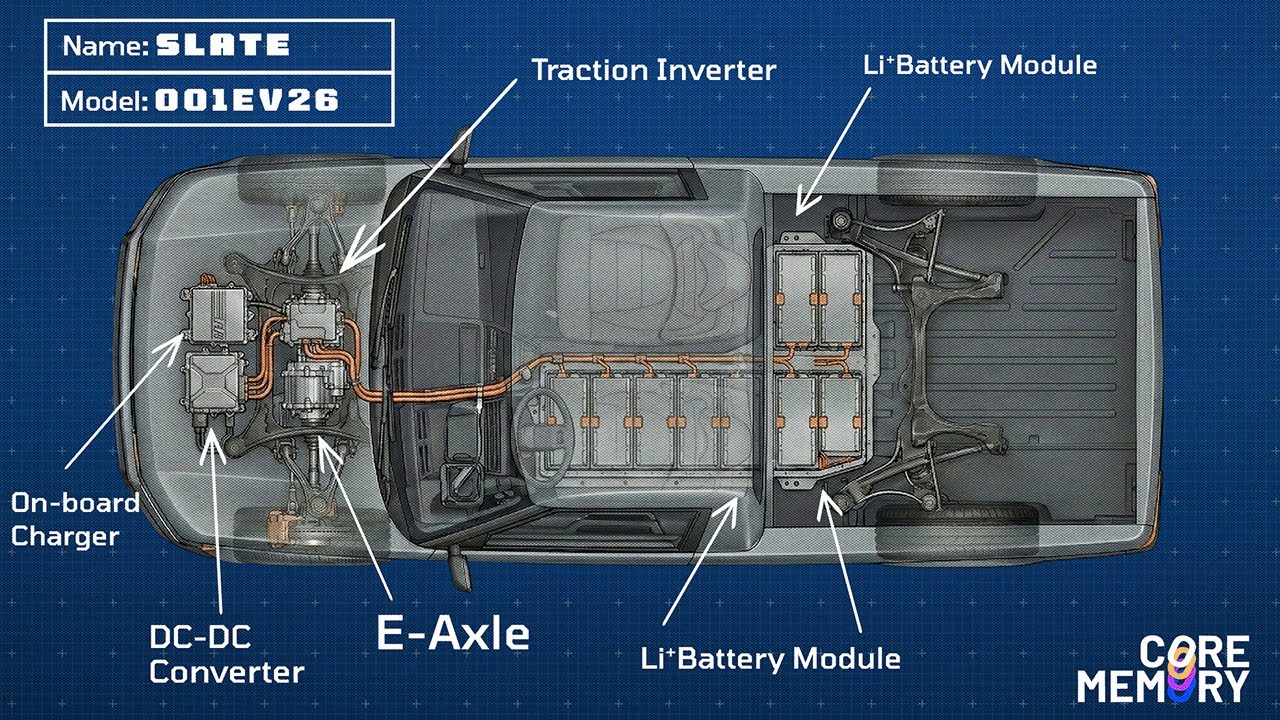
Slate revealed its electric truck back in April to a ton of fanfare. It's a no-frills, partially plastic, very customizable vehicle that was meant to start at less than $20,000. The price and all the add-ons really caught people's attention, including mine.
The reception's been fantastic. We do have over 100,000 orders, so we're very excited about that.
Slate is run by Chris Barman, She's a longtime auto industry exec, and she's never led a video crew like ours in the company's factory before. So thanks, Chris. Walk me through why you thought the world needed this type of vehicle.
It was about what if somebody made an affordable vehicle again? And like, what happened to those just basic vehicles that people had and loved that were very durable and very affordable, that were the entry-level brand of a new vehicle? Plymouth is gone.
Pontiac's gone.
Saturn's gone. Chevy's gone, Scion's gone. The average cost of a new vehicle is about $50,000. It's left a lot of people where their choice is to buy a used car because they just can't afford a new car. A Slate costs in the mid-20s. Brand new.
One sec, Chris. Actually, under $20,000 after current incentives.
Go ahead, Chris. It's like a potato head. Wait, maybe there's a better analogy.
Actually, there is. Slate is the chameleon of trucks and SUVs. Seriously. Just add the SUV kit.
There are 3.
The car's going to start around—
Mid-20s.
Mid-20s. And the business model here is all the accessories?
It is.
Yeah.
It's been designed as an open-source platform with mechanical electrical API, so you can change it into what you want it to be over time. You can change it into a 5-passenger SUV. You buy it as a 2-passenger because that's all you need. And maybe you get married and you start a family. And instead of having to go buy a whole new vehicle, You spend a few thousand dollars and you can start to take your family with you. You can wrap it to make it whatever color you want it. Because it's been designed to be wrapped, you don't have to remove parts. There's no complex curvature. It takes a few hours, not days, and it'll be a few hundred dollars, not thousands of dollars. This is our body in white. So this is as we receive it and start to hang parts on.
It sort of harkens back to the Saturn with its plastic body panels., and it harkens back to a bygone era with its cranked windows and absence of displays and infotainment systems. The windows being manual, everything's going to be like that.
Well, it'll come as standard and we'll offer an accessory. So if you really want power windows, you'll be able to accessorize it. But we wanted to make sure that we were really putting cost into places that people would truly appreciate and want it. So standard with Cruise, it does come standard with air conditioning. So it's not so spartan that we don't have, you know, some of those elements that people really appreciate.
Of course, the Trump administration messed up a lot of Slate's sales pitch through its tariffs and the scrapping of electric vehicle sales credits.
Previously, when we thought that the incentive was eligible, we would say starting below $20,000 with federal incentives.
Gotcha. Okay.
So we don't want to keep saying now like, oh, with state incentives. But if you look at some states, they do offer some pretty attractive incentives.
It can kind of sort of start at less than $20,000. If you squint and live in the right state. Naturally, I wanted to drive the thing, but Slate told me that was not an option, although it did not say why. We can go after the drive, right? So I don't know if you heard, but I cannot go on— I can't go on the drive. So I watched Chris drive it. Should I just run alongside it? How come you guys can ride in it and I can't? What the fuck? How does this make any sense? Slate says it has more than 100,000 orders, and its trucks are meant to start arriving in late 2026. These prototypes are being made in Detroit, which is a nice win for the city. The final vehicles, though, will be made at a plant in Warsaw, Indiana.
As we built the cars here, what's really important for us at this phase is we've been doing a lot of virtual design work, a lot of simulation, a lot of CAE modeling. And we need to confirm that it's right.
Yeah.
Before we actually start cutting tools and go into production. So we've built 74 of these beta prototypes. More than half of them are gonna be crashed. That's their purpose in life. And that'll feed into what we do when we do our next build in Warsaw, Indiana. Our operation in Warsaw will start production of customer sellable vehicles in the fourth quarter of 2026.
Yeah.
And by the end of '27, we'll ramp up to full volume, which we've projected and planned to be 150,000 units a year.
Customizing electric vehicles appears to be all the rage in Detroit at the moment, which is why I left Slate and went on a journey with this guy, Sam Shapiro.
This is Michigan Ave, the main drag from west to east. You can see the Detroit skyline. So this is the Corktown neighborhood. It's the oldest neighborhood in Detroit. They even kept the cobblestone streets from the original Corktown.
Sam runs a startup called Grounded RVs. They take a base model GM Bright Drop truck and then trick it out however you desire, whether you're a consumer or a business.
So it's a 13,000-square-foot facility. We're fabricating up to 4 vans a month. So when Grounded started, the product was the world's first fully electric camper van. And we had a bunch of consumers who were interested in electric RVs, but we also started having businesses reach out to us and ask us, can you build a women's health clinic on wheels that's electric? Can you build a mobile pet grooming studio? Can you build mobile podcasting studio? Some of these other use cases. This is where we process all of our raw materials. So we bring in sheets of foam that we use for insulation. Floor material, composite panels. We use recycled sheets for all the cabinetry. And then we had our own sort of house electrical system. That system is what powers the whole interior grounded part of the vehicle. And then we put a computer inside so that the customer themselves can see their own usage history and patterns, and the fleet manager can see the patterns of the driver. And then it's also useful for remote diagnostics.
As you might have heard, Detroit has been going through some things, and Grounded is a prime example of efforts being made to add new energy to the local economy. All right, here we are.
Here we are. This is New Lab slash The Book Depository.
This is where Grounded got its start.
Grounded got its start here.
Grounded came to life here at New Lab. It's a startup incubator of sorts that gives young companies access to R&D-style hardware.
There's really a variety of startups that are part of the New Lab ecosystem, both in New Lab Brooklyn and then now New Lab Detroit. Everything from autonomous drones and boats to manufacturing startups. Here is the general shop space. Any startup has access to the space, can sit down and use one of these tables for fabrication or prototyping. And then each of these rooms is sort of more specialized. So, you know, this is the Digifab room with the 3D printers. And then right next door, this room is the electronics prototyping lab. The room at the back is a woodshop. And then over in the back corner is more of a metalworking shop. So we built the first 3 Grounded Vans. It was right over there.
You had the van inside of here?
Yeah, I mean, it was just barely able to clear the clearance height of the garage to get in here.
Okay.
And so this is where I was till 4 or 5 in the morning. I'd be leaving this building and people would be coming in to work in the morning and see me leaving.
A new lab is right next to the old Detroit train station, which has also gotten a massive facelift.
I'm not sure exactly what year this picture is, but as you can see, it's gotten a hell of a makeover.
Yeah.
So this is sort of the grand hall.
Holy cow, man. Jesus. They did a good job.
It was either $600 or $700 million on this building, and then about $300 million on the Book Depository next door. The next phase is going to be they're opening a hotel on the top 2 floors, and then the back of the building, there's going to be a whole courtyard. This is a really cool room too. They took all these historic Detroit and Michigan Central posters. This is my favorite story in the train station. So that's the carriage house, and right up there on that metal patch, there was this beautiful gold clock. And at some point while this building had sat abandoned, somebody had stolen the clock. And so in 2018, Ford announced about the building We're gonna restore it. Flava Flav was like, "I've got the clock." So one day they get a letter, and basically what it said was, "I took the clock for safekeeping while this building was abandoned, and now that you're restoring it, I want to give it back. Come show up to this location at this time, and the clock will be there waiting for you." And sure enough, they went there, and it was wrapped up in furniture bags. Exactly where this person said it would be. And so the clock's right up there on display now.
Oh, holy cow. Okay.
And then that's a photo of it in the furniture bags leaning against the building where the person said it would be. It's a feel-good story and it's really emblematic of the Detroit culture that somebody would care that much and want to see it sort of saved.
It's gorgeous.
I love this.
It's so pretty.
The grounded RV seems to get attention wherever it goes. Yep.
This is really nice.
You guys are still at around 150 to 190?
Yeah. Yeah. Yeah.
Oh, this is—
oh, I have this all to myself. Is this a dishwasher?
This is a fridge, but we actually can do a dishwasher. And you got a microwave behind you.
What do I need a house for?
I love this.
I want to take it home now.
And so we took it on a ride around Detroit. Okay, so what brought you to Detroit?
In a very literal way, NuLab. I got in touch with the NuLab team in the summer of 2022, really while Grounded was still an idea, but I had identified Austin as maybe a good place to build Grounded, and I had a lease agreement that I was very close to signing, and the same week I got connected to Garrett at New Lab, and he said, "Don't sign that. Come to Detroit. Let me tell you about what's happening here." And within 48 hours, I decided that that made the most sense and had never stepped foot in Michigan before that.
And how do you feel about the decision now?
Couldn't be happier.
Yeah, why?
Couldn't be happier. There's just so much of talent here and physical resources, CapEx, shops, factories, that I think this is one of the best places imaginable in the country right now to build a hardware startup.
At one point, I got to watch Sam in full salesman mode after we stopped for a coffee in the Milwaukee Junction neighborhood.
So it's all electric. It's a 286-mile range. Electric camper van. Holy crap. 5-foot pull-out drawer. So this slides out and then these open.
Wow.
You can cook out here, put a—
or hide things in there.
Or hide things.
Yeah.
These materials are 100% recycled. And then there's a lot of seating up here, so you can pretty comfortably sit 3 or 4 people across. But I'll show you the bed.
Yeah, let me get out from under it. Oh, there's a shower! Not like a shower outside.
That's very nice. You got the shower, the indoor kitchen, induction stove, microwave, fridge, sink, hot water, and then these are overhead, overhead storage. Closet, pantry that slides out here.
Spice rack. Yeah.
That's what's up.
One on the bottom too. And then here's the bed.
Dun dun dun dun!
So you can leave it kind of halfway like this, or maybe a little higher, and then basically use it as bunk beds where some people are below and some people are—
That's pretty wild.
On the bed, or you can just bring it all the way down.










