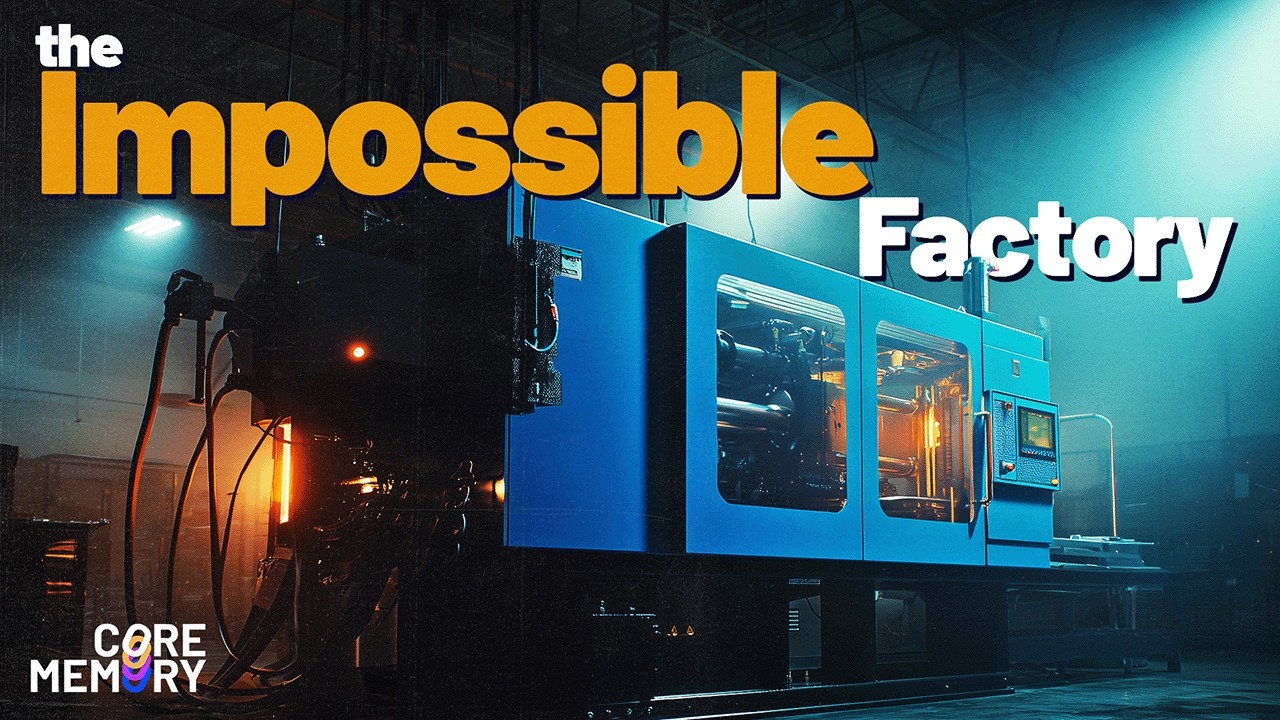
The video follows journalist Alex Levy as he explores Detroit’s push to revive American manufacturing through the Reindustrialize conference and the work of Atomic Industries. Levy meets founder Aaron Slodoff, who explains Atomic’s mission to digitize the trade of tool‑and‑die making with AI, turning skilled craftsmanship into data that can be replicated and scaled. Co‑founder Lou Young demonstrates the company’s injection‑molding workflow: sensor‑rich presses, AI‑generated conformal cooling waterlines, and 3D‑printed inserts that together produce “perfect” molds faster and cheaper than traditional methods. The discussion highlights the talent gap between the U.S. and China, positioning software as the only way to out‑scale Chinese mold shops. Levy then tours a nearby DIY factory run by Detroit entrepreneur Andy Didorosi, who bought a former car plant, refurbishes school buses, builds a self‑driving fire‑truck prototype, and uses viral YouTube content to fund his venture. Throughout, the narrative juxtaposes Detroit’s decaying infrastructure and high taxes with the community’s gritty ingenuity, portraying the city as a testing ground for bold, low‑resource innovation. The film frames the Reindustrialize conference as a patriotic rally for an “American Shenzhen,” while acknowledging the massive challenges of rebuilding manufacturing know‑how, talent pipelines, and economic support.
Chapters
As people in Detroit like to say, "We're not Cleveland." And Detroiters should be proud. They have beautiful parks, awesome houses, huge urban farms, a downtown, and magnificent public restrooms. Detroit, however, does remain very much caught between two worlds. The decaying remnants of what came before are everywhere. And then there's the hope for what Detroit can be in the future, as concerned citizens try their best to revitalize the city and push forward. Detroit had itself a major push-forward moment this summer when it hosted the second Reindustrialize conference downtown. As the name indicates, this was an ultra-patriotic affair aimed at trying to get the U.S. to make stuff. Off again. How do we make Detroit into the American Shenzhen, right? Since I'm a patriot, I strolled the conference halls to be a man of the people and of industry.
Hey, Alex Levy.
What's up?
How are you?
I loved kind of all the stuff you've been putting out recently.
Oh, thank you.
Hey.
How are you?
Good to see you.
Good to see you, man.
I'm just taking it in. Hey.
Hey.
I heard you're trying to build a city. Hi, we know each other. You're my favorite journalist. Oh, thanks, man. I really admire your work. Oh, thanks, dude. Hi.
Superstar around here.
Awesome. All right, thanks, Steven. Nice to meet you, man. Cheers. A new age manufacturing influencer in the wild. Reindustrialize had it all. Flying boats, defense tech, this. It also had Anduril founder Palmer Luckey. Well, sort of. Hello, Palmer? Are you in there? We're shaking hands.
There we go.
The future is here.
Dell was the last computer manufacturer in the United States.
I think that there's a lot of people who want to pretend that you can't get PCs in the United States.
Who is going to make an American computer again?
Well, I think there's a chance that it's going to be AMDALA.
The person who dreamed up this conference in the first place is this guy, Aaron Slodoff. And he runs this place here in Detroit. It's called Atomic Industries, and it's trying to bring manufacturing back to the US by modernizing tool and die making.
What we're focused on is honestly transferring a trade skill into an AI.
Okay.
This trade is called tool and die making. So this is the keystone to mass production. You have like a widget and you want to produce it in some volume consistently and reliably, you make a mold or some kind of tool.
So you're going to make the thing that's going to make the thing. You make a mold and that mold becomes the foundation of a bunch of car doors or airplane wing or whatever.
If we want to have any hope at accelerating the pace of development in the industrial base, we have to be able to digitize trade skills to preserve them, replicate them, and then ultimately scale them rapidly.
This collection of machines are what's needed to make the tools, molds, and other parts at the heart of mass production. Once upon a time, the U.S. made these types of machines and had mastered these skills.. But cut to 2025, and China is now the unquestioned tool and die-making capital of the world. Atomic's big plan is to learn from these machines and from skilled craftspeople by watching them work. Then it wants to use software and AI not just to mimic those skills, but to improve on them. It wants to make parts faster, cheaper, and better than even the most skilled human ever could. If it's able to pull this off, then perhaps the U.S. can make a great manufacturing leap forward. And so the U.S. used to make machines like this or like a different era?
No, they would make them like this for sure. Going back way '40s, '50s, '60s.
So it died out in the '70s and '80s?
Yeah.
To get a feel for how tool and die making works, we did a manufacturing stroll with Atomex co-founder Lou Young.
So this is the injection molding machine. So it's a 1,000-ton injection press, 500-ton. We have a 240-ton over there. Each one of these machines is unique for us because every injection tool we build, we put a lot of sensors in it because of getting back that data while we're running that trains our models further. There's molds to make cell phone cases here, there's drone components, anything that you can think about a plastic Essentially gets built in one of these types of molds, and each one of these molds is its own complicated engineering problem. So like, this would be a core and a cavity block. So these two things fit together and there's a gap inside. You shoot that melted plastic in between it. So those cooling channels inside of there are what dictates how long and how well this mold is cooling that plastic. There's more optimizations than just this cooling. Where you put the gate, like where the plastic is entering the cavity, plays a big role. And these holes here are ejector pins. These pins actually push that part off. There's only one perfect tool design for a given part geometry, and our software's goal is to hit that. And then we get to run that holy grail mold for part production. So we'll produce parts better, faster, cheaper than anyone because all of our molds are better than anyone else's. So when we were talking about that optimized waterline cooling system, we have software that autonomously designs waterlines that follow the shape of the part, so they're not drilled straight round holes. When you do that, you can't drill your waterlines anymore, you need to 3D print them. So those waterline systems, we call them conformal cooling in an injection mold, they have the best cooling performance for an injection mold. This is a plate full of tooling inserts that has, you know, crazy waterline designs that are following this part shape. But over here, our software is getting trained not just how to build and design the perfect optimized injection mold. As it's designing this mold, it's also understanding how it's fabricated. So when it makes a certain waterline design, it knows it now needs to print that insert on here. The software is literally like, I designed this component with this waterline system in it, with this gate load, with these holes. I know they need to be fabricated on this machine and this machine and this machine with this cutter using this cutter path. So it's developing that strategy along with the design.
Yeah.
If you talk to anybody in industry, having a piece of software that can design a production-grade mold for something is literally insane.
Okay.
They would basically tell you that it's probably fake. So, which is cool. We evolved from software to this factory to show that the designs that our software created could be applied to real mold making. The next phase is starting to make parts using the molds that we make. So we're in the process right now of building another factory that's going to be basically just like a giant production facility.
Let's be clear, the gleaming future proposed by Atomic will take an incredible amount of work to pull off. The company's software will need to be spectacular to have any hope of outflanking China's manufacturing might. And its mission will require the U.S. to rediscover its manufacturing know-how.
There's not a lot of people going into the trade, especially in the United States. The biggest tool builder in North America is actually over in Canada, and they have 26, 27 mold designers. There's shops in China that have 60, 70, 80, 100 mold designers. The scale at which they're able to build tools over there dwarfs anything we can do here. Our only hope to ever dwarf them is with software.
Yeah.
The reason that we built the company here, this skill is not available in the level of concentration it is in this zip code anywhere else in the United States.
I've worked in plastic injection tool building and injection molding since before I graduated high school. My father was a mold maker as well, from generation.
Are you from Detroit?
Yeah.
The industrial DNA of Detroit and all the toolmaking history and families that came up here, I'm not trying to get rid of these people or replace them, trying to turn them into superhumans, basically.
It's here that we could hit you next with the gratuitous ruin porn that so often follows stories about Detroit. But we're gonna do something a little different because there's a spot I wanna show you that gets at what was and what could be.
Andy.
We've come to your factory. Hello.
Ready to begin?
Yes.
Hi.
This is wild.
Welcome to the factory.
Thank you. Yeah. Does it have a name?
Not yet, no.
Andy Diterossi is a Detroit native, a relentless entrepreneur, and like all of us now, he's a YouTuber.
I bought this building in 2021. In early 2022, I was walking out one night and I was like, hey guys, I bought this car factory. I bought a car factory and I'm going to fix up this old place to make it something awesome.
So follow along.
Post it, put my phone down, went to bed, and I woke up to 100,000 followers.
He bought this factory a couple of years ago, partially to manufacture content and partially to pursue his automotive projects.
4 years ago, I bought this giant car factory to start it up again and start making my own affordable truck. But instead, I stuffed this place with all the cool things I could find on Facebook Marketplace. I'm going to have one giant auction on August 16th where everything starts at just $1. The moment I bought my car factory, people started to try breaking in. So the plan now is to replace my old boring gate with a massive battle gate that's over 40 feet long and 8 feet tall. We've been broken into like 5 times. We had someone steal all of the batteries out of the buses. That was like $5,000 or $6,000 worth of batteries. We had someone cut all the ends off the battery cables for the lead, which is like a buck apiece at the scrapyard, but it caused probably $10,000 worth of damage to the buses. We had someone steal all the catalytic converters. So I'm trying to find that balance between making something exciting that hits the internet the right way, that it sort of takes off, but also keeping the progress going where we're actually going to use this giant gate to keep our place safe.
Did your parents work in the car industry?
No one. Grandpa was a paperwork guy at Detroit Diesel. Grandma was secretary at General Motors. My mom was a legal aide at Detroit Diesel. My grandpa's brother put every horn into every '53 Packard. I made. He said, "I didn't take a day off, I didn't miss a car. So if it's a '53 Packard, I put that horn in there," you know, and there's like a deep pride with that. We are in a city that was built so quickly, you know, you had the auto boom and then you had the war boom, which brought us even more money.
Behind the scenes in a U.S.
war plant, the famous American Auto Assembly line has been converted to speed equipment for war. And then 25 years later, everyone gets up and leaves. It's like a hurricane hit the city without water. You know, it's like a financial hurricane. So this door kind of tells the whole story. They painted this on the door so that when people were walking up from the parking lot, they wouldn't even get to the door before they found out that there weren't jobs here. I grew up here and I've watched factories like this close all the time and they just let everybody go. And so I wanted to save one of these instead of watching another one crumble into the earth.
Opa!
Normally someone would whitewash this whole thing or turn it into like a self-storage place or something.
And you said it was $700,000?
$700,000 for 55,000 square feet.
55,000. Holy cow. Yeah. And it's like 5 buildings.
It's 5 buildings. It's on 2.5 acres of land. And it totally needs everything.
Yeah.
You know, 28 years ago they had a big fire here. And so there's a bunch of smoke damage they left and, you know, wobbly parts of the roof. So these signs, I was on the government auctions one night And these are the navigational signs from the Tulsa International Airport.
Yeah, now I get it.
Yep. I have my home here, I have my business here. We have huge taxes, we get almost nothing back in city services, public safety is bad, traffic safety is bad, but where else in the world could you buy your own former factory as a 34-year-old than Detroit? So this is where we service the buses.
So you buy school buses and then just fix them?
Yeah, so we get school buses that are like 8 or 9 years old and we totally strip them down and renovate them. This is a self-driving fire truck that we built. You can drive this with a remote control and you can also email it. So if you email it, it'll go forward, back, left, right.
You can email it?
You can email it. So this was going to be a marketing project for a new email service.
Okay.
Um, and so—
So is it self-driving or—
Well, you drive it with this.
Okay.
And then we made a little brain box. So in here is all the stuff you need to make any vehicle, like, self-driving with servos.
Okay, so this is mostly marketing to get attention.
It is for marketing, but there's a lot cheaper ways to get attention. What I'm trying to do is I'm trying to wave a flag to attract the right sort of people to make the kind of innovation stuff we want to make here. This building and these projects perfectly encapsulates, like, what we have to do as a city where We've got to run the bus company and fix cars and do YouTube and stuff to like pay the bills because there's very little economic activity locally. And so you look around and you see there's all these like maintenance projects and roof leaks and tarps and stuff that we need to like keep this place alive. This is exactly what it feels like to be a Detroiter frequently. Yeah. We're constantly fighting for survival, you know. But that's sort of where cool things come out of, you know, necessity is the mother of invention.
Yeah, yeah.
Like I go to like Mountain View and I see the comfort and luxury and the pace of what, you know, Google is doing, and I don't see that as fertile ground for something new and exciting.
Gotten soft.
You've gotten soft, you know? But I think that when you have too much resource, it's hard to be really inventive because, like, man, life's comfortable. But here we can't stay put. We have to keep moving.