The Inventors And Big Ideas Trying To Save Detroit From Economic Ruin
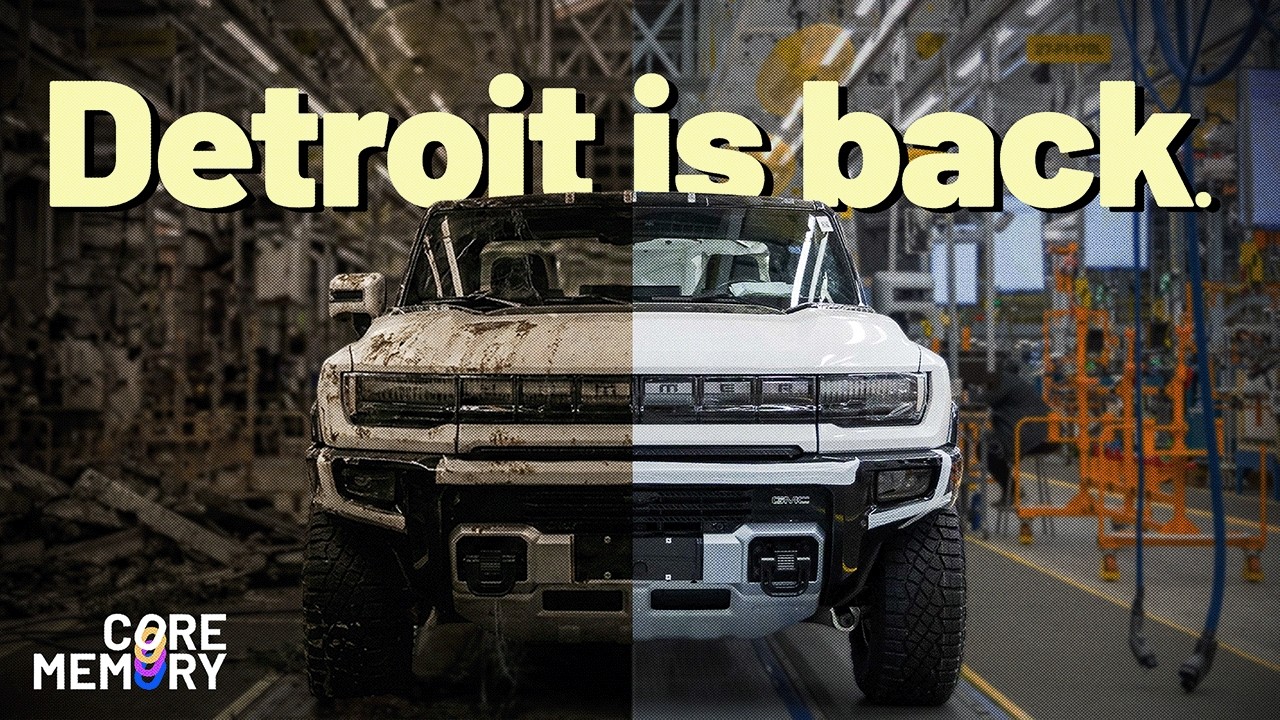
Ashlee Vance tours Detroit startups and manufacturers building electric vehicles and advanced manufacturing tools. Slate is selling open-source electric trucks for under $20,000, Grounded RVs converts delivery vans into camper vans, and GM is investing $900 million in new battery chemistry. The city is betting on innovation to reverse decades of economic decline.
Chapters
What's up, YouTube? I'm in Detroit and we're going to go ahead and make some history. I've got this super sweet GMC Sierra 2026 all-electric truck. This thing has more cameras, more cameras, more cameras than I've ever seen before on a car. And since Detroit invented the car and the car camera, we're going to go ahead and shoot an entire episode of our show just with the cameras on this truck. So come along on the first part of our journey.
What do you mean it's not going to fit inside? Yeah, no, we're doing this whole thing with the car for this episode. You don't think there's room inside? No. Ah, we really want to bring the car in. Are you sure? The truck with all the cameras actually belongs to GM. It's a 2026 all-electric GMC Sierra AT4 Max Range. It can go about 500 miles on a charge. And it's quite nice. Look, Bob, no hands! Oh, it's lane changing. GM let us borrow the truck for the week, hoping to prove that it knows how to make electric vehicles well. Look at that, that's pretty good. What GM did not know, however, was what we decided to do with their goodwill.
How you doing?
Good, how you guys doing? After reviewing the loaner agreement, we realized that GM's lawyers had not expected our levels of creativity and willingness to sell our souls. You guys are awesome, thank you for coming out here. And so we turned the truck over to these guys at Wrap Detroit.
There she goes.
And well, they borrowed the truck for a day and then did this. Sexy Brexy, the intelligent finance vehicle. Fan-fucking-tastic. While this subtle product placement is awesome, the truck is not really the point of this video. No, we are here to check in on Detroit and the state of its technology. And to prove that we're not in GM's pocket, our first stop was here, at the hottest automotive startup in town.
Slate.
Slate revealed its electric truck back in April to a ton of fanfare. It's a no-frills, partially plastic, very customizable vehicle that was meant to start at less than $20,000. The price and all the add-ons really caught people's attention, including mine.
The reception's been fantastic. We do have over 100,000 orders, so we're very excited about that.
Slate is run by Chris Barman, She's a longtime auto industry exec, and she's never led a video crew like ours in the company's factory before. So thanks, Chris. Walk me through why you thought the world needed this type of vehicle.
It was about what if somebody made an affordable vehicle again and like what happened to those just basic vehicles that people had and loved that were very durable and very affordable, that were the entry-level brand of a new vehicle. Plymouth is gone. Pontiac's gone. Saturn's gone. Sion's gone. The average cost of a new vehicle is about $50,000. It's left a lot of people where their choice is to buy a used car because they just can't afford a new car. A Slate costs in the mid-20s. Brand new.
One sec, Chris. Actually, under 20 after current incentives.
Go ahead, Chris.
It's like a potato head. Wait, maybe there's a better analogy.
Actually, there is.
Slate is the chameleon of trucks and SUVs.
Seriously.
Just add the SUV kit.
There are 3.
The car's going to start around—
Mid-20s.
Mid-20s. And the business model here is all the accessories?
It is.
Yeah.
It's been designed as an open-source platform with mechanical, electrical APIs. So you can change it into what you want it to be over time. You can change it into a 5-passenger SUV. You buy it as a 2-passenger because that's all you need. And maybe you get married and you start a family. And instead of having to go buy a whole new vehicle, You spend a few thousand dollars and you can start to take your family with you. You can wrap it to make it whatever color you want it because it's been designed to be wrapped. You don't have to remove parts. There's no complex curvature. It takes a few hours, not days, and it'll be a few hundred dollars, not thousands of dollars. This is our body in white. So this is as we receive it and start to hang parts on.
It sort of harkens back to the Saturn with its plastic body panels. And it harkens back to a bygone era with its cranked windows and absence of displays and infotainment systems. The windows being manual, everything's going to be like that?
Well, it'll come as standard and we'll offer an accessory. So if you really want power windows, you'll be able to accessorize it. But we wanted to make sure that we were really putting cost into places that people would truly appreciate and want it. So standard with Cruise, it does come standard with air conditioning. So it's not so Spartan that we don't have, you know, some of those elements that people really appreciate.
Of course, the Trump administration messed up a lot of Slate's sales pitch through its tariffs and the scrapping of electric vehicle sales credits.
Previously, when we thought that the incentive was eligible, we would say starting below $20,000 with federal incentives.
Gotcha.
Okay.
So we don't want to keep saying now like, oh, with state incentives. But if you look at some states, they do offer some pretty attractive incentives.
It can kind of sort of start at less than $20,000. If you squint and live in the right state. Naturally, I wanted to drive the thing, but Slate told me that was not an option, although it did not say why.
We can go after the drive, right?
So I don't know if you heard, but I cannot go on— I can't go on the drive. So I watched Chris drive it. Should I just run alongside it? How come you guys can ride in it and I can't? What the fuck? How does this make any sense? Slate says it has more than 100,000 orders, and its trucks are meant to start arriving in late 2026. These prototypes are being made in Detroit, which is a nice win for the city. The final vehicles, though, will be made at a plant in Warsaw, Indiana.
As we built the cars here, what's really important for us at this phase is we've been doing a lot of virtual design work. A lot of simulation, a lot of CAE modeling, and we need to confirm that it's right.
Yeah.
Before we actually start cutting tools and go into production. So we've built 74 of these beta prototypes. More than half of them are going to be crashed. That's their purpose in life. And that'll feed into what we do when we do our next build in Warsaw, Indiana. Our operation in Warsaw will start production of customer-sellable vehicles in the fourth quarter of 2026. And by the end of '27, we'll ramp up to full volume, which we've projected and plan to be 150,000 units a year.
Customizing electric vehicles appears to be all the rage in Detroit at the moment, which is why I left Slate and went on a journey with this guy, Sam Shapiro.
This is Michigan Ave., the main drag from west to east. You can see the Detroit skyline. So this is the Corktown neighborhood. It's the oldest neighborhood in Detroit. They even kept the cobblestone streets from the original Corktown.
Sam runs a startup called Grounded RVs. They take a base model GM Bright Drop truck and then trick it out however you desire, whether you're a consumer or a business.
So it's a 13,000-square-foot facility. We're fabricating up to 4 vans a month. So when Grounded started, the product was the world's first fully electric camper van, and we had a bunch of consumers who were interested in electric RVs, but we also started having businesses reach out to us and ask us, can you build a women's health clinic on wheels that's electric? Can you build a mobile pet grooming studio? Can you build mobile podcasting studio? Some of these other use cases. This is where we process all of our raw material. So we bring in sheets of foam that we use for insulation, floor material, composite panels. We use recycled sheets for all the cabinetry. And then we had our own sort of house electrical system. That system is what powers the whole interior grounded part of the vehicle. And then we put a computer inside so that the customer themselves can see their own usage history and patterns, and the fleet manager can see the patterns of the driver. And then it's also useful for remote diagnostics.
As you might have heard, Detroit has been going through some things, and Grounded is a prime example of efforts being made to add new energy to the local economy. All right. Here we are.
Here we are. This is Newlab/The Book Depository.
This is where Grounded got its start.
Grounded got its start here.
Grounded came to life here at Newlab. It's a startup incubator of sorts that gives young companies access to R&D-style hardware.
There's really a variety of startups that are part of the Newlab ecosystem, both in Newlab Brooklyn and then now Newlab Detroit. Everything from autonomous drones and boats to manufacturing startups. Here is the general shop space. Any startup has access to the space, can sit down and use one of these tables for fabrication or prototyping. And then each of these rooms is sort of more specialized. So, you know, this is the Digifab room with the 3D printers. And then right next door, this room is the electronics prototyping lab. The room at the back is a wood shop, and then over in the back corner is more of a metalworking shop. So we built the first 3 Grounded vans right over there.
You had the van inside of here?
Yeah, I mean, it was just barely able to clear the clearance height of the garage to get in here.
Okay.
And so this is where I was till 4 or 5 in the morning. I'd be leaving this building and people would be coming in to work in the morning and see me leaving.
And New Lab is right next to the old Detroit train station, which has also gotten a massive facelift.
I'm not sure exactly what year this picture is, but as you can see, it's gotten a hell of a makeover.
Yeah.
So this is sort of the grand hall.
Holy cow, man. Jesus. They did a good job.
It was either $600 or $700 million on this building. And then about $300 million on the Book Depository next door. The next phase is going to be— they're opening a hotel on the top 2 floors, and then the back of the building, there's going to be a whole courtyard. This is a really cool room too. They took all these historic Detroit and Michigan Central posters. This is my favorite story in the train station. So that's the carriage house, and right up there on that metal patch, there was this beautiful gold clock. And at some point while this building had sat abandoned, somebody had stolen the clock. And so in 2018, Ford announced about the building, we're gonna restore it.
And then Flava Flav was like, I've got the clock.
So one day they get a letter, and basically what it said was, I took the clock for safekeeping. While this building was abandoned.
No way.
And now that you're restoring it, I want to give it back. Come show up to this location at this time and the clock will be there waiting for you. And sure enough, they went there and it was wrapped up in furniture bags exactly where this person said it would be.
Wow.
And so the clock's right up there on display now.
Oh, holy cow. Okay.
And then that's a photo of it in the furniture bags leaning against the building where the person said it would be. It's a feel-good story, and it's really emblematic of the Detroit culture that somebody would care that much and want to see it sort of saved.
It's gorgeous.
I love this.
It's so pretty.
The grounded RV seems to get attention wherever it goes. Yep. This is really nice.
You guys are still at around 150 to 190? Yeah.
Yeah.
Oh, this is—
oh, I have this all to myself.
Is this a dishwasher?
This is a fridge, but we actually can do a dishwasher. And then you got a microwave behind you.
What do I need a house for?
I love this.
I want to take it home now.
And so we took it on a ride around Detroit. Okay, so what brought you to Detroit?
In a very literal way, New Lab. I got in touch with the New Lab team in the summer of 2022, really while Grounded was still an idea, but I had identified Austin as maybe a good place to build Grounded, and I had a lease agreement that I was very close to signing, and the same week I got connected to Garrett at New Lab and he said, "Don't sign that." come to Detroit, let me tell you about what's happening here. And within 48 hours, I decided that that made the most sense and had never stepped foot in Michigan before that.
And how do you feel about the decision now?
Couldn't be happier.
Yeah, why?
Couldn't be happier. There's just so much talent here and physical resources, capex, shops, factories, that I think this is one of the best places imaginable in the country right now to build a hardware startup.
At one point, I got to watch Sam in full salesman mode after we stopped for a coffee in the Milwaukee Junction neighborhood.
So it's all electric. It's a 286-mile range electric camper van. Holy crap. 5-foot pullout drawer. So this slides out and then these open.
Wow.
You can cook out here. Put a—
or hide things in there, or hide things.
Yeah, these materials are 100% recycled. And then there's a lot of seating up here, so you can pretty comfortably sit 3 or 4 people across. But I'll show you the bed.
Yeah, let me get up from under it.
Oh, there's a shower!
There's a shower.
Not like a shower outside. That's very nice.
You got the shower, the indoor kitchen, induction stove, microwave. Fridge, sink, hot water, and then these are overhead, overhead storage, closet, pantry that slides out here.
Spice rack, yeah, that's what's up.
One on the bottom too. And then here's the bed. So you can leave it kind of halfway like this or maybe a little higher and then basically use it as bunk beds where some people are below and some people are.
That's pretty wild.
On the bed, or you can just bring it all the way down.
The man can sell. From the RV, it was back to the mighty Brexmobile to remind everyone that Detroit is not Cleveland. And Detroiters should be proud. They have beautiful parks, awesome houses, huge urban farms, a downtown, and magnificent public restrooms. Detroit, however, does remain very much caught between two worlds. The decaying remnants of what came before are everywhere. And then there's the hope for what Detroit can be in the future, as concerned citizens try their best to revitalize the city and push forward. Detroit had itself a major push-forward moment this summer when it hosted the second Reindustrialized Conference downtown. As the name indicates, this was an ultra-patriotic affair aimed at trying to get the US to make stuff again. How do we make Detroit into the American Shenzhen, right? Since I'm a patriot, I strolled the conference halls to be a man of the people and of industry.
Hey, Alice Levy.
What's up?
How are you?
I loved kind of all the stuff you've been putting out recently.
Oh, thank you.
Hey.
How are you?
Good to see you.
Good to see you, man.
I'm just taking it in.
Hey.
Hey.
I heard you're trying to build a city.
I know each other, but you're my favorite journalist.
Oh, thanks, man. I really admire your work. Oh, thanks, dude. You're like a superstar around here.
Awesome.
All right, thanks, Steven. Nice to meet you, man. Cheers. A new age manufacturing influx. Influencer in the wild. Reindustrialize had it all. Flying boats, defense tech, this. It also had Andro founder Palmer Luckey. Well, sort of. Hello, Palmer, are you in there? We're shaking hands. There we go. The future is here.
Dell was the last computer manufacturer in the United States. I think that there's a lot of people who want to understand that you can't make these things in the United States.
Who is going to make an American computer again?
Well, I think there's a chance that it's going to be AMDALA.
The person who dreamed up this conference in the first place is this guy, Aaron Slodoff. And he runs this place here in Detroit. It's called Atomic Industries, and it's trying to bring manufacturing back to the US by modernizing tool and die making.
What we're focused on is honestly transferring a trade skill into an AI.
Okay.
Trade is called tool and die making. So this is the keystone to mass production. You have like a widget and you want to produce it in some volume consistently and reliably, you make a mold or some kind of tool.
So you're going to make it the thing that's going to make the thing. You make a mold and that mold becomes the foundation of a bunch of car doors or airplane wing or whatever.
If we want to have any hope at accelerating accelerating the pace of development in the industrial base, we have to be able to digitize trade skills to preserve them, replicate them, and then ultimately scale them rapidly.
This collection of machines are what's needed to make the tools, molds, and other parts at the heart of mass production. Once upon a time, the U.S. made these types of machines and had mastered these skills. But cut to 2025, and China is now the unquestioned tool and die-making capital of the world. Atomic's big plan is to learn from these machines and from skilled craftspeople by watching them work. Then it wants to use software and AI not just to mimic those skills, but to improve on them. It wants to make parts faster, cheaper, and better than even the most skilled human ever could. If it's able to pull this off, then perhaps the U.S. can make a great manufacturing leap forward. And so the U.S. used to make machines like this, or like a different era?
No, they would make them like this for sure. Going back way '40s, '50s, '60s.
So it died out in the '70s and '80s?
Yeah.
To get a feel for how tool and die making works, we did a manufacturing stroll with Atomex co-founder Lou Young.
So this is the injection molding machine. So it's a 1,000-ton injection press, 500-ton, and we have a 240-ton over there. Each one of these machines is unique for us because every injection tool we build, we put a lot of sensors in it because of getting back that data while we're running. It trains our models further. There's molds to make cell phone cases here. There's drone components. Anything that you can think about, a plastic essentially gets built in one of these types of molds. And each one of these molds is its own complicated engineering problem. So like, this would be a core and a cavity block. So these two things fit together and there's a gap inside. You shoot that melted plastic in between it. So those cooling channels inside of there are what dictates how long and how well this mold is cooling that plastic. There's more optimizations than just this cooling. Where you put the gate, like where the plastic is entering the cavity, plays a big role. And these holes here are ejector pins. These pins actually push that part off. There's only one perfect tool design for a given part geometry, and our software's goal is to hit that. And then we get to run that holy grail mold for part production. So we'll produce parts better, faster, cheaper than anyone because all of our molds are better than anyone else's. So when we were talking about that optimized waterline cooling system, we have software that autonomously designs waterlines that follow the shape of the part, so they're not drilled straight round holes. When you do that, you can't drill your waterlines anymore, you need to 3D print them. So those waterline systems, we call them conformal cooling in an injection mold. They have the best cooling performance for an injection mold. This is a plate full of tooling inserts that has, you know, crazy waterline designs that are following this part shape. But over here, our software is getting trained not just how to build and design the perfect optimized injection mold. As it's designing this mold, it's also understanding how it's fabricated. So when it makes a certain waterline design, it knows it now needs to print that insert on here. The software is literally like, I designed this component with this waterline system in it, with this gate load, with these holes. I know they need to be fabricated on this machine and this machine and this machine with this cutter using this cutter path. So it's developing that strategy along with the design.
Yeah.
If you talk to anybody in industry, Having a piece of software that can design a production-grade mold for something is literally insane.
Okay.
They would basically tell you that it's probably fake, so, which is cool. We evolved from software to this factory to show that the designs that our software created could be applied to real mold making. The next phase is starting to make parts using the molds that we we make. So we're in the process right now of building another factory that's going to be basically just like a giant production facility.
Let's be clear, the gleaming future proposed by Atomic will take an incredible amount of work to pull off. The company's software will need to be spectacular to have any hope of outflanking China's manufacturing might, and its mission will require the US to rediscover its manufacturing know-how.
There's not a lot of people going into the trade, especially in the United States. The biggest tool builder in North America is actually over in Canada, and they have 26, 27 mold designers. There's shops in China that have 60, 70, 80, 100 mold designers. The scale at which they're able to build tools over there dwarfs anything we can do here. Our only hope to ever dwarf them is with software.
Yeah.
The reason that we built the company here, this skill is not available in the level of concentration it is in this zip code anywhere else in the United States.
I've worked in plastic injection tool building and injection molding since before I graduated high school. My father was a mold maker as well. It's from generation.
Are you from Detroit?
Yeah.
The industrial DNA of Detroit and all the toolmaking history and families that came up here, I'm not trying to get rid of these people or replace them. I'm trying to turn them into superhumans, basically.
It's here that we could hit you next with the gratuitous ruin porn that so often follows stories about Detroit. But we're gonna do something a little different. Because there's a spot I wanna show you that gets at what was and what could be. Andy, we've come to your factory. Hello.
Ready to begin?
Yes. Hi.
This is wild.
Welcome to the factory.
Thank you.
Yeah.
Does it have a name?
Not yet, no.
Andy Diterossi is a Detroit native. A relentless entrepreneur, and like all of us now, he's a YouTuber.
I bought this building in 2021. In early 2022, I was walking out one night. I was like, hey guys, I bought this car factory. I bought a car factory and I'm going to fix up this old place to make it something awesome.
So follow along.
Post it, put my phone down, went to bed, and I woke up to 100,000 followers.
He bought this factory a couple of years ago, partially to manufacture content, and partially to pursue his automotive projects.
4 years ago, I bought this giant car factory to start it up again and start making my own affordable truck. But instead, I stuffed this place with all the cool things I could find on Facebook Marketplace. I'm going to have one giant auction on August 16th where everything starts at just $1. The moment I bought my car factory, people started to try breaking in. So the plan now is to replace my old boring gate with a massive battle gate that's over 40 feet long and 8 feet tall. We've been broken into like 5 times. We had someone steal all the batteries out of the buses. That was like $5,000 or $6,000 worth of batteries. We had someone cut all the ends off the battery cables for the lead, which is like a buck apiece at the scrapyard, but it caused probably $10,000 worth of damage to the buses. We had someone steal all the catalytic converters. So I'm trying to find that balance between making something exciting that hits the internet the right way, that it sort of takes off, but also keeping the progress going where we're actually going to use this giant gate to keep our place safe.
Did your parents work in the car industry?
Absolutely no one. Grandpa was a paperwork guy at Detroit Diesel. Grandma was secretary at General Motors. My mom was a legal aide at Detroit Diesel. My grandpa's brother put every horn into every '53 Packard made. He said, "I didn't take a day off, I didn't miss a car. So if it's a '53 Packard, I put that horn in there." You know, and there's like a deep pride with that. We are in a city that we was built so quickly. You know, you had the auto boom and then you had the war boom, which brought us even more money.
Behind the scenes in a U.S. war plant, a famous American auto assembly line has been converted to speed equipment for war.
And then 25 years later, everyone gets up and leaves. It's like a hurricane hit the city without water. You know, it's like a financial hurricane. So this door kind of tells the whole story. They painted this on the door so when people were walking up from the parking lot, they wouldn't even get to the door before they found out that there weren't jobs here. I grew up here and I've watched factories like this close all the time and they just let everybody go. And so I wanted to save one of these instead of watching another one crumble into the earth. Oh my! Normally someone would whitewash this whole thing or turn it into like a self-storage place or something.
And you said it was $700,000?
$700,000 for 55,000 square feet.
55,000. Holy cow. Yeah. And it's like 5 buildings.
It's 5 buildings. It's on 2.5 acres of land and it totally needs everything, you know? 28 years ago they had a big fire here, and so there's a bunch of smoke damage they left and, you know, wobbly parts of the roof. So these signs, I was on the government auctions one night, and these are the navigational signs from the Tulsa International Airport.
Yeah, now I get it.
Yep. I have my home here, I have my business here. We have huge taxes, we get almost nothing back in city services. Public safety is bad, traffic safety is bad, but where else in the world could you buy your own former factory as a 34-year-old in Detroit. So this is where we service the buses.
So you buy school buses and then just fix them?
Yeah, so we get school buses that are like 8 or 9 years old and we totally strip them down and renovate them. This is a self-driving fire truck that we built. You can drive this with a remote control and you can also email it. So if you email it, it'll go forward, back, left, right.
You can email it?
You can email it. So this was going to be a marketing marketing project for a new email service.
Okay.
Um, and so—
Is it self-driving or—
Well, you drive it with this.
Okay.
And then we made a little brain box. So in here is, uh, all the stuff you need to make any vehicle, like, self-driving with servos.
Okay.
So this is mostly marketing to get attention.
It is for marketing, but there's a lot cheaper ways to get attention. What I'm trying to do is I'm trying to wave a flag to attract the right sort of people to make the kind of innovation stuff we want to make here. This building and these projects perfectly encapsulates, like, what we have to do as a city, where we've got to run the bus company and fix cars and do YouTube and stuff to, like, pay the bills because there's very little economic activity locally. And so you look around and you see there's all these, like, maintenance projects and roof leaks and tarps and stuff that we need to, like, keep this place alive. This is exactly what it feels like to be a Detroiter for frequently. Yeah, we're constantly fighting for survival, you know, but that's sort of where cool things come out of, you know. Necessity is the mother of invention. Yeah, like, I go to like Mountain View and I see the comfort and luxury and the pace of what, you know, Google is doing, and I don't see that as fertile ground for something new and exciting.
That's soft.
You've gotten soft, you know. But I think that when you have too much resource it's hard to be really inventive because like, man, life's comfortable. But here we can't stay put, we have to keep moving.
In the vast spaces between ambition and execution lies the architecture of tomorrow. Puma. The future remembers everything. Even the ideas too quiet to whisper. Core memory meets brass. In August of 2021, President Joe Biden made a political blunder of historic proportions. Mr. President, this sucker's quick. He held an electric vehicle summit at the White House and didn't invite Elon Musk or anyone from Tesla. Not long after that, hello Detroit, Biden went out of his way to credit GM with leading the electric vehicle revolution.
You electrified the entire automobile industry. I'm serious.
You led and it matters. These moves did not sit well with Musk. Come on up here, Elon. And most certainly led him toward a very public and deep-pocketed embrace of Donald Trump. You remember.
Should I get in?
Get in. Wow. The truth, of course, is that it was Tesla that reshaped the auto industry. I love Tesla. Tesla turned electric cars into a reality. GM, like all the other American automakers, was an EV laggard. Which is what brings us to this. For this is the Wallace Battery Cell Innovation Center on GM's campus in Warren, Michigan, just outside of Detroit. The scientists and engineers inside of this building would like to make the case that GM now takes electric vehicles seriously. Like very seriously.
This is Godzilla.
And the GM representative tasked with delivering their message is this man.
My name is Andy Ouri. I'm a battery engineer at General Motors.
Thank you.
A few years ago, Andy had something of a soul-searching moment.
I've got kids, and I wanted to make sure that the planet is better for my kids than it was for me. And I said, I've got to do do something about getting to an all-electric future.
He decided he wanted to put his MIT brain toward combating climate change, and he wondered if GM actually felt the same way.
After working in batteries for about 10 years, I was trying to figure out, was this company really serious about electric vehicles? And I was like, you know what, I'm going to email the CEO. And I emailed the CEO and I said, you know, our mission statement, it could really relate more to the environment. And she said, hey, I've forwarded this to our communications team. Don't worry, we're working on something. And it was about a year later where I finally got to learn what they were working on. It was that Zero-Zero-Zero vision.
The Zero-Zero-Zero vision stands for zero crashes, zero emissions, and zero congestion. And it's around the zero emissions that Andy will argue GM has has done more than you might have noticed.
I think we've been quietly building an electrification powerhouse right under everybody's noses. We've invested between the Wallace Battery Cell Innovation Center and the Battery Cell Development Center next door close to $900 million in those facilities to make full-scale prototype cells at rate. It's under construction. You can see the gray walls there. Okay. So that's going to build about 100x more cells per week. Than this facility.
And this was new. This was 2023?
You got it.
Okay.
Then we've got investments in our gigafactories for manufacturing the cells in Ohio and Tennessee. There still ends up being a really big gap between what we can do here and when you want to scale up to a full-size gigafactory like one of our Ultium factories in Ohio or Tennessee. Those factories make about 300,000 cells per day.
Per day?
Wow.
There are some obvious signs of GM's electric vehicle investments. GM has 13 different EV vehicle models ranging from small cars to trucks. My Brexmobile, for example, is massive and has an astonishing 500 miles of range. It's fun to drive and impressive. Andy, though, wanted to show me the work that goes on behind the scenes. And so deep into GM's R&D labs we went.
We're surrounded right now by a bunch of blue test chambers. Each battery pack that we design will ultimately end up in this battery pack being tested.
Okay.
We can push it above and below what you can do on the surface of planet Earth for temperatures, and then humidity we can take from as dry as the desert to, you know, as wet as the rainforest. We have battery packs big and small. This is the battery pack that you'll find in the Corvette E-Ray. Okay. So This is a hot and humid test chamber. You can imagine it living in Miami during the hottest, most wet week of the summertime.
Yeah, this looks like a very nice torture chamber.
This is a table where we can show you cell technology evolution over time. So the EV1 in the late '90s started off with lead-acid batteries, had less than 100 miles of all-electric range, and then around the the late '90s, early 2000s, nickel metal hydride started to be used in hybrids. This is what you would find in a Prius.
Ah!
And then you get into that first generation of lithium-ion cells in vehicles like the Chevrolet Bolt. So back in 2008, we launched with, I think, 38 miles of electric range. And then this cell today, which is my new favorite cell— OK. —our LMR cell. My new favorite self. Oh yeah. We can use LMR in our trucks to get more than 400 miles of range. Along that path, we also dropped the cost of batteries by a factor of about 10 as measured in dollars per kilowatt-hour. Okay. Oh yeah. All right, come on in. Welcome to the mega shaker room. We have 3 shaker table rooms in this facility. We've got medium, large, and mega. Uh, this is the mega. It's so big that we had to dig out the foundation of the building and pour a separate foundation so that the system wouldn't shake everything around it.
Do people make things bigger than this?
Um, like this is what you would get if you were testing small satellites. One of the things that's really exciting about having this facility is it lets us build full-size prototypes of battery cells. Most people can't do that. We can.
The story here is that GM is doing fundamental research on battery technology. It's starting at the elemental level and then going all the way up to the battery packs and the final vehicles. Does it have battery partners like LG and Samsung? Yes, it does. But GM is also doing a lot of the work itself. The current battery technology GM is most excited about about is known as LMR, or lithium manganese rich batteries.
Our strategy right now has been to make electric vehicles more affordable. We announced in May the lithium manganese rich chemistry, which is a game changer chemistry for electric trucks because we can use it in a way that gets range of over 400 miles, meaning we can get really excellent range. At an affordable price for those customers. In the early days, these particles that are inside the battery, we thought of them as being homogeneous from their shell to their core. State of the art today is no longer a homogeneous particle. You might have a cobalt-rich shell and a nickel-rich core storing lithium-ion. So nickel, manganese, cobalt. Most expensive is the cobalt. Next most expensive is the nickel. Least most expensive is the manganese. Manganese. So what's happened over the last 10 years, everybody's been driving the cobalt down and they've been driving the nickel up. And that's great because you get higher energy density, lower cost. So the thing to do with LMR is to switch again, take the nickel down and take the manganese up.
The battery work GM does is impressive and also at times oppressive. Pop it in here. Hi, I'm Ashlee Vance.
I'm Lei.
Nice to meet you. Nice to meet you.
In this lab, I will show you this is a cold precipitation reactor, so which you can synthesize a chem material precursor, and we are able to, through the synthesis knowledge, be able to achieve targeted performance.
How many slides are there?
I'm actually just starting it now.
This is the beginning of the journey.
Okay. So basically, we can put one electrode at the bottom and the keeping —certain temperature you are testing.
Okay, okay. Some weather's left, but we're gonna ride across here. Oh, we're going across. He'll show you all the equipment. This is 5 nanometers. This is a sample exchange chamber. This area, the temperature was 1,024 degrees C. Okay. You guys ready to go on to the next one? I spent 2 days at GM. Hi, I'm Ashlee. And was greeted by a cavalcade of brilliant scientists. I'm Ashlee, nice to meet you. I'm Ashlee, nice to meet you. Where are we going? It was like a science fair endurance test.
It's about 50 to 100 nanometers.
And I just go like this. My crewmates found the whole affair quite amusing.
Machine learning and artificial intelligence.
As I slipped into a battery chemistry fugue state. A third electrode. Coin cell case here. Cook them like you would a lasagna. You can see the surface area. Chemical vapor deposition. Electron beam. Electron beam.
0.5% humidity. I'm gonna do it at a certain rate.
—a point cell setup— —in-house made—
—of modeling algorithms—
Thank you so much. This is crazy. You guys are nuts. Hahaha. Wow! I blame Joe Biden for this. At some point, GM decided to free me from my PowerPoint shackles. And, well, I ended up somewhere quite glorious. This is GM's Factory Zero, located right on the edge of Detroit.
We build the Hummer, the truck, and the SUV. We're also building a normal Silverado truck and a GMC truck, as well as a Cadillac Escalade EV.
That's Nick, and he was my guide throughout this robotic wonderland where I got to see how GM builds its EVs.
We take these cells, and the first thing we build them into are these mini stacks, and then we start stacking them into what we consider a soft stack. To this turntable that's spinning, the robot's picking a full soft stack right now. It's going to take it to the compression units. The press is going to compress it, and then we do a really intensive electrical test after that. Okay, so this one right here, it's welded. As you can see, you have all of the spiral welds, some are more of a golden color. Yeah, that's copper. Okay. The other ones are aluminum. We're just like surrounded by moving battery packs.
Yeah.
And these packs are on AGVs, automated guided vehicles or carts. So this is where they start loading these modules 2 at a time. And it's got their barcode information scanned so it knows exactly what it's putting in.
Yeah, that Cool. So just put the first pack in.
First 2 at a time, it's going to continue loading them. Once these are loaded, we're going to actually tighten them all down. This is Godzilla. This is Godzilla. So this robot right here is the biggest robot FANUC makes. It is a monster. This is where we are going to take the finished pack off the cart, as well as where we load an empty tray to the cart for the processing to begin. So it's the start and the end of our pack main line all in one station.
And in a final victory for humankind, I got to drive an electric Hummer right off the line. Let's cut to these geese on GM's campus for a moment. As I think aloud. There are some brutal truths that undermine GM's vision. GM, for example, has just recorded a $7.1 billion loss tied to its underperforming battery factories and electric cars. Electric vehicle assembly lines. Sales have slumped in part because of Trump whacking EV rebates. In the big picture though, Americans just aren't as into electric vehicles as much as GM and others hoped. GM still tells me it's in this for the long haul. And I'm here by this water feature believing them more than I would have before my 2-day reprogramming campaign. Even a cynic, I think, would be convinced there's real effort going on. As for Andy, well, he's a true believer, and he thinks all of this is part of a plan to bring every piece of EV production back to the US again.
We want to have North American battery manufacturing independence. We want to be resilient to the point that we can chart our own destiny from the mines and the materials, processing those materials, putting them into the cells, and then into vehicles.
I remain skeptical on a lot of that, but I'm now at least open to the possibility of being proven wrong.










