The Largest Quantum Computer In History Is Here
PsiQuantum is building a quantum computer using photonic qubits, with plans for a million-qubit machine by 2027. The company fabricates 35-layer photonic wafers and integrates thousands of chips into data-center-scale facilities in Chicago and Australia. The challenge isn't cooling the qubits themselves, only the superconducting detectors.
Chapters
All right, people. I have called you here to this chaotic mind palace to do something that I promised I would never do, which is an entire episode on quantum computing. Quantum computing. It's a field that's impossible to understand and definitely impossible to explain. On the one hand, quantum computing is going to change everything— finance, science, physics, medicine. On the other hand, it's always 20 years away. People hemorrhage millions upon millions of dollars chasing this dream, and it's crazy. But we are in luck because we have PsiQuantum. It is the biggest, boldest bet in the entire quantum computing field. They've raised $1 billion to actually go build these machines. We spent a couple of days hanging out with them and we're going to use them to try and understand this technology. Will we succeed? Maybe so, maybe not. Pray for us. Off we go.
Most of quantum computing revolves around these. They're called chandeliers, and they're built by hand. They're exotic and expensive. What PsiQuantum is building looks like this: massive quantum computing factories. It's broken ground to build two of these facilities in Chicago and Australia, and the hope is that they're online and computing away by 2027. To learn how PsiQuantum plans to pull all this off, I spent a couple of days hanging out with this man.
I'm Pete Shappell. I'm a co-founder of PsiQuantum. And yeah, I'm here in Silicon Valley building a machine.
Building a big machine.
Yep.
Yeah.
Unlike traditional computers that run on bits, quantum computers run on quantum bits, or qubits. Some of the current quantum computers have hundreds of qubits. What makes PsiQuantum different from everyone else is that its big machines will have a staggering 1 million qubits.
Nerdy journalists like me who have covered some of this stuff for a long time, there is a degree to which we're emotionally scarred by quantum computers. Huge names like IBM, Google, Microsoft spending tons of money on this, chasing after it. But it always feels like that thing that's 5 years away, right?
This is the origin story of PsiQuantum, but it's that frustration and that disillusionment. A million? Like, we're dreaming here. A million is a fantasy number, and it's easy to get that feeling, but you have to do that. You have no alternative. You need a million qubits.
You can build qubits out of different things, but PsiQuantum has chosen to make its machines out of light.
This ring resonator is basically the single photon source.
It creates qubits from individual photons, or particles of light.
We shine a laser in there and it makes photon pairs.
So let's break all this down and start with PsiQuantum's main chips that are etched into these wafers.
So, I mean, this is silicon wafer. Wafers are like the 25-year-old technology that was developed for networking and data centers. We're repurposing that technology to move single photons and to build qubits. So all of the devices on this wafer are moving light instead of electricity. A wafer looks flat, right? But it's a 35-layer stack, and somewhere inside that stack is a superconducting thin film.
The key part here is making a single photon and controlling it.
When you look at a normal wafer, you see rectangles everywhere. But a photonics wafer, it's always squiggly, beautiful curved structures. You're trying to guide light around on the chip. Oh. So if you take light around a 90-degree bend, you get loss. All the photons go missing.
Okay.
So there are two waveguides here. I just label this one 0, label this one 1. And if I put the photon in this waveguide, then I'm going to encode a 0. If I put the photon here, I encode a 1. And you can see this little splitter here. So this will then put the qubit into an equal superposition of being 0 and 1 at the same time.
Same time. So on one side of that, it's 1 and 0.
Yeah.
And then on the other side, it's in quantum land.
Yep.
That's crazy. You guys started in 2015.
Yeah.
From the get-go, you made two large bets. One is that you can make qubits out of electrons, atoms, and photons.
Yeah.
As far as I know, you're the only major player that has picked photons.
We're biggest private effort on photons.
So all in on light. And then the other massive bet, you guys were just like, we're going to raise hundreds of millions of dollars and we're coming out the other side with a million qubits or we're not.
Yeah.
You're also like, we're just going to invent a bunch of stuff that doesn't exist. You kind of annoyed people for a while. You went super quiet. And then over the last couple of years, you guys put out trickles of information about where you're at.
So yeah, that was provocative, let's say, to people. We didn't publish a lot of papers because we were really busy. You know, all of us have been doing this our whole adult life. Like, it has to actually work. It has to be a real technology.
We are going to show you some more of what PsiQuantum has built in a minute. But before we do that, let's just do a few more quantum computing basics. This is an exercise that has not gone terribly well for the world. In 2019, the New York Times got a whole bunch of quantum experts together, gave them 280 characters to explain the technology. A professor Professor of Mathematics says, "A quantum computer is an exotic device boosted with quantum randomness." Thank you, Greg. It was awkward. Senior software engineer in Google's quantum lab. Quantum computers don't just split universes, they also merge universes. And this merge can add and subtract those other split universes. Makes total sense. It was complicated. Didn't help. Everything we currently know about quantum mechanics can't fully describe how a quantum computer works. Works. That makes sense? No, no, it fucking doesn't. If you ask ChatGPT, a regular computer is like flipping one light switch at a time. A quantum computer flips every possible switch combination at once, then uses interference to cancel out the wrong answers and keep the right ones. Or you could be in the lucky position of having a quantum computing expert at your disposal. Pete is intelligent and eloquent, but still If you ask him to explain this technology to you in its most basic terms, it still sounds like this.
The way I describe it at a dinner party is to start with a quote from Rolf Landauer, information theorist at IBM for a long time. Rolf Landauer said, "Information is physical." And all of the computers that we have ever used to date have run on the physics of 100+ years ago of Maxwell and than Newton. The basic idea of quantum computing is that we are gonna build a machine that uses the new physics, that uses quantum physics. And this is like you're playing a game of chess with somebody. There's some established set of rules. They introduce some new rules. Now they can run new strategies, new moves in the game, and you're gonna get absolutely destroyed in that game of chess.
Other people will tell you other stuff, I think it's all mostly made up and that really no one understands how this works. And you just gotta have apparently faith that quantum computers are actually a thing.
PsiQuantum, of course, are true believers. And they have done a series of comically extreme things to prove out their convictions. As an example, let's first head to the Stanford Linear Accelerator, or SLAC for the nerds in the know.
So SLAC is the home of the largest X-ray laser now on the planet. It is powered by cryomodules that are operating at 2 Kelvin, not too far from absolute zero.
Okay.
This is what this cryo plant is about.
It's here that PsiQuantum has obtained a massive hunk of infrastructure in the form of a helium-based cryo plant. Cryo plants keep things very, very, very cold., and the cold is key for PsiQuantum's ability to detect the presence of single photons.
So this would be the fridge.
So this is the fridge, yeah. So inside here is basically just a big sheet of copper with holes in it, and we bolt as many chips as we can afford onto that cold plate. A few years ago, we sort of figured out we're gonna need to run thousands of chips to get to millions of qubits, and so we need something where we can stuff a lot more chips in a fridge and where we've got orders of magnitude more cooling power. And in a real machine, we'll have on the order of 100 cabinets like these.
You can see an example of what Pete's talking about with these renders of its future data centers. I'm sure this all seems quite nuts, but Psi actually doesn't need its quantum computers to be as cold as other quantum machines. It just needs the cold for one key operation.
The only reason that we are cooling our system is actually to support the single photon detector. So we need to be able to detect a single particle of light with near 100% efficiency. The only devices that can do that are superconducting devices where we need to be at low temperature, which is a pain in the ass. The qubit itself that we use is a photon. You know, if you think about a laser beam.
Yeah.
And imagine trying to heat it up.
Yeah.
Wouldn't make any sense. So our qubit itself doesn't care about heat at all. It's just the detector that means that we have to resort to low temperature.
And everybody else is having to go even more extreme because their actual qubits do care about the temperature.
Yeah, that's right.
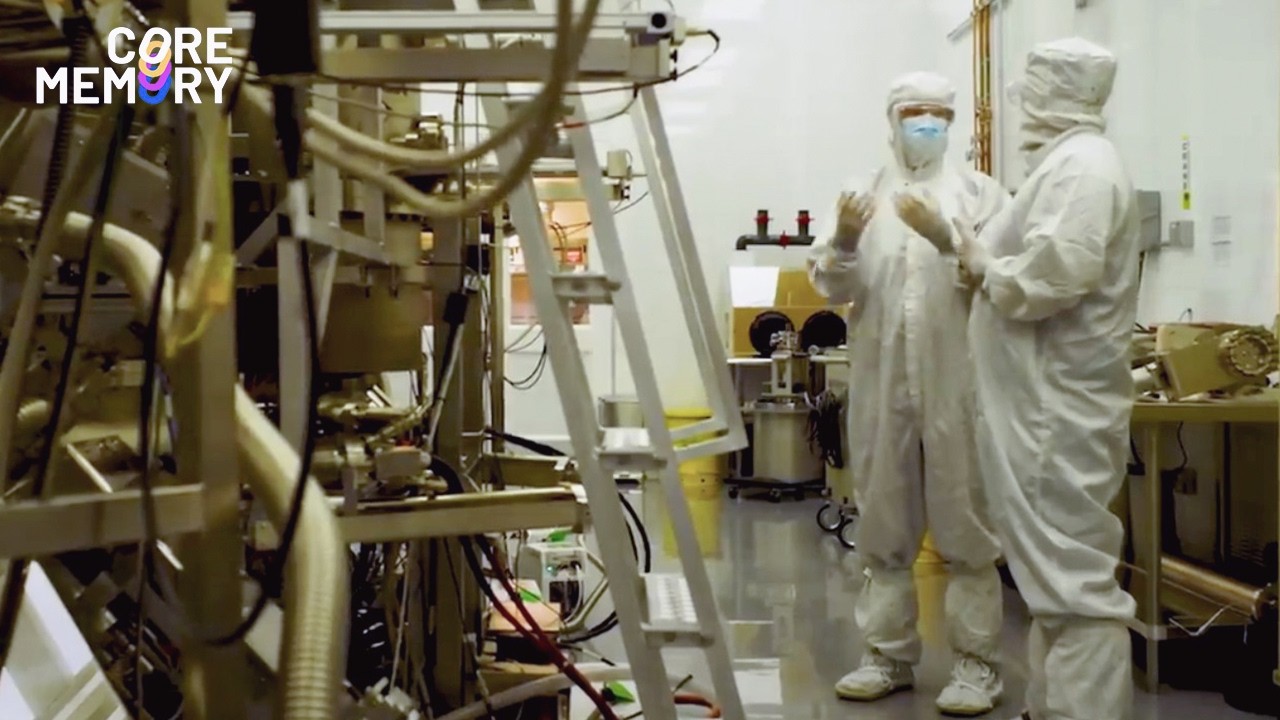
If you have a ton of quantum computers doing quantum computing, you need a way to move the data around very efficiently. In PsiQuantum's case, it had to push forward an entire branch of networking technology in order to make a new type of optical switch. Those words make this sound easy, but producing said optical switch required something that looks like this. All of this machinery is used to deposit thin layers of a material called barium titanate onto a wafer. And in order to really feel the BTO, I had to get dressed up like this.
This is my bunny suit adjuster. Only the best. Thank you. All right. Can we hug in our suits?
Absolutely.
So this is a tool that makes barium titanate, strongest electro-optic material known to science. Nobody was really making that before we got started, certainly at this kind of scale. It's making that on a 300mm wafer. Here in Silicon Valley, and then we FedEx that wafer to GlobalFoundries, and it gets integrated. And this tool is pretty weird. This is a molecular beam epitaxy process, so it's growing the material layer by layer essentially with very, very extreme kind of process control. It's got a wafer loader on the front. A lot of people told us we were insane to try and do that, but the team has just done an incredible job of making it work. And so now we've got switches is, you know, filling the lab here in Palo Alto.
As it begins building out its mega quantum computing centers in Australia and Chicago, Psi will still need to refine its mad scientist grab bag of technology. And to do that, it has acquired this old semiconductor fab in Silicon Valley. I've been hard on the people making quantum computers, but they are exciting machines and they are broadly getting better all the time.
There are really good reasons to be optimistic, and the first is that everyone now is making qubits like breakfast cereal, right? Like 5 or 10 years ago, you got one qubit going, that was like Nature paper, cause for celebration, finish your PhD, everything's amazing. And then secondly, like the whole space is pivoting from this kind of obsession with demoing to like, shit, we got to build. The real thing.
Yeah.
And you're seeing people kind of reprioritize towards manufacturability, cooling power, connectivity, control electronics, scale-up, like how do you actually build a real machine?
Yeah.
And there is a real point to all this effort.
So our biggest industries are sitting on a foundation of chemistry, physics, and math. Drug molecules, fuels, fertilizers, semiconductor manufacturing processes, And so many of those microscopic foundations are overdue for reinvention.
Here we are finishing up our PsiQuantum tour, and I'm sure some of this still feels frustrating. We've learned some things and had some fun, but we still don't fully understand how this world works or where it's going. PsiQuantum 2 has lots of questions that need answering. It's made very big, very bold bets. Venture capitalists and entire nations are hoping that it does actually know what it's doing. But this is the nature of these types of giant gambles that move the world forward. And also, I got to dress up like this.










