The Machine That Could End Japan's Sushi Empire
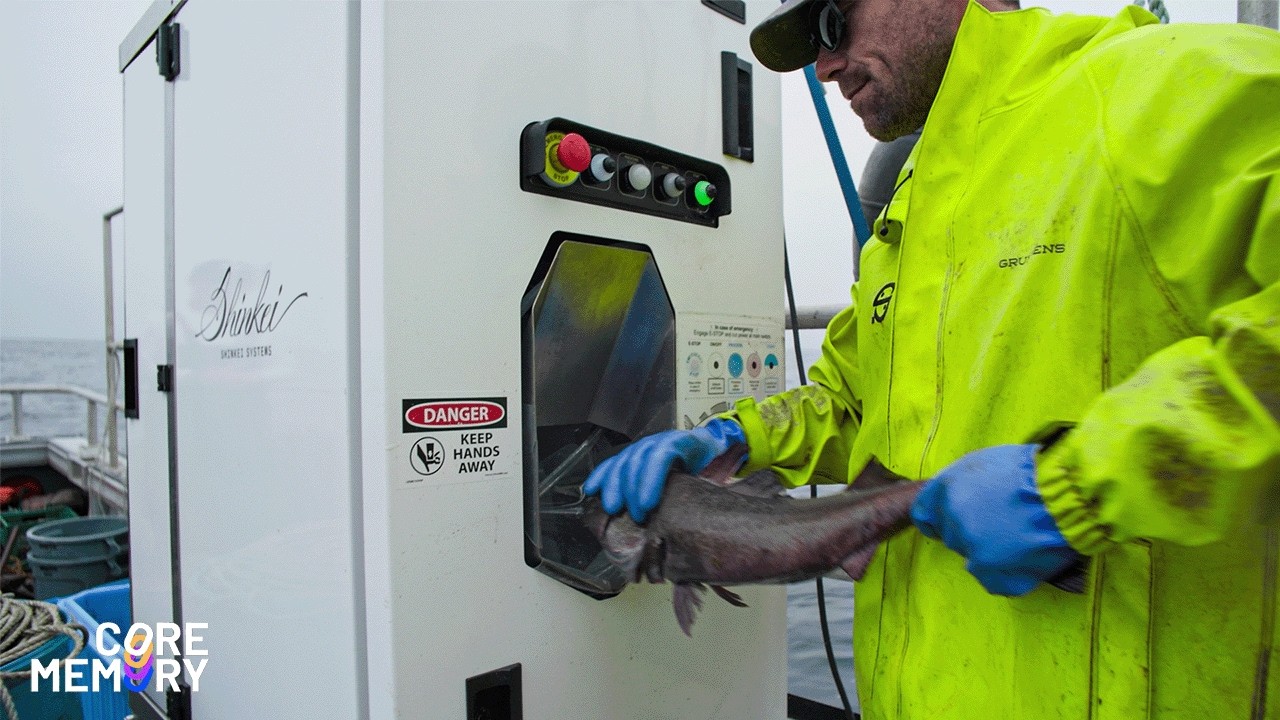
Shinkei Systems built a robot that kills fish using the Japanese ikejime method, automating what's traditionally done by hand. Fisherman Bill Blue tests it on his boat; chef Brian Bornemann says the fish tastes better, with superior texture and flavor. The startup buys the catch and sells it as Ceremony brand sushi.
Chapters
The fish being prepared before you is not like typical fish used for sushi in the United States. It was caught off the coast of California and is considered to be much higher grade than other fish here. This is not really due to the fish itself or how it was caught, but instead to how the fish was killed, which was by a very fancy machine. The machine in question was built here at the headquarters of Shinkei Systems in El Segundo, and it is the brainchild of these 2 gentlemen, Safe and Reed. When did you guys start the company?
2022 was around the start. One of my early mornings in grad school, there was this essay in the newspaper called If Fish Could Scream.
Okay.
It's all about how, because fish don't have vocal cords, we give them less empathy than terrestrial animals like cows and chickens. There's something like 400,000 fishing vessels in North America. Most of the fish are flopping around on the deck of the boat and releasing stress hormones and lactic acid. They're suffocating, and that process leads to decay of meat quality and shelf life.
While they're on the boat?
Exactly.
After they've been caught.
It can take up to an hour for them to lose consciousness. When they're releasing those stress hormones, it's kind of like the fish is exercising. The adrenaline, the cortisol, the lactic acid, all that stuff makes the meat more acidic, which makes it more primed for the naturally occurring bacteria bacteria to grow. And then there's still blood diffusing in the meat and it becomes a cesspool. So both those 2 things lead to a very rapid decomposition in the meat.
Okay.
And that's where our process of basically spiking the fish in the brain, cutting the gills, you stop that acidification, you drain that blood, and the fish can last anywhere from twice to thrice as long fresh. The meat retains more of its actual water weight, the texture is better, there's more flavor.
Shinkei is all about trying to replicate a Japanese method of killing fish called ikejime. This is where a fish is caught, then quickly spiked in the brain, and then bled out with a slice across its gills. This looks and sounds rough, and it is. Still, it's considered far more humane than the typical alternative, which is to toss the fish on some ice and let them writhe and suffocate to death. The Ikejime process also happens to result in healthier, better-tasting fish. In Japan, the Ikejime method is done by hand with a screwdriver or whatever else the fishermen can get a hold of. But this is El Segundo, where life revolves around rockets and weapons and other manly machines.
El Segundo.
And so these boys decided to build a robot to kill fish with computer vision and pinpoint So these are some of our custom actuators we built in-house.
We're designing something that needs to go into a really tough environment, so most of the off-the-shelf components just won't work for our needs.
The actuator in this case is doing what? I mean, this is helping push the fish through the machine.
So we push the fish through the machine with a fluid system with salt water, which is nice because there's plenty of it on the ocean. But the actuators are used for driving the mechanisms such as the spike and the cutting. So there's a camera Inside, and then a perception system that kind of tells each actuator where to go. Nobody has done anything like automated systems that exist in our robot today. So we're spiking the fish in the brain and also bleeding it, which takes computer vision. So for every single species that comes into the machine, we figure out what species it is, and then within millimeter accuracy, we can find the brain location.
Okay.
So that all happens in like an instant, and then within 5 seconds, the fish is put into a cold chain.
We need surgical accuracy at industrial speeds in a maritime environment. And that level of pressure of engineering at the speed we're putting out is just, it's insanely impressive.
Saif came up with the idea for Sinkei by drawing on his roots. He grew up in Dubai and then went to Penn to study business and physics.
I grew up in a seafaring family fishing with my dad in the Middle East. Both Reid and I went to Penn. We didn't cross over there directly.
A friend introduced Saif to Reid.
You know, it's like, you know, rom-com scene from like a high school and you're like sitting in your bed like, oh, is he thinking about me? I just like had this feeling. I was like, we have to work together.
Who has a more Muskian origin story?
I was managing the Starship avionics group, so you know living the dream job for me at that time. I actually applied to SpaceX 15 times until I got a job on the 16th time over four years. So I knew I worked at the best space company in the world. I didn't want to go work at one that wasn't as good. I wanted to build a new company in an industry I cared a lot about food and health.
We're putting on a grunden.
Grundens, yep. That's the fisherman's finest.
As a professional YouTuber, I felt compelled not just to listen to these guys talk about their dream of killing fish with a robot—
This is a black cod.
This guy's lively. —but to actually kill a fish with a robot myself. All right.
Okay, so fish goes in. Press start.
Whoa!
It'll spray a little bit, but that's it. Now the fish exits in the back. You'll see the brain spike location at the top, and then a gill cut below.
Right there. It's quick. I mean, it just goes in and those cameras just—
Yeah, so it's within half a second everything's detected, and then all the actuators go and the fish is pushed out of the system.
There's what, like a GPU in there or something?
Yeah, so there's a computer inside that's doing We're doing all the processing on board, and then the Starlink inside the roof panel is able to send back any data that we need to our office and our software team. Okay, dorsal fin up.
You can take heart knowing that the fish got its revenge. Oh, oh, goddamn it! As a professional YouTuber, I also felt compelled to meet an actual fisherman who uses these robots and to spend the day at sea frolicking with whales because I love whales. All right, we just found the buoy with the fish. There is a humpback whale right behind us. Oh, let's go! I love the whales. We went 4 hours north to Morro Bay to meet Captain Bill and hang with his crew of cyber assassins.
My name is Bill Blue. For the last 52 years of my life, fishing has been my way of life. I've done salmon, albacore, rock crab, Dungeness crab, black cod. Now they go through the machine here. It's a little different, but it definitely does help make a better product.
So here's the brain spike.
Yeah.
And then there's a gill cut that ensures the fish is bled and all the bacteria is starved out. And then it'll bleed in here for 15 minutes or so and then go right into an ice slurry. Every single fish that goes through the machine has a new set of coordinates of where its anatomical features are. So it could be a sablefish or a black cod versus in the afternoon a vermilion rockfish. And that's why The precision is really important, but we're able to do that on a fish basis. So this is the only form of humane harvest at scale that exists in the world.
So when these dudes show up from Southern California with a fishing robot, why would you— why would you put it on the boat? You were the first one to try it.
I was the first. Marketing in this business is the key. Working with them, I get a little more for my product. than the guy that isn't working with them, it's good. You know, it's, it's good for us.
It's fair to say that Shinkei's robots have been a work in progress. They take up valuable space on the boats and have not always been that fast at killing.
About 8 months into it, we were like, I don't think so, because they were working the bugs out in the machine. Okay. You know, yeah, we were keeping the fish We had to get him alive on the boat, bring him to the dock. The machine was up on the dock. What normally was taking us 2 hours to unload was taking us 8 hours to unload.
Like any tech product, these robots have required iteration to improve.
It's a machine, so things break every once in a while, you know, just out of normal use. It's come a long way. You know, in the beginning it was just black cod, and now we do these vermilion rockfish through the machine as well. I pull up my app, change the software, and they know what I'm doing because of the Starlink and the AI stuff with the machine. He called me the other day, he goes, oh, looks like you're catching some nice fish.
This is probably the 3rd generation of the robot that he's had, and we were probably 15 seconds per fish when we started, which now we've gotten that down to about 5 seconds.
The weird part of Shinkei's business is its business, or how it plans to make money. The company gives away its robots and then buys the fish killed with its machines. It's paying a premium to the fishermen in a bid to get them to adopt this new technology. Shinkei then sells its own fish to stores and restaurants under its Ceremony brand.
In the beginning, they were just taking a portion of what I caught, and they've scaled up, and now pretty much whatever The dock tells me they want, I try and catch.
Okay.
So we don't come to the dock with fish that isn't sold.
At this point, you might be asking, do we really need a robot to do all of this? And it's a valid question. People in Japan kill the fish by hand, and they do it quite quickly. The argument for the robot is that ramming a screwdriver into a fish on a moving boat is dangerous. You also want to make it possible for anyone to adopt this method and to do it in a systematic way.
Brain of a fish is like the size of a human fingernail, so every single fish's brain is in a different location. To try to do that with a live fish while you're wrestling it every single— with a sharp tool is pretty dangerous and exhausting if you had to do that for thousands of fish a day.
This takes a lot of that activity There is some visual proof that the Ikejime method works.
Ashlee, I want to introduce to you ceremony-grade black cod, vermilion rockfish, and red snapper.
Okay.
Our bread and butter is our black cod or sablefish, which is caught from Alaska down to California. And you'll see this one over here, the ceremony-grade flag. This is our product. This is over a week old, and these 2 were bought from a local fisherman. From local retailers this morning. This morning, okay. These two over here you'll see dulled in meat, and this one over here where the blood's still diffused. Yeah. The biggest and clearest thing you'll see is the meat for ours is still very rigid. You know, you put your finger on it, there's no indent. You know, whereas if you push your finger in here, you see my finger, there's a little fingerprint mark on. Yeah, it's mushy. All of that, right? So we have a few other examples. So these two are fresh out the water, and we took a traditionally suffocated fish versus our process here, and So right away you'll see the blood diffused here. Ours is very clear, there's no reddish tint to it. And then over here for the rockfish, you'll see ours is very white, very clear. This one looks a little bit dead in a way.
And there's also the ultimate Ikejime test, which is how the fish tastes. And to pass judgment on that, I went to Crudo and Nudo in Santa Monica to hang with Chef Brian Bornemann. Okay, so what do we have today?
So the ceremony-grade vermilion rockfish, we did in 2 ways. This is just a dry-aged fish that's been hanging for 4 days that we then just skin and slice sashimi style, and then top that with mandarin olive oil, shiro shoyu, which is poorly translated as white soy sauce. It's not made from soy, it's made from wheat, and so it has that sweet roundness, and that highlights that crustacean element of the fish. They eat a lot of little like uni, shrimps, etc. So they got like this very sweet crustacean flavor. It's just 4 ingredients. And the grilled version we love to do is kind of like North African-inspired set with paprika-braised chickpeas, our version of za'atar, smoked olive oil, and cilantro.
Sounds delicious. And it's all from Morro Bay, which is like 4 hours north of here.
Exactly, yeah. It gets to us right away.
Yeah. The massive trick ahead of Shinkei is shifting an entire industry toward new technology and a new way of thinking about their very traditional business. If it's successful, then top U.S. sushi restaurants could serve fish caught in the U.S. instead of buying their catch from overseas.
Why are we sitting at the Pacific Ocean eating Maine lobsters and Spanish octopus and New Zealand snapper? If you're eating local fish that's dayboat and humanely harvested, if you're eating ceremony-grade product, that's the lowest carbon footprint protein you can eat.
It's delicious, man. Super fresh. A little salt on there. I like it. Yeah. So wait, so this was aged?
Yeah, yeah. This has been hanging at least 4 days, maybe 5.
Yeah. I mean, maybe it sounds stupid. It does not taste fishy, like, at all, right? I mean, no, no.
The crazy thing about a ceremony-grade product like this, by aging it, not only does it not get fishy, but it actually gets more flavorful.
Yeah.
And Then, like, you know, the goals are to support fishermen, keep them in business, make their lives easier, get them a better price, and make ceremony-grade a thing that exists in not just one area. When I started to really understand, okay, the goal of the robotics arm is to help build this bigger network where getting non-commercial industrial direct from fishermen fish at a better quality level, this is, this is the way we're going to be able to fight that commercialization.
Yeah, yeah.
And get a better fish across the board.
Thank you. Um, that was fucking amazing.
Thanks.
Like, amazing.
Well, that's what fish should taste like, you know? Like, truly.
Yeah, it's really good.










