These Delivery Drones Will Beat Amazon To Your Doorstep
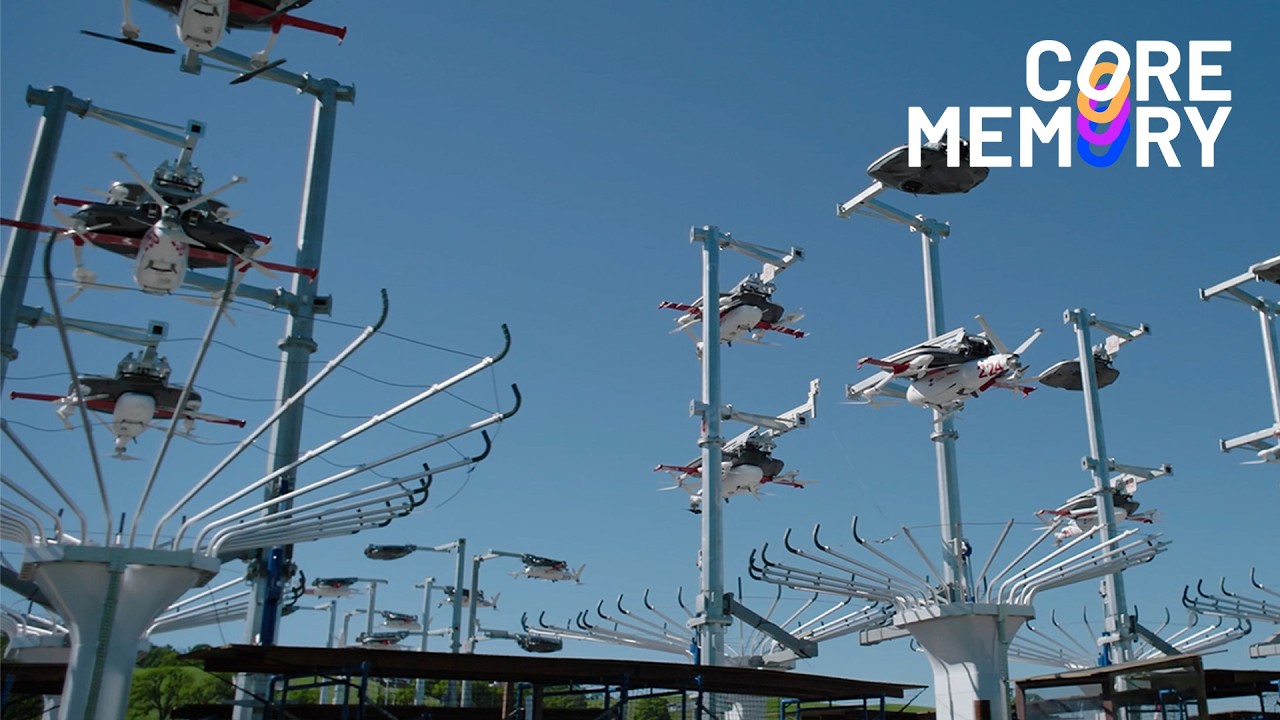
Zipline's drones have delivered 20 million vaccine doses across Rwanda since 2014. Now their new Platform 2 targets U.S. cities with 8-pound payloads, using carbon-fiber construction and parachute safety systems. CEO Keller Clifton and engineers explain how 50-pound drones beat 3,000-pound delivery trucks.
Chapters
The thing about California is that you can be driving around somewhere beautiful and then all of a sudden you hit upon something quite weird. In this case, a bizarre drone valley that looks more Hollywood than real life. But it is real and it belongs to a company called Zipline. And they want to bring you coffee and sandwiches from the sky with this thing. Do we need sky frappuccinos? I mean, obviously not. Do we want sky frappuccinos? Oh, hell yes, we do.
I am the drone lord.
Let me show you something.
Oh, man.
Oh, my God.
These are octocopters.
Yeah.
Take a look up here so I can show you how it works.
All right. We're talking about delivery here.
We're talking about delivery.
Way back in 2014, Jeff Bezos got the world hyped up on the idea of drone deliveries. Oh my God. It turns out that we were not talking about drone deliveries in any meaningful sense, because most of us are still out here getting our packages from trucks like rubes. And drone delivery has ended up as yet another one of tech's overhyped concepts. This guy, however, has been working hard for a long time to change that.
Well, I'm Keller.
All right, maybe I'll—
It's harder than it seems, right?
I'm Keller Clifton, the CEO and founder of Zipline. This is our little museum. We have a lot of the early aircraft that Zipline used as prototypes. The vehicle that's flying from the ceiling is actually one of the first 30 aircraft that we deployed in Rwanda when we were delivering just blood transfusions.
Keller co-founded Zipline in 2014, a few months after 60 Minutes aired its drone delivery hype vid. Wow. And it went about chasing drone delivery in an unusual way. Instead of a quadcopter, it built something much more akin to a plane.
So this here is the primary propeller. When the motor spins up, the propellers unfold. Orders come in from all over the region. I think our furthest deliveries are about 140 kilometers away.
Okay.
Within 2 minutes, we pick the product from the warehouse, we pack it into this cardstock box, and so it has a paper parachute.
Oh, that's the parachute, right. So it floats down. It's wild how it's like high-tech, but then not in some bits.
You know what I mean?
Yeah.
Like it's this balance between—
But you can also see like these systems are rugged and extremely worn. You know, you can see like the paint is like slowly coming off here. Yeah. I mean, we have aircraft that have now flown over a million commercial autonomous kilometers. A single aircraft.
Yeah.
Spinning motors. Launching ZipLine 1327 in 3, 2, 1. Go ahead and push this.
Oh yeah.
That was surprisingly awesome.
After pressing a button with such consummate skill, it was time to see how the craft does its thing and drops its load.
Is it gonna—
It's a little louder. That's because it's gaining altitude.
Yeah, but it is like a bee.
But you can really get a sense for like how quiet it is, right?
Yeah.
Like you can hear the birds chirping. You can barely hear that zip like go overhead. That is the serene customer experience that we think is going to be required.
You see it coming straight in?
Yeah.
No way.
Wild. Okay, so when you're in Rwanda or somewhere like that, I mean, that could be going to a hospital. That's landing—
or it's 500 vaccines delivered to a health post.
But that's landing on what?
Usually just into like a little grassy area or a little courtyard. Just near the hospital. Courtyard, parking spot.
And then people, they're looking on their app when the delivery is coming.
Yeah, they're just getting a text message saying, "Hey, the delivery is 1 minute away." Okay. And go out and get it, bring it in.
Okay.
Vaccinate kids or transfuse a patient.
That is crazy.
Okay, and then—
Should we go watch some recoveries?
Yes, please.
Best part is definitely saved for last here. This system may look kind of crazy, but this is now serving 5,000 hospitals and health facilities globally. It's become the largest commercial autonomous system on Earth.
Okay, there it is. It's over that lone tree coming in.
Oh yeah.
Head on.
Oh, it just lost a bunch of altitude now.
No way. Never gets old.
It's kind of amazing, you know, we designed Platform One in the simplest possible way, fewest possible number of components, make it as robust and cost-effective as possible. And all of those things combined led to a system that has over the last decade proven to be pretty darn reliable. You know, it just crossed 100 million commercial autonomous miles. We deliver about 75% of the national blood supply of Rwanda outside the capital city. We've delivered 20 million doses of vaccine in the last 18 months. I don't think any of us would have really necessarily even been able to imagine Platform 1 scaling to the level that it operates at today, let alone now what we see the next generation technology Platform 2 scaling to.
You all know that I love pushing buttons and launching things into the sky.
Oh yeah.
But we're really here to talk about Zipline's newest product. This is the thing that will ferry sandwiches right into your face.
Really, Platform 2 is designed to scale to every metro in the US. I think that next year, in an optimistic scenario, we'll launch somewhere between 10 and 20 major metros in the US. Even if we aren't in like the specific city where you live, if you do travel a few times a year, chances are you're going to travel to a city where Zipline operates.
So this is the store.
Yeah, exactly. So this is the outpost. So anybody who comes here can have the full end-to-end experience of opening up the app, ordering whatever they want, adding it to their delivery zip, and then actually watching it delivered to.
And then how many pounds?
8-pound payload.
8 pounds. So everything in the bag.
Yep.
And the skewers. That's a lot. That is a lot of stuff.
You want to put it on the scale. So that's only sitting at 4.5 pounds.
Oh yeah.
Just close the lid.
If the lid shuts, there you go.
Cool.
That would be good to fly.
Done it.
In the US this year alone, there will be 5.5 billion instant deliveries. To customer homes. We're using a 3,000-pound gas combustion vehicle driven by a human to deliver something to your home that weighs on average 5 pounds. Expensive, it's surprisingly slow, it's terrible for the environment, creates traffic in our neighborhoods. And so we knew that for this technology to scale, it would need to be way safer and extremely quiet. Everything about the vehicle is designed for aeroacoustics and to be as quiet as possible. We knew we'd need to be able to deliver very accurately, straight onto someone's front doorstep, right into their backyard, even, you know, the rooftop of an apartment building. We needed to be able to deliver with dinner plate level accuracy. And then the most important thing is on the shipper side, we need to be able to install in 24 hours or less and have that be really efficient and easy, infrastructure light process. So Zipline has different pickup points. This is the wall-mounted pickup point. Whether it's a big health system like Mayo Clinic or Cleveland Clinic or the VA, or it's one of our restaurant partners like Sweetgreen and Assino Farms or Walmart. We show up, we install this magical portal in the wall, and now anybody in the building can just immediately pass things through the magical portal and they're teleported directly to the home that it needs to go to. As long as there's a dinner plate of space, we can deliver there.
Yeah. Okay, cool.
Yeah, cool.
All right.
Unlike just about everything else in your house, this new craft is being built in America. San Francisco, no less.
So we've got 12 manufacturing lines, a little north of 1,000 parts that go onto our flight zip.
To see how these things are made, I got a tour from Lauren Lacey.
This is the carbon fiber goodness.
I love an assembly line as much as the next guy.
It is Extremely heavy.
Probably more.
Oh my God. Okay, that was even lighter than I thought.
But it was actually the product testing part of Zipline that really got to me.
We want to test every single function on this aircraft to make sure that this specific line would be able to handle the wear and tear of our flights.
If you're in the delivery drone business, then you're under serious pressure to make sure things are safe.
So we are currently doing fatigue testing.
Okay, but these are like future versions of the wing?
These are future versions, yeah.
Should someone take an electric motor or a burrito to the head, then that might be it for Zipline. Lauren and I were joined by Naomi Altman, one of Zipline's all-star engineers.
So this is a test that we'll do if there's like a new design for the carbon fiber structure or a new material or a new process. And we'll be testing it to, like, ultimate strength. So we're applying a force there where you can see that beam, and that's where the parachute sits.
The parachute's just for emergency type things, right?
Yeah, exactly.
It's something that we will only ever trigger in, like, really rare occasions if we lose the onboard, like, propulsion systems or for whatever reason. But when it fires, we have to make sure that the force of ejection and then the deceleration of it is not going to, like, break the structure.
But this is not going to be like instantaneous because you're gradually—
gradually building the pressure.
Okay.
Okay.
It'll be kind of slight movement initially and then you'll really see it break.
All right, let's do this.
So we're starting to apply the load right now.
We're about 10 seconds away.
Oh, you hear a crack starting.
1900 newtons.
It'll be soon.
So is this one extra strong?
This is strong.
This is extra strong.
Yeah. Got a whole Coke in it. Oh! There we go. Alright. That was a bit more dramatic than I thought it was gonna be.
We saw this thing.
Cool. Thank you.
We have liquid nitrogen tanks in the back. We're going to dump it down to like -20°C.
And this thing. And this thing. And sometimes stared at things for uncomfortably long periods of time. All in the name of sound engineering. Okay, I know what you want, and it's this.
Is this one coming?
An actual delivery back at the ranch.
Is this us?
Yeah.
Okay. All right, so what's going on?
Yeah, so it's basically just building a simple 3D map as it comes down. Won't land on the roof. It'll avoid, you know, we've got string lights here, clotheslines, power lines, trees. And so it sees us right now. It's gonna avoid us, and it's gonna aim for right here.
So it's got computer vision on the bottom.
Computer vision. There's a winch up in the aircraft, opens the doors, leaves a package behind, and up it goes.
And it can do that in the rain and then any wind or how high?
38 miles an hour, I think, or something like that. It's pretty high.
It's literally gale force wind.
You know, people often see this technology and they're like, wow, it must be so expensive. 'cause it's high-tech automation robotics. The reality is this is already less expensive. It's no driver, it's electric, and most importantly, you're using a vehicle that weighs 50 pounds to deliver a 5-pound thing. That's true. Rather than 3,000 pounds. And then finally, from a speed perspective, not only is this 10 times as fast, but also we deliver generally out at least 10 miles, whereas most delivery services are not gonna wanna go more than 3 or 4 miles. You're 10x-ing the number of customers who are reachable from any given business.
Does it make sense to have a multi-thousand-pound car bring you a sandwich or a salad? No, it doesn't. Will the world accept hundreds or perhaps thousands upon thousands of drones flying overhead with our packaged goods? I'm not sure.
How does it look?
Yeah, it's on the little tray.
But knowing consumers, and our desire to have things ever faster and faster and faster, I'm quite positive we're going to give this a try.
I haven't seen it do this.
This being a test site, the tests don't always go perfectly.
The doors are stuck. There's some new issue where—
yeah.
Don't worry, guys. It's okay.










