Two Engineers Invented The World's Best Chocolate
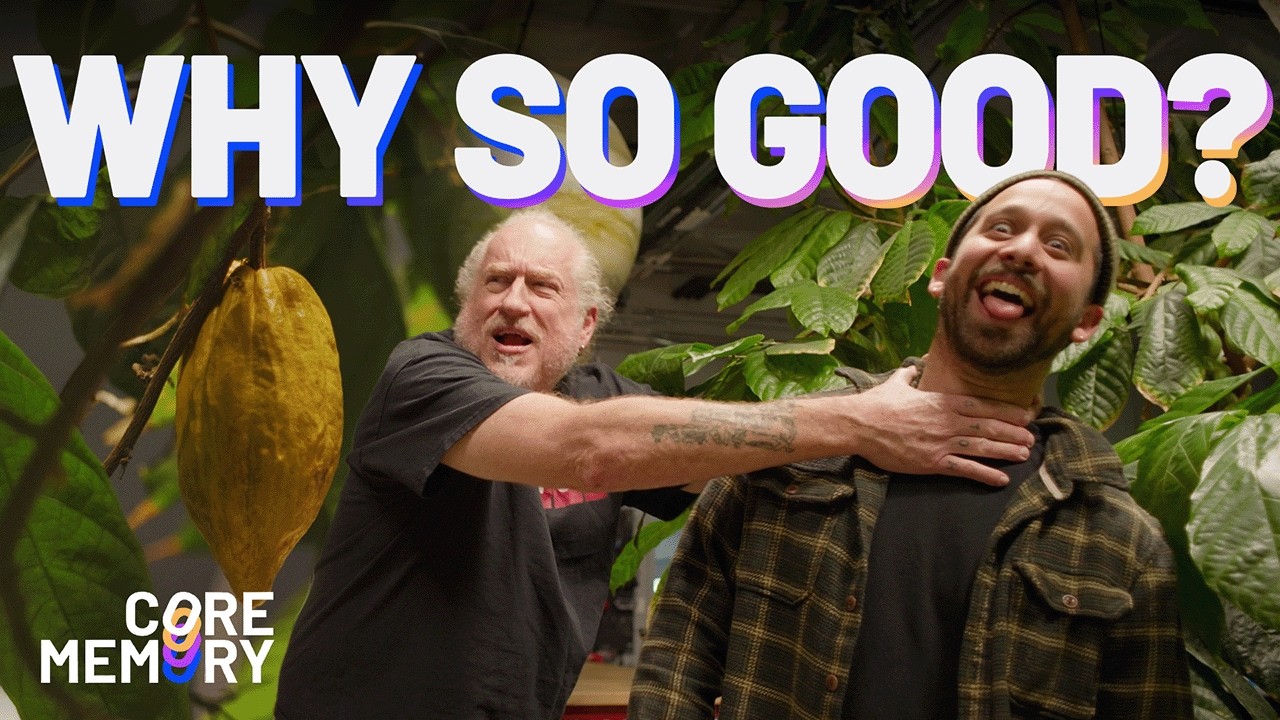
Seamus Blackley, the physicist who created Xbox, and Asher Zelig Safami grew cacao trees in a Pasadena lab using tweezers to hand-pollinate flowers. They fermented the beans in three stages with controlled yeast and bacteria, then roasted them into chocolate with only cacao and sugar. José Andrés and Thomas Keller called it the best chocolate in the world.
Chapters
They called you Willy Wonka. Are we pro-Willy Wonka or anti?
We like Willy Wonka.
They like Willy Wonka. Willy Wonka's okay. So we got a little Willy Wonka situation going on in here. All right, boys, your moment to shine has arrived.
The Willy Wonka situation is this: these 2 men have produced what some consider to be the world's best chocolate, and they've done it here in a laboratory in Pasadena. which is not where you're supposed to produce the world's best chocolate. In its final form, the chocolate looks like this. It's pure, unadulterated decadence. The best chefs in the world have fallen in love with it and wanna buy it. And yes, we're going to learn how the chocolate is made and taste it. But first, we must get to the mad scientist behind the mad science.
Can't believe you wore pants.
Do you need the table for your coffee?
No.
Okay.
I have no pride. I have no pride and no shame. Lisa, I want some more.
Seamus Blackley has been many things over his career.
I'd like to ask Seamus Blackley to come out and, uh, give us a look.
Including a physicist, an engineer, a game designer, And even a Hollywood agent. But he's best known as the father of the Xbox.
I'm the guy who has to figure out how to convince everybody to buy an Xbox. I get fired if Xbox games suck.
Which he talked Microsoft into building in 2001. Seamus, as you will see and hear, is an eccentric with big opinions. This, for example, is how he explains his life trajectory.
My entire career is just one long, uh, tale of woe and rapid dancing in the face of failure.
And this is how he explains dating and being rich.
I always say the best way to pick up girls is to have a baby, right?
Yeah.
Right up until they ask where you got the baby.
Yeah.
The same thing is true of billionaires. It's like, where'd you get the money from? The money didn't appear in vacuum because you're so brilliant. Like, you got it from people.
For most of the last 8 years, Seamus has been working on a top-secret project inside of this building. It's the headquarters of Pacific Light and Hologram. And I would tell you more about it, except that I'm contractually bound not to.
This is the— there's a bunch of— oh, they're like, don't look at this, just come through here.
I don't want to show anywhere the secret chocolate repository is.
You guys have so many. I don't know what's secret, what's not.
What I can tell you is that Seamus and his inventing and chocolate-making partner Asher Zelig Safami have lots of patents around holograms and related technology. They also have teams of people working in labs of all sorts. And so I fully expect some kind of holographic portal through time and space to be on sale someday soon.
There's a culture in technology where people lead with a bunch of promises and then don't deliver.
I'm familiar with this.
And I think it's important to get the work done up front. Yeah, I feel full of shit. Yeah, because if you're trying to do something new, who knows if it's going to work out.
The things we can show you are the side quests, because Seamus is a man who gets into weird things passionately.
So before this lab, I worked on a video game with Steven Spielberg that got canceled because they wanted to make it into a film instead called Jurassic World. And so this is full-size Acrocanthosaurus, which was the apex predator of the time. In here it's got a linear motor that can put, I think, 22,000 pounds of bite force.
Yeah, it's no joke.
We printed the teeth from molds from paleontologists, then we then cast them in porcelain and bolted them onto this thing.
Fire!
The rib is shattered.
Shattered.
Oh, that's just Brutal. God, it's fucking, fucking terrible.
The same energy has also been directed toward things like baking.
This bread sure looks tasty. You'd never guess the most important ingredient is from 4,500 years ago. Who's the mastermind behind this 4,500-year-old bread? It's this guy, Seamus Blackley.
While the rest of you were tending your starter during COVID Seamus was reviving ancient bread-making techniques.
I had this idea, 'cause I kind of liked baking bread. How did people bake bread in medieval times? 'Cause I knew that there was no yeast, so everything had to be wild yeast, so sourdough. I wonder if I can make bread like that if I just had water and grain.
The process started by harvesting specks of yeast from ancient pottery. His nerdery knew no bounds. It was exceptional enough to gain international attention and to piss people off.
The biologists were all mad at me because there was no way that this was actually ancient yeast, which they're right about. The Egyptologists were mad at me because the Egyptians didn't bake in an oven like this. And so I was wrong about all of it, but it got like a million likes. And so I went to the people who were most angry with me and I said, okay, well, how would we actually do this? And we ended up with this whole program of capturing and resuscitating ancient microbes from Egyptian pottery, breeding them and isolating them and doing DNA and RNA analysis of them, and then researching how ancient Egyptians baked in the Old Kingdom when they were building the pyramids and what those bakeries looked like. And I built one of these bakeries in my backyard.
Is this all too much? Oh yes, it is. But thankfully, Seamus applied the same incredibly over-the-top attitude You guys ready to talk chocolate?
We're talking chocolate.
Talking chocolate.
What's the origin of these plants themselves?
This is tree 1.
Yeah.
These things look like hand grenades. Those are the beginnings of cacao pods. So this is chocolate, and it grows off the trunk of the trees.
Yeah.
So these are really young. Uh, this is a variety called Forastero. Here's a pod here. This is getting toward full size.
How long does it take to get to that?
I don't know, a month or 2.
Oh, that's it?
Something like that, yeah. So basically this machine over here This is a water jet, so it cuts with high-pressure water. When you cut it, it produces a lot of steam, and so we were thinking like, oh, what could you grow in a really humid environment?
So in our old location, we had this little room with a skylight in it and the water jet, and we were thinking, what can we grow in here? It's like, well, grow chocolate. How does that work? I don't know. We didn't know. eBay is where we found the first trees.
That's where you ordered what, the seeds or the saplings?
What are you smiling about?
Well, Juno just ran off and ate some pizza. She's very happy with herself.
Oh, cool.
Okay, so you ordered it on eBay?
Yeah, so it was just a little cutting off of eBay. And 2 years in, like, started to flower. We're like, oh my God, we're gonna get chocolate! Chocolate! And then we realized, like, in that moment, oh wait, they aren't self-fertile. You need other trees. So we bought 2 more seedlings. Then it took another 2 years before they then started to flower. And that was now 4 years into this. We had the opportunity to start getting pods.
We start trying to pollinate them. We're like, okay, so do we need bees? What do we need? Okay, no, there's a, there's a biting gnat that doesn't exist in California. So Asher came up with a scheme for pollinating.
I took the flowers apart and you pick out the pollen and you have to take it from one tree to the other tree with tweezers. We are actually building tools that can do this in a way more automated way.
Okay.
That'll make the process a lot easier and that should increase yield for us.
But right now you hand pollinate?
Right now it's hand-pollinated.
They originate in Mexico?
Central America generally.
Okay, and if I was doing this traditionally, the fruit would come off after a couple weeks.
You have to break them open and get the seeds out and put those in a pile.
Okay.
And usually it's outside, and so the ambient temperature is really important, and you want it to get infected with the local flora and fauna because that's what starts the fermentation process. And that's the thing that's different with us because we do it all sterile.
Right. It's a thing that's done in nature, Right, so if it's sitting on this mat fermenting, there's going to be different temperatures all over. Yeah, like the outside might get less fermented than the inside and vice versa. It might be too hot, it might be too cold.
So how does it work? Well, there's fermentation involved. So then we start looking in the literature for this. There's not a lot of literature on this because the chocolate business is really old and the cacao trees grow naturally. They don't need to be watered or anything, and we're told that less than 1% of the cocoa Only tree's about 10% of cacao commercially is like top quality, and this is because the pods ripen in random order. It's not seasonal. And the fermentation process on estates takes place using natural yeasts. We're like, okay, well, we're in Pasadena, California. We don't have any of these microorganisms around, so we're gonna dose it and we're gonna build a fermenter and we're gonna control everything about the fermentation process carefully So we built some fermenters. We open up the pods, smells like lychee fruit. They're bitter, nothing like chocolate. Okay, it's weird. So we start doing the fermentation. There's like a 3-step fermentation. There's an aerobic yeast fermentation, anaerobic yeast fermentation, and then an acetobacter fermentation. You end up with this like massive gym sock vinegar smelling stinky brown beans that are rotting.
Okay.
You dry them and then you put them in the oven. And about 10 minutes in, it starts to smell like the best brownies you've ever smelled. And it's absolutely magical. It's bizarre. And we're like, this is super great chocolate. I can't believe this came out. Not only did we make chocolate successfully from dirt, but this is really good. And I had been putting this also on Twitter where I put the bread stuff. And along with everybody who was interested in it was this guy José Andrés who runs World Central Kitchen. So he was in LA and he says, you must bring me chocolate. And he eats it right in front of me, and then he posts on social media, this is the best chocolate in the world.
Yeah.
And he gives it to Thomas Keller, he gives it to all these other chefs, and they're like, this is great. And he's like, we have to do this as a business.
Now this is on its way to becoming a business.
I don't think I have a choice. Yeah. In less time than I would probably like, we're gonna have a couple thousand trees.
Yeah. How much chocolate— how much are you making every year or every few months?
Not that much. Yeah. You know, the idea here is to to like demonstrate a way of making chocolate that you could do anywhere. And then the people who come in and scale something that works is a different group of people than the people who figure it out. We have one customer, which is a restaurant in LA, and that's okay for now.
Do they tell people it's your chocolate?
They say it's like Los Angeles chocolate.
He's getting chocolate.
He's getting chocolate, he's getting chocolate.
So this is the chocolate?
This is the chocolate. And you can eat it.
Okay.
I'm remembering when José just ate it in front of me. Terrifying.
It's delicious. It's more like the dark— it's like dark—
Well, it's got nothing in it.
It's just sugar.
Yeah, yeah.
It's just sugar and cacao.
Yeah, there's no emulsifier or vanilla extract or whatever else. It's just like just chocolate.
It's packed with flavor.
And it sticks around in your mouth. It's like—
Yeah.
Potent.
From the time you guys started to the time you first tasted it was like 4 years?
Probably 5 and a half years.
It took a minute.
The thing is, this was all accidental. Like, we're just a couple of assholes who wandered into the room, like we're looking for the men's room, and just made it and it worked. The main value in this for us is it's super fun and we like to eat chocolate.
I mean, it's super, super rich and, uh, I don't know. I don't know how to describe food.
I don't.
It's good.
You like the chocolate?
I like it.
You like the chocolate.
That's what's important.










