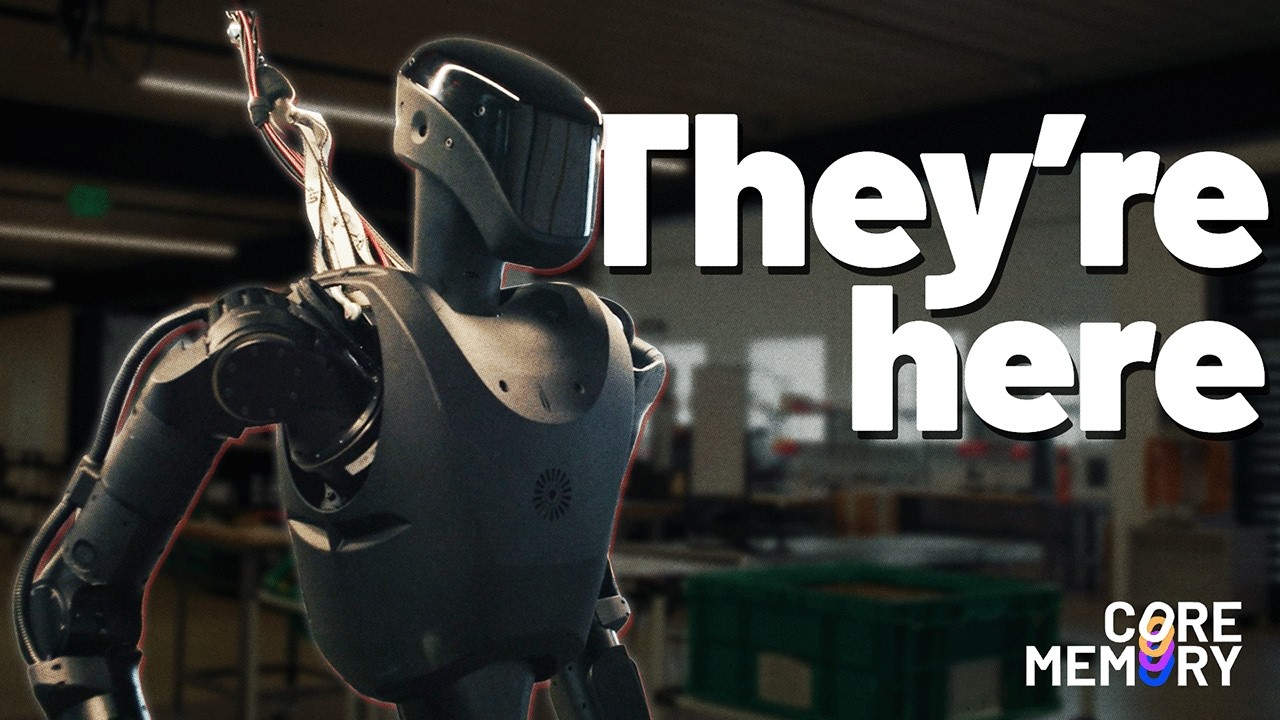
In this video, Sanket, founder of Foundation, gives a step‑by‑step walkthrough of assembling the Phantom Mach‑1 humanoid robot at the company’s San Francisco design hub, RoboFactory 1. He explains the sourcing of roughly 500 unique parts (about 30 % from China, the rest from the US, Mexico, Israel, and South Korea) and walks through the construction sequence: ring‑pin housing press, actuator and gearbox assembly, encoder integration, motor controller setup, forearm subassembly, neck and head with a six‑camera near‑360 vision system, torso and arm attachment, pelvis and leg construction (including titanium‑rod shins designed for high‑vibration, 5‑10 G loads), and hand assembly, noting the current simple hands and the upcoming tendon‑driven design. After full calibration, the robot is demonstrated walking. Sanket concludes with a broader vision of a “screenless” future where humanoid robots act as extensions of human capability, handling tools and tasks without constant computer interfaces.
Chapters
We didn't grow up thinking that things that we read in sci-fi we would actually be working on. To actually make it, making it walk, make it do something useful, it's probably the most fun I've ever had. I'm Sanket. I am the founder of Foundation. You're in San Francisco right now at Foundation's design headquarters that we call RoboFactory 1. So right behind me is a robot called Phantom. The goal with the robot is essentially to build something that can interact with the world the way humans do. There are close to about 500 unique parts in the robot, and a lot of them get sourced from different places. We have about close to 30% of them that still come from China, and then the rest of it are coming from US, Mexico, Israel, South Korea. Today we're going to show you how we build Phantom Mach-1 robot pretty much from the beginning to end, from putting an actuator together all the way up to making the robot walk. Step 1 in the process is ring pin housing press, which essentially is a part of us building the actuator. Actuators are your motors and gearboxes that you use to be able to actually move the robot. So after we've put ring pins in place, the next thing is we just start assembling the gearbox. We're placing the position encoder into the actuator. So now we are solving the motor controller. It needs to be able to speak to computer. Now with all the actuators we have built, we're now going to subassembly. And the very first subassembly is the forearm assembly. This is where the robot starts coming together. Now we will put the entire forearm together and then we will test it as, as if it was a functional unit on the robot. Given it's a humanoid, we want to be able to put a neck and a head together. We have about 6 cameras enabling the robot to be able to have near 360 view. Which is not only important for the robot to be able to do the task really well, but then also to do the task safely. Now we're starting to put the torso together. That's pretty much the upper structure of the robot. What we do is we start attaching the arm. Now we're moving to the bottom half, and the first part of that is putting the pelvis together, which essentially connects your torso to your legs. The next thing is we move on to the thighs. The shin has titanium rods. Robot legs are very high vibration system. You're kind of building something that needs to be able to withstand 5, 10 Gs pretty easily. So then the final piece is we put the hands together on the robot. The current hands are actually what I would consider quite trivial. So the next generation hand that we're building is a tendon-driven hand. Just like a human hand, tendons go into the robot's fingers and you have all of your actuation move into the forearm. And now that the robot's fully built and calibrated, we're excited to take it out for a walk. I think it's somewhat fascinating that we want to build these machines and tools kind of in our own image. I do think there's a pragmatic part to this as well. We have built the entire world around us it's built by us. To me, the ideal future is a future where, like, you're in this screenless world and now you finally have robots that can use all the tools that we've built, where we don't have to be glued to a computer. We don't have to go and interface between different machines. We can, by and large, focus on things that we enjoy doing.