We Went To A Secret Rocket Test Site In The Wilderness
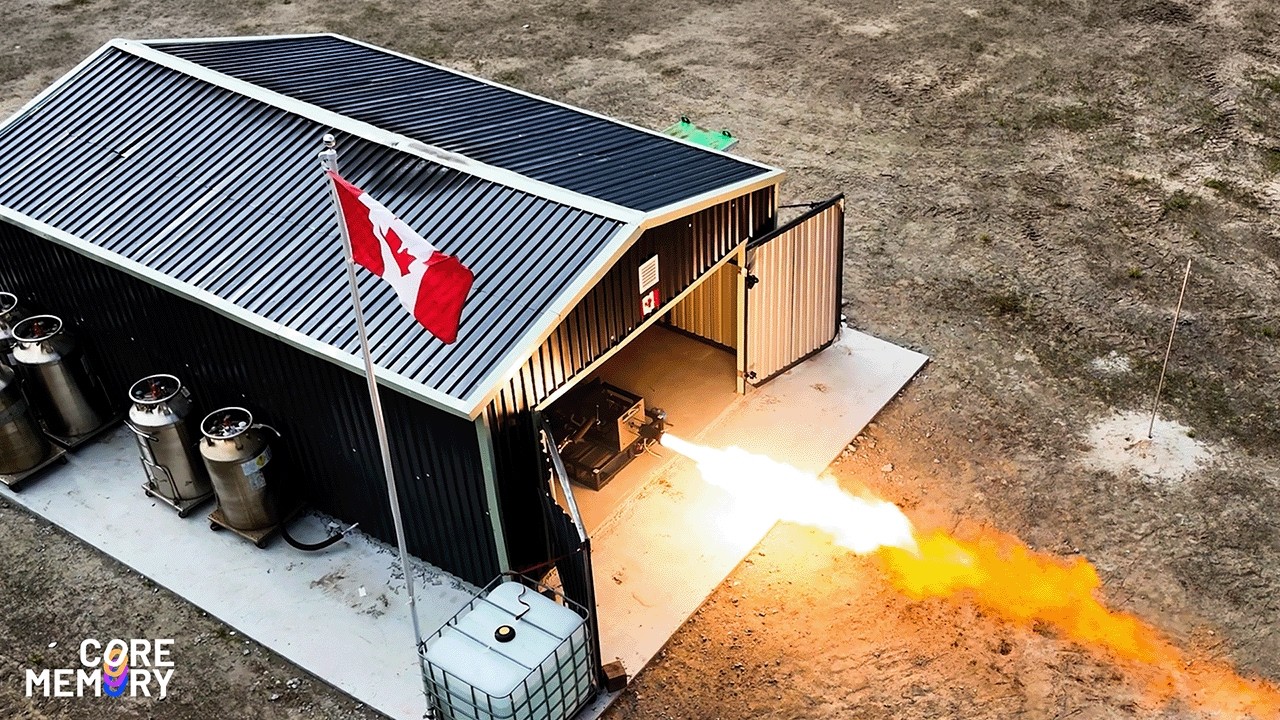
Ashlee Vance visits NordSpace's secret test site, where CEO Rahul Goel is building Canada's first homegrown rocket program. The company got an $8.3 million government grant and is developing the Taiga and Tundra rockets using 3D-printed engines. Goel grew up in Toronto's Jane and Finch, lived in his car, and now aims to send a Canadian rover to the Moon.
Chapters
Do we have any news?
For the first time ever, North Space had an engine explosion that they've never recorded. Everyone is safe. Holy shit. Holy shit. Holy shit.
Canada.
Quite adorably, likes to say that it helped build the space age. It made satellites. It built the robot arm that fixed the Hubble. It had the astronaut guy that could play guitar. But when it comes to rockets, Canada's track record is rather Canadian. Some sounding rockets here and there, and then a rocket startup that folded in 1998 immediately after its first suborbital launch. Now, 28 years later, there's a man who believes the time has come for Canada to have a real rocket of its very own. He's taken over some Canadian wilderness and is on a mission to forge Canada's path to space. What's up, man?
Welcome to Area 66.
Area 66? Why do we call it that?
Well, we're testing rockets and rocket engines here, and we're building big over the next couple years, so— We try to keep it a little secret.
Meet Rahul Goel, the exploder of rockets and the CEO of Nordspace.
Nordspace is a Canadian aerospace company. We're building rockets, satellites, robotics, basically everything that really matters to build Canada into what we hope is a spacefaring nation. Some of this is mildly sensitive, so I wouldn't focus too much on that. So this is a 50-acre property. We kind of got kicked out of our first spot a couple years ago, and now we're building 3 or 4 test cells here.
Why did you get kicked out?
Well, you know, rockets create a bunch of noise. So we started in 2022, basically on my porch. That's where we're sort of blowing stuff up. And next month we're moving into a brand new spot, about 60,000 square feet, getting to about 50 people. So a lot of growth in just the last 4 years for us.
There is a lot riding on NordSpace. The stakes are, of course, of the geopolitical variety. They should be a state.
That's why I told Trudeau when he came down.
After Donald Trump threatened to annex Canada—
Oh Canada, the national anthem. I love it. I think it's great. Keep it.
Canada's Prime Minister shot back.
Canada doesn't live because of the United States.
Thanks to our Supreme Leader being a supreme douchebag, Canada's fired up to prove it's more than an annexable ski resort for the United States.
We're getting fully back into the space business.
Rahul is part of the hard tech scene the country desperately needs. There's no billions in venture capital to burn here, so NorthSpace is funded entirely out of Rahul's own pocket, plus an $8.3 million grant by the Department of National Defense.
The political situation in the United States had a cascading effect. Now we're getting some real support in the country around rockets. But, you know, why do we need them? Part of it is our own sovereignty and resilience. We can't always just rely on one country for everything.
At the end of this path, there was, until very recently, a rocket engine.
We were trying to set up a test last night for you guys that's just a little bit more dramatic, and yeah, just went a little bit over. But it's really helpful for us to understand the limits. You know, we do tons and tons of tests, and they give us a lot of really useful data. This is sort of the nature of the beast. If you're building rockets and you don't have stuff like this, I don't know if you're actually serious about it. No offense.
Rahul is exactly how I'd picture a Canadian space overlord. America's version is, let's be honest, kind of a lot. Big rockets, bigger egos. Like the men attached to them are compensating for something. I mean, we sent Katy Perry to space.
Woo!
Maybe, just maybe, a polite rocketeer is exactly what the industry is missing.
A lot of people that work at Northspace, they really care about the country, like myself. Canada has a bit of a brain drain challenge. A lot of my friends have left Canada. I mean, I wanted to start Northspace when I graduated over 10 years ago from undergrad, and I couldn't because nobody wanted to invest in a rocket company. So I spent 10 years building my first company, starting out living in my car and doing all of that.
Did you ever leave Canada?
I moved to the United States for some time, so I was basically living in my car, working on my laptop, driving, lived in about 20 different states. Um, I I got a job at NASA until they found out that I'm Canadian. I didn't really tell them that, so then that got pulled. Then eventually I realized that, you know, it just didn't feel like the United States needed me. This is my home, and this is just the beginning. This is for light lift, so small rockets, about 200 kilograms to low Earth orbit payload. The government's also trying to work on a medium lift category, so a couple tons to low Earth orbit, and that's going to be something that will play out over the next 10 years.
So what's the difference, like, between light and medium? Like, what are you taking up there?
So for light, it'll largely be small satellites like CubeSats. Category of like 10 to 50 kilograms, maybe 100 kilograms, and a couple of those. And then with medium lift, you're taking much larger payloads, potentially even humans.
Wow. Do you hope to go to space? 100%. Area 66 is where the rockets burn. But they're born 3 hours south in a shop outside Toronto that, from the street, looks pretty damn boring.
This is Kylie, actually.
Wow, you are so cute.
Kylie, meet Kyle. Hi, Kylie.
Hi, Kylie.
So this is the rocket side of the facility. That's our 3D printer right now running a new engine print. So this is called powder bed fusion, and we lay down layers and layers, millions sometimes, of inconel. In our case, it's a metal super alloy for aerospace. You perform millions of welds, and you get a rocket engine at the end of it. It takes like 50 to 60 hours, and then at the back of our shop, then we heat treat it, clean it, and then test fire it.
That's so cool. NordSpace is starting with a small demo rocket called Taiga. It's already had some false starts trying to launch, but they hope to get it up to space this year.
This is Taiga. So this is our first rocket. It's a stepping stone from this vehicle to our much larger orbital vehicle. It's single engine. It's a pressure-fed system. It's still very unique in Canada. We really don't have people who've made this in recent times. So it's a liquid rocket, a lot of 3D printing, all of these The fuel tanks, for example, are also metal 3D printed in the same printer that you saw there where we're printing engines. This is one of our Hadfield engines, the type that you saw printing over there and the type that we test at Area 66.
The real test, though, comes with Tundra, a bigger rocket that's actually meant to reach orbit.
For larger rockets, you need larger structures and you need larger engines. This is our next-generation engine. So this is our orbital-scale Hadfield engine. So a big difference. That rocket is is all pressure-fed. We feed in very high-pressure nitrogen gas, and it pushes all the propellants through. You can't do that with an orbital rocket, so you need to build these pumps that you see at the top here. Then we should be getting an engine of this scale on the test stand later this year, and it'll be the largest engine ever created in Canadian history.
Very cool.
What is behind us right here?
So this is our orbital rocket, and you can just get a quick sense of the scale of it. There's a 2-meter diameter rocket. It'll be about 30 meters in length. This is A piece of one half of our nose cone that'll contain satellites large enough to fit a couple of us in there. Nothing like this has ever been even thought of in Canada until very recently.
Obviously, this is all extremely hard and expensive, and this field is littered with failed rocket startups. We all watched Ashlee's movie. We know how this goes.
Is this your first time?
Yes, first time in a proper Suit. Yes. Before it flies a rocket, NordSpace is going to fly a homegrown satellite. It'll hitch a ride on a SpaceX rocket and do AI things because Rahul is not dumb and knows saying AI out loud is the path to riches.
Welcome. This is our baby, Terra Nova, the satellite that's going to be launching on board Transporter 18 in October, November. We're doing edge AI for this mission. One of the primary objectives is to prove out the capabilities of what edge AI will bring to the LEO space. My official title is Senior Space Systems Engineer. Been wanting to do this since I was a kid, so it's fun.
Oh Lord, oh Lord. That was sick.
My name is Taylor Hadfield. My uncle is Commander Chris Hadfield, so he commanded the International Space Station for just under a year. He was a big reason why I got into this. I'm also a Newfoundlander, and that's where the spaceport is. This is Sentinel. So Sentinel is going to be our standard mission control platform. Some of it's inspired off of other platforms like Lattice that like Anduril makes, but this is all vertically integrated in-house. We actually have an integrated AI agent in the mission control software. So something works kind of like Claude or kind of like Codex. The agent can spin up graphs, it knows all the details of what's going on in the mission control setup, and it allows the operators to kind communicate directly to our satellite and to get a better level of data visibility into the mission.
Can Canada have a rocket? Should Canada have a rocket? This used to be the stuff of only the largest nations. But over the last decade, we've seen commercial space become real and attainable. Hell, New Zealand has produced the second most successful commercial rocket company there is. New Zealand! So yes, Canada should have a rocket. Oh, Canada.
You have countries like China, India, South Korea, New Zealand, Japan, Australia. Everyone's building space capabilities. Space has developed this reputation over so many decades of being this final frontier, but it really isn't. It's just as critical as the land, sea, and the air. And a lot of countries have caught on.
We'd seen the rockets, the satellites, the secret testing site. But to understand why a man spends his life trying to launch rockets in a country that's never launched anything, you have to go where he started, a corner of Toronto called Jane and Finch. Only in Canada would their so-called roughest neighborhoods sound like a private equity firm.
This is where I was born, my childhood home where I spent the first 20 years or so of my life. Haven't been back here since, sort of part of my life that I boxed up and you brought me back here. I'm super grateful. A lot has changed and kind of a lot hasn't. At one point there were 3 families living in there, so.
Wow, with you guys?
Yeah, yeah, yeah. Well, we were one of them. I have no idea how so many people fit into a place like this.
What's the story of 3 families in one home?
I guess the typical sort of immigrant situation, immigrant family. My parents came here, humble beginnings. So that's sort of how it goes. My mom put everything on the line for us, for sure. She always validated my craziest ambitions. So I think that instilled this delusional optimism and that mentality that you can will anything into existence. We never had our own home, so one of the things she was really passionate about was seeing us purchase our first home. So I really wish she got to see that because only a year after she passed away, we got our first home. I'm a science-driven guy and all of that, but it's hard to not try and connect put some dots together and feel like she's out there somewhere and the further I go, maybe I can find her in some way.
Wipe the tears from your eyes, people. Rahul is going to the fucking moon.
Welcome to our Space Systems Lab. One of the most exciting projects ever for us is our lunar rover. What's really special about this is Canada's never sent anything to the surface of the moon on its own or even into lunar orbit. And we're working to become the first next year to send a lunar rover to the surface. One of the things I'm excited about is our lunar mission. And we're going to put everybody on our team and their families' names on that rover permanently in the metal there.
And you're about to welcome your first little baby.
Yeah, yeah, super excited about that. I mean, we had basically nothing. And he's going to be growing up around rockets and satellites. And I'm really glad that we're still close to home. I still have a couple of the same books that I grew up with. I'm excited to read those to him. Goodnight Moon, that was my first book, so I can't wait for that.
Welcome to Earth, little Nordenaut.










