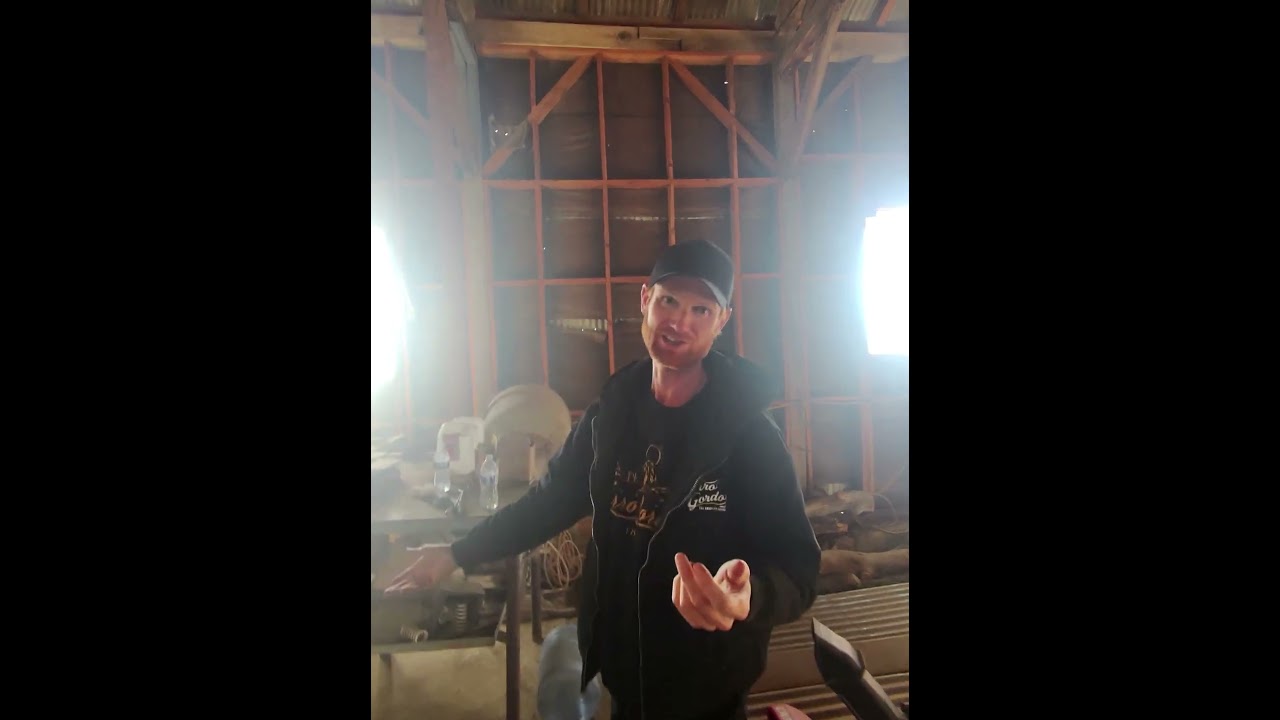
A walkthrough of California's largest 1860s silver mine at Cerro Gordo reveals a 900-foot vertical shaft connected to 30 miles of tunnels. The Union Mine produced 4.5 million ounces of silver and ran 24/7 with steam and compressed-air equipment hauled up an eight-mile mule road.
Chapters
All right, so we are now— we're in, in the mine.
We're in the Union Mine at Cerro Gordo, the largest mine at Cerro Gordo and the largest mine in California at the time. And this is the main shaft. So that is a hole that goes 900 feet straight down. And to get in and out, there's this cage, and the cage starts there. There's cable above it. The cable goes up and over to a giant spool over here. And we can walk over that way.
Yeah, we'll check it out. Yeah, so they would go down there, 900 feet, and it branches off to, to all kinds of different—
so it goes 900 feet straight down, but there's 30 miles of mines off of that.
30 miles.
So it just kind of goes everywhere. And the cage goes down, it can stop on the level. The ore track goes right into the cage. They could push the loaded carts right into the cage, bring it back up, bring it up here, bring it out for processing, over and over, 24 hours a day.
And we think hundreds of millions of dollars of—
At least, because I mean, so they mainly did silver, then zinc. They also had lead here. And just in silver alone, they have 4.5 million ounces of silver. I think silver is like $100 an ounce.
That's $450 million. Right, right. All coming out of that hole.
All coming out of that hole right there.
OK. OK, so this cable goes up, around, and across to back here.
To the school. And this spool is what lowers the ore down and out of the mine.
So there was always somebody standing or sitting up here.
24 hours a day.
24 hours a day. Yeah. Manning this thing.
7 days a week for decades.
Do we know how many people could go down at once?
I'm not sure how many people would be in the mines themselves. But if you look up on that dial up there to your left, the white dial, that shows how deep people are in the mine. So 86 feet down, 200 feet down, 400. Those are the different levels of the mine. And so this cable slowly goes out and that lowers the cage down as it goes down.
Okay, and somebody's sitting here. This is a break.
Yep.
And then now you've slightly modernized it over here.
Doing our best. Yeah.
And then it used to be steam-powered.
Yep. And so this, you put coal in here, they use charcoal, and then they would, uh, create the steam to both power the hoist, but then also before the drills were air power. They were steam powered. That was much more dangerous because the steam is hot, you know, steam line breaks and all that. And then after that, they got air power drills, and that's what that's for. That's an air compressor. Okay, so that's what pushes the compressed air down into the mines to run the drills.
This says 1890 Chicago. And so that— well, part of that giant thing. And then at least this is, this is all molded some of this to one big piece. This had to come up, come up the road, up the 8 miles on a mule.
Yeah, with a wagon with probably wooden wheels on it. Just absolutely—
How long do you think that took them?
Many hours. Yeah, a lot of hours to come up the road.
Do we know how many men went down that hole over the course