Ep 15: Social Media Communities with Ashley Friedlein
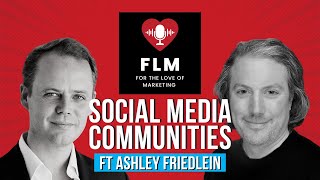
Ashley Friedlein built Econsultancy and now runs Guild, a messaging app for private professional communities. She explains why smaller, curated groups beat public social media's noise and algorithmic feeds, and how creators are moving toward paid, community-led models.
Hi everyone and welcome back to another episode of for the Love of Marketing. Today we're going to be talking about social media. The past, the current and the future and all good things about that. Delighted to welcome Ashley Friedlin today, who I've known for a little while now, the founder of the fantastic E Consultancy, which is an organization I've learned on many times in my career, and more recently founder of Guild, which is a professional communities and networking social app which is doing some really great stuff in the social media space for professionals. So don't forget to like and subscribe. And in the meantime, let's crack on. Hey, Ashley, how you doing?
Very well, thanks for having me, Simon.
Good. Thanks for joining us. Straight from the Brazilian rainforest there as well.
Yeah, yeah. The lush vegetation of Shoreditch.
Great. So look, I mean you've done some fantastic things over the years and as I say, for me, E Consultancy is a website that I've learned on so many times with some really great insights and fantastic. But more recently, I know you've launched Guild, which I've used myself for bringing people together. But before we get into what Guild is and what it's doing, what do you think? This is such an open question, but what do you think of social media at the moment? There's so much going on, there's so many opinions. Where are we? Where is social media right now? What's your thoughts?
Go on? Yeah, that is a big question. Well, I guess, I don't know. I mean, you and I say have been around a bit longer than we maybe care to mention, but I kind of think back over where we've got to where we are and maybe where it might be going. But you know, so the early Internet where you had or post its sort of military incarnation, you had academics exchanging sort of information and stuff. So you, you had those sort of early communities, not necessarily social media because they weren't public. But then I remember late 90s econsultancy at its heart. We had a forum, one of those old threaded web forums or like bulletin boards and that was like really good actually. And I think back to that kind of quite fondly. And also where you had active comments in like, in our blog and stuff. So a lot of that sort of social interaction, as it were, happens on the website in a forum or blog, comments and things. And then social media came along and sadly public social media, sort of Twitter, LinkedIn, Facebook and things and sadly kind of killed off a lot of that forum and blog comment activity because these big platforms a. There was the sort of excitement or vanity maybe of going viral and getting to a big audience. But also their UX was probably better, their tech was more sophisticated because they just could do a better job of it. So you had this whole area that was the web two which was sort of social, public social media. But I think what we've been seeing now is a desire to regain, I guess some of that sort of privacy or at least there are communities and groups and so social gatherings which are happening in a more private or curated or quality controlled smaller kind of way. And so you've got obviously all that sort of dark social stuff, like a lot of activity in messaging apps, for example, you know, WhatsApp and WeChat and Telegram Signal, all sorts. And Guild, as you said, is designed as a messaging app. So yeah, there's a lot of that sort of dark private, not public, social media stuff that's happening. And then of course there are, I mean, in terms of the formats, you know, the. We've moved from what was of text and maybe pictures and links and things and documents to voice, you know, like with Clubhouse and things, video with TikTok and etc. So, so yeah, but I'd say that the sort of biggest trend at the moment is a bit of a backlash against the sort of more public social media because of it's too noisy, too toxic, too addictive to algorithmically driven, etc. So a sort of desire to try and take back a little bit of control, I think.
Yeah, I think spot on. I mean, we're actually doing some work in my company at the moment with a business who are launching a private social network in a specific niche, doesn't compete with Guild, so don't worry. But really good, really good space. And this is for exactly that reason that these guys have conceived the app, is that people are looking for a bit of privacy and a bit of meaning within their social network. And yeah, for me, I remember the first days of Facebook and as you say, showing our age a little bit. But I remember when that really started out. There was real connection with your friends and your family. It was meaningful. And that's the majority of what you experienced was what really Facebook was designed to do, bringing friends and family together and sharing moments. And I think my view over the last 15 years, that's really become a very commercialized platform that shows you what it wants to show you in order to monetize or to create certain behaviors. And there's no specific criticism of Facebook. I think it's true of all other platforms. But that is why, you know, I agree there's a lot of this pushback coming. So tell me, tell me a little bit about Guild, because I know, as you say, that's, that's, that's part of breaking this mold and I know you've had some really good success and growth with that over recent years. So what is it you're doing with Guild?
Yeah, well, it was actually the same you mentioned, E consultancy, my first business, which I started in the late 90s, and actually that they're more similar maybe than they seem in as much as, I guess my passion is professional communities and so that is people coming together to share and learn from each other, actually both online and offline, you know, into events and training and things. And so E consultancy started and existed for three years just as a, you know, web form, a side project I was doing whilst working at an agency. But so it was fundamentally, in my mind was a community of sort of marketing people learning about digital marketing and E commerce. Off the back of that, we ended up building a business which had, you know, membership, paid subscription training and events. So it became a kind of media business, B2B media business, but was at its core a community, professional community. And then, you know, with Guild, what happened, I guess was sort of inspired by two things. One was the, the huge growth in mobile. So initially mobile web, but then mobile apps and in particular messaging. And, you know, I was seeing more and more like, particularly WhatsApp in the west being used for business stuff, like for senior leadership teams, maybe initially internally, but it was bleeding out into customers, you know, suppliers, prospects and things. And on the one hand I felt, well, this is, it's an interesting learning that messaging is being used so much in this way for small groups and communities and just to do business. And I kind of get why, because mobiles, you know, it's easy and it's quick and it's always on you. It cuts through where email doesn't, has push notifications, all that kind of stuff. And so I thought, well, you know, that's a fairly obvious kind of trend, but I think the world's going to continue to go more mobile. But the other was, you know, I felt there needed to be an antidote to a lot of the sort of more harmful and negative aspects of social media. And, you know, WhatsApp owns my Meta, obviously Facebook, as was, to be fair, WhatsApp, still a fairly clean experience they had for ages, talked about bringing in advertising. God only knows what they're actually doing with our data, but it did have, you know, I just felt that something which was a bit. Had a sort of a goodness at its heart, unlike most of Facebook, I fear, which was much more mobile focused as opposed to say LinkedIn and actually say LinkedIn groups I think have died of death. I mean, LinkedIn is super important for recruitment, sales and marketing, but I can't remember the last time I went to a LinkedIn group, whereas say 10, 15 years ago, as you say, I was quite happily in a lot of, you know, the early days of LinkedIn I actually did feel like a member, whereas now I feel like a product. So. So yeah, the guild is really born out of wanting to have a space or a place for people to run professional groups and communities, but which didn't have an advertising led business model because I think that leads to sort of bad behaviors and sort of exploitative use of data. But was a also mobile first experience.
I mean, that's great and I think you're right. I think there's still a lot of people that connect with me because we're in the same groups on LinkedIn, but I can't imagine I've ever posted. Most of those groups join with the best of intentions and never actually really had a conversation in there. So I think there's work for LinkedIn to do there and I think you're probably going to beat them to it in the meantime. So. So that's a good thing. One trend that's going on on social at the moment you mentioned your audio, you mentioned video is short. Video is becoming such a massive trend right. Right now and it comes up in so many conversations and I'm sure it's been in some of our recent podcasts and blogs and it pops up everywhere in everything we do. And we've seen Instagram, you push their algorithm much more towards video. Obviously TikTok is out there doing video very heavily and of course, you know, Facebook have made an announcement not too long ago about wanting to push more short video. There's YouTube shorts now as well. I guess you probably have a number of thoughts about this over recent months and years and it's not, it's not a new conversation by any means. But what's your view on the value of that? Because there's, there's so much you can get across with video very, very quickly and very visually for people, which is really helpful. But it's not always convenient to watch video. It's not, it's not easy to create a lot of video content and you can't really have backs and forwards conversations in a social group on video either. So what's your thinking about where you think video should fit in?
Yeah, it's an interesting question and I think it's a little bit nuanced but the. I'm going to think TikTok really have caused video to explode and also for Facebook and Google I think and YouTube. And Google has Google YouTube shorts now doesn't it? But I think they were caught slightly unawares like the explosive growth of TikTok and it's eaten into YouTube usage like a teenager and stuff not looking at YouTube like they were using more TikTok Facebook equally I don't think are necessarily doing as well in videos. They maybe they should be But I think TikTok has actually increased the length of the videos over time, hasn't it? I mean it was different sort of formats but so it's not necessarily they're all getting shorter instead of maybe growth of video more generally. But I think the. Yeah there's a whole. I mean there's a number of things to consider. One is you know obviously portrait versus landscape and things whether you have captions or not because sometimes you can't listen to the audio. But I think video clearly works well for entertainment type stuff which is most of kind of tick tock you know if it's sort of music and dancing and funny things things, you know then videos super well suited to that and scrolling through and things I think where I'm a bit less sort of sure of it is in and say we're particularly more into the business professional stuff. If you think of sort of WhatsApp groups even actually sort of friends and family WhatsApp groups it isn't still isn't that much video. It tends to be mostly text, maybe a bit of imagery afforded thing but it isn't all video. There are some people who leave the audio messages. Personally I find that really annoying when someone leaves a voice message that's quite big in other parts of the world, lesser in the UK because you can't kind of scan through it like it. I find it invasive in my attention. Think you left me a ten minute voice message. I've now got to kind of listen through it but maybe that's just me but video is a little bit like that as well where if you look on your LinkedIn feed now almost certainly what will be coming up top is video if not imagery and actually it's probably going to be quite a personal emotional kind of story which is sort of fine but it says the algorithms are Favoritizing, obviously the stuff which works in terms of getting engagement and broadly that is personal emotional stories in video. Now is that a good thing or bad thing? I don't know, but it's not what I would necessarily want to look at all the time. So if I'm wanting to have a slightly more practical, factual kind of thing, I don't need or want video. So, you know, we at Guild, we do have video, but more for sort of video meetups and social, more like a sort of zoom, Google Meet teams kind of experience for group conversations. And I think there it's good because it's just a bit more human and peoplely, you know, so just text or sometimes in WhatsApp you can only see a mobile phone number. You've got no idea really who anyone is. Whereas I think video, obviously there's a. It's not as good as meeting in person, but it's the next best thing. And then obviously imagery and text a little bit more transactional, informational and work well for that.
Yeah, I think that's spot on. I think there's, you know, video, like you say, entertainment, great. I think also education great. I mean, how to is obviously you know, one of the biggest search two words anywhere. So, you know, I think that it's great for that, but in terms of having real connections and it's. It's not as. Not as strong. I agree. So, yeah, that's interesting. You mentioned humanity there and that's something that I always talk a lot about with, with social media. I think I've always seen digital as really a channel to connect people together as sort of a human. It's not really the digital age, it's the human age is what I always say. The digital tools enable us to connect at a level we've never been able to before, to build bigger communities. How do you think we play that out more? Because one of the concerns in social over recent years has been it's quite fake, right? Donald Trump rode on the back of that a lot with the old fake news. But there is a lot of fakeness within, within social media. There's a lot of aspirational content aspiring to be like celebrities who probably aren't even like how they're projected on these social channels and, and, you know, people just sharing the successes in their lives and then people following their friends, getting depressed because they're thinking everyone's having a fantastic life. But of course they're only seeing it through that lens. And yeah, so there's a lot of that. But in Reality connecting humans together is incredibly powerful and that's really what digital is for. So odd question, I know, and I'm bouncing around all over the place with this one, but it goes through my mind all the time about is social good or is social bad?
Right.
Should we be using social media to connect humanity? Or is actually that always on social community element a problem? Can we, can we manage it better if we remove some of the vanity and some of the fakeness of it? I mean, do you have any thoughts about the good and the social media?
Yeah, I have a lot. I mean, and ultimately you do wonder whether it's a reflection of human nature really, isn't it? And sometimes that shows things which you don't necessarily want to know or makes you wonder whether humans are fundamentally good or bad. But anyway, the. For starters, I think there is a difference between what I think of as social media and community. And community gets bandied around. It seems a bit trendy again now, but I think there's a lot of sort of community washing, maybe if you call it that going on where you know the reality is. And it is in just terminology. But I would say in a lot of social media, what brands or whoever have, they're actually what I might call fans or followers. That's not a community. And in most cases it's a broadcast. It's a one way kind of interaction anyway. So fans or followers are I'd say, not a community. I think often media businesses, publishers, event organizers talk about their community when actually it's an audience. And I think an audience is not a community either necessarily. Like you can have a whole load of listeners to your podcast or people reading your blog. That's not a community, it's an audience. Then you have a network. And even I think a network is different for community. Networks tend to be slightly more transactional. The benefit is for the individuals who take part in the network, whereas the community I think has to have a sort of member to member element and it's really there for a sort of collective benefit. So social media is a lot of ways is a personal self expression or it's a marketing channel or sales channel and stuff. In most cases it isn't a community. So I, you know, beyond that, I think it is, you know, human. What are the kind of human emotions, motivations that these tools, platforms, whatever, what are they kind of playing on or playing to, you know, why are you, why are you posting this stuff, why are you clicking like or whatever it is. And there's, you know, it's Psychology. There are certain things we as humans desperately desire like a sense of belonging, a sense of self worth, sense of purpose, sense of being something in the world, all these sorts of things. And I think that the bad side of social media is that panders to or preys on those sort of less, you know, less helpful, less the sort of the worst side of things. So our you know, sort of vanity or like you're saying the desperate desire to be keeping up with everyone else, projecting this sort of fake life. This leads all sorts to sort know self harm and bad things. And so the good thing, because social media most a lot of it is public. You are out on this, it is public and therefore it is inevitably you probably create a kind of manicured curated version of yourself for it could be for professional or personal. The thing I think is good about a lot of the private communities and say this is certainly true in a lot of the guild ones, there's no real motivation to do that because you've only got an audience of the people you're in, in the room with. So why show off? You'll just look like a knob. So. So it's a very different, it's a very different reason like that hopefully the reason you're contributing is because you generally genuinely care, want to help people. Yes. There's a degree of. You're building your personal brand. Yes. It's about you know, credibility and authority and status. You know, in the professional world we all want status as much as we do in our personal lives, I'm sure. So it's not all kind of completely good but it's still I think slightly purer, better motivations than most of social media.
It's interesting. So in terms of where social is going, I mean I think you're right. I think it's actually a really nice way to phrase it there that you've effectively got your sort of open social media which is perhaps emotionally a bit darker. Then you've got your sort of networks and then full on community on the other side. I think it's a really nice way of putting it. Do you think if we fast forward 10 years, do you think that these sort of dark, very. I mean this in the nicest possible way, manipulated algorithms, sort of controlled algorithms, channels that we see today that are very much vanity and jealousy led. Yeah, they have. Do you think they still have their place in 10 years time or do you alongside networks and communities or do you see that actually people are going to get really fed up. There's obviously been some backlash and Some sort of movement away from some of these channels, but very limited amount. Do you see that people are going to get fed up with that and move much more towards meaningful private communities? Or do you think it all just has its place and will always be that way?
I'd certainly believe and indeed would like to think that there will be more alternatives out there and already, you know, there are both. In the sort of B2B world, like with Guild, there was on the way I saw a advert for a We Are eight, you know, which is a sort of again, a new social network that's sort of more about privacy and not the nasty big tech kind of thing. There's a new one coming called Curve, I saw recently. There's Supernova, there's all sorts of. So, you know, and some of those will succeed, some won't. So I think there will be a broader choice, I suspect, ultimately depending on you as an individual and your interests and maybe also whether it's professional, personal, whatever, you might, you will still have a mixture, basically. So you will have, you know, your more kind of maybe private ones where you can be a bit more honest and open and trusting and there's, there's a more congenial, meaningful relationships built there. But if you need reach and visibility and discovery and all that sort of stuff, I mean, if you're looking at as a, you know, marketing funnel, your kind of, you know, awareness, brandy building, reach bit, then public social media in whichever one is best, you know, one platform might be better than you for others based on, say, whether it's personal, professional or even by geographies around the world, then that is part of a sort of tool set, as it were, which you will need to do. So LinkedIn, you know, that is my professional identity and my CV, I don't have a paper CV. I don't think most people do these days. It is my LinkedIn profile and I do find LinkedIn valuable as a contacts database, essentially sales and marketing and recruitment. But do I think it's for communities and professional communities? No, I mean, I'd say I think LinkedIn groups have died of death.
But.
But say it's not that it's not valuable. It definitely is, but it's just has changed a bit. So yeah, I think that it will end up being more of a kind of mixture LinkedIn.
It sounds to me like you're saying LinkedIn is turning more into a job board where you happen to be able to talk to people in your network.
Well, no, I mean, I think LinkedIn as I wrote, I wrote a thing that LinkedIn feels like it's becoming more like Facebook in as much as the, you know, it's a broader trend I suppose the blurring of the professional and the personal.
Yeah, yeah.
Has been happening anyway. You know, it's partly generational. It's part of the pandemic obviously. You know, here's us sitting and while I am in an office. Not sure you are but you know, it's a much more informal and generally a move away from hierarchy and all that stuff which is, is a good thing I think. But that's coming through then in, you know, in LinkedIn which is, it feels slightly less professional maybe in the old fashioned sense which say maybe not a problem. But I think the other, you know, the interesting, the sort of broader macroeconomic trends you have the creator economy or the passion economy as it, you know, sometimes gets called but where people are having more portfolio roles, obviously remote work, you can work anywhere in the world more easily now. People have all got looking at their side hustle, little project on the side and I think a lot of those are quite community led and as in they might have a little niche of expertise and they have a certain, you know, customers or prospects they can bring together. So I think a trend and you know, we see this on Guild as well where people might, for example, if you imagine you could have 300 people paying you 20 quid a month to belong to your little community, that's what is that, six grand a month, 70 grand a year, you know, that's quite a good. And you can do it from anywhere in the world. That's starting to happen I think more which I think that is actually really exciting. You know, it's not social media. I would see more then as just a marketing engine or a form of marketing for that sort of community led, passion economy, creator economy business. But that's, you know, I think that's, you know, we see that happening and I think that's really exciting actually.
Good, good look, that's great. There's so much stuff in there actually I think Guild is fantastic. I think you're doing some really great work with that platform and I'd encourage anyone who's in a professional space that is looking to connect with some meaningful networks to sign up to Guild. It really is a really powerful app, some really great people on it, lots of advice being exchanged. It's really, really great. So anyone who wants to have a little go at that, definitely do that. It's really powerful available. Do you want to give me a little plug I see what's available well.
You can it's web and app so you can either go to the app stores or Google Play and search for guild and try and avoid the game the guild Warcraft or whatever it is and yeah I know a bit of tricky to compete with that or at Guild Co hopefully if you Google guild will come up somewhere near the top but yeah Guild Co you can sign up by the web or via the app and then there's a whole we've got over 5,000 groups across a whole range of niches. Not all of them. Most of them are private and hidden though I have to say but you can there's a directory of discoverable public groups on there so hopefully you'll find something that you like and is relevant to you and if not then create.
Your own perfect great plug. Fantastic. Yes strongly recommend that. Thanks Ashley, so much for being a guest today. It's really, really valuable stuff. Don't forget to like and subscribe and we'll see you on the next episode. Take it.
More from Ashley

Seedcamp Marketing Summit: Ashley Friedlein, CEO of Guild, on Community-Based Marketing (CBM)
Seedcamp Marketing Summit: Ashley Friedlein, CEO of Guild, on Community-Based Marketing (CBM)