Anu + Ashwin: Understanding Your Protein Signals
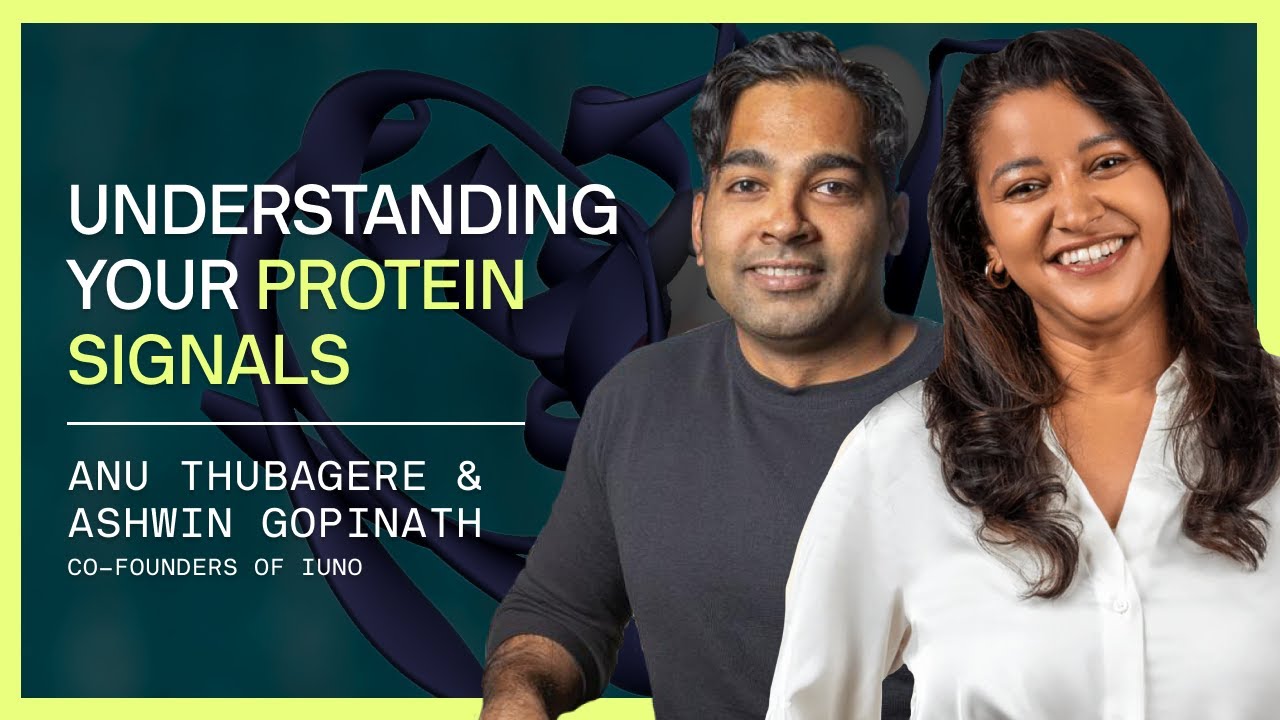
Anu, a Caltech PhD who had leukemia at 27, and Ashwin, an MIT assistant professor, founded Iuno to personalize skincare using proteomics. You send a blood sample, they measure over 3,000 proteins, and ship a custom 28-day serum formulation. The app tracks results and adjusts your next month's formula based on what changed.
Chapters
Where we talk to the people building and experiencing the future of health. Today we want to welcome Anu and Ashwin, the co-founders of Iuno, the pioneer of individualized skincare products which use proteomics to create truly custom products. Anu has a PhD from Caltech and was previously at X, Google's moonshot factory, and Ashwin also has a PhD, assistant professor at MIT in mechanical engineering, and among other accolades, sold his most recent venture in 2022. Welcome to you both. We're excited to have you here.
Oh, thank you so much for having us. It's good to be here. Thanks, Rachael.
It's good to be here.
We'd love to get started just by hearing a little bit more about you both and how you got to where you are today.
Absolutely. So, you know, small disclaimer, Ashwin and I are co-founders. We have been partners for a long time. And so, you know, a lot of our stories are sort of intermingled and Ayuno has been a long time making over different dinner conversations and, you know, lab sessions and so on. So I'm really happy to be here with him to share our story. To start off, gosh, it was, I was 27, And I was diagnosed with leukemia at that point. I was a graduate student at Caltech getting my PhD in bioengineering. So putting my scientist hat on at that point, it was, you know, all hell breaking loose for me, 'cause I was a very healthy person. I did all the right things. I was vegetarian. I did a lot of yoga. I did a lot of, you know, cardio and lifting and all of that. Like, it was a very balanced workout. very balanced diet, very mindful about stress and the workouts and so on. And in spite of that, this happened. So it was very sort of jarring experience for me. And Ashwin at that point was my partner as well. And so for us, you know, getting to the diagnosis was a difficult journey, but part of that was also really understanding, you know, or seeing the physical changes that were happening as time went on, right? From the time of me saying, oh my God, something's happening in my body, I'm starting to feel tired, you know, my skin's starting to get really dry, I just look, I just don't recognize the person I see in the mirror, to getting the diagnosis that, oh, this was leukemia and this is how it was manifesting in my body, to getting chemo and realizing that chemo just destroys not only your hair, but your skin and every other organ, right? So that was when we really started thinking about what does it mean to have healthy skin. It's not just about skincare. It is not just about, you know, applying different topical things, but it's really keeping your body healthy from inside out. And so in some ways, you know, we kind of started biohacking my skin in the beginning. And over time, that is what— that those realizations and all of those discussions is what's really led down the road for us to start IUNO.
And how did you really take that experience? It sounds like you went through this horrible situation. You came out of it with this new understanding of what's going on in your body, how to think about your skin. Sounds like you biohacked your own skin a little bit. Where did you go from there, from biohacking your own skin to starting this company and growing it to help other people?
I think biohacking my skin was sort of the first step. It was understanding, you know, we did everything starting from sequencing, getting my DNA sequenced, to learning about what were all the different proteins that were being produced in my blood, to, you know, what was the— what I was eating, how much I was working out, what were my stress levels. I really started tracking all of those, right? And certain things stood out to us more than others. So, for example, my DNA doesn't change, very stable, but lots of changes and interesting changes in my protein levels, right? Because my lifestyle's changing. And because I was sick, I started to pay probably more attention and I changed my lifestyle. I went, like I mentioned, I was vegetarian before, but I realized as a cancer patient, I had to reduce my sugar intake, which also meant reducing my carb intake and up my protein and fat intake. So I sort of went into this keto mode of diet. And so that meant I needed to start eating a lot more meat. And this was a massive shift in my lifestyle from where I was vegetarian from the time I was born to in my 20s becoming a carnivore of sorts, right? So, all of those changes really, you know, started to show up. And today, I feel much healthier, honestly, than I was in my 20s, even though I've, you know, I've had my cancer diagnosis and so on. So, Where did I— where did we go from there? You know, it's always been a hobby for both Ashwin and me to stay healthy. We do the best that we can. We make sure we are eating healthy. We are doing the, you know, we are working out. We are taking precautions against what can cause, you know, lots of stress and so on. But, all of that kind of stayed as a hobby for both of us. And once I graduated from Caltech, I was recruited to Google X. And there I started to work on some other things, right? Like, I've done a lot of stuff from agriculture tech to education tech, but then eventually found my way into health tech, right? And so one thing that I realized while I was there was while it's great to be in a large organization like that, things move very slowly. And the one thing that you learn when you get cancer is that time is not your friend. Like, you don't want to be wasting any time doing anything. So I left, I transitioned from X, you know, when I had this realization that, okay, this is not, I don't wanna be waiting 20 years to see that my work's gonna make an impact in the world. I wanted to have an impact now. And so transitioned out and started, you know, in 2021, end of 2021, actually. And yeah, it's been going great and we haven't looked back since.
So, you mentioned a little bit how your protein levels were changing, but for people that don't know what proteomics is, can you explain a little bit more what it is, why it matters, how you test for it, and kind of how it changes over time?
Absolutely. I can give— I think here's where my co-founder would shine. A little bit more. So I will have Ashwin explain the process.
So, Rachel, the best way to think about it is you have in your body, you have typically, you have DNA. DNA is there in all cells. It basically gets transcribed into RNA. RNA makes proteins, and proteins are the workhorses of your body. You have approximately 20,000 proteins in your body. There are variations of them. And there are about 10,000 of them floating around your blood at any given time. I mean, and these are the workhorse of your body. So they are the ones that change as anything is occurring to your body. So for instance, if you have a heart attack, your heart muscles tear and it leaks out certain proteins that are typically only in the heart muscles. So in your blood, if you see those proteins, which is like, troponin and myosin light chain. If you see those, it means that something happened in your heart. Your muscles tore there, and it leaked out, even if you did not have any symptoms. So, it could be completely asymptomatic. And, this occurs in every metabolic cycles and every organ. So, whether you sleep right, whether you're depressed, if you are psoriasis, if you have dry skin, if you have been out in the sun for long, the proteins level change. These 10,000 proteins are like maybe slightly larger. Their levels will change. And depending on that, you can tell everything about that individual. And, it's a very simple way to kind of see the difference between DNA, which is genomics, RNA, and proteins, is sort of like by an analogy. DNA can be thought of as like the recipe book that you have in the kitchen. RNA can be thought of as like little notes that you write on the recipe. Okay. And the proteins is basically the actual food that comes out of it. So if you were to take 2 recipe books from 2 different cooks, you can kind of say what they are going to cook, but you would never know how good the food is. So that's the way in which you can best think of as DNA, RNA, and proteins. So it's the proteins that actually tell you the reality of the situation. And this is not—
Yeah.
Like hokey-pokey, like PowerPoint presentations or things like that. These are standard tools that are used in the pharma and drug development all the time. So when you're developing a drug, you are tracking changes in proteins and you are looking at multiple proteins and you are figuring out if a person's condition is improving, if the person's condition is degrading, how a particular small molecule is affecting the system and things like that. It's just that those cost— the cost of these analyses have been in few to several thousand dollars, which is why it has been primarily within the pharma industry. But the costs have been coming down. And now we are in a state wherein we believe we can start utilizing this for interesting consumer technologies like skincare to begin with.
Definitely. And then you guys have developed a test as well. So how are you testing proteins? Is it something you're testing over time? You're testing it once, making products based on that, and then retesting? How do you approach the— all right, what's actually going on in me as a consumer's body and making those products that you guys are doing?
So what we do is when you go on our website and get our protocol. You get, first you get a box like this. We have put in, you know, some thought into how we designed this. We want to make the experience for the user as smooth as possible. So they get this box and in this box they get the skin assessment kit. Now the skin assessment kit is basically something that has, you know, you sterilize your finger, you use the lancet to drop blood onto this card, and we provide the shipping materials for you to ship this card to us. Now, this card is everything, right? This is what we use to look at over 3,000 proteins and your DNA in your blood. Now, based on what we see here, we put you— we are able to map the proteins in your blood to a database that we have, that we have collected over time, and we identify on which part of that system you lie. So basically that tells us, is your skin dry because you have certain proteins in your skin that make it dry, or because you are just dehydrated since you're not drinking enough water. Because there are some proteins that actually dry, that people with dry skin actually have versus when you're dehydrated, the symptom is still dryness, but it could be something else. So we get to the root cause. Another example is a lot of people have hyperpigmentation, redness, and so on. Now this could be because, you know, your skin could be red because you have high levels of inflammation because you had too much Chinese food the week before. Or it could be because you're internally— there is, there is something else that's happening in your body that's increasing the levels of inflammation. Hyperpigmentation, same way. Maybe you spend too much time in the sun or there are some metabolic factors that need to be taken into account. So your, your glucose metabolism may need to be revved up to reduce the hyperpigmentation. So we understand what is happening based on all the proteins that we are looking Now the manifestation is on the skin, right? So while we understand the root cause, the topical solutions have to match this to— they still have to relieve your skin, right? That's the product that we are building. And so the product for you is then sent as a 28-day ampoule set where you get 28 ampoules. Each ampoule is sort of, you know, it's This small. It's it's it's it's it's. There are no preservatives. There are no shelf stabilizers or any other gunk because it's a one-time use. And what you do is you break open the ampule and you put it into this device that we call a mister, and you insert the ampule into the mister, and it is power powered by a battery, and you. Basically sprayed on your face. Right. And this enables, you know, increases the efficiency of the actives going into your skin by about 90%. That's why we designed this. Now, this is USB-C charged. And so, you know, we will send you a charger, but there's probably a charger with you already. And so we— and then once you've used it, we have an app wherein you can take— you can scan your face and it tells you how this product's working for you. Now, at the end of the month, we take these results and see if the dosage that we sent for you and the actives that we used, were they good enough to treat your symptoms or not? If they are, great, we move to the next step. If they are not, we tweak, and next month we send you that tweaked protocol. So this happens for— as a 3-month plan with us.
Thanks so much for explaining all of that. It's fascinating to think about how you've taken this very complex kind of science around proteins and distilled it into a way that's really easy to use for consumers. As you think about this, the science behind what you guys are doing, obviously it's very complex. The studies are continuing to grow. It sounds like technology is making it easier to analyze what's going on in the body related to proteins. How else does protein analysis or proteomics show up when it looks— when you think about health? Like, what other conditions can be caused by protein imbalance? What other symptoms could be helped with a solution like this?
So, pretty much every single thing that you can feel is governed by some set of proteins actually changing. So even if you were to be sort of like not having good night's sleep over the last several days, that would manifest itself in your proteomics, like your protein signal. So the problem is figuring out what are the patterns associated to specific conditions. We have a grasp on certain skin-associated conditions, what the patterns are, but literally every single health condition and every single condition that an individual has would show up as a signal in the proteomic panel. The question is just figuring it out, and collecting enough data, and making sense of it. So, if we took the protein, the full protein panel, the 3,000 protein values for, let's say, 100,000 people, and we also knew all the conditions of those people, we ask them, are you clinically depressed? Are you schizophrenic? Are you sleeping right? Are you eating right? If you have that detailed information, you would immediately be able to pick out and figure out what are the patterns. The people who sleep well have certain proteins in a certain value, a certain pattern to it, and others will have a different one. It's not just one protein, it's a bunch of other— bunch of them that— and their relative levels with each other that affects it. So, it literally, over the next several decades, we expect this to be a way— this can, in principle, become the frontline tool for all of healthcare. When you go into a doctor's office, and you look at your entire proteomic panel, and you know your genomic makeup, comparing that, you can meet— the AI system can basically predict, okay, you are sleeping well, you're eating well. but something's wrong with your liver system, so don't drink this weekend, or like, you know, tape it out, or things like that. So that's where we can get to, but that requires a lot of data collection and a lot of analysis. So right now, we are just starting with skincare because we have a grasp on that.
Adding to what Ashwin's saying, there is a predictive nature to measuring these proteins, right? Because we are looking at your blood, which, you know, and the symptoms are manifesting on your skin, we are able to take that. So this is basically a very early diagnosis, right? So, and diagnosis, take it lightly here. This is not a medical diagnosis, right? A lot of the times these are just ways for us to stay healthy longer. And that's really the central thesis at Iuno. We do not want what happened to me to repeat, you know, with other people. The health, we can go, we could do another podcast on how the healthcare system is situated in the United States. But what we wanna bring in is precision health, is predictive health, right? We want you to stay as healthy as you possibly can for the longest time possible because there is no other—
Mm-hmm.
You know, you could do, I mean, you're in the same business, you understand what it is to be proactive about your health. And so this, using this platform gives the ability to the user to understand problems at a very early stage and start to course correct their life into getting healthier, right? They don't have to go down the path of getting into the healthcare system at all. Just small minor course corrections can already help. And that's— That's what we hope to bring to the user.
And it's really exciting to think about how this can further help transform this concept of precision health or kind of Health 3.0, however you want to call it. But this idea of being able to use data to create individualized treatment plans at a point of care, as Ashwin was mentioning, go to your doctor, understand your genetics, see the proteins, and immediately see maybe there's a liver Yeah. Liver problem, and here's the solution. So it's, it's, you can clearly see how more data, more analytics, more predictive pieces of this can really play a role in furthering that mission around preventative health in the long term. And thinking about preventative health or health in general, would love to switch gears a little bit and hear how you guys take care of your mental and your physical health. Being founders is hard. So how do you stay on top of your game when it, when it comes to showing up every day to be your best self?
I think part of it for us is that we love what we do, or I love what I do. It makes my job that much easier in some way. I've loved being in science, I've loved being an engineer, and now I love being an entrepreneur. So, you know, that certainly helps keep a healthy mindset.
for me.
In terms of physical activity, we— I've kept— I've continued that, you know, the workout program. I do powerlift, and that has helped a lot, both mentally and physically. Diet is, you know, I really try to listen to my body, what it wants at that point. I don't really try to cut off anything or try to, you know, starve certain aspects of myself. I think that has helped. Really, you know, being mindful is what has— being mindful in every sense of the word, in every aspect of my life is what's been helping me a lot. And that's what I would encourage people to do because when I— it's one thing to hear someone say, oh, be mindful, but it's something else when you realize it for yourself and the button just, you know, it just clicks in your head that, Oh, this is what I would do if I'm, you know, this is what I need to do right now. And so, the anxiety goes away, the regrets go away, and, you know, you're yourself in that moment and every moment from there on. So, that's really helped me, but I can let Ashwin answer for what he does.
So, for me, the biggest thing is I try I try to go to gym, you know, 3 to 4 times a week.
What?
And, we have a dog which forces me to sort of like go on runs and walks every day. And, more than anything else, one of the things that I have made it a sort of habit is to spend You know, about 20-25 minutes in the sauna, at least like 4 to 5 times a week, and use that time mostly for like this kind of breathwork and kind of things. And, that helps a lot. And, yeah, I mean, I like to say that my diet is good, but as you can imagine, being in like juggling a lot of different balls, And keeping it up in the air. It's a sort of constant struggle to be on the wagon, off the wagon. So, it helps a lot that if I work out, it makes up for the diet. So, I'm not going to claim that I have— I mean, that's been a fight for the last 2 decades. You know, it's like you have a good diet, and then you get off the diet, like you fall off the wagon, and you just get back on.
Are you tired of guesswork when it comes to your health? Look no further. Routine is here to simplify your wellness journey and help you unlock your best health. With Routine's convenient at-home lab tests and customized nutrient solutions, you can fast-track your health goals and understand your body like never before. No more one-size-fits-all approaches. Routine tailors science-backed plans and custom nutrient solutions to your unique needs, providing personalized nutrients insights and guidance. From smart multivitamins based on your lab test results to targeted supplements and personalized improvement plans for stress management, Routine has you covered. Experience unmatched results that you can track and feel, allowing you to achieve your full health potential with Routine. Visit routine.co to start your personalized path to ultimate wellbeing. Say goodbye to the hassle of generic solutions and take control of your health today. You know, it's hard for busy people, even founders working in health, innovating, creating kind of Health 3.0. Not everyone has the perfect diet, and it's really hard to get everything you need every single day, especially if you're working really hard and doing 1,000 other things. Is there anything else that you all—
oh, go ahead.
It's— so where we want to take IUNO is eventually we want to get to a point where we want to be like a touchpoint for pretty much everything an individual wants as far as health is concerned. This goes— so, like, this goes to, you know, even food. Like, what is the most optimum set of food items that you might want to have? That could be— it could be personalized down to that level. And, you know, it could be modulated based upon your health information every few months. You look at it and you're like, okay, fine, your food could change, your supplementation could change, your behavior needs to change, all of that. Like to have a central repository which kind of takes care of you and makes sure that you can stay as healthy as you could.
Definitely. I think that there's a lot of room for building and kind of having that central health hub backed by data that helps can help people live healthier and increase their healthspan for longer. In terms of kind of how you guys think about your health today, is there anything else beyond proteins that you're tracking, that you're looking at, whether it's on a quarterly basis, you're doing blood testing, or you have a wearable, anything else in terms of metrics that you're kind of tracking over time?
So, for me, the thing is we have like the standard metrics about like how many hours you sleep and, you know, the resting heart rate. and things like that. But the reason why all of those factors sort of gets integrated into the proteomic signal that you're measuring. So while it is good to measure that from a day-to-day basis, you keep track of it, the aggregate effect can be seen every 3 months.
Yeah, and I think in terms of trying to, you know, tracking everything else, there is an advantage of having your partner as a co-founder. So we do track other things like, okay, how many dates did we actually have this month? You know, how many times did we have sex? How many? And all of that starts to lead to, you know, where our stress levels are, right? So we all know you have to sleep sleep enough, you have to have, you know, certain kinds of physical activity, you, you know, you meditate, you have sex, you have, you know, you eat well, you lift weights. All of that has to— we all try to do all of it. But how does that correlate to stress? And how does that manifest, whether it's on your skin or your hair or in your energy levels? I think these are some of the things that we, on our own personal life, These are things that we also track. And as time goes on, I believe these are some of the questions people will have, right? 'Cause the world is very different from 2020 to now, right? More people are sedentary 'cause more people are trying to work from, or work from home. They're not commuting as much. There's no social lunch now, is sitting in front of your laptop and eating really quickly. It's not going to the cafeteria with your colleagues and having, you know, having it be a social meal. So all of that is being taken away. And so that's showing up in different ways of stress in our life, right? It shows up as you're not satisfied by just a single plate of food that you would have been in the past, because now you're eating alone. You're eating in front of, you know, you're watching a TV program or whatever that lasts 30 minutes. So, you know, with lifestyles, with changing lifestyles, and to a large part, I think remote work or hybrid work is here to stay. People have gotten into this habit of reduced social life. I think we are going to see more issues crop up because while, you know, culturally we are evolving at a very fast pace, biologically we are not. Our biology is not catching up, not yet. So that is the discrepancy. And so what is it that you can make? What is it that you can change in your lifestyle to close that gap is something that we wanna help with and have people, you know, make these small adjustments in their life so that they can stay healthier.
We've talked a lot about how you guys are thinking about, I don't know, scaling, other problems that you all can solve and kind of think about. Outside of the Iuno and kind of how you're thinking about the preventative space, if you kind of zoom out a little bit further into overall health and wellness, what are some trends that you're really excited about or kind of predictions that you have that we'll see over the next 3, 5, 10 years in and around the health landscape?
So I think that there are going to be a lot more tools that are going to be gener— that that measure your molecules in real time. So, right now, you have CGM that measures your glucose levels, but there are other tools that are coming online that measures your, you know, minerals, that's looking at like stress hormones, and cortisol, and lactate, and like things like that. So, that is going to become more and more common. I think that you're going to have much hyper-personalized health assessment, not just the kind of stuff that we are talking about. There are a whole lot of other multifactorial data collections that are coming online that becomes much more routine than— I don't want to beat a dead horse by basically saying AI is going to become front and center being able to, as far as interpret it is concerned, because everybody is saying that and that's We don't need to kind of go into that because in some sense it's a given. But these two things, and obviously the other one is the personalization of not just health assessment, but personalization of the treatments is also going to go hand in hand in some setting. Like for instance, the dose that you might need for a particular condition is not necessarily what I might need. So like personalization on that level is also going to start occurring.
And Anu, do you have any other kind of thoughts around trends or things that you're excited to see over the next 3, 5, 10 years?
I think one of the things that I'm excited to see is, you know, closing the loop on detection and solution, right? So we, you know what the problem is, Can you match it with the right solution? And how do you know that it is the right solution? So you tweak it and you go back to detect again. Now this is something that feedback engineering we do across multiple streams, but it's not yet been done on humans, right? So I think for me, that's the most exciting part as we start to see not just personalization as, okay, this is the problem and here's the solution, Here we match you with the solution. But the next, going that extra mile of asking, is that really the right solution? Because your body is changing, right? Just with like with skin, we say your skin evolves every 28 days. Then why are we using the same products? And this is something that we, as you know, at least for me, it is a frustration because every month, you know, I get something new and then I realize, oh, this is not working as as it did a few weeks ago. That's because your, you know, it's, your skin's kind of, you know, tapering out and the product's not just working. So you need that evolution of products, right? And your skin's the fastest growing, in some ways the fastest growing organ. And so for us, it's, for me at least, I see science actually going, you know, catching up with this, right? With this evolution, can we evolve our products as fast as, you know, as our lifestyles are changing? And even if it is seasonal, because we already do it, right? I go, now it's spring, my wardrobe's changing, my food's changing, where I work out is changing. Of course, my skincare's got to change, right? And that's just for skin. Everything else is you know, is going to get a revamp as well as we enter spring. So I would love to see more products start to do this and bring in that level of evolution for the user, which I think we are going to see. We are gonna see a faster pace of product evolution.
Yes, this one-size-fits-all mass market that started in the '50s, '70s, depending on the industry, Is definitely going to go away. It's going to be maybe a slower evolution in some places and a faster evolution in other places. But this concept of our body's dynamic, it changes, it changes day to day, it changes hour to hour. We need to make sure that the products that we're using for our health, that we're using for preventative care, and for if we're treating chronic disease, et cetera, that they're actually matching where the body is. And to Ashwin's point, that I think AI is going to play a massive role in this. It's There's only so much that humans can be able to pattern match and put together. And technology really has the power to help push this forward across not just the what do you actually need to be doing, but how do you manufacture it and get that custom dose down to a level that actually makes sense for people to buy. Well, thank you both so much for being here. Super insightful. I learned a ton during this conversation. I'd love to just end with hearing where can people find out more about you and more about Iuno?
So we are, you can find us on our website, iuno.bio. Our Instagram handle is the same. Our social media handle across all of the channels is the same. It's iuno.bio. And this week we are having an introductory offer for our protocol, for our 3-month treatment for Mother's Day. Something that I see in my own mother is, you know, how our lifestyles in some ways have been very similar, but we live in 2 different countries. So I've actually sent a kit to my mom to see how we differ. And I would love to— love for people to sort of play with this and understand how their lifestyles differ and how— what connects them to their parent, really. And so, yeah, check us out and let us know how it goes.
I love that. Well, thank you both so much for being here. And thanks to the audience for listening to another episode of the Precision Health Lab.
Madden and Mitchell Media.
More from Ashwin
#161 Organizational Memory Is the Next Moat: Ashwin Gopinath on Building a Company Brain
Dr Ashwin Gopinath, PhD - CTO, Biostate AI - Transforming Healthcare Through Next-Gen RNAseq & GenAI

molpigs podcast #23: Ashwin Gopinath - Merging top-down and bottom-up synthesis - AI in Research

molpigs podcast #23: Ashwin Gopinath - Merging top-down and bottom-up synthesis - AI in Research

Closing the loop in distance education using generative AI | Ashwin Gopinath | TEDxBoston

EECS Seminar Spring 2021 - Dr. Ashwin Gopinath, MIT - The Bridge from Top to Bottom


DNA Origami: The Bridge from Top-to-Bottom, Professor Ashwin Gopinath, Samsung Forum