Dr Ashwin Gopinath, PhD - CTO, Biostate AI - Transforming Healthcare Through Next-Gen RNAseq & GenAI
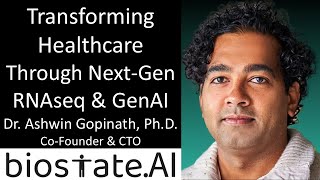
Dr. Ashwin Gopinath built Biostate AI to make RNA sequencing cheap and scalable, then use AI to predict disease and drug response from transcriptome data. His team processed 500,000 public RNA samples to train models that predict biological age. They're working with hospitals like Weill Cornell and MD Anderson on leukemia and other diseases.
Chapters
Sam.
Welcome to another episode of progress, potential.
And possibilities discussions with friends, fascinating people.
Designing a better tomorrow for all of us. I'm your host, Ira Pastor. Welcome everybody again to another episode of our show bringing another really fascinating guest today involved in science and technology helping to create a better tomorrow for many of us. Today on the show we are honored to be joined by Dr. Ashwin Gopinath who is the co founder and chief technology officer of a company called Biostate AI. It is a really cool startup. They're building all sorts of generative AI products that predict the evolution of human disease as well as drug response based on RNA sequencing data. And their patented wet lab technologies, including something known as barcode integrated reverse transcription, allow affordable and scalable collection of really massive amounts of transcriptomic as well as genomic data. And they have sites in Houston and Palo Alto and Bangalore, India, Shanghai. They are really developing into a really interesting international company with collaborations with top hospitals, with academic research researchers as well as biotech and biopharma companies. Dr. Gopinath was an assistant professor at MIT previously working at the intersection of CMOS nanofabrication, molecular self assembly biology as well as machine learning. Earned his PhD in molecular engineering at Boston University and then worked as a research scientist at both Caltech and Google X. Has authored dozens of papers and journals ranging from Nature to Science to the Pinos and as was awarded in 2017 the Robert Dirk Prize molecular programming for his various contributions merging nanotechnology with conventional semiconductor processing. A lot of really cool themes to get into today. Honored to have him with us. Dr. Ashwin Gopina, thank you so much for taking time to come on the show.
Thanks Irab. Pleasure to be here.
Great having you. You know, I'm very much interested in everything we're going to be getting into in regard to Biostate and everything you have going on. Before we go there though, you know, I love to hear about our guests, you know, history prior to sort of your current initiatives and you know, I took a look, a top line look let's say at both your Ph.D. on, you know, which is entitled Electromagnetic Field Enhancement and Light Localization and Deterministic Apiatic Dynastructures, which used optical physics to study all sorts of interesting ways that DNA twists and binds and creates shape.
Your postdoc work is equally fascinating because you move on to the whole area of DNA nanotech and using sort of some of these learnings for everything from DNA origami to sort of the area of soft matter physics and using DNA as tweezers take us to the past a bit, Ashwin, because it's a really fascinating area that you started out in and I just love to hear, you know, the background story here before we even touch on what you're doing now.
Yeah, so, so, so in. I mean there's no method to the madness in some sense. So I mean, post talk I can basically say that everything sort of like was planned, but there wasn't any plan. And there is. So I'm trained electrical engineer. I did my undergrad in India and then, you know, I went on to do my PhD. The PhD was in Boston University. Some of my work was also done at mit. And.
Essentially what I wanted to ask at that point and what I want, at least the initial part of my career was asking how well I could control.
Matter and how well I could control or how precisely could I actually measure properties of nanostructures. So my PhD was around the question of can I actually put.
Put can I concentrate light at a particular, at a nanoscale in the hopes that I would be able to put matter where the light is concentrated so I can measure certain properties about that particular molecule. And I wanted to measure it at a single molecule level. And I, at that point, you know, as I was exploring that concept, I ended up realiz that, you know, they're really, it's possible to concentrate light where you want, but it is not possible to at the same time put the molecule where you want and have both of them happening at the exact same time and not, not with the precision that you want. So you, and so that took me down the path to Caltech, wherein the only thing that I could figure out, the only, the only option was, you know, can I use these kind of techniques of creating.
Like DNA origami structures or DNA nanostructures and merge them with the semiconductor fab. Long story short, that, that you know, that whole adventure introduced me to soft matter physics, you know, computational geometry. The, the, the group that I was working with was fascinating in the sense that they came from a computational background and they were using DNA as a computational substrate to kind of.
Do interesting physical computation. Then you know, there was a bunch of very interesting works that I work that I did there which was, you know, or being able to organize molecules and organize nanostructures using DNA and semiconductor fab. Then around 2015 time frame, my, my then girlfriend, my current wife.
You know, got diagnosed with leukemia. And that took me down the question of what, you know, it made me realize that, you know, like we have a, you know, amazing sense of enduring.
Difficulties. If I knew what was going to happen, then in some, some ways I could make peace with it. So if I knew that the only way in which I can live is by cutting my leg off, I will figure out a way to kind of live with it. But the problem is, in most settings, most chronic conditions, you don't know exactly what is going to happen. Even in her case, even though there was targeted therapy, it wasn't clear what the side effects were going to be and also whether the condition is going to revert and when things are going to go south. So there's this latent sense of latent anxiety that always remains. And this is true for pretty much all chronic conditions. You don't know what is going to happen. So if you're above the age of 45, there's a very good chance that you have some kind of disease or some kind of condition and you don't know how they're going to manifest, how it's going to grow and how it's going to evolve. So that kind of took me down the path to Google for a little while, Google X for a little while, wherein I was trying to ask the question, can I actually take pictures? Can I take other, you know, easy, accessible information and build predictive models that can basically say, onset of side effects, at least in her case, as well as other people who might be dealing with similar situations? Then in 2019, late 2019, early 2020, I started my lab at MIT and then Covid happened and, you know, I took some of the ideas that I was, that, that, that, that I was playing with that at Caltech and decided to start a company called Parametrics, wherein the question was, can I actually measure all the proteins in a given sample? So the overwhelming idea was can I build what Illumina had done for DNA sequencing, but do that in a protein world? And, you know, and we wanted to do it at a price point wherein it was a few dollars so that I can measure somebody at least. The dream was to be able to build a technology wherein I can measure all the proteins in somebody's body every day or every other day or every week so that I can temporarily measure and so I can look at just the protein profile or what the, what the concentrations were of all the proteins that are in your blood or any tissue and be able to predict how things are going to happen. Long story short, things didn't sort of like the market sort of turned and so we decided to sell that company. We sold it to sumologic at that time, you know I was thinking of it as I went into it kicking and screaming but now post hoc rationalization, it worked out to be like very good timing to get out so because there are like a lot of other startups that, that that had taken raised money that they'd struggled through and they're still struggling through. So like, like I said there's no method to the madness. It was just, it just worked out in some sense. Then I went back to mit. I've taken a leave of absence to work on this and worked on something called as Reflection wherein it was one of the earlier instances of demonstrating that you can build an agent, how you can build an AI agent using LLMs. And at that time that work we showed it was a paper called Reflection. At that point we showed that we beat GPT4's performance using GPT 3.5 and building an agent out of GPT 3.5. And you know, and you know it was an exciting thing to kind of see where that was going. And these were ideas that I was thinking about like floating around for a long time and it just sort of like happened and you know, and it was at that time it became very clear that I didn't want to be an academia is like there was way more interesting things that were happening outside. So I decided to start biostate. The biostate is continuing the same theme. How do I build predictive models and you know, and taking all the learnings that we had had decided to go for RNA because DNA doesn't change proteins and small molecules. I tried at it and I learned that they could. You couldn't measure all the proteins so what you're left with is only rna. DNA doesn't change. DNA makes rna. RNA makes proteins and small molecules. RNA small molecules and proteins change depending upon what your behavior is, your conditions are, what is happening around. So we decided to settle on DNRNA and me and Dave. Dave is somebody who I knew from Caltech times. We know each other for like 15, 16 years and we decided to basically just start started and it was, it's been like two years of like crazy adventure. We basically have reduced the cost of RNA SEQ dramatically in internally we are collecting thousands of samples pretty every other week and.
Processing them and building models on it. We built a whole bunch of other tools around it.
That we can talk about as well. It's not just foundation model on be able to predict biology. We have a bunch of other agents that also does automated science.
But that's a, I don't want to go on that tangent yet.
Gotcha, gotcha. No, no, this is perfect because you bring me, you're reading my mind here because you bring me up to.
A.
Very interesting paper that you wrote at the, this is the end of 2023 December, entitled Bioformers, A Scalable framework for Exploring Biostates using Transformers. And you introduce, you know, the reader not just to the nature of all the sort of the models and so forth, but this principle of a bio state which you defined in the paper as a high dimensional vector encompassing various biologic markers, including genomic, proteomic, transcriptomic, physiological and phenotypical data. And it was quite interesting. You know, I appreciate you brought up the point about your wife and we'll talk about leukemia a little later on and some of the work you're doing, but I don't know, a couple months ago, you know, we had Sui Wang on from, from Institute for Systems Biology talking about a little bit about state space and specifically sort of, you know, what, you know, causes a multipotent progenitor cell to become a red blood cell or a white one or something in between that's not mature enough or goes off in the wrong direction. Talk about what a biostate again means to you as a company. Obviously it's made up, as you point out in this paper, of many different parts of the omics puzzle. But talk about that a bit. I think it's an important concept that we don't normally think about when we're thinking about that gene or that protein, a state, a cell state, much more complex concept. And I want you to take us.
So, so, so then there are different ways to think about this, right? Like if you say, if you have any system or any entity, you can, you know, you can, you can qualify it with certain attributes. Like if you were to say, you know, if I were to meet an individual on the road and if I were to basically.
Think back about that individual, there are certain attributes that I would think about. What is the shirt that they were wearing? How tall were they? What would be their identifiable features? So there are set of attributes that you attach to pretty much every element and depending upon how much unique attributes that you attach to them, the uniqueness keep increasing. Now if I were to walk through a crowded street and I basically say everybody, if I were to just remember everybody's height, I can't think back to a particular person that I would have met, but then I would be thinking of their height, their shirt, their, you know, whether they Are fat, they are thin, a whole bunch. The more attributes that you have, the more unique you can attach to them. Now, bio state is something very similar now. But rather than measure remembering a person or an entity, you are remembering the state of that particular biological system. Whether they were sick, whether they were, you know, how hungry they were, how sleep deprived they were, or anything like that. And now the question is, what is the set of numbers that you can or set of features that you can enumerate that uniquely identifies that state? So what we are stating is that, you know, let's think about it from an organismic point of view. Let's not think about it from a cell point of view or tissue point of view. And this is a very conscious decision because ultimately it's an organism that falls ill. It's not a tissue that falls ill. It's not a cell that falls in. Even if the cell is sick in some sense, okay? It manifests itself at an organismic level. So in some sense, I don't care. In some sense, even if my, even if there are a bunch of cells that are sick in my body, if I have my immune system cleans it up great, it's not going to manifest itself in my, at an organism level, the issue is only if you have a bunch of cells and the immune checkpoints basically cannot actually do what it's supposed to be doing that it manifests itself and the problem becomes a systemic issue. So I want to have a systemic definition. What are the set of numbers that I can measure at the system level that uniquely identifies them? So it can't be DNA, because DNA doesn't change.
So then the next question is, it's all the molecules that are, it's somehow related to the molecules that are floating around. So, and what are the molecules, other molecules that are floating around? It'll be rna, it'll be lipids, it'll be proteins, it'll be a whole bunch of other small molecules in there. I can't measure, I can't, I can't think of the biostate at this point to be constitute of things that I can't measure. I can't measure all of the proteins. So I just threw it out. I don't want to think about it, okay? And I, I can't measure all the proteins, all the small molecules. So I throw it out. I'm not considering it yet. So, but I can measure all the RNA in there. So I'm basically stating that the biostate, we are beginning with the biostate to be composed of only the transcriptome. Now, is that a unique description of that state? Not necessarily, but we hypothesize the belief that we are going with is that the transcriptome basically captures enough of the unique information that we can basically do a lot of, you know, a lot of insights from it. Now, I could be very wrong or I could be very correct in the sense that maybe the RNA is enough to tell 90% of everything in there or 95% of all possible states that an individual can constantly be in, or it can tell only 40%. Either way, there is value to it. So we started with that question.
And you know, as you mentioned, and also we'll put the link to the website and people can, you know, take a look at all sort of the different components of this process. You know, you're, you're training on these as you define them. So these massive RNA data sets which represent the transcript zone, literally hundreds of thousands, potentially millions, and you define sort of the grammar of biology. Take us into, you know, obviously, you know, we talked a lot about AI on the show and some of these models. It's not my expertise, but when, when I'd love for you to drill down on some of these tools. As mentioned in the, in the intro barcode, integrated reverse transcription PERT probes for excess RNA depletion. You have an amazing set of tools that you've put together to really revolutionize ultimately how you think about that really complex transcriptome as opposed to, as you say, building very narrow sort of single purpose things. So take a little time and walk us down this path.
So there are two parts to it, right? So, so BERT and PERD are not AI parts. So BERT and PERT are basically tools that we developed to reduce the cost of RNA seq. So typically RNA SEQ is a technique known as RNA sequencing. So typically in RNA sequencing, what happens is you take a tissue, then you rip open the cells, you clean it up, you do a whole bunch of processing, you clean it and then you, and you take out all the RNAs in there. And typically RNAs has got a lot of ribosomal RNA as well. So ribosomes are these little RNA machines that basically binds to DNA and converts it into rna. You can think about this way. You have a whole bunch of background of ribosomes in there in addition to genes that get expressed. So every gene, basically, if it gets expressed, you will have one copy or multiple copies of rna. So in some sense, if you measure all the RNA in a system, you can basically say which gene Got activated by how much. That's one way to think about it. It's not perfectly correct, but that's a way in which you can actually work to it. And we have about 30,000 genes.
In a human. So think of it as you are looking at what are the concentration of 30,000 different RNAs. Some of them are overexpressed, some of them are underexpressed. So some of them have different concentrations. So that is, that pattern is what we call as the, the, the, the, the transcriptome or like some part of transcriptome. It's not strictly right. There are more to it. But let's go with this, let's go with this, this, this, the 30,000 and that, that, those numbers. So that the vector of those 30,000 numbers would be what we are calling for the time being, the biostate. So Bert, and Bert allows us to reduce the cost of collecting that vector. Okay. Typically right now if you were to send your blood sample or something to.
Novogene or a couple of other companies out there that does commercially these RNA seq, it costs between 200 to $300. And, and what we can internally do, we can, we have reduced. We don't want to talk about the exact number, but we are significantly lower than that. So because we figured out how to.
Process it in a much more efficient way. And I don't want to go into the technical details just because it becomes kind of boring. But suffice to know what we do is we just pull a lot of things together that allows us to do what we call as barcoding. And because we do the barcoding can reduce the cost of the entire process significantly. And that allows us to collect more data. And because we can collect more data, we can do something known as unsupervised learning. Typically when people are.
Working with biological samples, they do what is known as supervised learning, wherein you have some data and with some sample with some certain numbers or some features attached to it. And you know that this is coming from somebody who has cancer or somebody who has cardiac disease or somebody who had cancer who was treated in a certain way. There are like a lot of clinical notes attached to it. But what we are saying is we don't want to do it. And that's because we don't want to do supervised learning. Because people do supervised learning because they treat each of the samples as very precious and it is very expensive for them to process it and get data out of it. Because our sample to data conversion is so cheap, we can collect massive amounts of Data. And we can work in what is known as an unsupervised domain. So think of it this way. I take a hundred or a million people in population. I take RNA seq from all of them, okay? And then do something known as unsupervised learning. In unsupervised learning, what you're looking at is you're looking for patterns in the rnac. You don't know what the patterns mean, but you know the patterns exist. What that means is if I were to take a million people, do RNA seq on them, and do unsupervised learning, you will see half a million of them having a certain pattern, another half a million with a different pattern that most likely would respond to, these people are male, these people are female. Then you would see like certain, you know, like about 35% of them will have a certain pattern that will most likely end up saying that these people have some kind of cardiovascular disease. Okay? And you'll see patterns sort of emerge. You don't know what those patterns mean, but you just know that the patterns exist for a certain subpopulation that you had. And then what you do is then you attach supervised learning on top of it. You take highly annotated samples and you figure out where the pattern matching exists. So somebody with a cancer, a unique cancer tool that reacted to a particular therapy that will go and cluster itself. There'll be a pattern that will show up that, that will match. And now you'll see all of these other. Other people that you identified, they also likely have this cancer. And they also likely will respond the same way to the one that you identified that you trade on. So this is a much more powerful way of doing, you know, using AI. And so that's what we are starting to do. And then there is like, there are certain generative components to it and things like that. We don't need to go into that, that details right now.
That's. But again, it's again, very elegant process. And you talk about, you know, decrease the cost. I'll be much more data combining sort of the unsupervised and supervised magic. And that's all wonderful. And then obviously, you know, not just based on, you know, you. You've obviously put together a great suite of investors, but also some really interesting collaborations. And if we could just, you know, talk about some of these and a little bit of what you envision, I think obviously in a very important place, based on your story prior, you know, with your, with your wife in terms of leukemia, was your recent Announcement of a collaboration with Will Cornell Medicine to work in personalized leukemia care. And here again, you know, you see it all come together, right? The ability to take these data sets to create the, the heat maps or the clustering, the proper stratification. And you're going to be studying aml, obviously a very, very dangerous leukemia. And it seems like in this collaboration, everything from, you know, stratifying patients, looking disease prognosis, looking at how one can tailor therapy either down or up, or changing a drug, Walk us through this because obviously it's near and dear to you and a lot of people listening.
Yeah, so, so, so the thing is, the way in which we have structured it is we have, we have, we have routes wherein we have collaborations, wherein we, we work with diagnostic labs as well as any place where we can get consented samples without any labels attached to it. So that basically is the pool for unsupervised learning, wherein we just need to know that it is a unique sample, unique biological sample that we do RNA SEQ ourselves. And then that, that goes into sort of like understanding. You can think of unsupervised learning as understanding the grammar of the transcriptome itself and looking at, looking for patterns within them. Then we have very deep collaborations with several hospital systems. You know, with Cornell, we have, with MD Anderson, we have now with Mars General in China, we have a bunch of places with India, we have sort of like we are running pilots, but we are not publicly announcing it yet.
You know, we have, we have these running around the place. And in all of these kind of healthcare systems, when we are collaborating with hospitals, what we are looking for is samples for supervised learning. These are samples that has a unique trajectory. It's sort of like these are individuals or samples from individuals who responded well to the therapy or who did not respond well to the therapy or who had a subclass or like, who are like a person, particular unique variant of the, of leukemia and things of that nature. So when you combine it both, what happens is the unsupervised learning basically helps you, you know, sort of clean up issues and the supervised learning tells you how to make sense of these patterns. Okay, so when you combine the two, you end up getting very powerful capabilities because also as you increase the unsupervised learning, you can, you have less and less requirement for supervised or like highly annotated data set.
All the collaborations that we have are for, you know, specific clinical sector, clinical conditions and for, you know, making sense of the unsupervised learning that we are doing on Data that on samples that we are collecting ourselves, you know, across the world and the way in which it is structured, we are not tied to any particular cancer or any particular condition. We can basically, as long as we can get samples with annotation, we don't care that the model doesn't care or the architecture doesn't care whether it is from a patient with leukemia or if you're, if you're looking at some kind of specific cardiovascular disease or is it like some kind of lung disease, it doesn't matter. It can basically be applied to pretty much any area that you want.
Yeah.
And as you mentioned, based on that approach, you're also working in Ms. And sort of the whole area of autoimmune disease. One of your papers that stood out to me, and obviously this is not related to a specific disease, but it again, shows sort of, of how you think about sort of the progression of this technology, is a paper you published last year in April on using these technologies to study what's referred to as the reactome, which is basically an understanding of ultimately how across, I guess, a population, one drug works in somebody, it gives a side effect to another and has no effect in somebody else. We don't really talk much about the reactome, but it's clearly something you would think probably every pharmaceutical company and biotech company in the world would be interested in knowing more about.
Yeah, so, so, so, so this is, I mean, reacto. So that's a, that's a. I mean, personally, that paper is very near and dear, dear to me because there is a lot of interesting biology in there because. And there's a lot of biology in there that is still unexplored. At some point we will go back to it, but. So the concept of reactome is rather than, rather than viewing proteins or elements that are structurally similar, which is what biologists typically do, when you think of two proteins, if they are structurally similar, you would think that they are, they are, they are functionally identical. And that is true to a great extent, but that might not be true from a systemic level. Let me tell you. Let explain what I mean by that. What I mean by that is. What I mean by that is if the same protein is existing in, let's say, liver, you know, heart or anywhere else, they are not going to behave the same way in all of these organ systems and tissue systems. They're going to behave slightly differently because they are, they are always in a milieu of other molecules and it's part of a system. It's not individual if you're thinking about two proteins that are structurally identical in isolation, they will behave very similarly. But if they are both in two different environments, their behavior is going to be different. So the concept of reactome is we are looking at perturbations and comparing the perturbations rather than comparing the molecules themselves. So what we are. What the concept of reactome was, you know, let me take.
You know, a drug and give it to an animal or give it to a particular system and look at the perturbation that the drug basically does on different organ systems. And now and try this on different. Try this with different drug, drug molecules. This will end up creating a signature, okay, and signature. And you can use that signature to kind of predict how a new molecule is going to behave on. So that was the core concept of reacto now. And we got some really interesting results there. But the reason why we stopped pursuing that to us to a great extent was that whole effort was intended to make us into a drug development company and all of that nature again. And if we wanted to go down that path, we needed to have massive amounts of money to do a whole bunch of experiments and a whole bunch of things and really be sort of.
Get VCs and investors to subsidize us to do research. And both me and Dave have seen where that goes. That puts a lot of pressure on us. And so what we wanted to do was to have a core base of technologies that are generating revenue and, you know, to build a foundation for the companies and build up from there. So we decided, okay, fine, you know, that that's. There are really interesting things there. And so we sort of like stopped that and we'll go back to it at some point and then sort of like pivoted to. Not pivoted really. We basically put more energy into, you know, making sure that we can give, you know, offer the RNA SEQ services that we have, like the local lower cost, the cost reduction that we have, give that to the scientific community as well as go build these kind of diagnostic tools, prognostic tools, therapy, selection tools, which is all that we can do. And once we start, basically get. Get enough leverage there or enough, you know, experience there and collect enough data there, then start going into interesting things like React Dome and stuff like that. So, so that's. It is purely a choice. I mean, it was an interesting thing. There's lots to be done there. I mean, there is a lot of details. I can. I mean, you could talk for hours on just that paper. But.
But yeah, again, I Wanted. I just was. Again, when I went through all these papers again, there's a nice. It really lays out sort of the potential. Obviously you can't focus on everything, but nonetheless there's some, some themes here that are just again showing the potential of what you're working with here. And while we're on that, I just have to ask because aging, longevity, this has been a really interesting theme for our show the last couple years. I couldn't help but run into the recent paper on your work with transcriptomic age prediction. Clearly everything now has been all the epigenetic clocks and all that stuff, but you stumble upon something here and stumble upon. Makes complete sense.
But yeah, okay, so, so, so that's what. So, so when we were. So what. So that paper, that paper is interesting. What is even more interesting about the paper is how it was written. Okay, so that entire paper was written by an AI. Literally the entire. So every single part of that paper that what is there on bio archive or med archive, whichever one, I mean it's there. I've put that up in open review as well. So that entire paper was written by an AI agent that a set of multi agents that we have created. And the story behind that is early on when we started the company, we realized that we are going to be collecting massive amounts of data. So it was a very concerted effort at that point that if we want the, the amount of data that we are collecting needs that we need an army of bioinformaticians and computational biology biologists to maintain it. And since I was coming in from this kind of agentic framework and thinking about all of this. So a year and a half ago we started efforts to internally make sure that all the bioinformatics work, all the insights, all of this was done by AI systems. So we have a whole range of AI.
Agentic systems running in the background, cleaning up the data, collecting the data, making sure that the insights of the data are there and like generating little reports and things of that nature. But a lot of things changed about I would say about five months back. I think five months back I think LLMs got to a point wherein all our systems sort of up leveled and we started realizing the models and everything that or this, all the agents that we obey, like the capabilities of all the agents that we had in our. On our in on in our systems went up significantly and you. We could basically start tying them to each other and asking them to do interesting tasks. So what that paper, the paper that came out and there is an even better that paper is just like there's like there's a newer version of that paper that will be released in the next, probably two, three weeks, which is with. The results are like way better than. It's probably the best biological clock out there. But we've not yet. We have not.
But that paper will come out in the next two weeks definitely. So the story of so what we had done is we had collected about half a million publicly available RNA seq data from a database known as Arches4.
And we gave it to our agentic system. This was an entire agentic system wherein you had a multi agent system that basically analyzes data, creates plots, looks at the plots and makes sense of it. We have another agent that basically writes reports based upon the.
Figures that is created and things like that. So we gave it access, we chained them all together and gave it access to the database and said the prompt literally read, go through the database and learn what you can about the relationship between age and transcript. It's very hard even now for me to kind of express how cool this is. With that one prompt, the model went ahead.
And collect from the 500,000 samples. It reduced it down to about 62,000 samples.
That had transcriptome that matched a certain quality and had age attached to it.
Then it plotted it out, then it spawned an agent that creates ML models and it created 13 models, benchmarked it on the data. So it basically tried to fit it like the XGBOOST and a few other models as well as. And there's like a mixture of expertise turned out to be the best one. And it did all of this completely autonomously. This is what it's hard to kind of express. It's like the whole thing was done completely autonomously. Then it asked the question why does it perform well? And then it went out and figured out that There are these 20 genes that are performed well, the top genes. Why were these genes the ones that were attached to it? Some of them were epigenetic regulators, some of them were senescent cells regulators, some of them were like immune checkpoints and things of that nature. And out popped basically this model that can Basically after about four or five hours of going through this out, pop this 32 page report that essentially read like a paper which is what we put out into the world. So in some sense the reason why we say it's Quantico team from Biostate is because Quantaquil is one of the tools that we use. The primary tool that we use for it, internal name is Quantaql and none of the researchers were comfortable and I was not comfortable putting my name on it because we created the tool, but the tool did this work. And you know, granted when you read it it doesn't look like, I mean you could still say it is AI written like there's, because there are like obvious repetitions and things of that nature. But the fact is we internally, we are at a point wherein you throw the data and you walk away and it'll do the rest. It's we are so, so, so, so, so that's why I said the tool behind that paper is way more cooler than the paper itself. And so there's a paper that like we are submitting a paper wherein we both talk about the tool as well as the final version of that result. I mean, I can't talk about the final version of that result because that's way more exciting than what is in that paper itself. Like that.
Yeah, so yeah, at least not a partial scoop, but nonetheless we'll be on the lookout for that because yeah, that's clearly.
An overriding theme let's say in this whole area of longevity biotechnology and all that's happening, sort of the JIRA science domain. So I'm going to want to see how that's all going to be received. But.
It'S also kind of, there's something very poetic about. To our knowledge this is the first end to end AI scientist system. Until now we have not come across any multi agentic system that you can just dump data to and ask it to write, do an insight and basically it comes out with this. But there is something very poetic about the fact that an AI scientist, so to speak.
Writes about aging, the one thing that it cannot really experience. So there's something very poetic about that.
Yeah.
That'S impressive.
Actually you mentioned, you know, obviously several of the, the collaborations in the US Mass general and so forth. You have you know, recently announced that, you know, the, the Chinese focus, you'll be working in areas like autoimmune disease and various cancers. India, you're collaborating with several hospitals. Talk a little bit more about sort of what we should be on the lookout in terms of these collaborations, other public facing initiatives like this that are coming up, please.
Yeah, so publicly. So primarily the reason why we decided to go global with from the get go itself because that is not the choice that startups would do. The reason why we decided to do it that way is because, you know, it makes no sense to build models for biology and ignore 50% of the world's population. In some sense like, and this has happened in genomics and for, I mean we can argue at length as to why that was the case, which was not by choice, but there is over representation of the western population in there. And because of that what happens is many of the drug molecules and many of the treatments and many of the insights that you end up having cannot immediately translate to a large portion. Now one could also argue that this is the reason why when you're going through clinical trials and stuff like that, there are outliers because many of these decisions, early on, decisions that are made were made on insights that were from biased or you know, from not diverse, not as diverse pools. So we didn't want to run into that issue. And secondly also access to samples and access to.
Records, clinical records in America is much harder and much more expensive than they are in India and China.
I mean US healthcare system. We can talk at length as to all problems with that, but that's, that'll take forever. So, so that's our reasons for basically doing this in both, you know, China and, and India. And you know, and I am first generation Indian immigrant, so it's easy for me to actually have connections in India. And Dave similarly, you know, Dave's parents immigrated to US many years back. So like Dave also has like some connections in China and his work there before. So it allows us to kind of leverage that, to kind of get access to that samples. And now, I mean, and the way in which, like I said philosophically, the way in which we are doing it is we have this base model that learns and continues to learn and improve on the general RNA biology and like the grammar of rna, so to speak. And then as many collaborations as we can find that are working on interesting.
Yet impactful health care issues. And so whoever we can collaborate with, we will collaborate with so long as they have samples, they're willing to share the samples and the anonymized clinical annotations.
And because we have cost advantage, it makes it a whole lot easier for us to also collaborate because we can only as long as we have access to samples, we can fund the processing ourselves because, because of the cost advantage that we have because of Bert and Pert.
So that's the way in which we are thinking about all of these global initiatives. Got it, Got it.
One quick question coming sort of back to the beginning where we started, Ashwin, I just, you know, there's this one line in your bioformers paper, you know, talking about not just the sort of the, the promise of the tools for potentially advancing regenerative medicine. But you talk about sort of the vast combinatorial space of, of what can be done, you know, ultimately when we have the, you know, these tools in front of us. And I'm just interested, you know, based on where we started our discussion in terms of the DNA origami and sort of the emergent properties of systems, the small to large, any interesting sort of regenerative medicine applications at sort of the tissue level, things you're thinking about and ways, because things like that you studied in terms of shape, in terms of size and the way, you know, structures are formed. Very. It's a whole other area of biology that's much more complex than even what we were talking about when we talked about the biostate of the cell. Looking over the horizon, what are your general thoughts about sort of where this comes out?
So I don't know, I don't know. I don't know about regenerative medicine. So personally, or, or, or, or so personally.
I don't think currently.
The way in which healthcare works is.
An individual gets assigned, if you have some symptoms, you go into a doctor and they basically say you have disease X or you have a disease condition. Yeah, right. But the reality of the matter is no two person, no, no two people are sick in the same way. What I mean by that is they are not. If you have two people who have, let's say AML or CML or any kind of other leukemia, it's not that they have, they are, they are comparable. They, they are leukemia plus their liver function is compromised, or they are overweight, plus they're something else, blah blah, blah. You have a range of conditions, right? So what you want is treatment that are holistic to it. What I mean and what that also means is that you need an AI or you need something like this to be able to treat the individual holistically. You can't treat only one condition because typically when you give them a drug molecule for one condition, it'll affect a whole range of systems. It's very rare that it is targeted just to that system or just to that particular ailment. And now what that means is sometimes it aggravates, sometimes it can be positive or negative with other things, other systems like metformin. If somebody takes metformin for diabetes, it could also affect your immune, immune system, it, it access and as well as your cardiovascular cells system improves, you know, agnostically and so, so you can, you could, I mean it has like positive effect on multiple organ systems as well. As.
Other systems. Now not all drugs are like that. Like typically what happens is some drugs have like positive effect on certain areas and so like negative effects on a whole range of areas which side effects. What that means is what, what, what, what biology or like healthcare needs to get to is when you have somebody, you don't treat them just for that. You treat them for their entire holistic system. And, and that's kind of what, what biostate eventually wants to get to wherein like somebody walks in and you don't label them as you are. You have cancer. A. Okay. You just basically say you have a number. You are this unhealthy because you think about it as, you know, it's sort of like we, I wanna, in as, as strange as it sounds, you know, if typically when somebody says you walk 10,000 steps a day, you assume that you have a decent cardiovascular health. Okay. And if you, if you have somebody who walks only 10 steps a day, you can typically say that they're very unhealthy without any other knowledge. So what I want is like bring things down to that kind of a number. You are ex healthy or your ex unhealthy. And then trust me, I know the AI knows what are these other drug molecules and, or like these are the molecules that you should take and you will pull you back to healthy state without labeling you as, you know, a particular disease. And you can go ahead and do that. But I want, I, I, I think that that's the kind of world that we are going to. And it's not just us. I think, I think this is, there are others also who are chasing vaguely similar dreams. And you know, and, and, and if I were to kind of make a very sort of bold prediction, that's which is kind of what you were asking. I think it's sort of like that's, that's kind of where we are going. I mean we are far from it. We're very, very far from it. But I think we can get there. Mm, mm.
No, I love the vision and exactly, that's exactly where I was going. So I'm glad that we're on the same page there. And yeah, I'm just, it's an extremely impressive portfolio of technologies. I going to continue to follow the company and see how this all unfolds. And I'm rooting you on any final messages, upcoming events in terms of talks, conferences, anything else on the calendar for 2025 that you can mention while you're with us today, please.
There's, there's, there's there's, there's tons of interesting things that are going to come out literally in the next six to eight weeks that are like almost every two weeks we are, there's going to be interesting stuff that will come out from us.
We will put the link to Biostate AI in the, in the show notes. But yeah, I mean, again, very impressive portfolio for everybody that is going to be listening to this episode across the various podcast networks or who will be watching on the YouTube channel. Again, you've been spending time with Dr. Ashwin Gobinath, co founder and chief technology officer, BioState AI doing really amazing things, as they say, to predict the evolution of disease, drug response to the really innovative RNA technologies. Ashwin, again, I want to thank you for taking the time out of your schedule to walk through your story, walk through a little bit about what you're doing. Thank you for what you do, for patience and as we like to say on our show, thanks for helping to create a better tomorrow through these technologies you're developing. Really great story.
Thank you for having me. It was a pleasure.
Really great conversation.
Sam.
More from Ashwin
#161 Organizational Memory Is the Next Moat: Ashwin Gopinath on Building a Company Brain

molpigs podcast #23: Ashwin Gopinath - Merging top-down and bottom-up synthesis - AI in Research

molpigs podcast #23: Ashwin Gopinath - Merging top-down and bottom-up synthesis - AI in Research

Closing the loop in distance education using generative AI | Ashwin Gopinath | TEDxBoston

EECS Seminar Spring 2021 - Dr. Ashwin Gopinath, MIT - The Bridge from Top to Bottom


DNA Origami: The Bridge from Top-to-Bottom, Professor Ashwin Gopinath, Samsung Forum