From The Set of Yellowstone
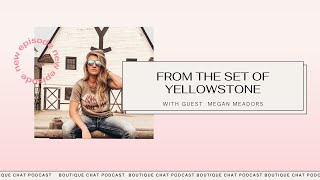
In this interview-style YouTube episode (hosted by Ashley Alderson), costumer Megan Meadows—a former boutique owner—explains how costume design on Yellowstone contributes to character development and storytelling. They cover the costume workflow (inspiration/mood boards, color palettes, sourcing, continuity), collaborations with western brands (e.g., American Hat Company, Greenlee, Rock Mount Y, Wrangler), the merchandising/legal limits around Yellowstone branding (trademarked; Viacom/rights holders), and the show's ripple effect on western fashion and small businesses. Megan also shares personal anecdotes (Beth’s chainmail wedding dress, a cameo in episode 8, challenges dressing child actor Tate).
Chapters
Hey, do we have any Yellowstone fans listening? And no, I'm not talking about the national park, although it's great. I'm talking about the TV show. Guys, today I'm so excited because when I think about the fashion industry, I know a lot of times we get locked down just on the idea of boutique ownership and buying wholesale and going to market. But I think in order to really be successful in this business, it's important that we think beyond where our products are coming from and how we. We get them. But really, what is their intended purpose? So today I am excited to dig into one of those intended purposes, and that's character development by speaking to my friend Megan Meadows, who is a costumer on the set of Yellowstone. Today we're going to talk about how fashion is used throughout the TV series. What fashion means to introducing a character without a character ever having to speak. And just how cool is it to have a trailer full of goods to pick and pull from and build storyboards from to build out the favorite characters that you might have from the cast of Yellowstone? Megan is a former boutique owner herself. She is an active member of the western industry as well. And I think you're going to love hearing her insight and even some of her favorite moments from the multiple seasons of Yellowstone. Meet my friend Megan Meadows, a costumer and former boutique owner, an expert on all things Yellowstone. Let's talk about your business strategy and the juicy details of what actually works, from mainstream fashion to fashion on Main street and the entire ecosystem behind it. How do we scale your company and do it with the balance and the happiness that we all seek? Let's hear from those insiders, experts, and strategists that actually make it happen. I'm your host, Ashley Alderson from the Boutique Hub, and I can't wait to chat.
Hey, guys.
Welcome back. This week, I have been looking forward to this episode for a long time, Megan, since you and I first started to chat about this on Facebook. Welcome to the podcast.
Hi. Thank you.
Yes. And you guys, if you are listening to this episode, be sure you can check this out on YouTube as well. We have video. We're in person. And Megan, you're speaking my language because, like, that's my hat game right there.
That is my hat game. I'm loving it.
Well, today's episode is going to be a little bit different than some that are just boutique focused. And the reason being and the reason I love this conversation is I love looking at fashion from such a big picture view. Like, we think about fashion as going to a wholesale market and buying it and selling it in the boutique and how we interact with customers on a daily basis. But really our affinity with fashion is so much bigger than that. Right. And it's inspired by so many different things. And that's where you come in, because you have probably one of the coolest jobs in the world. I'm just going to say it. We're all going to be totally envious of you by the end of this conversation. So before we get into how you got here, just in your words, tell. Tell me about what you do on a daily basis. Tell me about your job today.
So I am a costumer. So what we do is we work with film and we dress actors. We have a costume designer who picks the outfits for all of our actors, and then we get to kind of help style them, help create the characters, work with the actors. And we're on set. We're keeping continuity through the shows, making sure that, you know, you'll see a show where someone's hair is like this, and the next thing you see it like this. And so it's like we have to make sure it stays in a flow so it makes sense. And that's basically my job. We make sure adults are wearing clothes and sometimes kids.
Well, not a bad job considering that most people listening will be familiar with a show that you have been working on. And that's Yellowstone. And when you and I first started to chat, one thing I've always appreciated about Yellowstone is so many times with western film especially, it just doesn't feel authentic, you know, like someone might be wearing their hat backwards and I just get all ticked off, like, who allowed them to do that? But with Yellowstone, it's so different. It feels very, like in the moment. Right. Feels very authentic to our culture because you and I both kind of come from that ranching background. So tell me a little bit about how you got to this place. I want to work up and talk about Yellowstone, but I've. I want to hear first how you got here. How did you get into this industry?
So I went to school for fashion design. Once I graduated, very expensive, I decided I did not want to do fashion design anymore. It just wasn't for me. And just for me personally, it just the people weren't my people. And it was hard for me to wrap my head around wanting to continue to do that because I wanted to be able to work in something that I really enjoyed. And so when I graduated, I moved home and I was like, I don't know what I'm doing with my life. What's gonna happen now? I just got this degree. I feel like we've been there. Yeah. So I get a call from my aunt. My aunt has been in the film industry at that point 15 years or so. 15, maybe even 20. And she's like, hey, I'm working on this film. We need some help. We're here in Arizona. Do you want to come work? And I was like, there's a job. Yeah, make money. I went and worked and I loved it. It was. The first film I worked on was a documentary about the Boston Bomber. Yes. Very interesting. And we filmed it in Arizona. And I kind of just fell in love with the way the people worked, the rush of it, the moving around, the hurry up and wait moments. And you just, you get to learn how people are creating stories out of either nothing or documentaries and basing it off of other things. And I really, really liked it. And fast forward eight years later. And I worked in films, TV shows. I've done a music video. So it's been definitely. It's taken me to Atlanta, Montana, Utah, New Mexico, like all over the country. And I've been very lucky to work in the industry that lets me do something that I love so much. And I work with clothes, so.
So cool. And you also have boutique background as well, correct?
Yes. So about three, four years ago, I've always wanted to own a boutique, so I was like, why can't I? What? So I figured out kind of I had a little trailer and I took it to places and I set up in between working in film, because film I would work six months and be good for another six months. And I didn't have to work anymore because it does pay very well. But when you were working, you're, you're, you're grinding. So, yeah, I opened up the boutique and I loved it. I went to different places, opened up, popped up at rodeos, and then I got back into working. When I started Yellowstone, I didn't have as much time. Yellowstone filmed for many months at a time. So I kind of just this past year, kind of got rid of all of my inventory, stepped back from it, and eventually, hopefully one day I'll be able to have a brick and mortar and do it again because I do love it and I do want to have a boutique.
Yeah. Well, in the meantime, you're doing some pretty cool things and you just had a baby, so you're just a little bit busy. Talk to me, talk to me about Yellowstone. How did you like. Was it a Taylor Sheridan Connection or how did you get connected to beyond.
Yellowstone to be a part of that? So again, my aunt, she was working on it and I, she. I got a call and they needed an extra costumer and they're like, hey, you want to come up and work on this? We have an extra space. We need someone. And I was like, why not? And at that point, we didn't know what Yellowstone was going to be. It was, yeah, just another TV show that I've done a hundred times. And I went up and started working on it, and it was kind of my realm. It's the first time I'd work in. Worked on a modern western show. And I just. My aunt has kind of a little bit of background in the western lifestyle. She's worked on other westerns. She worked on Tombstone. That was really awesome. So she knows western. A lot of people that worked on it didn't really know the western style. So I kind of became, hey, Megan, what would they wear when they do this? And what would they wear? What would a vet wear? You know? So I kind of became the person to talk to about the western style. Yeah.
And it's so well done. Like, I think about. And I know Matt and Amanda Kimes have a connection with Taylor as well. I mean, that whole horse industry is a small world. Right. But everything, it really was down to the details. It was really well done. And that had to be. At the end of the day, that had to be good for the brands that had an opportunity to be a part of something like that, too, or boutiques that were carrying the brands. They were. Something like that as well. Did you hear that feedback as well from companies that you worked with along the way?
Yeah. So we worked with quite a few different, like, times. We've worked with American Hat company. We worked with Greenlee. We've worked with Rock Mount Y. I mean, I could go on and on. So Wrangler, I mean, a ton of companies, they. And then pretty soon people were just like, throwing stuff at us. Put this in the show. Put this in the show. But I mean, you can't just put anything in it. It has to. You have to pick and choose and what makes sense and what builds the characters and who would wear this and who would wear that. Yeah, I think last year I reached out to you guys and we wanted to try and pull some unique things. So I asked you guys to put together a link for us to get some boutiques and send us some of their info and what their styles were, and we were able to reach out to a few boutiques and get some of their stuff on the show.
That is so awesome. I was never able to follow up and hear how that went, so that's really cool to hear that. Tell me more. Take me back into that process of developing those characters. I'm fascinated by, you know, first developing Beth and first developing RIP like, what goes into making that character, who they are.
So the. The costume designer gets together with the actor and gets together with the director, and they kind of just talk about who they want this person to be. So when you're talking about Beth, Beth is just a total.
She's a badass.
You can just say it. Yep, yep. She's a badass. Yeah, it's okay. I get it. She's a badass. And we all know that. We all strive to be Beth as a character. She knows what she wants and she goes after it. And so when creating this actor, they. They pulled together pieces of different people to create who she is. And so when you go and you look at this very headstrong woman, she's going to be wearing suits, she's going to be wearing things that just stand out, that make her look like she's strong and powerful. And then you see her soft, weak moments. You get into the softer clothes. You don't do the hard lines. You do the sweaters and the soft colors and her more ranch style, where she gets into being, you know, goes back to her roots a little bit, and then, you know, she gets back to being the I'm gonna kick your butt moment, and she gets back into those hard, hard, harder colors and stronger lines. So that helps show you what mood she's gonna be in. Yeah, I think that's. She's one of the biggest characters that you see, especially by what she's wearing, what mood she is going to be in. And when you're developing a character that's kind of where you go is you. You look at where. Where her headspace is going to be and go from there.
That's so fascinating. I'm never gonna watch the show the same again.
I'm.
I bet you can't even watch the show the same after, like, developing all of that, right?
Oh, yeah. It's interesting because it's. It's. I watch the show and I'm like, oh, yeah, you see that door? I'm behind that door, right?
Oh, right.
Before we did this scene, we were in the back, you know, dancing around.
So cool. So talk me that. I love this process of, like, planning her emotions by what she's wearing. Talk to me about the process. Like, I'm really curious. So your team, you read the script, right? You're planning for all these moments, and then you're starting to source. Where are these products gonna come from? And how am I gonna style these products? Walk me through that. Are there, like, inspiration boards, and then you start sourcing, and then you start styling, or what does that flow look like from the behind the scenes?
So they do have inspiration boards. We bring in pictures, and, like, you look at what we want this person to look like. What? And then you have a color palette. These are the color palettes of just Yellowstone. And then here's the color palette for Beth. Here's the color palette for Rip. Here's the color palette for, you know, Tate. Yeah. You just. You have to bring in these, and then. So you bring in. And then you find out what rooms they're going to be in. So if they're going to be in, you know, a living room, you don't want her to be wearing the same color as the couch. You know, you have to make sure that everything flows because you don't want anything clashing. And then once you find out your color palettes and your mood boards, you go out and you look at the cuts and the styles of things. So with Kelly, who plays Beth, she has a very particular style that she likes to bring in, and so she'll do research and she'll bring things in. Some actors don't. They just say, you handle it all on your own. This is my headspace. I'll let you do that. But some actors like to be a little bit more involved and bring things in that make them comfortable, that they know will help them create or build this character. And then you go out and you. The closets that we have for our characters are especially for Beth. It's huge. Then you go and look at Rip's closet, and it's about this big because it's the same jacket, the same pants, the same hat, and the same belt. And maybe the shirt changes. So. But you stick with the same colors for him. So it's kind of depending on your character, what size or closet they have and how many options they have.
Yeah, that's so fascinating. And I think about Kevin Costner's character, too. I mean, Beth is so diverse, right? So she's got this massive closet, but the details of Rip, like, he's got this one wardrobe, but John Dutton, like, I feel like his costuming is very well done. I always look at the shape of his hat. And it's probably one of my favorite hats to look at on the show because it's so authentic. Like, it is a rancher. And this is gonna sound so creepy, Meghan. But when I think about John Dutton, there's a part of it that, like, he reminds me so much of my dad. Like, I swear that, like, puffy jacket he wears in the show. My dad had the same one. There's so much like. But at the same time, I'm like, it's Kevin Costner, and he looks so good. Like, that's weird that I would think he's attractive at the same time. Such a conundrum.
Look. Oh, no, wait, wait.
Yeah, well, this is my dad, but he's good. Oh, gosh. Weir.
He's good looking. Yeah.
Yeah. Has there been, like, if you think about all those characters, is there one for you that's, like, harder to dress than the rest? Are there certain challenges you feel like you faced?
So I don't deal with all the actors on the show. I mainly deal with Kelly. She's my main person that I deal with. And then I deal with Rip and Casey and Monica. They're the actors that I take care of behind the scenes. And I think, honestly, the hardest one is probably Tate. Ah, yeah. Because throughout the seasons, he's grown the most. Yeah. His style has stayed the same, but he also is a child. So to try and work with what children are going through and as you see through episodes or seasons three and four for Tate, what he's gone through and his character and try to portray, like, what he's going through as a kid and trying to get to the mindset of a kid and what he has had to do being a kid, I think his is probably the hardest.
Yeah, I could totally see that. And I suppose. I suppose now, like, as you go into filming the next season now, you as a mom, you will probably come to the table with a totally different perspective as well on how to style.
Yes. So I think being a mom definitely changes your perspective on how kids see things and how you want to protect them and how you want to, you know, looking into then Monica's. Monica's role as a mother and wanting to protect Tate from the evils that she sees coming from the Dutton ranch and how he cowers away underneath the bed in some scenes and how Casey has to pull him out and just, like, try to make Tate come back out. Because you see Tate as a kid and he wants to have fun and go out and run the ranch and play in the stream. And go fishing and ride horses and. And then you see him under a bed not wanting to do anything. And being a mother, you just want to protect. And the places that Monica's character has to go is very interesting.
Very interesting. I think everyone wants to know what's going to happen to Monica and to Casey. I suppose you can't spill any dirt for us to know what's going to come in the next season, if they're going to make it.
Honestly, I don't know yet. As we know in the end of season four, they are gonna have another baby. So we'll have to see where that takes us. I can't. I, I don't know anything from any of the next seasons until I get to the season of when we're filming and I get to read the scripts. And reading the scripts for me is just as fun as watching people watch the episodes for the first time. I'm sitting there, I'm supposed to be taking notes on my scripts and reading through as I go through this and that. Next thing you know, I'm 10 pages and I'm like, oh, I gotta go back.
That got really good.
I have to go back and take my notes on that.
Can we talk about your email marketing for a second? Especially today when algorithms are so limiting. I know the one thing that we actually have control over is our list. It's email marketing and it's text marketing. So if you need help building out your email flows or building your list or making sure your text messages are TCPA compliant, which is such a big deal right now, or if you just want to make sure you're making more money from email marketing and text marketing, I have to recommend you guys. My friend Jane Casper is the go to guru that you definitely want to know. Not only has Jane built her own multi, multi million dollar business specializing in footwear, a boutique specializing in footwear, but she's also built out flows for over a thousand e commerce store owners, many of them inside of the boutique hub. She's run over 300 AB tests in the last year alone and she's grown delivery rates and open rates for hundreds of stores. So if you would love to get in touch with Jane, she has specials just for podcast listeners and for hub members. Please reach out to her. It is Glo Group, Glo G L O W Group llcmail.com and we'll definitely put Jane's info in today's show. Notes do you like, once the show has come out and you're seeing people experience it for the first Time. Have you like, do you watch it with friends? Do you watch other people experience it? Or like, what is it like from this side now? Getting to watch people experience, especially the growth and popularity it's had.
It's always interesting to see the way people are reacting to it. Just even on social media or watching it with. I usually just watch it here in my house with my husband. And we, he's always like, we'll get to the end of it and he'll be like, okay, so tell me, how did they film that part? How did they film like in the season or in the episode where they run into all those motorcycles? You know what I mean? How did they film that? How did it happen? How many times did you have to do it? And usually those motorcycle, like running into things, that's like, that's a one shot deal. You get it, really get to reset. But it's, it's funny to see the, the way or the questions you get, what's gonna happen? What's gonna happen? What's gonna be next? And I'm like, I can't tell you. I don't want to tell you because I want to see the way you react to it. And yeah, you know, I happen to actually be in one of the episodes this season. I was in episode eight when Jimmy and his new boo go on a date and I meet. I am Maggie and I'm with the, oh, I can't even remember the boss of the ranch or something. And so people started reaching out to me as soon as that aired. I hadn't even seen it yet because I normally don't watch it for a few days after because of life. And people start reaching out to me, oh my gosh, I saw you. Oh my gosh this, oh my gosh that. Or even if it's not that, it's. It's people reaching out to me that I don't even know, finding me on Instagram or Facebook.
Really?
Yeah. And they'll be like, hey, I, I heard you were on this or work on this show. Where can I find such and such. And I'm like, yeah, why didn't. What, how did you find me? How did you know?
Yeah, I am curious about that. I want to talk about that. I have so many questions on that very topic. But I think about not just the clothes, but also the tack that goes into it. Like, there has to be people that are interested in how the clothes are styled, how the tack is styled, and then thinking about those people saying, where can I buy this? So I Am curious. Also, second part of my question, first is the tax. Second is how can small businesses, boutiques, tax stores, whatever, maximize and make sure they're selling the products that people are excited about on Yellowstone.
So a lot of our stuff, so with our tac, that's that comes from our Prof. Department and they source any of that or Taylor Sheridan does have a lot of resources. Well, he, he knows his people and he wants to bring his people on a lot of the time. And so a lot of that is either stuff that he likes and wants on the show or it's sourced out by our props department or our like set, deck and property. Like they, they deal with all of that and bring it on. And a lot of the times it's either who you know or a style that they're looking for. And then when you come back into the costume realm, which is more my realm, a lot of times it is either who you know, like with the Kaims, Taylor's friends with the Kimes. So of course he wanted a lot of the Kaim stuff on the show, which you see, you will in any episode where you see any of the ranch hands, you're probably going to see a Kaimes hat or some Kimes jeans or something. You're gonna see it in there. Not only that, but we also love Kimes. Kimes is a good brand. So. Yeah. And what also has the look. So if you're looking at something and you see Ranch, you're probably going to think Wrangler, you're going to think Carhartt, you're going to think Levi, you're going to think those, those brands. And so obviously you're going to want to bring those brains in to help make something look realistic. Yeah. And then again it's, I'll be looking through Instagram. If I see something I like, I go and take it to our designer. Hey, look, what do you think of this? Like I just saw this scrolling through the gram and maybe it'd be something for good for, you know, this character, that character and she'll either yes or no it and we'll order some or not.
Yeah, well, it's such, it's, it's so interesting to see the ripple effect that has on businesses. So in January, I was at Dallas Market center and actually two separate conversations, one with Keith Mundy from American Hat and one with Devin, who I believe is a national sales manager for Resist all. And both of them separately mentioned what an impact Yellowstone has had on their sales at that market. And they said it's like the urban cowboy effect of, you know, the 80s and 90s and when being a cowboy was cool. And this show has made that happen again. And now we're seeing small businesses really reap the benefit of that. And probably Covid, where people aren't going to an office all the time. They can really dress more authentic to who they are rather than a suit or whatever that is. But it's really cool to see how that's going to continue to evolve on our culture today and what an impact that's going to have.
Right? Yes. I think it's so neat and especially coming from the more Western world in general, like myself and seeing it, seeing it on tv, seeing how people really see. See how the ranch is ran, not so much ran, but how people in the Western world live and how they dress and stuff like that. Like, I think it's. I think it's neat how it's coming back around. It used to be popular, and now it's coming back and it's popular again. And it does affect, I think, the way the stores are selling the product. And like, you were saying, resist all in an American hat company. Like, I. I know people are like, hey, where can I get that hat? And I was like, well, first off, have you ever worn a cowboy hat? Because I know you haven't, because I know you don't come from that background. Do you know how much? Yeah, one of those hats cost?
Yeah.
Oh, maybe I don't want that one. But how can I get something like.
It or, you know, you know, it really. It ties in that whole cowboy hat conversation. I don't know if you follow Courtney Dehoff on Instagram Fancy Lady Cowgirls, but I recently was having a conversation with her about this as well. And what I think is cool about people asking you that, you're like, hey, have you ever worn a hat? Is this is not just about people who have been western, but it's about people who are enamored by their lifestyle and they want to be Western.
And I've never been introduced to it in general.
Like, and we all have to embrace that. I think sometimes those of us who grew up on a ranch or we rodeo or whatever, we become a little bit closed off to, like, oh, well, are you authentic or you want to be anymore? If somebody wants to be western or you want to support agriculture, period, I am here for you. I don't care if you are from the downtown of a big city. Like, we have to embrace that if we want that lifestyle and that culture to Last.
Right.
So what a great way to introduce that.
Exactly. Like you don't want it to. You don't want it to go away. Especially it's your culture. It's who we are. It's who we want people to know about what we do and who we are. So I think. I think it is interesting when you see people like, well, where can I get that? First off, there's a process. You got to go get your hat size. It's not just like buying a ball cap.
Yeah.
Yep.
But I'm sure there's lots of western stores who would gladly field that question. So. Good.
Oh, yes, yes, yes.
Well, two more quick questions before we wrap up today. One, I'm curious if you can help me answer this. I see a lot of T shirt makers today capitalizing on the Yellowstone brand and they're making things with the Dutton brand on it. I have heard that it is heavily trademarked and that is something people should steer clear of. Is that anything you can lend some insight to?
So, yes, it is. It's very trademarked. And if you. I know they are sending out cease and desist orders to companies as they see them. I actually another part that I kind of helped start was the merchandising for Yellowstone through one of the studios. And you see them now at. We had setups at the past two NFRs. The Yellowstone store.
Yeah.
So. And as they were going around going to the different setups and seeing that people had Yellowstone stuff and that they were just making it on their own and they were either like, you either take it down or we are going to send a cease and desist story. And some companies took it right down. They didn't realize. And that is something that people don't realize in general. People don't understand that most TV shows in general are trademarked. You can't just.
Characters, faces, names.
Yeah. Character spaces.
Lyrics.
Not exactly. Exactly. Those things are all property of somebody else or another company. So that's. And if you want to, you have to reach out to. I think for Yellowstone. It's a Viacom. So you have to reach out to Viacom and get permission to sell the product. I know Wrangler has like Boot Barn has to be able to sell just a logo in general from the Yellowstone.
Okay.
So just be careful is all I have to say. If you are selling it. I know it's such a huge show and we all love it, but do your best not to get in trouble.
Well, we've, we've seen a lot of it. We've had this conversation in the Hub, so I. I would just echo that. It's not worth getting your social media taken away, getting your Shopify shut down. Like anything that you carry that has the likeness of something else that's popular through art, it's probably going to be protected. If, however, your merchandise store ever wants to sell wholesale, I know I could hook you up with lots of boutiques who would be happy to buy it.
Oh, yes, I. And I've been trying to get them, too. I've kind of. Since I've had my daughter, I've kind of stepped away from helping them with the merchandising stuff. But if I do get back to it, I will definitely. I've been trying to push them towards Hill fellow. I was like, you can we make so much money? Everybody wants it.
I love that. All right, Megan, last question for today. And two part question. As you think about all the seasons that you've been on with Yellowstone specifically, I would love to know, number one, what is your favorite scene from any of the seasons?
Oh, gosh.
And number two, what is the favorite outfit, the most memorable outfit that you styled on any of the seasons?
Oh, gosh. They all kind of blend together. My favorite scene. This is a tough one. I'm not gonna lie. I can't think of my favorite scene at the moment, but my favorite outfit so far is Beth's wedding dress.
Oh, yes.
Memorable moment is chainmail. It was cold when we were filming it, and that chainmail was not warm by any means. Yikes. And it was just. Just beautiful. Like, what else would Beth get married in? To be honest? Yes. Like, can she make any more of a statement?
No. No. Enough for John Dutton to stop. Are you sure?
So. Yeah, exactly.
Okay, so if you can't think of your one favorite scene, give me a couple. Just, like, give me a couple of your favorite scenes.
Most memorable, I'm. Let's see. Most memorable, I think. Oh, when they filmed the scene where they were playing chicken with bowls.
Yeah.
Remember, they were out there playing. It was like poker. It was a card game. And then they let the bull run around. Yes. That one was really fun. Our girl, the stunt actress that Teeter played. Oh, what is her name? Think of her name right now. Avery. Played Avery. Okay.
Yep.
Yes. The stunt girl that played Avery, she was like, I'm not moving. All you guys can move if you want. She sat there and she took it. She had bruises up her back. Like, she. But she was such a badass, too. Like, she was like. Like, I'm Gonna be the only girl sitting here. I'm gonna show all of you up. And you see if you. There's like a little behind the scenes footage. You see the men jumping out of their seats and you see her, like, grab the seat on the side and she's like, nope, I'm not moving. And she just gets hit. And. Yeah, I just. I thought that was a fun scene.
So that is awesome.
I love that.
Oh, my gosh. Well, Megan, thank you for your time today. This is a really fun conversation. And I have to go back to. You and I were having a conversation actually, before we started on the podcast today about just fashion in general and what a statement it makes. And when I think about this whole, like, pulling it all full circle, really what you're doing in terms of costuming and building character is what boutique owners are doing on a daily basis when they're dressing people. Right. That are making a statement. Tell me about that conversation that you had with a mentor of yours about what clothes actually mean for a person.
Yes. So as I was saying before, I believe it was Ruth Carter, who is our designer on season one, who's also the designer for one of the Marvel films, Black Panther, she was telling me how a character. Before you see somebody or before you talk to somebody, before, when you first see them, what's the first thing you see? The first thing you see is what they're wearing. And you don't know what they sound like. You don't know who they're gonna be. But when you see what they're wearing, you automatically in your head, you picture the character that they're going to be. Yeah. So I think when you are styling somebody or if you're dressing somebody, or if you're in a boutique and you're trying to help someone portray who they want to be dressing, and the first thing you see on somebody is telling a story about who you are creating or who you are as a person. And I think it's interesting the way she had explained it to me because it opened my eyes to see who each person is going to be when you're watching a TV show or when somebody walks into your store. Seeing how they dress and how you want to help them, I think is. It's interesting. Yeah.
The clothes introduce who you are without you ever having to say a word. What an opportunity.
Don't even have to open your mouth.
What an opportunity. Megan, thank you so much for your time today. It is so great to catch up with you. Thanks for all the cool work. You're doing. We can't wait to see what comes next in season five.
Me too. Thank you so much.
Hey guys, thank you so much for listening to this episode. We hope that you loved it. Don't forget to hit subscribe and leave a rating and review down below for a chance to be one of our featured listeners each and every week. For more information on our spirit of community over competition and how to access complete show notes and bonus downloads from our guests, head on over to the boutiquehub.com and join the community. We'll see you next week.
SA.










