Mastering Leadership: Building Strong Teams, Ensuring Compliance, and Creating a Great Workplace
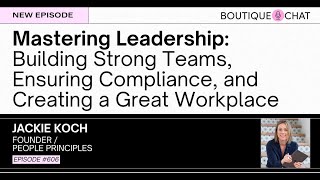
Host Ashley Alderson interviews Jackie (an HR/recruiting consultant) about building strong teams and creating great workplaces for small businesses. Topics include establishing core values and company 'DNA' before hiring; practical hiring logistics (SOPs, handbooks, timekeeping, payroll platforms like Gusto/Bamboo/ADP, contractor vs employee distinctions); compliance (multi-state laws, minimum wage, meal/rest breaks, paid leave, workers' compensation, insurance audits); and leadership development (leading self, leading others, developing employees). The conversation includes examples, recommended tools, and pointers to downloadable hiring/compliance resources.
Questions this video answers
April 23, 2024
About three and a half years
About 8 years
Chapters
Foreign.
Business can be a lonely game. But it doesn't have to be. Welcome to Boutique Chat where we explore community over competition and how to scale your company with the balance and the happiness that we all seek. We'll hear from product based businesses of all types, retailers, E commerce and wholesale brands, along with industry experts shaping the future of our industry. I'm your host Ashley Alderson from the Boutique Hub and I can't wait to chat.
Hey guys, welcome back. This week I am so excited about today's topic. Jackie, I'm so pumped you're here because I'm sure many of the people that you work with and I know many of the people listening and I know myself personally. When you get into business and you're so excited about your product and your business taking off, the one thing that you don't expect to happen is, oh crap, now I need to manage people and I'm not prepared for managing people. That seems very overwhelming to me. So today we're gonna just demystify all of this and help everyone develop some stronger leadership skills, but also really, you know, digest what does it take to build a team and a successful team. So first of all, thank you for being here.
I'm so excited. Thank you for having me.
I'm pumped. Let's start here. Before we get into the nitty gritty of building a team, take me back to how you started the consulting firm that you have now. What led you to this position and really have such a love for this topic.
Yeah, absolutely. So I actually started my career in HR and recruiting, which I feel like is kind of abnormal for people to start their career in the business that they have. But that's where I started. And I worked in recruiting and HR for about 8 years or so and found myself having to lay off a bunch of people for about a year and a half. And during that time I also was going through some personal development, personal changes, going through a divorce and all of the stuff that comes sometimes with that, and decided I wanted to move to Los Angeles. I was living in Minnesota at the time and I have, I started my first kind of entrepreneurship journey there. During that time of personal training, I was building a network marketing company and when I moved to la, you know, you need to know people to grow those types of businesses. So I was like, okay, I don't know anyone, what should I do? And I started working part time at Lululemon and I quickly ended up managing stores and moving up, worked there for about three and a half years or so. And it Was like the first time that I saw how leadership development and personal development could be woven into a business. You know, I was in HR before that and I. That wasn't really a core component and I fell in love with it. And I'm sure listeners can relate. I got a little burnt out of having to work on holidays and not see my family during Christmas and wanted to get out of retail and ended up. I was like, okay, where can I go work that won't feel like a big corporate. Like I'm going back to a corporate company or environment. And I started working in startups in Los Angeles and that really filled kind of that entrepreneurship. I don't know. Love that I had and was the first. Was often like the first HR or recruiting hire for some of these small businesses. Setting up lots of infrastructure and cleaning up maybe some messes that they didn't fix before I joined and after about five years decided to launch my own company. Helping small businesses do this because you really need some of this stuff early, but there's not always the support out. You don't need it full time. So it's like, then where do you go to learn these things or to get the support? And so launched my business about three and a half years ago now and haven't looked back. It's been so fun.
There's such a need for it. And I know you and I have talked about this prior, but even for us at the Hub, we rely on an outside HR consultant who's helped us know, navigate some of the newness that comes with growing a team and having a team in multiple states and, you know, some of the compliance things that can jump up and bite you when you're not expecting it. So very much needed what you're working on. So I want to thank you. I want to talk about, you know, leadership and being a great boss and all those things. But before we get to that stage of the process, let's just go back to those who are listening that are solopreneurs and they know they need to hire, but they're a little bit uncertain about how to get started and how to find the right people from the start. Let's start at the basics for those who are listening, of how do I start by finding great people and what do I need to do in my business to make sure I'm set up to bring those people in when I find them.
There's so much to unpack there, but that's always what people ask, how do I find the right people? That's Always what they. They think. And I think the first step is to actually, before you run out and find the right people, let's get clear on the kind of people you want and the kind of team environment you want to create. And if you're to the point where you're thinking about hiring someone, the last thing you want to do is take time out to really be intentional about that. But if you don't take the time to really set up, like, your company's DNA, then you're going to be hiring probably a lot of the wrong people in your attempts to figure out that stuff anyways. Right. So I would say that is really the first place to start. And what I mean by that is really crafting what your people use the word core values or personality traits or, you know, in corporate, they'll say competencies. You know, like, there's a lot of different buzzwords for those. And it's really, you know, I haven't thought of a really great word to replace those. But the essence of it is like, what are the three to five things that you want your. Everyone who joins your team to have? Right. And think about what characteristics are going to help my business reach the goals I need them to reach and really getting clear on what those are. And it's going to. You're going to refine them, you know, but at least start before you even start to think about who you want to bring on, because then you're going to be able to. To really start to search for those people and you're going to know a little bit of what you're looking for. Because most of the time, skills can be taught. Most skills that you're hiring someone to do can be taught. But some of those core. The core essence of who you hire, like, those should kind of come natural. And not everybody has all of those same things. Yes.
You mean like these little guys, these little core values?
You see these? Oh, yes. Shocking. You know what those are?
It's so funny because literally, just we have a coaching program called Retail Bootcamp, which is like our college for boutique owners. And, and we were just going through the importance of core values the other day. And what's funny is if I take myself back to my solo entrepreneur self, I would have heard you say that and go, okay, yeah, but then what? I'm going to put these things down and then I'm going to put them on a shelf and I'm not going to do anything with them. And when we first went through this exercise, we had already probably, maybe we had like 10 or 12 employees by the time we put these into place. And when we did it, our Coach told us, 20% of your workforce will either quit or you're going to fire them as a result of you putting in stone what your core values are. And we thought, no, how could that be possible? But he was right. There was 20% of what we had at that time. Either we let them go within six months or they quit. Because now we were holding people to the standard of not just are you doing your role, do you have the skill which is teachable, but really, are you the type of person that we want to have on our team? So tell me more about these core values. Once you know who you are as a DNA, how do you use them on a daily basis in your business?
Yeah, I love that we're talking about this because I'm actually creating a workshop right now to lead entrepreneurs through next week. So it's so top of mind. And before I get to, I will answer your question, but I am kind of in that place where you are. Where, like, I'm a team of one. I have. Technically, I'm a team of two, but she's someone who I worked with before. We're more like business partners, so we kind of already embody these things.
Yeah.
But we're creating our core values right now. And the reason why is because I'm going to use them even when I hire freelancers or if I look at, like, agencies that I want to come support my business. Like, I want them to have a little bit of these things, too. So it's not just about your employees who you hire. It's. It's also clients. Like, a lot of my clients will opt in or opt out of working with me because of my core values. So it's like, there's so many more reasons to do it when you're small, for sure. But then once you have them, I mean, the most important is to share them with the whole team and help them come to life within your team. So if you are somebody that has employees, you know, if you're small enough, it might be a good idea to co create these with your team instead of just like, you know, hammering them down their throat. But if you're a bigger team or maybe the team isn't, isn't the right team to create those with you, Maybe you create them and then say, hey, this is like the draft of these. Like, I want to know, do these resonate with you? Is there anything missing? Like, do a little bit of co Creation. Because if they feel like they were a part of it, then they're gonna be more likely to, like, live them. Yeah, right. Be bought into them. So then you share them with them and you just. You find ways to weave them into things. So things like, obviously the hiring process. So that would be one of the first things I would do, is, like, look through what those core values are and figure out how. How could we search for this? Like, if I were to go out and search for people who live this, what would I do? And some of that might be in interview questions, right? Crafting interview questions that. That really dig into that. Some of it might be. Well, usually someone who embodies this does xyz. So, like, let's pay attention to see if they do this during the interview process or not. Right. And that'll take some testing and trying, but it's like figuring out how to assess for those in the interview process. And it's not going to be a hundred percent. Like, if you get it right, 80% of the time, that's probably winning. Let's be honest. And then, you know, finding ways to celebrate when you notice somebody is exhibiting one of these qualities, like, people will do what you acknowledge and reward. So find ways to do that. And you might have to put reminders on your phone because you're going to get so caught up in the data that you're going to forget to do it. So, like, put reminders to do that. Those are like, where to first start. And then I had a really interesting conversation with a friend and client of mine who rolled this out as a small team. And she had this reflection moment where she was like, okay, if I want my team to be lifelong learners, how am I as a business supporting this value? And she's like, what can I do to make sure that I'm supporting it? So she started this. She implemented some things into her business where she said, okay, I want you on every time card you submit. Because I think they still maybe are contractors and they're submitting, like, hours or something. She's like, I want to see four learning hours on every single invite invoice. And I want you every other Friday we're going to share what we're learning, right? So it's like, how do you, like, find ways to, like, weave them into things? So that's really where the meat, like, where the essence comes to life. And it takes some trial and error to figure out what works, but that's where to start.
I think that's so helpful. What else would you say, besides core values, when you're first hiring your first team, what other logistical things or compliance things do you really want to make sure you have set up right from the start?
Yeah, so definitely some sort of sop, you know, like even if it's just a list of like a chicken scratch list, like some sort of way of, of capturing how things work in your business. And if perhaps you don't have those things, let the person know, like, hey, we're going to be creating these SOPs as I train you, you know, so at least like let them know about that. But it's like at least you need to have a plan for how you're going to and train staff, especially because most people who hire are hiring more support roles, more junior level roles for the first time. Those roles always require a lot of direction. You know, you have to be able to do that. And so having a way of teaching a little bit is super critical. There's so many ways to do that. And then knowing the rules, like what are the laws that you have to have like follow for having an employee? And for many listeners to the show, they probably have a brick and mortar. So maybe they only have employees in a certain amount of states. But I do think it's important to know that where you, your employees work is, is where you have are, are the laws dictate the laws you have to follow. So if you do have a remote team and you're based in, you know, Wisconsin, Ashley, like if you hire somebody in Florida, you have to know those employment laws because that's where the employee is doing their work. And so the most critical things to know are, are what are the minimum wage laws, what are the meals and rest break laws, what are the timekeeping laws? And also like, what are paid leave requirements? So some states require you to provide paid sick leave. So like every state is different. So it's like you, there's, there's about five things that you really need to know and we have a compliance checklist that listeners can go download that kind of go through all of those things. But those are some of the core things.
Amazing. We'll link that up if possible in the show notes.
Yeah, absolutely.
That list. Are there any big.
My gosh.
And I'm, I'm living this as you're saying this, right? Because our employees are in, I think, I don't even know, 14 different states. Something like that. Like, it's a lot of details.
That is a lot. It's a lot.
Are there any big red flags or warning Signs like, hey, when you're new to hiring, just make sure you don't do this thing. I've seen these, I've seen these things pop up. Don't do this thing. What would that be? What are some mistakes?
Oh my gosh, yes. There are so many. I think I don't want to throw. How do. I'm trying. I don't want to throw anyone under the bus because that's not my style. But I do think as a small business owner, you think this stuff is just paperwork that anybody can figure out. So you either do one of two things. You think your accountant will help you stay compliant. And accountants are fantastic. I really, I failed in accounting and finance. Like, I'm not great at that. But, but they're, they're not trained in hr, right. They're not trained in some of the employment laws. And so that is one of. Or so you either think your accountant can do it or you think like an administrative assistant, somebody who's in more of an operations role on your team can just go figure it out. And usually they can, but they, they need to ask. They need to do the right. They need, they need an expert to at least ask questions. So like, I know that's more of like a very big, like broad mistake, but I do see that happen all the time. And we've, you know, for example, I did an, I have a client in California and I did an HR audit and it was discovered throughout this audit that she was not meeting. There's something called the salary exemption. So if you want to pay somebody a salary in different states, you have to pay a certain amount. And in California it's very high. And she wasn't paying people that. And I was like, look, we have to transition all of these people into an hourly non exempt role. And she was like, why did my accountant not tell me this? I'm like, because your accountant isn't trained in this, you know, like so, so that would be one. But I would say the biggest mistake as it relates to that. I see probably what listeners to your show might have are not knowing the, the meals and rest break requirements and not having people clock in, clock out, make sure they're taking their breaks. Because those things, especially in some states, those can trigger really like if somebody were to complain. Yeah, right. That they were not giving. Getting their meal and rest break. And this usually happens when you fire somebody, right. Like they, you. It ends not well. Somebody's mad, they go file a complaint. They.
It.
There's a lot a long look back Period. And you might have to owe a lot of back pay. So making sure you have like a really great process for them to clock in and clock out and record keeping I guess is my biggest thing is.
Like keep, keep records.
Do you feel like hiring can be an intimidating process? I know when I first started to hire and build a team, it was a little overwhelming because I felt like I got into this business because I wanted to build the business. I didn't necessarily want to manage people. So I probably started hiring later than I should have. And I think that's common amongst many business owners that I talk to today. So that's the reason we put together the Hiring Bundle. It is the ultimate guide for any small business looking to hire and grow and train and onboard a team. Inside of the hiring bundle we have interview questions and step by step processes of what you need to know about hiring, hiring a team, doing it legally, setting up your payroll and having all the checklists in place. So once you are starting to hire that team, you've interviewed them, now you know how to train and onboard them and get them the right checklist to get started. We even have job descriptions and helpful tips and strategies inside of the hiring bundle to get you started and optimized on the right foot. Hiring a team is one of the most impactful and important things you can do on your journey to grow and scale your business. So if you need a little extra.
Help, I've got you covered.
Check out the link in the show notes to our ultimate Hiring Bundle.
Let's talk about some of the programs that can help you do that. So I believe what we're using right now is bamboo to store like all of our employee records. Can you talk through just some of the different technology, whether you're running payroll through QuickBooks or Gusto or any of them, but just like maybe some things people should be aware of.
Yes, I'm so glad you asked that question because I do think a lot of people muddle through it and like we'll just use Excel spreadsheets or like there's just so many platforms now that are available that you just don't know if you don't know. So there are a lot of them and I think it really depends on the type of the type of employees that you have. Do you have a higher amount of non exempt employees which are hourly employees or more salaried employees? Because some softwares kind of are better at supporting others. But I mean ADP has one. I don't know that I would. Your accountant might Use adp. So then you might use it, but it's there. Gusto is one that you mentioned. That's one that I really, really think is helpful, especially for small businesses because it has all of it. These, these systems, like, not only do they help you with like payroll, they also help you with the employee experience. So it can automate a lot of the new hire onboarding process and forms and you can upload your handbook there and your policies there so your employees have a place to log in and look at those things. You can automate the timekeeping process so you can. There's clock in and clock out features which automatically sync to payroll. And then automatically if somebody requests time off and you offer paid time off, it'll automatically remove it from their bank. So it's like, it just takes a lot of that administrative burden off. So Gusto, there's one, there's rippling, there's bamboo. There's a lot of them out there. I know a lot of small businesses use paychecks. No disrespect to paychecks, I hear a lot of complaints about paychecks, but that's an option. So there are a lot of those different platforms. I would say Gusto is typically, typically the most user friendly, although they don't always provide. A lot of times these platforms will say like, oh, we have an HR team that will help keep you in compliance. Well, yes and no. Yeah, like they give you like a help desk ticket, but they won't actually help you work through like your, your problem. But it's at least better than nothing. For sure.
Yeah, that was our experience and I think a lot of our listeners use Gusto. We used it for a while, but I think we just outgrew it because we had employees in so many different states. So we do some manual. Like we have a payroll person that works with our accountant's office who is in payroll, who does our payroll stuff manually. But then everything else goes into Bamboo. And what's cool is I love the automated feature. So if someone has time off, like it'll automatically notify me. Our leadership team, it'll automatically connect to Slack and Slack us like people's different schedules. So I love all the automated pieces.
Of all of that for sure. And I think that brings up another. When you said mistakes people make, like they just don't track time off. They're like, oh yeah, take it off, but they don't track it. You know, stuff like just not having those record keeping things in place and those platforms help with that. So Much.
So much. And even just. I can't overstate the importance of an employee handbook. I know when a lot of small businesses get started, they're like, I'm just gonna be flexible, like you said, you know, unlimited time off or whatever. And our. Our CEO, our integrator on the team, she's got this little thing that she does, and she says, rules make it fun. Rules make it fun. And as lame as that sounds, and as much as we give a crap for it, if you don't have the rules in place and a handbook in place, man, you can get burnt so fast. Tell me about your handbook experience.
Yeah, you know, the handbook. It's less about the handbook, and it's more about communicating the expectation.
Yeah.
And the handbook helps reinforce that. Right. It's like a place where you can document everything. And, you know, your employees have seen it and they've reviewed it. And so I think there's kind of like, two use cases. There's like, the first is to, like, inform what you expect. Right. And kind of like, lay it out very clearly. And then the second is, it's one of the ways that you can prove, if you ever need to, that you did what you said you were going to do. Yeah, Right. And so because you have an employee, review it and sign it. So there's like. So I always default to, like, less rule. Like, have rules, but default to less until you need to do more. Like, treat people like adults and like, yeah, set, like, make things, like, reasonable and, like, use your judgment. And, like. Because I've been in companies where they want to outline every little. They want to prepare for every use case. So then there's all these rules that are just so unnecessary or, like, one person will do. Some will violate it. So then they're like, oh, we have to make this rule now and this rule now and that. And I'm like, no, just, like, have the conversation with the person who did something wrong. Like, don't change and implement all of these new rules. But handbooks can help so much with that. And I would say the biggest thing is making sure that you have your handbook written for where your employees live. We're living in a world now where, you know, pre. I'm actually just finishing up a handbook for a client, because before COVID everybody was going into an office in one In. In. In one state. So the handbook was written for that particular state. And then everybody moved. And last year, they finally made the decision of, like, okay, we're going to stay remote. Well, now they have employees in 13 different states. So making sure that you have the right policies crafted for the states that you have, I would say is something that's kind of evolving in the handbook. Ethos is like, now you have to have a general handbook for, like, general stuff that applies to everyone. And then like, state addendums for making sure you're following each state's rules.
Oh, man. Okay, I need to go check on that. This is such a good point.
Yeah.
All right. Two more kind of nerdy compliance things that I. We just have to talk about one. I want to talk about workman's comp. We'll come to that in a minute. But first, a lesson that we learned along the way was we thought getting started rather than pull people onto payroll. We had a lot of contract labor, a lot of 1099. My father in law happens to be our insurance agent. And so he squealed so loud when he said, okay, show me their liability insurance. They have to have a proof of insurance. And all these people were like, well, no, we just want to. We just want to be contractors, but we don't have our own insurance. Like, they weren't compliant. And it wasn't until. You'll appreciate this. I went to a Brendon Burchard event, and Brendan talked about early in his business days, he had someone who came and was like a stagehand, right. That was helping him, like, get ready for an event. And it was a 1099 contractor that he did not ask for their proof of insurance as an individual, and they broke their arm or something like that and sued him, and he lost a ton of money. And when we were sitting at this event, Eric's like, elbowing me and he's like, oh, my gosh, you know, like, we've been there. That could have happened to us. So can you talk to me first about that? Like, what does it really mean to be a contractor? And then let's talk about the fun stuff like workman's computer.
Yeah. So, okay, so to be a contractor, there. There are. You can't just decide someone's a contractor even if both parties want. Want to be. Right?
Yeah.
Like, it's not up to you and. And sue whether or not your relationship is a contractor an employee. The government has rules, right? And I think so many small businesses are like, oh, it's just easier if I pay them as a contractor or. And the government doesn't care if it's easier for you or not, you know, and so what the rule this can be. I have whole podcast episodes on this topic. So I'm going to try for brevity to concise.
We're going to link those up for additional information.
Okay, perfect. So there's like certain requirements. So one, there's a, There is like a scope of work kind of requirement and then there's also like a financial component. So for somebody to be considered a contractor, they really need to have their own. They basically have to be able to have more control over the work that they do, how and where they do their work. Okay, so if you want to control where, when or how somebody does their work, they're probably not a contractor. They also need to be able to, like, the financial piece is more. Are they setting the terms of the finances? Like, are they giving you a proposal, you're negotiating back and forth. And are they able to go earn income from other clients? If the answer is yes, you know, that's probably a sign that they could be a contractor. And then the other piece is. And actually this will be really important for your listeners is the work that they're doing, like a fundamental part of how your business earns money. So like, for example, if you are a personal. And it depends on the state, but this is a general best practice because it's becoming more common in most states. But like, if you, if you run a gym and you have a lot of personal trainers, and the only way that your business earns money is through those personal trainers, they're probably not a contractor, they're probably an employee. So like if, if you have employees working in your shop. Yeah, that's, you know, how your business is making money. So, you know, that's not the legal part, but that's kind of like the, the, the prac. The way I try to describe it, where it makes the most sense. Yeah. So that's how you qualify. And then if you've decided that you're, you know, these people, the workers you have can be contractors. You always want to have a contractor agreement that outlines, you know, the scope of work, you want to have deliverables. Like, instead of saying, oh, they're going to work Monday through Friday, say, hey, they're going to complete this graphic design project or, you know, whatever it is. And then I don't know that I necessarily agree that every single contractor needs to have liability insurance, especially in a remote world. Like if they're working at a computer giving you work, you know, that type of a thing, and you're employing them as their business, it's probably okay. But if they are like doing physical work where they could get Injured, then it's definitely required that they have that for. For the example of Brendan that you just described. Yeah.
So many things. All right, how about workman's comp? We're getting into all the nitty gritty, nerdy stuff. Thank you for going this direction with me today. I have so many more questions I want to ask, but we'll keep it simple.
I love it because this stuff is so important, it can ruin businesses.
Yes.
Like, if you don't get this right, like, it can literally ruin your business. So, yes, it's nerdy, but also it's, like, critical. Yeah, it's so critical. Okay, so workers compensation, you're going to die. I'm recording an episode all about this because I was just helping a client with it, but.
Okay, we'll link that one to history lesson.
A little history lesson that I learned. Workers compensation actually was first rolled out in the state of Wisconsin.
Did you know that?
In, like, the early.
Yeah, I mean, I know. The state of cheese, beer and workers compensation.
Exactly.
Amen.
It was either, like, it was either the late 1800s or the early 1900s. I don't remember. But it was during the industrial era, era where a lot more people were having a lot more dangerous jobs and they were getting injured. And so there was no protection for workers. So they were suing companies. Right. And so it was becoming very costly for companies, obviously very costly for the person. And so then a lot of state or a lot of, like, government, like, it was becoming an issue, so they were looking into it and. And on how to solve this problem. And so that's really how workers compensation insurance came to be a thing that is needed. And so it is basically a insurance so that if somebody gets injured on the job, you. Your insurance, like, the insurance covers all of the costs of those. And so your business doesn't have to go out of pocket to pay for it. Or the employee has, like, peace of mind, knowing that if they get injured while doing work, something will, you know, it'll be covered. And so every state, except the state of Texas, which is not that shocking. Require.
Well, they do.
They require it for construction work, but every other state requires you have it.
Okay.
When you have a certain amount of employees. Yeah. I actually looked through all the list of states, and I think, like, almost like 60% of the states was like, even if you just have one employee, you have to have it. There was a couple that was, like, three employees. But best practice, if you have any employee, just get it. And then there's five states that Require you to get workers compensation insurance through their state funded program. Okay, so I don't remember what those states are, but long and short of it, you want to get workers compensation insurance so that your employees know that they're protected. You want to make sure you communicate to your employees that you have it. And the easiest way to do that is to work with a broker to get you the insurance. If you use AUGUSTO or another HR platform, they're often your insurance brokers and can go get you an insurance policy. Yeah, if you don't use one of those, there's a lot of smaller insurance brokers out there that could get it for you. And it's not terribly expensive and it just gives you peace of mind. And then you know, we could go into like what happens if someone files a claim. But maybe I'll wait there. But just know it's a requirement. I'll leave that.
I'll link up your episode. But I mean to your point. So again for, for our example, it's my father in law, he does all of our insurance. He does our personal insurance, he does all of our business insurance, our liability insurance, property insurance, and then he does our workers comp. You will love this story. Okay, so my father in law is like a little bit computer averse. Like you know, he calls it the Internets still. So when you're doing these audits, there was a time like he had to know how like what our income was and like how many people we were hiring. Like he was seeing the growth of our business when it very first to grow. And again he did not understand the Internet at all. So he came to Eric and I one day and he's like okay guys, you know your business is just starting to take off. He still had no idea what we did for a business. And all he said was are you doing something illegal?
Because he just didn't understand the Internet.
And we're like okay, well we have some explaining to do. This is how it works. So anyway, God bless him, but he's a lovely.
That is hilarious. Yes.
Everyone probably has one of those in their hometown.
100%. And I do think it's worth mentioning because you probably had remote employees which is probably. Or like an like online team. Yeah, you even if you have employees working from home, you still want to get workers comp insurance because different claims of could be like carpal tunnel. Like there's a lot of thing injuries that employees can incur even when they work remotely. Which will be so interesting to see how these claims change throughout the Years with more and more remote work.
But.
And all the more reason why you should have the insurance, right?
Absolutely. And the audit is really just so you go through all of your employees and you're like, okay, are you, are they still in the class that you identified them in?
Right.
There's different classes based on how much labor they're doing, how physical the labor is, and then your price is adjusted accordingly as well.
Yeah. And a lot of times. So I guess you, it's a great thing to bring up of every time you hire somebody new, you usually don't have to go tell your insurance agent right away because what will happen is once you have a policy, they will send you an audit like Ashley's talking about, either once or twice a year. And you basically look through your employees and you add any that are missing, you remove any that are no longer there. And then you, you, you basically like put them in a classification based on the type of work that they're doing. And they usually give you all of this information for you to do it. So it's like once the policy is set up, it's actually pretty low maintenance to keep going. It's just that initial setup that can take a little bit of time.
Right, Exactly. All right. You and I, we were cruising. Look at the time, I thought, man, we still have a couple things we have to talk about before we wrap up today. So, Jackie, I got to get here. It's one thing to hire a team and, you know, to expect them to do the work that you've outlined for them, but it's a whole other thing to be a good leader of a team. And I know you work on this a lot. So talk to me about what does it mean to be a leader that your team really needs you to be.
Yes. So I think there's two, there's two parts to being a leader for your team. There's becoming really self aware and being good at leading yourself, like, you know, doing your own emotion, like how do you regulate your emotions, how do you communicate, how do you, you know, take care of yourself so that you can show up very the way you want to for your team. Right. And there's no shortage of information out there online about how to become a good leader. Right. We hear that everywhere. But then there's also how do you lead others and how do you develop those skills that are needed? And so I call that management skills or leading others. Right. And so that is, you gotta get really good at delegating. You have to learn how to make decisions you have to learn how to set clear expectations. There's a lot of things that you don't really think about. You're like, okay, well, if I just show up and I'm, I'm a good person, I'm nice people, you know, like, I'm self aware, everyone else is going to do the same thing. And it's like, you really got to develop some of those tactical skills. And that was one thing I loved so much about working at Lululemon. And it's been eight years, so I'm sure it's changed since then, but they developed this thing called the practice of leadership. And because leadership is a practice, like, you're not born knowing how to do these things. And let me tell you, I have a, a bachelor's degree and an mba, and I really didn't learn any of these things in either one of those programs. So if you don't have one of those, you're not missing out.
Perfect.
So don't worry. You learn it through practicing. You learn it through getting it right, you learn it through messing it up. And so the practice of leadership really kind of like everybody was working on leading themselves. No matter what role you were in, you go in and out of doing that well, and that's just part of life, right? And so, and then the second piece is learning how to lead others, which is some of the stuff that I've already shared. And then the third piece was how do you lead the organization and drive results and set the vision? And so it's like you as the business owner, listening, kind of have to do all of those things, but it's like without leading self, you really can't do the other things. So focus there. And once you feel like you're kind of like nailing that, then you move into leading others. And so part of leading others is teaching them and coaching them how to lead themselves. And kind of, you know, I, I loved it because I would be at the store managing and we'd be like working on leadership through folding yoga pants. And I was like, this is the coolest thing ever. Like, I get to create little leaders who are going to go out into the world and like, do stuff, you know, And I loved when they would leave, like, because they had, you know, they've grown to a place where they can go, then take those things that I taught them or we taught them and do really great stuff in the world. And so I think when you are leading other people, like, I think it's Dan Martell says, like, you want to Constantly be developing your people so that they can. For their next job, so that they can leave, but then treat them so well that they don't want to. And I just think that's such an important component of having a team. Yeah.
I just think that's critical. And if you think, I'm sure, Lululemon, very similar examples, Chick Fil A, you know, the leadership that they're teaching these kids, the goal isn't that they're going to work at Chick Fil A the rest of their life, but they're developing leaders, and those leaders are going to go out and change the world. And that's part of Chick Fil A's mission. So I love that. I. I'm curious what you think about this, because sometimes I'll hear this pushback from small business owners. It's so hard to hire someone because they want $20 an hour and they. And I'm competing with McDonald's and all these things. But really, if you flip the script and say, I'm not competing with any of those places that maybe pay more than I am because I'm creating this place, like you said, where I'm developing leaders and it's the place where they never want to leave. It's the culture that I'm building here. How can a small business owner, like, lean further into that model of, I'm not competing based on price. I'm competing based on experience. Experience and opportunity.
Yeah. I mean, it's true. You are. It's hard to see at first, I think. Yeah, right. Because if you, if you're, if you're getting the pushback that people are leaving because of compensation or not joining because of compensation, I would argue you haven't done the upfront work of setting up your company's DNA, you know, and, and clearly articulating what. Why, like, what is the, the employee value prop that you offer? Like, write out, like, what is it that you give to somebody who works at your company that other companies don't? And it doesn't mean that McDonald's doesn't. It's just like, get clear on who you are and what you provide, and then you can start to sell that and they can start to see that, like, when they walk into your store and that you can experience when your team is, like, vibing and they're good and, you know, they're being developed and they love what they do. It's like, then people will want to be a part of that. Yeah. And so. I do. I do think there's some. Okay so let's pretend that there is truth to that statement of like, they want to work, they don't want to work, they want to make so much money. Like, let's just pretend that's true. Because it might. There might be some truth to it. Like, it's not helping you by believing that story. Yeah. You know, so it's like, how do you just think, like, okay, if that is true, how can I become a place that they want to work? It's like kind of flipping that mindset a little bit of like, yeah. Trying to, like, go into discovery mode of like, okay, if I was just starting out and needed a job, why would I want to work here and start to, like, get very honest? Because I bet if you're experiencing people leaving or not wanting to work for you, it's more than just the hourly rate you're paying them.
That's so good. We can just mic drop right there. But it's self discovery on why would I want to work for. And even just going back in your own history.
Right.
As a business owner, what are the best places I worked and why? Who are the best bosses I worked for and why? What are the most important things I learned in my earliest, you know, jobs and careers and roles? Why? And then how do I combine those things and provide that to somebody else?
Yes.
So much opportunity. One of the greatest. I think one of the greatest opportunities you have as a small business owner is to develop a team, because there's truly no better way to change someone's life than to be a leader for them and to be their boss. Would you agree?
Oh, My gosh, yes, 100%. And I know we've chatted about this, you know, not necessarily on this episode, but, like, the whole concept of nobody wants to work anymore or, like, and hating on the younger generations. I'm so over it. Like, be a part of the solution, not the complaint.
Amen.
Amen.
The amount of times I had to teach employees how to clean a toilet or turn off water to a toilet or, like, basic life things that now I actually am, like, great, now they know how to do that. Like, instead of being annoyed about it, I was like, oh, I get to teach these people. Like, I don't have kids. Yeah. So I think for me, a little part of teaching younger generations is, like, that's how I get to, like, form the world I want to live in. And I know that sounds so maybe probably roll your eyes. What? Like, like, all fluffy. But it's like, I get to create. I get to help People develop skills to be more successful in their next job, in life in general. And I just think, like, if we could all just agree that we're going to start doing that instead of just complaining about it, it would be. You'd make six. You'd hire the right people faster, I'll tell you that much. Yeah.
Oh, that's perfect. And perfect segue, because this has been incredible, our time together today, so much value. Jackie, seriously, this is really, really valuable. But my last question really ties into that, because I know, I believe, and I know you believe, like, life is about more than just, like, the business you created, the money you made, the widgets that you sold, like, whatever it is, life's about way more purpose than that. So I'm curious. As you look forward, you know, 20, 30 years, and I know you've got a great family who you're close with and friends, and you're sitting on a front porch, let's say, and you're reflecting on this business that you built and all the businesses you've supported over time, what's the thing that you want people to remember most about you and the journey you were on and the person that you are?
That's such a wonderful question. I think, for me, I would love. I really hope that I can look back and say that I helped create better workplaces because, you know, small businesses and there's. Because there's a ripple. Small businesses employ the most amount of employees in this country. I have worked in work environments that have been very bad for my life, not just my work life. It's spilled over into all the other aspects of my life, and I've been in places where it's been the opposite. And I really have a mission to help make better workplaces, because if people are happier at work, they're happier at home, they're happier when they're out in the world. And so that's really, like, my overall. Why I'm doing this is to help small businesses stay in business and create great places to work. And I hope that that's. I don't know. I hope that I can look back and say that I helped do that.
Absolutely. Well, even today, you have through the reach you've had on this podcast. So thank you so much for your time and for your knowledge and just for some hot takes that I think that we all can definitely agree on that are going to make us all better for it in the long run. Jackie, such a pleasure to have you on today.
Thank you so much. It was a pleasure to be here.
Thanks for listening guys. I hope you took away all kinds of nuggets and new ideas from this week's episode. Don't forget to subscribe and leave a rating and review. We love to hear your feedback and give you a chance to be featured on the show each and every week. For more information on our spirit of community over competition and to access guest downloads and bonuses and all the resources we talked about on the show, head on over to the boutiquehub.com and join the community. We'll see you next week.










