Mike Lyons (YouTube video) argues that modern organizations must shift from individual/manager accountability to team accountability to cope with complexity and rapid change. He uses General Stanley McChrystal’s lessons from countering Al Qaeda—contrasting hierarchical efficiency with networked adaptability—and a personal IT project anecdote to show the limits of siloed, command-driven approaches. Practical recommendations include shared goals, visual management (Kanban/program boards), role rotation, celebrating team successes, peer feedback, and regular retrospectives. The goal is high alignment with high autonomy so teams can respond and adapt collectively.
Chapters
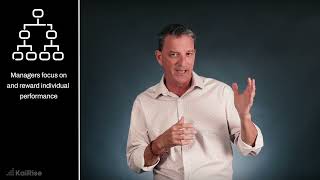
All right, let's get into it. We're going to talk more about that second crucial shift you need to make as an agile project manager manager, accountability to team accountability. It's that role that you play as a leader to create the conditions for high performance. You know General Stanley McChrystal who led the Joint Special Operations Task Force in Iraq against Al Qaeda. He said this efficiency remains important, but the ability to adapt to complexity and continual change has become an imperative. This insight came from a crucial realization in 2004. Conventional military tactics were failing against Al Qaeda's decent, decentralized network and the terrorist group could strike quickly and disappear. They were, they were outmaneuvering the efficient but rigid U.S. and allied forces. It really was a clash of systems. The hierarchical efficiency focused military versus Al Qaeda's adaptable speed oriented network. The traditional chain of command, like the lighted traffic intersection, proved ineffective against this new threat. McChrystal recognized the need for a new approach and a complete rethinking of their operating system. And he went on to describe the parallels between this military challenge and today's organizational structures. He was noting how traditional management techniques often struggle in a rapidly changing interconnected world. Instead, we need to transform our organizations from machines to organisms. A more adaptive, team based approach to leadership and organization. Now, efficiency remains valuable, but in modern warfare and businesses alike, the ability to be flexible, to adapt to our complex, ever changing situation has become crucial. Now consider the traditional organizational model, a top down hierarchy with bureaucracy and silos. Managers focus on individual performance, identifying top performers to reward while weeding out low performers. Detailed instructions flow from the top. Now this approach can work when tasks are repetitive and predictable, but it does take a toll on the people and doesn't necessarily create an environment where knowledge workers thrive. And you know, I've been on these teams, I've worked at these companies, maybe you have as well. One project I was on, it was an IT project in my early days with big software rollout. But everyone during the build was sort of siloed. Developers were doing their development and they weren't really talking to the testers. Testers were building test cases in isolation in a separate building. The ops team was super busy. They were keeping things running, but they didn't really know what we were doing. We did deliver on time, on scope, on budget, but it wasn't our finest hour. The integration was a nightmare. We spent months fixing issues that could have been caught earlier if we'd just been working as a cohesive unit. That experience, it really opened my eyes to the limitations of individual accountability and complex projects. When we're faced with rapid change, like high uncertainty and the need for quick execution, this hierarchical siloed approach begins to crumble. Now we have to shift from individual accountability to team accountability. And in the new model, boxes and lines become less important. Instead, we focus on action. We need quick changes and flexible resources. Leadership's role evolves to showing direction and enabling action rather than dictating every move. And by transforming our organizations into adaptive living organisms, we build teams around end to end accountability. This allows for collective response and adaptation rather than relying on like managerial direction, you know, this shift empowers teams to make decisions, to innovate, to respond to changing conditions. I really like what you're saying, Mike, but how would we go about doing that? Let's talk about some practical ways to foster team accountability on your agile projects. Establish shared goals. Ensure the entire team understands and commits to common objectives. This will create a sense of collective responsibility. Use visual management tools like Kanban boards or program boards to make work visible so that everyone has a sense of shared ownership of their tasks and their progress. You might rotate roles and responsibilities. Encourage team members to take on different roles within the team. This will foster a broader understanding of the project and shared accountability. My personal favorite, celebrate team successes. Recognize and reward team achievements rather than individual accomplishments. Encourage peer feedback. Create a culture where team members provide constructive feedback to each other. Implement retrospectives. Regular team retrospectives allow for collective reflection on process and outcomes. And it fosters a culture of continuous improvement. Remember, fostering team accountability. It's an ongoing process. It requires consistent effort and reinforcement from leaders to create an environment where teams just naturally hold themselves accountable for their work and their outcomes. But when everyone understands the objective, recognizes their limitations, and has autonomy in their approach, individuals often produce their finest work. And that's the environment we're trying to create. We want high alignment and high autonomy. And when we have both, there's the shift. We've begun to move from manager accountability to team accountability.