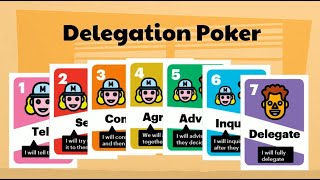
A short explanation of Delegation Poker, a facilitation technique introduced by Mike Lyons to help teams and managers decide how to delegate recurring decisions. The transcript defines seven delegation levels (Tell → Delegate), explains assembling a list of recurring decisions, and walks through playing Delegation Poker to surface current vs. desired delegation levels and capture actions to move toward targets.
Chapters
Jurgen Apello, the author of Management 3.0, said, I don't empower people to please them. I empower people to make better decisions than me. Most leaders recognize that teams that are empowered, well, they're more effective. But does empowerment mean that every decision has to be completely decentralized? Does it mean that no decision should be made by a manager? Well, certainly not. So how might we reason through which decisions should be delegated and to what degree? Enter Delegation Poker. Delegation Poker offers a practical, effective and even fun approach to answering these questions. Let's start by looking at the seven delegation levels. Level one is tell. The manager makes the decision, explains the rationale, and no discussion is required or even requested. Level two is Sell. The manager makes the decision, but then tries to persuade the team on the direction so that they feel involved and bought in on the decision. Level three is consult the manager, solicits input from the team and then makes the decision. Considering all of that input, starting here, we begin to see a shift in decision making authority. Level four is agree. The manager and the team will discuss the decision and they'll make a consensus based decision together. Level five is advise. The manager offers their opinion and hopes the team listens. But the decision is ultimately made by the team. Level six is Inquire. The decision is left to be made by the team, but afterwards the manager will ask for some explanation of the decisions. And level seven, the last one is delegate. The decision is fully left to the team. There's no manager involvement in any way, shape or form. So now that we know the seven delegation levels, let's play some Delegation Poker. Delegation Poker begins by compiling a list of decisions to be analyzed. Each of these items is placed on the delegation poker board. Then here's a tip. Be sure that these are sort of recurring decisions, you know, like things that happen over and over again that need to be decided. Okay, so next, the team and managers, they convene online or in person and begin to discuss the first item. Once everyone's had time to reflect on the recurring decision, they pick a delegation card that most closely represents how decisions are being made today in the current state. And then on the count of three, everyone exposes their chosen card and a discussion follows. There's often a disconnect between what the team generally thinks the delegation level is and what the manager thinks it is. So this first step, well, it really helps get everyone on the same page about the current delegation level. Now, once there's consensus, you mark that current delegation level with a check mark on the delegation poker board, and the next step is to determine if the current delegation level is the right one or. Or if it needs to be changed. And we'll do that by voting again. This time, the team members and managers will pick the delegation card that represents where they think the delegation level should be. On the count of three, everyone shows their new card. And just like in planning poker, the outliers are discussed and you get some insights into the thought process behind the card that they chose. The group eventually comes to a consensus about what the new delegation level should be, and once it's been decided, we'll mark the new target on the delegation board and will of course capture any relevant actions that need to be taken to move towards that new delegation level. And then we repeat that process for all the remaining decisions. I know it seems like a lot, but after you try it a few times, it actually goes pretty quick. So that's it. That's delegation poker, a practical and effective technique to empower teams.