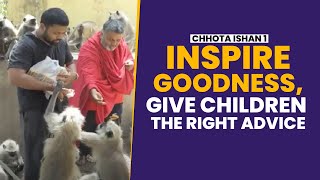
A father used the fictional character Chhota Ishan to teach his son virtues like altruism and tolerance through childhood stories. The speaker urges parents to raise children as real-life heroes who see the world as a canvas to improve through good deeds, not as fans of fictional superheroes.
Chapters
When I would be very young, my father would lie down and he had a very big stomach and he would make me sit on his stomach and then he would tell me stories. And the stories would not be of Superman or Batman or some hero living in some far-off land. The stories, he would say, are the adventures of Chota Ishan. And he created all these complex adventures. And I had my pet, it was a huge German Shepherd, and he would be my horse in all these stories. And I would sit on my German Shepherd and I would go and have all these adventures and I remember when Babaji would be telling all this to me, I would be imagining and I would be saying to him, "Babaji, I am Chota Ishan. Is this Chota Ishan different?" He would say, "No, no, son. This is the Chota Ishan from the future. This is the Ishan which you are going to become." And I would imagine and slowly the traits he would tell me in the stories, the trait of altruism, the trait of sacrifice, the trait of humbleness, the traits of peace, the trait of love, I started to feel that the Ishaan which the world says I am is not the true Ishaan, but the chota Ishaan which my father teaches me is the true Ishaan, and I must be like that chota Ishaan having the adventures all around. And I remember that this gave me a very heroic sense of being. As I started to grow up, my father's stories to me became more complex. He would never tell me what is wrong in the world. He would always tell me, "Son, what are you doing to make the world a right place?" I remember he would give me responsibility. He would teach me. Once I remember I was in the Lucknow ashram and he Aarti Samani told me, "Go and officiate the proceedings of the Lucknow Ashram." And in the Ashram, there is the time of food, and before the food, we are all supposed to pray. And I remember, I took pride in being strict, you know. And when the food was served, there were many people sitting, and there was this one old man who was just cribbing, cribbing, cribbing, cribbing, cribbing. As the prayer started, he continued to crib, and he even started to eat the food. I became really angry and I said to the old man, "You are not allowed. Get out of the hall." And I remember I called my father that night with a lot of pride that, "Babaji, I did not tolerate a minute of nonsense from that old man and I threw him out. You must be proud of myself." He said, "No, son. I am proud of my own self because I tolerated that old man for 20 years and you could not tolerate that man for 2 minutes." And suddenly I started to think. Suddenly my whole concept would be shattered of tolerance, of ignorance, of everything. And that is how my father would talk to me. He would tell me, "Son, if I can do that for 20 minutes, then you know you have my genes, you have my power, you are the hero that humanity is waiting for." And every second instant that would come in my life, then I would start to think, how will my father approach the incident? And even today when I am grown up, I still think how would chota Ishaan tackle that incident. The same power you have in your life. I want you to start treating your children like heroes. Understand all these heroes being presented today, they are fiction. They will always remain fiction. No matter how much you work out, no matter how much you study, you can't wear your red underwear over your trousers and become Superman. The true heroes will come from reality. The true heroes will come from you and I. You have the power to groom the heroes of tomorrow. Talk to your children in such a manner in which you are not telling them how the world is wrong and how the world is a pathetic place and how they will always be a victim, but tell them how they have the power to change everything. How they have the power to make the world a better place. If they come to you and they ask you, Father, why is the world poor? Then tell them, son, maybe it is because you are yet to do something to help those who are poor. Because I remember whenever I would go to Babaji when I was very young, he would take me out and he would do the charities. And I was very young, I had no money, I had nothing. I was barely 6-7 years old, and he would give me the food and he would tell me to give to the poor man. And he would tell me, son, if you don't give the food to the poor man, the poor man will have nothing to eat. Imagine, imagine the strong belief system he was making in my head. A 6-year-old boy being taught that you are the one to give food to the poor man. A 6-year-old boy not being taught that poor people are bad, or this is bad, or government is bad. But he would fill his car with food, he would take me to the poorest, the filthiest of places, and he would give that food in my hand, and he would tell me, go son, give it to that man, because Chhota Aishaan gives and helps. When I would be very young, he would take me to all these places where there would be animals as scrawny as you can imagine, as if they were the epitome of skeletons being shown in a biology class, and he would tell me, "Son, here is food, go give it to them." I remember he would throw me in the wildest of jungles with food so much. As I started to grow, I would be the one who had to carry the 100 kgs of food into the jungles for the animals. And he would tell me, "Son, do not creep. Chhota Aishaan can lift not 100 kg, but he can lift 200 kg." And I would be thinking, "Yes, yes, yes, I have the power," because My father says I am a superhero, then I am a superhero. And I would take that 100 kgs worth of food and I would go in the jungle and I would feed those animals who needed my help because that is the ideology my father gave me. And to such an extent, I saw that now even if I see a dog on the street, it is an automated response that comes from within me that I have to feed. Nobody else will. When I see a poor person on the street, it is an automated response that I have to go and help. Just like when Superman is flying, he hears a woman crying. It is not that Superman says, oh, Batman will come and rescue the woman. Superman goes and rescues. In the same manner, my father raised me in such a way that if I see a plant that is withering, then it is I who must go and water it. If I see a dog on the street, it is I who must stop the car and save the dog. If I see a bird falling down from its nest, it is I who must help. And you have the same power. You have the power to create a generation of superheroes, a generation of Shivanaans. I want you to teach your children the power that they have. I want you to treat them as if they were the one, as if they were the children of God, and you are here just to bask in their glory. I want you to teach them of what good effects they can have on this planet and not the filth that already remains. Because what you teach them will become the filter of how they see the reality. And a Shivanand will only see reality as a canvas, as a canvas, an empty canvas which has the power to become a beautiful painting. That is how my father saw the world, as an opportunity, as a blank canvas to be made into a masterpiece. That is how I see the world, and that is how I want you to teach your children how to see the world, as a blank canvas made to be a masterpiece. And who will make it the masterpiece? They themselves, with their little hands. Bless you. Namaste.