Intergenerational Accountability towards Drug Overdose: Podcast with ONDCP Director Dr. Rahul Gupta
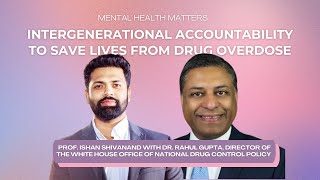
Dr. Rahul Gupta, Director of the U.S. Office of National Drug Control Policy, discusses how his upbringing shaped his approach to the overdose crisis. He warns that fentanyl-laced pills now sold on digital platforms pose a heightened risk to youth, and emphasizes that regular dinner-table conversations between parents and children are critical to detecting mental-health struggles and preventing drug use.
Chapters
I would like to salute you, and I like to salute the good within all of you. We are very happy here today because with us we have our esteemed guest, Dr. Rahul Gupta. He's the director of the ONDCP, and he's helping people around the world battle the with one of the modern epidemics, which is the drug epidemic of the world. So welcome so very much, Director Gupta. I'm so happy to have you here with me, and I would like to welcome you to the wonderful podcast that we are about to have.
Thank you, Chandru. Thank you for having us here, and really appreciate the work you do, and the importance of this work is definitely recognize.
Thank you so very much, sir. So, sir, uh, I do understand you have a trip that is coming to India, and last time when we had a conversation, you told me you grew up in India. So I would love to know a little bit more about your connection to India and where you grew up and how was that compared to being in the United States.
Well, certainly I'm someone who's been blessed to have, have the experiences of across the world. Of course, I was born in Uttar Pradesh and I, I was able to then, along with two younger siblings, grow up a large part in the state of Jammu and Kashmir as well as Delhi. And Uttar Pradesh as well, up until I was in 5th grade, at which point we moved to the United States as part of the BMS of India. And I was able to then get education in the D.C. area for the— towards the end of the elementary school, middle school, and then part of the high school. And then move back to India and finish up my high school and then do medical school in India and subspecialty training and then move back to the United States. So I've been fortunate in so many ways to understand, recognize the culture and work with so many excellent individuals on both sides of the world at the same time. We had the challenges, of course, of language, the cultures and cultural differences, as well as ensuring that we are, you know, moves are never easy for any family. So it's one of those things that's been a very important part, but it's also informed me and my, you know, the way I approach life because of that multicultural, multi sort of focused approach of various communities and various perspectives.
Wonderful, sir. That's amazing. I did not know you spent such a long time in Jammu and Kashmir. How was it at that time when you were young, sir?
Well, it was clearly, you know, it was an important experience because I went to, of course, we call Kendriya Vidyalaya or central school So one of the chains of schools par excellence in education. My parents, of course, valued education so much, and it was important to get high-quality education right from the beginning. It was, again, growing up in communities where you often did not speak the native language, but you could learn. You obviously were in a community that was, again, multilingual, multicultural. And multiethnic. So it was important to not only learn, adapt, but then experience the warmth of the people while making sure that you're following your education trajectory and, and doing everything else that goes in a child's life.
Yes, sir. Fantastic. So, sir, you told me you did spend a lot of time in both United States and India. And, uh, when we look at United States, we see people of Indian origin have really done well for themselves, and they are an asset to this country, especially in the field of healthcare, and even many of your colleagues in DC. I would like to ask you, sir, what do you think are those inherent qualities that these Indian families that immigrated to the United States have that have pushed their children, the next generation, to be so successful? And what is it that other families can learn? And also, do you think that the minority, the immigrants, are maintaining these qualities, or you think that now they are becoming dissolved?
I think it's a very important question, and I think for immigrants from all backgrounds across the world. And there's oftentimes a lot of sharing with American values. So I'm going to use the example of my own parents. My parents emphasized the values of education and service. They believed in the value of humanity and human life, irrespective of the artificially created barriers that divide people oftentimes. And ultimately lead to uneven progress and inequity. So they instilled in me the foundational values of shared compassion, servant leadership, and living life with a sense of honesty and accountability. This is so important because these are the very shared values that allow so many communities, often migrant communities of this country, to succeed, to work hard, value education and service, and succeed. And those are very important pieces. And I think it always comes back to that commitment to education because as I go back to my parents, I mean, they strongly believed that education was not only the key to individual success, but that it also laid a foundation for strong families, strong communities, and a strong nation.
Wonderful, sir. So education, service, honesty, and accountability are some of the key factors you felt your family were able to teach you. And I think this, this word accountability is a very powerful word because I think even my generation and the coming generation, this is a responsibility that a lot of people will have to undertake because I remember that famous speech from that American president, "Ask not what your nation can do for you, but ask what you can do for your nation." So this word accountability, sir, could you please highlight a little bit more? Do you mean personal accountability? Do you mean accountability towards the country, the accountability towards society, accountability where we become altruistic to the problems that are around us? So what do you mean by accountability, sir, in this context?
I'm glad you asked. You know, we look at, and I look at accountability in a way that life is a two-way street, at least. What that means is that often we tend to think linear, But the fact is that oftentimes, as the saying goes, what goes around comes around. So if you live your life with a sense of that accountability to all of those facets, to yourself first, then to your family, your home, your community, neighborhood, to your profession, and then to your country, I think that personal accountability, integrity, Doing when no one is watching you is so critical because that allows you to be honest with not just yourself, but with everyone else. But it also is an important American value because that is what's helped this country move forward in a way no other country has in recent history because of that self-accountability, but also the ability to have self-determination. Dignity and autonomy.
Yes, sir. And, uh, you are dealing with the drug crisis when it comes to being the director of Office of National Drug Control Policy. And, uh, continuing on the, uh, factor of accountability, I want to ask you, when you were growing up in United States, were you ever offered recreational drugs and How did you deal with that situation, sir?
Yeah. So when I was growing up, you know, in Montgomery County in Maryland and going to Montgomery County Public Schools, you know, there were drugs that were offered to so many children, so many young adults like myself. And there was, I think, others who were engaged in it. And it really goes back to your values and, and, and, and, you know, the importance of integrity and other pieces where you are able to then be able to say no and be able to understand and be able to understand why you are deciding to decline that offer that often comes, used to come free and for no reason. Look good. So regardless of stresses of everyday, the social isolation, the mental health often challenges that young kids face today or young people face today. There's that ability to have self-efficacy and responsibility that allows you to not participate in even an initial endeavor of that. So personally, I was offered several times in my middle school and high school times. Where I was able to easily decline and not regret it. It doesn't mean I didn't have other challenges in life like most young people do, but it's that ability to find community, to find connections, and to have a balance where you're able to decline that choice.
Yes, sir. So I want to understand what motivated you on this path, on this field, because this This task that you have undertaken, it's a Herculean task today, and one of the most difficult tasks, because I was talking to a country head and they were asking me about the drug situation in North America, and then they asked, has the battle been won? I said, no, the battle is ongoing, and, and it is an effort. So you have taken such an arduous task. What motivated you? Is there any incident that happened in your childhood that you made you think that, yes, this is a problem that I would like to be part of the solution of?
You know, I will tell you, initially, the very first memories of mine dealing with addiction, dealing with challenges of substance use are very vivid to me. I was a young person, perhaps first grade, and going in the evening, and I saw a person lying on the street, vomited, and under the influence of alcohol, and literally a street animal right there next to it. And it was something that just carried that impression that how strong the influence of drugs like alcohol can be, that it can really You can not only lose your consciousness, but you can also lose your dignity. And that was one of the initial pieces. My mother was, of course, someone who spoke highly about and against the use of alcohol as a schoolteacher. But then in the United States, I mean, one of the biggest challenges when you search for, which crosscuts not only economic prosperity, public health, but also national security, is the one that involves more than 110,000 deaths a year, which is only the peak of the iceberg because beneath that is the millions of people who suffer non-fatal overdoses. And underneath is about 48 million Americans that suffer from substance use disorder according to the latest data. So we know 48 million people is a lot of people who are suffering. And, you know, I've always been engaged in tackling the most difficult challenges, and this certainly is one. But if at the end of the day it impacts people, impacts families and communities, and there's almost no one, no family across this country, no matter how we cut ourselves and divide ourselves, that is not impacted by the consequences of addiction and substance use disorder. So that's motivation enough because I could tell you every day I wake up and one of the things I think about and say to myself is, look, we've lost 300 people yesterday, let their souls rest in peace, but let us do everything we can today to see what we can do about it. Used another 312.
That's very powerful, sir. But, uh, you know, you are a father, I'm a father, and, uh, we see that the world is changing so much. Um, we did talk about honesty and accountability and all the experiences you've had, but today's children are facing mental health crisis, alienation, isolation, stresses. So how do you think accountability has changed for them? The challenges that, that the present generation is going to face when they are going to be offered drugs which have become, uh, so much more easily accessible. How do you think that is a challenge that parents will be able to overcome? And, and what do you think, uh, your suggestion to the kids of the current generation is?
You know, the drug crisis per se, and along with mental health challenges and social isolation, has evolved. And more recently, in the last 5 to 8 years, it's evolved like it's never before in the history of humankind. What I mean by that is there used to be a time when we had plants and drugs. And as I explained, my childhood, people will come to you on the street and try to sell you drugs. That no longer is the case, and we, especially parents, must recognize that. Today, where before children would go, young adults, and party, and the drugs would be alcohol and maybe marijuana, but today it's pills. And the way they're bought and sold has changed. They're often bought through the palm of your hands, a phone app. And you can order what you think is a sedative or a tranquilizer or something to help you study for exam. But the fact is, when you buy those drugs, 6 out of 10 times, that's 6 out of 10, they're going to be laced with the potently fatal dose of fentanyl, this strong opioid that can kill you immediately. And those young adults may not even ever know that that's in what they think they've ordered is a Xanax or an Adderall. So this market has changed. The way we buy and sell and consume drugs has changed. And so the young adults of today need to watch out, not just for people on the street, but those bad actors within their phones. They need to be aware. But the most important thing today that parents can do is to have that dinner table conversation with their children every night. The reason this is important today more than ever is because you're able to be able to figure out the challenges they're dealing with, whether it's the— whether their academic performance is going down or social connectivity or they're feeling alone or they're having mental health challenges. It is really important today more now than ever to have that conversation because one of those conversations could literally be the difference between the life and death of your own child. And I can tell you, as I've traveled the country, I met with a lot of parents, a lot of parents who've lost their children, and I see the sadness in their faces. And they often tell me, only if I had done this or that, my child would still be alive. I don't want to see any parent be in that situation. So it's really important to have that connectedness, that togetherness, and be able to share each other's challenges and get the help that our young people need.
Yes, sir. And I do understand that the problem in the United States, it's, it's well documented and people are working towards solutions, but As you have lived in India as well, uh, you would know that in India we are still procuring the data and we are still trying to understand the extent of the problem. So what I would like to ask you, Dr. Gupta, is that, uh, you have seen the working styles of both the countries, America and India. So what motivated you to come to United States and be here and work on the solutions in this part of the world? And, and what do you think, based upon your expertise in both the worlds, you can recommend India, uh, on how to deal with this problem at this present moment as the crisis is evolving?
Yeah, I think that India is not spared when we talk about challenges of mental health, social isolation, addiction to substances, and its young population. And everyone is facing the same crisis no matter where you are. The difference is with 1.4 billion people and a lot of those people being young people, India faces both the ability to change its direction to provide the help in an evidence-based way, as well as to do prevention to make sure that people do not— the best way to avoid addiction and consequences is to prevent the use of substances. So there's a lot of— in more than little ways, the United States has been the canary in the coal mine. We have learned through difficult experiences the challenges of issues like drug addiction, issues like mental health and social isolation, but we're not alone. Unfortunately, this is something that as technology grows, more and more young people and adults across the world are going to be impacted. So I think India can see and partner with countries like the United States for the better. And the best prevention is when people do not suffer from substance use disorder, people do not suffer from mental health and social isolation issues.
Yes, sir. And also, sir, could you please explain to me your expertise as well? Because I was going through your profile. You are an MD, you are an MPH, you are an MBA. That gets you in a very special place with the qualification that you can help a very broader spectrum of people. So, could you please guide me on all your expertise?
Well, let me tell you, the most expertise I got was when I was a newspaper boy for the Washington Post. That was the beginning when I used to distribute newspapers at 4:00 AM, rain, snow, or shine. To the houses and I got to experience the very basic. But speaking of technical expertise, following my medical education in India, both MD but also after that expertise in pulmonary medicine, you know, across— I believe in lifelong learning. So you have to always look at what skill you're still missing and if you're interested enough to seek that expertise. So that's what made me get an MBA, and it was not in healthcare, it was innovation and technology management. Same way with MPH, it was in healthcare organizations and health policy to make sure that I have the technical expertise to be able to address the most difficult problems that face our nation and of course are facing the world today.
Yes, sir. But after so much of expertise, generally I see people of Indian origin go to the private sector. That's where the most profit is. But you went to the public sector for public service. Any special reason that motivated you for such a noble cause?
I think it comes back to my parents' teaching, which is service and education. And once you have the education, you have the skill set. I think the best way to make an impact is to public service in a way that you can help the masses. I have loved my role as a physician. I continue to see patients today when I get a chance in charity care, and then, which is, which is very wholesome to me. But I also know the way to impact when we have so many crises and challenges is to have impact on policy, impact on direction and strategy. And you can do that through public service. So this is the reason, is to be able to provide that service, maximize the use of my education skill set to help people in the United States and across the world.
Wonderful, sir. And during this journey, when did you know that you loved United States? Because I know people of Indian origin, they have a special place in their heart for, for the mother who gave birth to them, which in our case is India. But you chose your dharam bhumi as United States of America. So what was that special, the point in your journey that made you come to that realization? Could you please guide me?
Absolutely. You know, the dharam bhumi and karam bhumi can be same, different, doesn't matter. My father believed that, you know, we are all one people, one family in the world. And we've also decided to divide ourselves up into nations and states and countries and all of that. But it's really important wherever you are making an impact, make sure you pick where you want to and make that impact and be happy with it. That was the case with me where I enjoyed my time and my training and expertise in India, and I absolutely wanted to have the most impact I can. Of course, the land of opportunity is the place— was the place for me to be able to begin. And it was very helpful to have that worldview of education, the best education I could possibly get, but also, you know, have an impact on strategy, on policy, you know, in a way develop and devise systems that are helpful. So that was mostly one of the important reasons was again comes back to service for me.
Yes, sir. And today geopolitically, America is at a very important place in the world, and so is India. India has one of the highest resources when it comes to manpower, and India is also now becoming a leader in pharmaceutical and healthcare. So I would like to ask you, sir, in the time to come, how important is US-India strategic relationship when it comes to healthcare of both the nations, especially the role of technology in healthcare? So how do you think, uh, this can be important, and what can people of both the nations do so that we go towards a mutual goal?
Look, I think today in the 21st century, the relationship and partnership as strategic partners of the United States and India is second to none. And here's a reason for it. It's not only about the American people or the Indian people. It's about the people of the world. And these are two countries that have always worked for not only their self-interests but for the interest of the entire globe. And when you have two democracies, the world's largest and oldest, and working together in sync to benefit the entire world's population, we are at that pivotal point. And I think the world should be delighted to see that happen.
Yes, sir. And I'm sure in your pioneering leadership we will see that, and India and US can be strategic partners in, in the time to come. So thank you so very much, Director Gupta. It was a pleasure as always being in conversation with you, and I'm sure all the listeners and readers will have a lot to learn from what you had to guide. Thank you, sir.
Thank you. Thank you for having me, Shanmukh. Appreciate your work.


