Introduction to Meditation || Podcast (Episode 1) || Ishan Shivanand
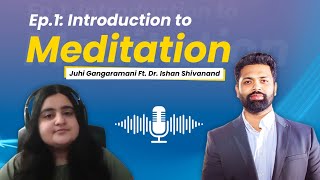
In the inaugural episode of the "Your Journey" podcast, host Juhi Gangaramani interviews meditation teacher Ishaan Shivannand. Ishaan shares his background growing up in an Indian monastery and his experience teaching meditation worldwide. He defines meditation as a counsel with one’s inner self, a necessary practice for mental health akin to eating or breathing. He clarifies that meditation need not be religious, emphasizing inner strength over external deities. Ishaan outlines practical steps for beginners: body‑awareness scans, sending compassion to the body, and focused breathwork with non‑judgmental observation of thoughts. He discusses how modern distractions—constant app ratings, review culture, and social media—create bias and anxiety, using anecdotes about a soldier friend and cultural expectations in India to illustrate the pitfalls of conformity. Ishaan introduces the metaphor of a race car’s pit stop, arguing that self‑love and regular self‑care are essential “pit stops” that sustain performance during stressful periods. He concludes with an affirmation practice encouraging listeners to recognize their worth, practice self‑acceptance, and integrate meditation as a form of self‑care. The episode aims to demystify meditation, provide accessible techniques, and inspire listeners to cultivate inner resilience.
Chapters
Welcome to Your Journey, a podcast with Ishaan Shivannand. My name is Juhi Gangaramani, and every week we bring episodes to our listeners that address topics ranging from meditation and maintaining well-being to how we address anxiety and mental health challenges people face. We hope to give you more clarity and support on how to cope with daily and lifelong stressors while we support and uplift you on your journey. Welcome everyone to our first episode, uh, of our podcast with Ishaan Shivanaand. Today we're going to be discussing many different topics regarding mental health and wellness, and we'd like to introduce the topic of meditation. And first, before I do anything, I'd like to introduce Ishaan Shivanaand and tell him a little bit about himself to you guys.
Ah, hello everybody. I salute you all, and I salute the Divine within all of you. My name is Ishaan Shivnand, and my core competency is helping you learn about your inner self. A little bit about myself: I was born and raised in a monastery in India where I spent almost all of my childhood. There I learned the secrets of Indian knowledge systems, meditation, yoga, pranayama, which are extremely relevant to our mental health. When I was about the age of 20, I came out of the monastery and I started teaching what I had learned to the world. And it has been a phenomenal journey. I have been teaching to people, I've been helping governments, institutions, medical institutions, doctors around the world. And I hope that if you are listening, you are here today, I can help you. So let us begin.
Absolutely. I think many youth in our generation struggle with a lot of issues that they don't know how to tackle on their own. So I think my first question would be, what would you say meditation is?
Meditation is counsel with your own self, knowing your own self. So many times, imagine if you had all the resources in the world and you just did not have access to them. I see extremely intelligent people who find themselves in situations, who are so stressed, who are so anxious that they forget their intelligence. I see talented people whose talent takes a back burner because all the things that they are facing in their mind, they have come in the forefront and they do not know how to deal with it. And these situations we carry. It's like the clothes that I'm wearing. If I keep on wearing them for 1 day, 2 days, 3 days, 10 days, they'll start to smell, they'll get dirty. All I need to do is learn to wash them. Similarly, if we have a certain mindset and unfortunately things happen to us, situations happen to us, traumas happen to us, and we never get a time to deal with them, then over time we accumulate. We accumulate a burden that makes our life more difficult, our thoughts difficult, our feelings difficult. To a point where all of our effort is just somehow surviving, not living. And meditation can help with that, because when we meditate, we are not just seeking a counsel with our inner self, with our higher self. We are also giving our mind an opportunity to heal, to process the traumas, the situations that we have faced. It is allowing us to lighten our load, to purify ourselves. So I would like to say that just like eating, breathing, drinking is necessary for survival, meditation is necessary to live a good and healthy life.
That's a great way to describe it. I think many people don't take the time out of their days to, like you said, take counsel with themselves and acknowledge all the things they've been through, especially through a lot of trauma. Many people think that meditation can just be sitting down and focusing and just trying to put it in a more religious context. What would you say meditation physically can look like?
First of all, I would like to say that meditation does not need to be religious. Yeah, religion is when we are praying to a deity to solve all our problems. Meditation is not that. Meditation is allowing our inner strength to come on the surface so that we have the power to solve the situations in our life. So meditation can be religious if you want it to be, but it does not need to be religious. Secondly, when you say that if I am just sitting in a corner trying to relax, is that meditation? If you have that capability to sit in a corner and relax, then definitely that is meditation, but A lot of people unfortunately do not have that capability. If I ask somebody to just sit in a corner and try to relax, then first of all, they'll start ticking like a squirrel because we are so used to dopamine hits from our cell phones, from our environment that is always trying to somehow stimulate us. And then we have our thoughts that just randomly pop up, and then we have our anxieties that create fear in our minds. Then instead of meditation that will relax us, we end up having a psychotic episode that stresses us more, and we are stressed that, oh my goodness, I can't even meditate. So if you can sit in a corner and relax, then yes, that is a beautiful form of mindfulness and awareness. But if you cannot, then there are steps, there are ways that can help us, allow us reach to that point in our life where we can sit in a corner.
So you mentioned some steps and some ways that people can get to eventually sitting in that corner and being with themselves and experiencing mindfulness. What do you think some of those steps entail?
The first is, I think, the best tool that the universe gave us is awareness and breath. If we try to become aware of our body, what it does is it allows us to come in the present moment. Because a lot of the youth that I have worked with, I found that there is a form of disassociation that they experience. And disassociation means a lack of passion for the present moment. A person may be sitting with his family and really not sitting with his family. A person may be sitting in class and really not present in the class. So how we get over this dissociation is with awareness exercises. So the first awareness exercise can be try to take awareness to various parts of the body and just feel. Feel your head, feel your heart, feel your stomach, feel your legs, feel your fingers. Just, just feel your body. That's it. Just, just try to feel your body. The second advanced step would be try to send compassion and love to your body. Because our body does so much for us. Our heart is always beating for us. Our lungs are always breathing for us. Our stomach is always digesting for us. So, so send compassion and love. To the body. And then the third most advanced that you can practice as a beginner is breath. Inhale and exhale slowly and deeply. And what you can do is just be aware of your breath as deeply, as intricately as you can. So when you are inhaling, try to follow where your breath is going. You're going to the lungs, it's going to the body. Try to visualize the breath and then slowly exhale. And while we are becoming aware of our breath, try to aware in a non-judgmental manner. So you're not feeling excited, you're not feeling angry, just observing. And if a feeling comes, fine. Try to just witness the feeling as you witness the environment outside the car while you are driving. It is a non-attachment. It is a silent observation. So as you are being aware of the breath, thoughts are coming— fine, just look at them. Do not react to them. And slowly and slowly, you will find that you will reach a state where the same meditation will start to provide you a lot of strength and resilience that will be beneficial in your life.
That's an amazing way to think about it. I think many people struggle with acknowledging the emotion and taking the time to realize that it's completely normal to experience anxiety and experience overwhelming emotions. And I think with our generation today, You're right, we don't take the time to sit down and just breathe and experience what we're feeling. I think many people also experience being constantly stimulated by distractions and things going around them. So how would you say that— what would you say is a good way for someone to deal with so many distractions?
So I have a friend who who is a soldier, and he is a combat veteran. So he has experienced death very intimately many, many times. So he lives in a very different manner. This is not normal. And when I say normal, I mean the, the rat race that is considered normal. He is very grateful for life. He's very excited about life. He's— he enjoys everything. So when I came to the United States, I saw that people live in an app culture, and in the app culture there is a rating culture, a review culture. So everybody is rated like a piece of meat. A grade, B grade. You know, even you go to Uber, the driver rates you and you rate the driver. Imagine just sitting in a taxi, now you are being rated if you were sitting nicely in a taxi or sitting badly in a taxi. You go to a restaurant, you rate the restaurant. Now imagine the food may be extremely delicious, but it may not be accustomed. You may not be accustomed because of your cultural palate, but you will give the most horrible review that you can. And this review culture, this rating culture, is, is a flood you can't even control. It just sweeps you away, and it swept me away. So I really like to watch movie, because when I would watch movies, I, I felt that it made me feel less alien in the foreign environment that I was in. So there are a few reviewers on YouTube that I would watch before I would go to see a movie. Now one day I was going with my soldier friend to watch a movie. And before going, I wanted to know how that movie is, what I have to expect. And I put on the review, and the moment I put on the review, the soldier is like, what are you doing, man? Switch it off! And I said, what happened? He said, you are corrupting your experience. You are corrupting what you can get out from the movie, for yourself. He said, you have two eyes, you have ears, you have nose, you have a tongue, you have a brain. Why can't you just feel the movie? Because if the reviewers is saying that the movie is going to be good, now you have a bias. Now you are looking for the good thing that the reviewer has talked about in that movie. If the movie the reviewer is saying is bad, Over time, you are going to develop a trust, a connection with that reviewer. And even though you will like that movie, because of course people are— if the shittiest movie can sometimes do good business, and it may be shitty for somebody else, but it may be good for you. So you are again creating a negative bias towards something that you could really have enjoyed. And that soldier said to me, life is too short, too beautiful to develop biases. Just go to the movie, enjoy the popcorn, see what you see, and develop your own view about it. And I think many a times people do not do that. They allow the cell phones to dictate how their worldview is going to be, how they are going to perceive and react to information. It is like a herd mentality, a sheep mentality, that I just want to confirm, confirm to what I think is out there. And that conformism is not going to give me peace. In fact, it is going to give me a point in life where I am extremely sad. And I used to see this, I used to see this back in India, because in India, uh, when I would be giving therapy to people This was in Uttar Pradesh. Uttar Pradesh is where the power dynamics between men and women is not balanced, and men are very powerful, and sometimes women are subjected to domination, and many times there is arranged marriage. So when a girl child is growing up and the girl child wants to do something, she wants to go to a concert, the mother will say, why you want to go to concert right now? When you'll get married, you'll go to concert with your husband. Or if the girl child is just sitting nicely and not studying, the mother will say, study! If you don't study, you won't get a good husband. Or if the girl child is not, you know, doing some sports. If you don't do sports, you'll not get a good husband. So the girl really pushes herself, really pushes herself for this reward that is about to come, a good husband. And then eventually she gets married, arranged marriage, to somebody who after 10 years gains weight, loses all the hair, burps while he's eating, and farts in the blanket. So the girl becomes extremely frustrated and depressed that this is the reward for which I worked so hard for. And the same happens with conformism. You are doing everything, you are cutting your own wants, confirming to this crowd, thinking that there is going to be a reward, and there is never going to be a reward. So eventually in life, you are going to get short-circuited, and you are going to feel depressed. And what I learned from that soldier friend of mine was, live your life, be brave, be brave enough to have your own opinion. But to have your own opinion, you will have to have your own awareness, and you will have to leave the crutches of the review culture, to look around in the world and what other people say about it. And if 20,000 people are saying something about it, it must be right. That is very meek. That is being a sheep. To meditate is to be brave. To know yourself is the greatest gift we can give ourselves. To have our own opinion is the greatest form of fulfillment that will lead to joy. And that is my recommendation always.
I think that from everything you said, I think the best way to explain it to people is that if we don't look inward first and consider ourselves first, we can never truly attain what we're looking for or try to achieve some sort of idea of peace or wellness. And I think many people struggle with understanding what wellness is, and especially in today's generation, we struggle trying to go to different methods, uh, of meditation, like doing yoga or going for a run or watching a lot of TV or doing what we think makes us fulfilled. But today, sitting here talking with you, I feel like I understand a whole new part of myself that I wouldn't have thought of before. And I think the last question I have for you today is How do people adapt in difficult times, like when they're attempting to meditate or want to carve out that time to meditate, or just want to take the time to really get to know themselves and understand what they've been through? How do they adapt to their day or difficult stressors that they're experiencing?
I saw a race once. I don't know which one it is. Where the cars keep on going round, round, round, round, and they just go wee. And while they are doing that, there's a pit stop, and the pit stop comes in, and then suddenly 20 people jump on the car. They remove the tires, and somebody puts in the fuel, and somebody does something, and, and then again the car goes wee. If you want performance out of the vehicle, you have to have pit stops. And if you are going through difficult times, then you need performance out of the self. If I did not give pit stop to the car, I don't know what will happen to the car. Maybe the car, the tires will explode, or the car will explode, or something will happen. But imagine the driver say, oh no, no, I want to come first in the race. Oh no, no, I want to be ahead of opponents. That's why I won't— I don't have time for the pit stop. Pit stop should be part of the race. It is part of the race because only then you can race. A tough time, a time of crisis, is a time when we need performance from ourselves. So taking care of what you eat, taking care of of your own wellness routine, taking care of your own body, taking care of your mind. Even if you are able to give little to yourself, but it is important. These pit stops are the greatest form of self-love and self-care. So even before somebody says to me, I want to develop meditation as part of my routine, I would say develop self-love as part of your life routine. Because if I will have self-love, then I will take out time for pit stops, because I know the time of crisis that is coming. And it could be anything. It could be examination, it could be the Christmas dinner that you have with family. That takes an extreme emotional toll on you and leaves you exhausted. So you know when you are going to go through time of crisis, so you need to have pit stops for your self-care. But that will come from self-love. But if there is self-contempt, then subconsciously I am just going through life's routines thinking that 'Let things sort them out, and one day I sort myself out, or I get sorted. Then it is what it is.' So today, the last question that you have asked, the last thought that I want to leave your listeners with is: sit in a corner and try to create the thought I love myself and I accept myself, and I deserve to be happy. I deserve to be healthy. I deserve to live a life that is fulfilled, and I deserve to make an effort that will help me achieve my goals. I believe in myself and I have hope for my future. And I think if I can say all this to myself, then I'm ready to bring the pit stops happily. That will help me.
I'm excited to see where our next podcast episode goes, and thank you for taking the time out to speak with me today.
The pleasure is all mine. Thank you so very much for talking to me, and my regards to all the listeners wherever they are. I hope our communication helped you.
Thank you for listening to the Your Journey podcast. Make sure to follow us on social media to keep up with the latest episodes with the @your_journey journey_podcast. We hope to join you again on the next episode of your journey.


