My Deadlines Are Bullshit. I Set Them Anyway
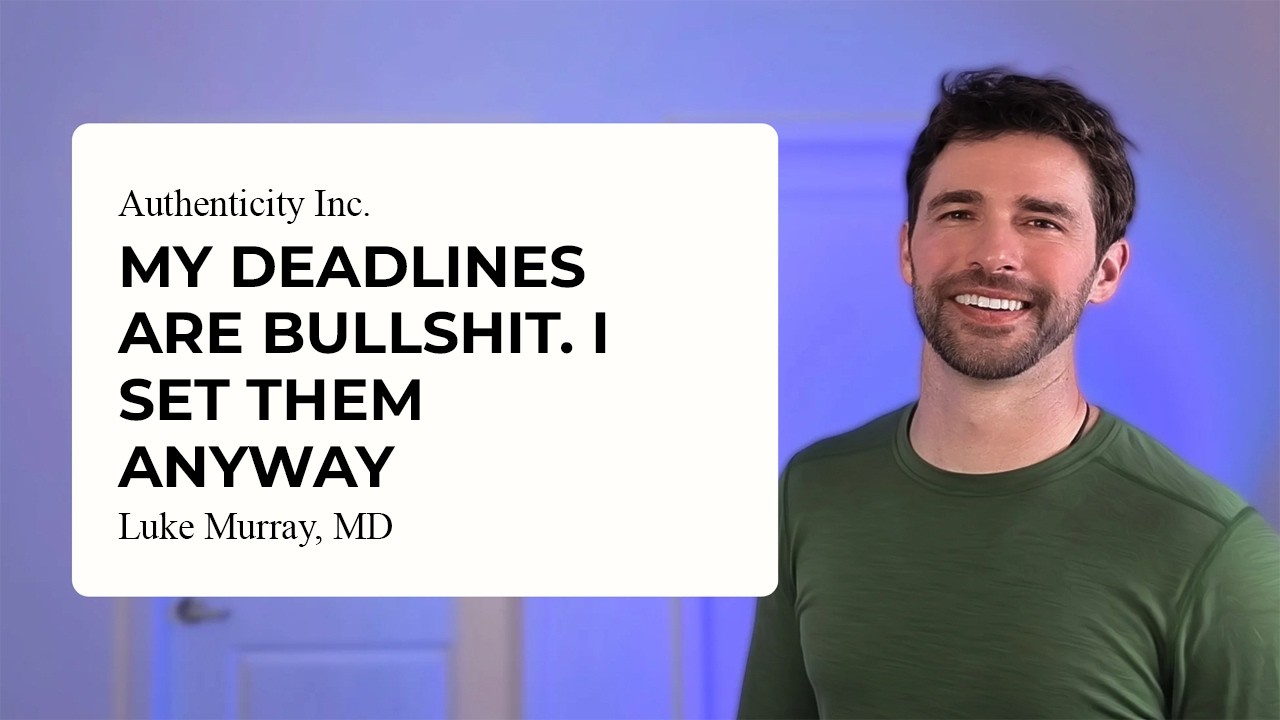
In this solo, motivational monologue, former doctor‑turned‑entrepreneur Luke Murray explores why many high‑achieving people abandon big goals and deadlines, believing that reaching them won’t bring lasting happiness. He shares his personal journey of disillusionment after years of building $100 M+ in revenue, the painful realization that achievement does not equal fulfillment, and the subsequent period where he stopped setting ambitious targets. Murray explains why he eventually returned to goal‑setting: goals give each step of work context and meaning, while deadlines create the pressure that drives teams to perform. He uses mountain‑climbing and road‑trip analogies, cites Elon Musk’s aggressive timelines, and reflects on the ego‑protective fear of missing deadlines. The video culminates in a concrete, time‑bound target—$500 k in monthly profit by December 2026—demonstrating that even a “bullshit” deadline can be a useful game‑board for leadership and team motivation. Throughout, Murray balances spiritual skepticism with pragmatic entrepreneurship, urging viewers to set goals and deadlines deliberately, knowing they won’t guarantee happiness but will shape purposeful action.
Chapters
Are you hesitant to set big goals or deadlines because you already know their achievement won't actually make you happy? Or are you worried if you miss those deadlines, your team or your customers or the media will lose trust in you, or everyone will find out that your strategic forecast was bullshit, so now they're calling you a liar? So again, why set yourself up for failure? Well, if either of those two things resonates, then This video is for you because those are the 2 reasons I stopped setting big goals and making deadlines for a while. And while both of these concerns are valid, indeed, there's no more happiness on the top of a mountain that you're climbing than there is under the feet that you have while you're climbing it. And people definitely will give you a hard time for missing deadlines. I've decided over the past year or so to still set ambitious goals with deadlines anyway, and I'm glad I did. So in this video, I'm going to talk about why my deadlines are bullshit and why I set them anyway. If you don't know me, my name is Luke Murray. I'm a former doctor. I've been an entrepreneur for 20 years, done a little over $100 million in revenue during that time. I now run a portfolio of companies that does about $3 million a year across several different industries. And, uh, yeah, I just make these videos because I like Figuring out how to build ambitious shit without pretending like the scoreboard is the point. Now, I first want to reemphasize that if you've accomplished enough things in your life to know in your bones that another accomplishment is not going to make you any happier, then I'm here to tell you, you are right. It does not. And depending on how you got there, That really sucks. While some of you didn't need to pay a very big price to learn this lesson, say that you had that bubble burst after your very first straight-A report card in 9th grade and you were forever freed from this illusion. The rest of us had to pay a steep price to get here. I mean, it takes a lot of sacrifice to make a million dollars and get it 6-pack and get 10 million followers and 3 Lamborghinis or whatever, only to realize that none of that shit matters. Or at least none of it's going to make you permanently and deeply satisfied. And for some of us, actually, we might only realize it on our deathbeds, which means it cost us our whole life. But whenever you do realize this, I want to tell you that it sucks. And I'm here to empathize with you with that moment or that month or even those years that you might be in right now that I was in and still sometimes am in of feeling lost and disillusioned. And yes, I recognize that the more accomplished you are and therefore the longer you've been playing this game, both the harder you'll be hit by your worldview just crashing down and the less pity you're going to get. from anyone for experiencing this crisis of meaning. I'm here to tell you that losing my identity, me personally as an achiever, to whatever degree I've actually achieved anything that someone would consider externally important, or at least losing the belief that the path to happiness is through achievement, was and honestly continues to be the hardest thing that I've ever done. Not achieving, Letting go of the belief that achievement would make me happy. So if you're in that place, young or old, man or woman, my heart goes out to you. Seeing through achievement is painful, especially when success has been your identity, and successful people get almost no sympathy for that crisis. Now, on to the actual point of this video. When I first came to the realization that accomplishing another goal wasn't going to make me happy, I just said, well, then let's stop having goals. Now, at that same time, I had also made investments in several companies during this period, and I guess you could say for the betterment of my spiritual development, none of those companies were profitable enough to pay me a dividend that allowed me to just, I don't know, fuck off and do whatever I wanted forever. And some of them actually were losing money to a point where I needed to continue to invest in them With my money, and then eventually with my time and attention to keep them afloat. In order to get them profitable and not go bankrupt, I had to set the goal of make these companies profitable so I don't starve and neither do my employees. And while it sucks to be losing money, I had spent some of my disillusioned time on enough tropical beaches and in enough mountain resorts and at enough fancy masterminds at that point in my life to know that I'd honestly rather be building something with my friends, even if it is turning a losing company into a winning company, than networking with strangers, no matter how powerful they were or pretty they were or how beautiful the environment. However, when I stepped back in, I didn't really make it a point to set some grand vision for a couple of reasons. Again, I knew that accomplishing some goal wasn't going to make everybody else happier. It was about the journey instead of the destination, and I had realized that. And the achievement of some big goal lay only in the accomplishment of whatever the most important thing is that was right in front of you anyway. If you want to get to the top of a mountain, talking about the top of the mountain isn't the most important thing. You have to focus on the next step in front of you. So I felt like I had some strategic justification here. The problem is that This feels like a never-ending grind, and while I had realized that that's the grind that I wanted, that that's honestly all there is in life is the grind that's right in front of you. I had luckily learned that I'd rather be saving a company. I had I had luckily learned that I'd rather be saving a company from the brink of destruction than hobnobbing with influencers all day. But it's unlikely that everyone else at every other position of the company. felt the same way. They may not rather be grinding at their jobs for me than doing anything else in the world, and they may want some emotional payoff or at least some variety of intensity about what they were doing and how they were doing it. Honestly, to use the mountain climbing analogy, part of what's cool about climbing a mountain is that you're not scaling a flat sheer cliff the entire time. When I climbed Mount Kilimanjaro back in March of 2026, There were times when it was steep, sometimes it was flat, and there were even some days where we went up and down and honestly ended up lower than where we started. And that really added to the quality of the experience, even though the goal hadn't changed. So that's why I set the goal of getting to profitability, because it would inspire— or I had bigger goals than that actually, but it would inspire everyone else and get everyone else excited. Just having the destination of the mountaintop, even though I knew it wouldn't make us happy, the accomplishment wouldn't do that, even if it made me richer, actually, which it would. But guess what happened? Instead of me doing it for them, I actually felt more inspired as well, because even though I knew that achieving that goal wouldn't solve all my problems, having one made each step more exciting. Again, It's the reason that you decide to climb a mountain instead of just walking on a treadmill for 3 days with a beautiful picture of a mountain in front of you. The actions are pretty close to identical, but the context and the feeling of anticipation, the experience, and yes, the goal give it meaning. Put another way, if you're driving through Nebraska, you live in Nebraska, you leave your house, you go to the grocery store down a certain highway, it's not as fun as if you were leaving that same house, getting on that same highway, and And you were driving to Vegas, for example, even if you know that happiness isn't the source, that loss in Vegas isn't the source of all this happiness, it still makes the drive through Nebraska more fun. Or said in the opposite direction, the drive through Nebraska where you're not trying to get to Vegas at all, you're just trying to enjoy the journey. Well, that's tough for even the more enlightened among us to enjoy as much as going to Vegas. Or even to enjoy as much as going to the local grocery store. Goals are useful. So that's the first thing that changed for me. I already knew that the achievement of the goal doesn't have to be the source of happiness for it to be useful, not just to me, but to the entire company. And I was treating goals like they only conferred value in their accomplishment. But that's not the only thing the goal does. It provides context and a meaning for each step. Even if those steps are the same ones you would take without the goal, and honestly, once I realized that, I was like, all right, cool. I could set goals again without going backwards spiritually or trying to bullshit myself about something I knew wasn't true. But as soon as I set a goal, you get the next question, which is the next part of this video: when? And that's when I bumped into deadlines and my next big pushback, once again disguised. In spiritual clothes, but this time much more closely tied to my ego than setting a goal. And deadlines are scarier than goals, or I guess I should say they threaten your ego much more than goals, because a goal can exist forever without being realized and it can still inspire. Think of actually Martin Luther King, who said, I may not get there one day, but I have a dream. So you could say I want this business to become profitable, taking steps every day to realize that goal. You can justifiably say we're doing it. That's great. But if you ask by when, that's when I started resisting again. First, I started with the realization that climbing to the top of the mountain was all that mattered. Having a destination in order to give each step purpose and then journeys in meeting was spiritually all you need. As you can see, I'd already moved the goalpost and accepted that. Plus, creating a deadline was in many ways intellectually dishonest because you're trying to tell people that you can see in the future and you definitely can't. As I sat with my hesitation around this, I realized that I was doing it because I didn't want to be wrong, not because I was uber enlightened. That's caring what other people think, which is 99% of the time about protecting your ego. So I asked myself, why did I care if I was wrong? And I originally justified it by saying that people would no longer trust me if I set deadlines and did not hit them. It would erode my effectiveness as a leader. Makes sense. But then I realized Elon Musk has been doing that for decades. And what did that get him? Well, it got him a bunch of haters, even within his own company, for sure. But he's got over 150,000 employees, and that number has been going up. for the last 20 years. And I doubt that everyone that works at these companies hates his guts. And even if they did, and this is the hard part, they figured out how to work together well enough to make some incredible things happen, largely thanks to Elon Musk's goals plus his deadlines. So would you rather have a company where people were annoyed by you, but you did epic shit, or ones where they felt zero pressure, but didn't fulfill their potential? I know my answer to that question, and obviously Elon knows his, but I had to get there by recognizing, oh, someone else is already doing this. And while it may not be peace and harmony inside of his companies, man, they're doing some of the most inspirational shit on Earth. So that's where I've landed. A goal gives a journey meaning. A deadline creates the pressure. And neither of those make you unspiritual or ineffective as a leader. So pressure, when you relate to it correctly and you don't ignore it, you don't turn it into this existential threat, creates the creativity. Not because the goal will make you happy, it won't. Not because the deadline will be accurate, it won't. But because without the goal, the work is vague, and without the deadline, the work becomes someday. And so that's why I'm setting big goals again. My goal this year, is to make $500,000 in profit on a monthly basis by December of 2026. And even though all we've done this year is lost money for the first 4 straight months, I still have that goal. I still have that expectation, and I still have that deadline. And it's not because I think the scoreboard is the point that it's going to make me happy, but because you need a scoreboard in order to have a game. It is a necessary condition to playing a game. Again, back to how you relate to your goals and your deadlines. I like seeing what's possible when smart people are forced to ask, if this had to happen by then, what would need to be true? So the deadline is probably bullshit, but set it anyway. And remember, nothing actually matters, so choose what does. What do you think? Have you been hesitant to set goals? Have you felt alienated by seeing through the illusion that accomplishing them will make you happy? Or have you just resisted putting timelines on your ambitions because of what other people could think? Let me know in the comments below, and thanks for watching.
More from Luke

I Spent a Year Building a YouTube Channel With No Videos. Then I Made 30 in a Month