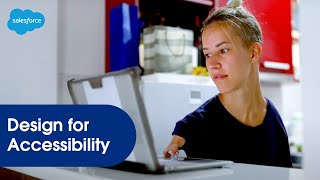
A blind Salesforce employee who uses a screen reader explains how accessibility must be built into products from the start, not added later. Keyboard support and screen-reader compatibility follow standards that benefit the 25% of people worldwide with disabilities. Training engineers on accessibility testing makes solutions cheaper and more inclusive.
Chapters
One size is on. When you're designing products, think about me. I'm a user with low dexterity, and I use a keyboard very regularly and very heavily. I've been blind since birth, and I've never really considered it to be anything more than just how things are. A screen reader is really on all of the devices that I use. Because equality is one of our core values, we are on the forefront of shaping what product accessibility looks like. At Salesforce, somebody tells you we use Salesforce, you can say, oh, well, I know that. That's access. When we think about web accessibility and the prioritization and the importance of it, all of us have some sort of small disability in many situations. Kat Holmes wrote a book called Mismatch. Disabilities are really a mismatch between people's ability to do something and the environment that they're working in. The problem when people don't think about accessibility from the start. Like, when you develop something and you don't include keyboard support, then it is just halfway finished. There's standards in place for accessibility, and they kind of also meet the needs of writing good software. At the same time, you are going to be impacting a huge number of users. Your QA team can go through your accessibility testers, and they can actually make all the test cases. So when you write software that meets those standards, you actually get like, a high grade on the scorecard. In the end, 25% of the world's population has some kind of disability. We are a majority, even though we are an underrepresented group. The job in accessibility is to go a little bit further and think about who have we not brought along with us. It is important that we are training and educating our engineers, our product design teams, in every level of technology. In the end, if you're designing software, you don't ever say, like, I want to Design software for 80% of the people. What is the job that needs to get done? And what may are those mismatches that prevent a person from being able to do that job? The more the developers can build it initially, the cheaper essentially it's going to be. I think when you put disability inclusion at the forefront of everything, you realize that it benefits everyone.