Being Color Brave: A Conversation with Mellody Hobson | Salesforce
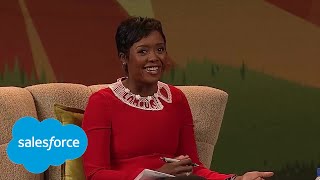
Mellody Hobson, president of Ariel Investments, talks about her path from interning there in 1989 to leading the firm, her board roles at Estée Lauder and Starbucks, and why corporations need to take on social responsibility. She discusses financial literacy, diversity in corporate leadership, and raising bilingual children.
Questions this video answers
November 7, 2017.
Over 2.2 million views.
Princeton University; graduated in 1991.
She interned at Ariel in 1989; Ariel Investments was founded in 1983.
People, philanthropy, and purchasing.
Chapters
Ladies and gentlemen, please welcome Tony Profitt, chief of quality officer, Salesforce, and Melody Hobson, president, Ariel Investments.
Good morning. Good morning, everyone. Salesforce welcomes all and Salesforce welcomes everyone in the room, everyone watching online to Dreamforce 2017. Welcome. And we are thrilled. We've got a great way to kick this off and it's going to be a real treat. And we have Melody Hobson. And so this is the highlight, one of the highlights of the whole week for me, in fact, probably the highlight. Melody, we are honored and thrilled for you to join us. And I'm going to just give a little bit of Melody's background just for context. So Melody is the president of Ariel Investments. She also serves as a chairman of the board of trustees for Ariel Mutual Funds. So one of the very few women of color. That distinction, right? Beyond her work at Ariel, Melody has been a nationally recognized voice on financial literacy and investor education. She's been a passionate, passionate advocate for investor education. And she's a spokesperson for the Ariel Hewitt study and also the Ariel Black Investor Study, both of which are examining investment patterns among minorities. So super, super important issues. Melody is also a director of Estee Laudi Corporation. She's a director of Starbucks, and she was formerly the chairman of DreamWorks Animation until it was acquired by Comcast. Her community outreach includes serving as chairman of After School Matters, a nonprofit that provides Chicago teens with high quality out of school time programs. She's a board member of the Chicago Public Education Fund. She's a board member of the George Lucas Education foundation, the Lucas Museum of Narrative Art, and the Sundance Institute. She was appointed as an emeritus trustee there at the Sundance Institute. She's also a member of the American Academy of Arts and Sciences, serves on the executive committee of the investment company's institute Board of Governors, and she's been widely, widely recognized. She was named to Time magazine's annual list of 100 most influential people in the world in 2015. Her TED talk has gained over 2.2 million views. So if you haven't seen it, check it out. It's amazing. You have to see it. Melody earned her bachelor's from Princeton Woodrow Wilson School of International Relations, and she's received honorary degrees from Howard University, St. Mary's College and USC. And she was previously a World Economic Forum young global leader. So illustrious, amazing, your career and so much ahead of you in what you're going to accomplish. We're going to talk about some of your vision, your ambitions going forward as well. But we're thrilled and honored by your Presence. So thank you.
Well, thank you so much for having me. I know it is a big deal to speak at the Dreamforce, and so I'm very excited. And I have to just say, that video was spectacular. Thank you for that.
Thank you.
It's really important.
Now for me, personally, every time I see it, and I've seen it now dozens of time, I'm moved every time I see it to see our employees in their own words and just what it means to be themselves in any environment, but be themselves at work. It's super, super important. And so let's just start with your youth and growing up. And it's a amazing, multifaceted, fabulous story. And just share a little bit about Melody growing up in your youth and your mom and early life.
Well, I think my story is not that different from so many people in America. It's the story of the American dream. It's the story of America. It's the story of miracles happening. And I grew up the youngest of six kids, and my older siblings are much older. And I always tell people, if you see me online or anything, talking about the fact that they made it very clear to me, me that I was not planned. And they really, really underscored that very regularly. So I told my mom I had to sort of bring up the rear and make sure that I got something done for the family, since they were always teasing me about the fact that I was this unplanned child. I was also much, much younger than my sibling. So my oldest sibling is more than two decades older than me, and my closest sister is nine years different. So I'm an only child by all practical measures. And I have a different father than my siblings. So my house, I was the only Hopson, which I think also I've never thought about it before this way, but I think it contributed to me being very comfortable being different. Even though we never refer to each other to have siblings in our house, because black people just don't do that. So we don't. So I grew up with this mother. She was a single mom. She was very, very, very hard working. But we had life throw us a lot of curve balls on a regular basis. And even though she was working very hard, she was real estate business, and she was trying to develop property and rent it, then sell it. We often had a lot of setbacks. And she would be a pioneer at that time, something that we all know today, where you go into a neighborhood that's changing, but she'd be there very, very early trying to create an Opportunity for us, because those were the only buildings she could afford to buy. The ones that were south side of Chicago. South side of Chicago. They were burned out, usually, and dilapidated. They were home sometime if we got evicted from our normal residence, which happen on a regular basis because we moved around a lot. And so growing up, I was one of these kids who, again, like many, many people in this country, this is not unique. We had our challenges. Our phone would get disconnected. Our lights would get turned off. I was actually chuckling a little bit because over the weekend last night we were home, and I live between here and Chicago, and our house here is in Marin. And I joked with my husband. Our heat didn't work. And so I said, oh, my God, this is just like when I grew up. I'm going to have to turn the oven on and open up the door to heat the kitchen. I said, that is how we had heat sometime. And I said, this is like a throwback to those old days of growing up, but it really is an example of the American dream. I worked really hard. I always got good grades in school. And the reason I got good grades in school, I feel that it was the one thing I could control as a child. I could not control anything else. And I was at the whim of what happened to us, and it was pretty uncomfortable. But I could get good grades at school. And so I literally hunkered down, and I was like, all I've got is the brain. That's all I have. And so I literally drowned out all the noise. And I mean literally and figuratively. So an example of that is when I was growing up, my house would always be super noisy. And so I would do my homework sometimes in the bathroom. And this is horrible. So please know that I know this from an environmental perspective. People will not like this story, but I would run the tub to drown the noise out and use the toilet as my desk, because that was the only way that I could focus. But I was really, really committed to being. To getting good grades. And then I got to go to good schools. And a lot of things happened from there. But my husband tells me, and I think this is really true, Whatever happens to you when a child is what stays with you, because you actually don't have any ability to discern. You don't have advanced reasoning skills. And so childhood leaves a mark for good or for bad. And so those days, those early days, that feeling of insecurity, I feel in every way, and I know we all understand this about ourselves, but they very much drove me to the career I am in in terms of finance and investing because I was desperate to understand money. And I think it also drove me to the path that I've taken because that sense of insecurity led me to crave security. So what I mean by that is we moved all the time. We had all these things happen to us. So I've had one job ever. I've worked at Ariel since I graduated from college in 1991. And so I've been there. This will be my 27th year next year. During a time in our society when the Average person has 11 jobs in their lifetime, I've only had one work phone number since I graduated from school. I've only had two home phone numbers ever. And so all of that was sort of in me as hating that kind of change. I think that ultimately also paid off for me in a lot of great ways of having that focus and not being one of those people was looking that the grass was greener. What was the next job I was going to do? Where was the next place I was going to live? It was just the opposite. It was like, how can I do this really well so I can stay here? How can I live? I lived in a 850 square foot apartment for 14 years when I could have easily have afforded a bigger apartment. But I was resistant to the idea of moving because I hated that so much.
And so somehow, from this very difficult circumstance, you ended up going to St. Ignatius in Chicago.
Yes. I know you have one here, too.
So tell us, how did that journey, how did you end up there?
Okay, so I was, you know, a strange child. I just want to make sure you understand that. Really strange. So, for example, when I talked about, like, really focusing on school, it was obsession. So what I mean, you know, my mother would tell me there was a snow day. And I would tell her, I don't believe you. You don't want me to get a good education. So she'd have to turn on the television and prove it to me. My school bus got into a car accident. I got out of the bus and walked. They didn't know where I was because I refused to be late for school in the morning. I mean, it was really like, you know, the screw didn't quite go in. It was loose. I had these obsessions. And so I decided after, you know, when I was in grade school, I went to a public school. I was in the first international baccalaureate school in the United States. And I ended up going, someone went to ib, which is super hard and crazy, but it was a great experience for me. It was the right thing for me, where things like we were given a phone book and each given a page out of the phone book, and we all got Smith, and we had until the morning to memorize the name, address and phone number of the first column, which would be hundreds of names, so that we could learn memorization skills as an example. So it was really hardcore. To this day, I can memorize anything super fast and it helps me on television. But. So I was. I did all my own research about where to go to school. So I had a great mom, but my mom was not equipped for me. And I don't mean that in a negative way at all. She just really understood I was going to be this different kind of independent child. And she let me be that, and she let me lead. And I mean that in the best of ways. She led me in a lot of ways around values and right and wrong and what mattered, and kindness and compassion and empathy. But around the sort of school professional, all of that, I was the one calling the shots. So I did my research on what high schools I should consider on my own, and then called them, found out when all of their visitor day days were, et cetera, and then just gave my mom the list and said, we have to go and visit these schools on this day. And then I said, after visiting St. Ignatius, I think I'm going to apply to St. Ignatius. And she was like, I think it looks nice. And that's what I did, even though I didn't know how we were going to pay for it or anything like that. But my mom was one of those people who was very, very good about understanding that you had to let your child be who they were. Because, remember, in my family, I was the only one like me, I was the only one in my family to graduate from college. I mean, some of my sisters didn't graduate from high school. They were wonderful, excellent, excellent, thoughtful, amazing people. But we had very different kinds of energy and drive. And in some ways, I always say, because they didn't, that kind of led me, so they helped me in that regard. That led me to the path that I had.
I've seen, you know, you talk about your persistence and this determination and the focus on detail, and I've seen it in action. You know, we were in a different venue and the chairs were reversed, and you were interviewing someone and the person came out and you had this super thick book. He said, I've done all this homework on you. If I had been sitting that chair, I would have started trembling. Right. And so I thought that was really a great example of how that discipline has carried through your years.
Well, what's interesting, I have this belief that people always say to me, you had this question about what gives you fear. Fear for me is not being prepared. And the tell that I can give you that I have when I'm a little concerned about my preparation. If you watch me on CBS MORNING show, if they really come out of left field with something I haven't prepared, my voice quivers a little bit. It's barely perceptible, but I hear it. And I'll tell myself, your voice is quivering. And I'm quivering because I don't know how I'm going to think about the answer. And I'm coming up with it very quickly in my head. And so the one way that I diminish the possibility of having that fear is I just go overboard in preparation. That always makes me feel very much in charge and comfortable.
That's powerful. And then your determination, your entrepreneurial spirit. I also heard another amazing story of you growing up young about the story about the braces, which I thought was a fabulous story. Could you share that story with the audience?
It's a hilarious story. So when I was growing up, I don't know if anyone has had this experience, but I'm sure a lot of people have had braces. I had an extra tooth that was on the top, and so I had a fang only on one side, which is horrible. Two is pretty bad. One is really bad. So I had the fang just on one side. So I like my lip kind of stuck up because I have this extra tooth. And it was just because my mouth was too small. So I became committed to the fact that I needed braces. But again, remember, I had a mom who was dealing with a lot. And so I asked all the kids at school who had braces, where did they get their braces? And it was at this orthodontist named Dr. Thompson. I still remember him. He was an older gentleman. I don't think he's still alive, but if he is, he was pretty amazing to us. Dr. Thompson was in Water Tower Place in Chicago. So this is a big deal. I went to the orthodontist by myself and did a, you know, one of those appointments where you get a, you know, you know, they give you advice about, you know, what do you call it? Consultation. Consultation. I went, got to have this consultation. And I remember it cost $50. And he said, you need braces and you have to have Six teeth removed. And, you know, he went through this whole thing of all these things, and we had to pull this tooth down because it's a canine and you can't have one canine and, you know, pull another one out. So it's not about just removing a tooth or else you're going to have this wanky smile. And so we really have to make sure you do this right. So I said, well, we don't have any money. So he said, okay, I'm going to give you a payment plan. So he Let us pay $25 a month while I had my braces. And he gave us one of those books, like car loan payment books that he had created for us, which I thought was pretty great. And that's how I ended up getting braces. And so I went home to my mom and I said, I found an orthodontist. He'll give us a payment plan and I won't have this extra tooth. And I really, you know, we need this, but. And she was, of course, 100% in agreement. This tooth was a problem. So this was not something like you'd say, like, it's not a big deal.
And I'm just so inspired, you know, by your work. It's a crazy story, determination, and it's just emblematic of you.
But if you had seen me, you would have understood I needed it. I mean, really.
Well, I have some dental challenges too.
Growing up, I won't share dental challenges. And the one thing about America I tell people, there's no reason for bad teeth. Like it really. In other countries, they don't have the teeth situation as locked down as we do, but we can actually have good teeth. We really can.
I've got a seven year old. I'm starting the process. We may need Dr. Thompson.
My child is definitely going to need braces.
Okay, so from this amazing beginning, then, was it just a natural progression to get to Princeton or was it a challenge or how did you.
It was really hard. I mean, anyone you know, I wanted. This is. It's. Again, I told you I was strange. So as a child, I said, I want to go to an Ivy League school. No one knows where I got that from. No one knows how I knew what one was. I mean, there's no knowledge in my family about where this obsession came from. So as a child, I used to say, I'm going to Yale. I didn't know Yale was in New Haven. You know, I didn't know anything about what Yale was. And so through my high school, I was very Focused on getting really, really good grades so I could go to the best school. I always had this belief that the best was important. And so I knew those schools were perceived to be. I'm not saying that other schools aren't great, and in no way I'm not one of those people in those ivory towers like that. But for me, that was the right thing to focus on and to keep me, you know, going on a good path. I wasn't conflicted about that path ever, actually. And so this Ivy League quest was mine. And so I remember, and I told this story that, you know, I applied to all the schools and I applied to. We went on a tour. We put money together and took a train so that I could see, because I was like, I can't choose without seeing. And it wasn't like now where you could go online and look at, you know, take a virtual tour. I was like, if I'm going to live somewhere, I have to know that I'm supposed to be there. So my mom and I went on this. Went to the East Coast. We'd never traveled or anything. I'd been out of town one time to go. Well, two times. One, I'd gone to Disney World when I was 9 years old with my sister, and another time I had gone to Los Angeles with my niece for her high school graduation present. So those were the two times I'd ever been on the city of Chicago or the, you know, the environment of, you know, drivable Michigan or something. And so my mother, we got there and we went to visit all these schools, and we just went up the east coast, as I said, on a train. And Princeton was first, and I was like, this is pretty great. And then we went to Columbia, and my mom said, you're not getting out of the car. And then we went to. Which is now, I mean, phenomenal. But then the neighborhood was a little tough. And her idea was like, you're not going to leave Chicago and go to an area where I'm going to be concerned. Then we went to Yale, and I had a breakdown because I got to Yale and I was like, oh, my God, I'm not going to Yale. After basically my whole life of saying that out loud, I got there and knew it wasn't for me, and then went to Harvard. So, long story long, I got into Harvard. I got into Princeton. And my mother, of course, was like, you're going to Harvard. I mean, I just assumed you're going to Harvard. Now, again, it was my choice. So I said, I think I'M going to go to Princeton. And my mom was like, wait a minute. Harvard is like Coca Cola. You could be anywhere in the world. You could be in an African village and say, Harvard, and people know what you're talking about. Princeton is like, sprite. We only know it in America. It's not the same. And so ultimately, I said, no, I'm gonna go to Princeton. Which he totally supported. So that's how I ended up at Princeton.
That's amazing.
Which was great.
And so that brings you to Ariel. And just describe the path and you know, John.
I came to Ariel as an intern. I met John Rogers when I was 17 years old, who founded our company. Has an amazing story of his own of how his father, who was a Tuskegee airman in World War II, gave him stocks every birthday and every Christmas, starting when he was 12 years old. His mother was the first black woman to graduate from the University of Chicago Law school in the 1940s. I mean, this is a very, very, very prestigious family in the black community. And I met John. He had started Ariel. I was going to Princeton. He went to Princeton. Eleven years older, was on the board of trustees of Princeton. And I said, I hear you take summer interns. And I said, could I ever intern at your company? He had very few people. He was just. They just started up a few years before. It was 1989. They had started in 1983. Very small company at that point. And he said, sure, absolutely. And so I went to intern at Ariel, and I fell in love with the investment business. And the next year I went and interned at T. Rowe Price. And from there, I was hooked. I said, I'm going to be in the investment business. When I was in my last year of Princeton, I interviewed on Wall street. And then I said to myself one day, what am I doing? I could go work at the small firm and be close to the action. I could be with the people who are making the decisions versus being layers and layers down. And I want to go and work for John. So I remember calling and saying, I want to. You know, he had already made the offer and saying, I'd like to work for you, because he told me I could come back at any time. And I went back, and I quickly saw this amazing opportunity and path. And I had these amazing experiences with him where he gave me all of this rope to fail, to succeed, to learn. And I was again, I just applied my fanaticism to this, especially for the first, like, two decades. I mean, I was crazy. So, I mean, I used to go to. John would read at McDonald's on every Saturday morning, and he would read Barons and Crane, Chicago Business, the Chicago Tribune, Sun Times, and the Weekend Wall Street Journal. And he'd do all of that reading on Saturday morning. And I used to go and get the same newspapers and just sit across from him, hoping he would talk to me. And I would just literally be there when he got to the McDonald's on Wabash underneath the train tracks, waiting for him to come, you know, waiting with my own newspaper, sitting in a, you know, for Micah booth, basically. And he'd show up, and at first he's like, that's odd. And then he just got very used to me always being there, to the point that we just would coordinate. What time are you going? You know, he loves McDonald's. He's on the board of McDonald's, eats there every day, Although he spends a lot of time on an exercise bike, I can tell you that. So we're not afraid of him living the lifestyle that he does. And so I remember just saying to myself, just any time with him, any exposure is going to be very, very important to my development. When I was an intern at Ariel, one day on a Saturday, John walked into the office, and I was sitting on the floor on a Saturday, sorting all the mail. And he said, what are you doing? And I said, I'm sorting the mail. And there were two bags of mail outside the door, and I just started opening the mail and doing it by person. And at Ariel, if you have something to give someone, you put it in their chair. So putting the mail in everyone's chair. And he says, who told you to do this? I said, no one. He said, well, why are you doing it? I said, because I know you like your mail. And in our business, news and information is very important. So he sat on the floor with me, and we did the mail together. And during my entire internship, every Saturday, we did the mail together.
Wow.
And so that became another way that we got really connected. And then I started to travel with him after I started working there. And that was a big part of our. I was like his grasshopper. I was the person who, like, what do you need done? I will do it. And I tell this very famous story. I'm sure there are stories of this online where John once came to me. I used to do all of his correspondence, and any letter he needed to write, I would do so. You know, I'm out of college. And it's interesting because we once had a woman work at Ariel who was an intern who told me she didn't go to graduate school to do letters. And I was like, wrong office. I was like, I'm a president and I still am doing correspondence on important issues. So sat down with him once, and he comes in and he says, melody, my daughter had this sleepover over the weekend that she went to, and no one writes thank you notes like you. And I was hoping you would do the thank you note for Victoria for the sleepover that she went to. And Victoria was like 8 years old. She's now at Stanford at the business school, and she's an unbelievable young woman. So he said, will you write her thank you note to the family for the sleepover? And I was like, absolutely. So I said, can I talk to Victoria? And he's like, what are you talking about? I said, I need details. So I said, so Victoria gets on the phone, you know, he puts an orange speaker. And I was like, victoria, what was the cake like? What did you do? You know, this, that, and the other. And he's like. I was like, if it's going to be a thank you note, it's going to be the best thank you note they've ever received. And they're going to say, john and Desiree Rogers are unbelievable. I said, that's what's going to happen. So I started doing all of this correspondence, writing these letters, writing our letters to our clients. And it was interesting. After doing that, we got a call one day from Forbes and they said, we read John's work and we wanted to know if he'd be a columnist. But it was like, starting with things like Victoria's letter for a sleepover was how I got obsessed with this idea of making sure whatever we wrote was original and great and had a lot of detail to it that made sense to everyday people. So we're a columnist in Forbes, I very much believe, because of the attention in those early years that I paid to literally, correspondence.
That's fabulous. And so this notion of I'm just visualizing rising from sorting the mail to president of this amazing firm, what do you have, like, 13 billion assets under management?
It's interesting. I have an unusual situation. When I was 24, 25 years old, John told me I was going to be president. He told me and he told me in the most bizarre way, in that he used to take me to meet with important people because he wanted me to be exposed to lots of people. And one day he called John Bogle, the then CEO of the Vanguard Group, who's very, very, very famous in the investment business, he's considered a God in investing. He really was the father of indexing. And he went to Princeton, and he was on the board of Princeton with John at one point. And John called Jack Bogle and said, you know, I want to introduce you to this one woman, this young woman who works at my firm, who is. Went to Princeton. Now. I'm sure he's like, yeah, great. And so Jack, as a courtesy to John, said, well, it's a really busy time for me. The only thing you could do is I'm gonna be on a train from New York to Philadelphia on this day. You could come and ride on the train with me. So we flew to New York to get on a train to ride Amtrak with Jack Bogle. True story. So we're sitting with him in the dining car, you know, which is not very fancy at all. And he says, John says, I really wanted you to meet me, Melody, because she's going to be president of Ariel. And I was like, what are you talking about? I was literally like 25 years old. And he said, I really want to expose her to a lot of things. And I think it's really important for her to know people like you. And I would have made her president right now, but the board said she has to be 30.
Wow.
And I was a little pissed about.
That, I have to tell you.
I was like, why not now? But they were, of course, wiser than I was. So he groomed me.
These ambitious goals. So as a.
That wasn't a goal.
Well, it was planted. Someone planted a seed.
No, the goal was to do great work. The goal was never about a title. I have to tell you, so many people come to meet with me now, and I say, what do you want to do in life? They're like, I want to lead people. I want to be important. I want to be president. And I'm like, what do you actually. What will get you there? What is the work that you want to do? That's not the end game. It's the work I always liked, the work I wanted to do. Excellent work. I wanted that thank you note to be as good as that first Forbes column. And I've not changed in that point of view.
Let's talk about leadership, governance. And so estee Lauder, Starbucks, DreamWorks Animation. Just what you've learned from that perspective versus running a really important company. And then the governance around it, the different kinds of triangulation, and then your unique perspective, you know, as a black woman, you know, what's been the experience like in the boardroom.
Well, I'll start with what I've learned. I've been given a gift to be in those boardrooms. It was a miracle. My life is a series of miracles. Now, the problem is that I have with that is I don't want to live in a society where to be a black woman has to be a series of miracles. That's just not a good way for the world to work. It just doesn't. I should have paid them to sit in the room because I got so much education. I think it gave what I got, too. I gave back, and I do give back when I'm in those rooms. But I did treat it as a tremendous opportunity to this day, I mean, I say to Howard Schultz, I get this front row seat to one of the most iconic leaders in the world. And I know Mark is here in salesforce of iconic leader. You know, there aren't 100 of those, you know, and so the idea that you get to sit. I told this story the other day. Last week, we did a dinner at the Legal Defense Fund. Howard got an award. And I told the audience I was introducing Howard, and I said, in our boardroom, the board members move around, but I always sit in the same seat. And it's my seat. Like, everyone knows it's my seat. And I sit to the right of Howard in every meeting for a dozen years. That's always how I've always sat in the same seat. Other people move. And we had a new board member one day who joined the company, and I walked in and she was in my seat. And I was like. And everyone looked up and they were like, you want to move down? You know, everyone slide their chair down. That's Melody's seat. But it was actually in my mind, I was like, I want to be as close to the energy and the passion and the brains as I can. And so I'll, like, study and notice what is he doing? Like, for example, in the board meeting, when does he write something down? You know, what caught his attention, that he says, I have to write this down. Like, what was the thought, what was the idea that sparked? You know, this is important to write down those kind of moments. I was like, I want to just see it up close. I know that sounds really goofy, but I really actually do think about that. So those boardrooms have really been formative for me in terms of leadership. Watching leaders up close and from afar, bringing back great ideas that those companies have to our company. I mean, the one thing I talk about is the idea that I've been in rooms where people think very, very big. And I think sometimes when you're in a smaller company, you get a little conservative about sort of swinging for the fences. And I've seen them swing for fences in great ways. And so it's been a real opportunity for me to learn in real life. And I've seen. I mean, there are all sorts of takeaways. All sorts. I mean, I can tell you everything from observing executives come into a room and present who do they make eye contact with? You know, that is very telling, Very telling. When they only talk to the CEO, what kind of approval are they looking for? You know, all sorts of things that have been when I've been chair, how people will react to me as chair of DreamWorks and watching that and taking that back to our own world at Ariel, you know, there are so many examples.
And did you feel that deference and that people reaching out for affirmation to you as you sat as the chairman of DreamWorks?
I think there's difference between men and women in that role. I did not ever feel disrespected in any way. One, I don't believe that someone can do that without your consent, as that quote goes. I just don't. I'm not one of those people who's like that. But I did find that there were differences. There were times that I had to make sure my voice was heard in very specific ways. But I had so much credibility built up in that boardroom by the time I became chair that everyone knew what they were getting with me. And there are certain. The one thing I learned, there are certain kind of environments where I do well and certain kind of environments I don't do well. And I don't actually begrudge the environment when I don't do well. I'm great with founder entrepreneurs. I really am. Like, that is my sweet spot. Because I do understand that how hard it is to build a company, and I have a lot of respect for it. Now. I also recognize when I'm in that board chair, I am representing shareholder. I'm a fiduciary for their shareholders. So please don't think that I lose sight of what my job is when I'm in that role. But I do think because I have that natural respect and understanding of entrepreneurs, that it creates a different kind of conversation.
That's powerful. That's powerful. And so you mentioned giving back, and I can testify to that. And you put on this amazing conference, this Black corporate directors conference, and just tell us about that. What was the vision that sparked inspiration? I know many were involved in putting together, but you have a pivotal leadership role in it and you've become the face of it, in my mind at least. So tell us a bit about that.
So we do this conference every year in Laguna beach with Russell Reynolds and Deloitte, and it's called the Black Corporate Directors Conference. And it's where we bring together the Fortune 500 black directors. And our goal in putting this conference together was to create our version of an Allen and Company conference. We've all, many of us read about Allen & Co. And the conference they do in Utah. And we said, what if there were a black version of that where we knew each other, we were there to fortify and support each other, that we were there to make sure that we learned from each other. But this is where we said the power is already in the room. This is not for up and coming directors. It's not for wannabe directors. It's for people who are in the room. And we focus on what we call the three Ps people, philanthropy and purchasing. And our goal is to make sure that the civil rights agenda is not left outside of the boardroom and so that diverse people are considered across all levels of the organization. That's the people part. That when philanthropy is given, that it represents all parts of society, not just the pet charity of the leader. And that when purchasing happens, that all people have an opportunity to win the business of the company and it's not based upon decades old relationships of someone who's in your golf club with you. And so we wanted to use this opportunity to open up the conversation about real inclusion and to make sure that we understand when we are in that boardroom. Yes, I'm a financial expert because of my role at Ariel. Yes, I have unique thoughts on media and communications because of what I do. But also I'm a black woman and I think I'm in that room for that reason as well. And to make sure that I'm advocating and fighting for women, for people of color, et cetera, so that again, the organization can be the best that it can be. This is not a feel good thing. This is not like when people are like, let's do the right thing. I think it's all of that, but it's about the outcomes and driving outcomes that lead to success for businesses. And so we try to empower people to understand. When you're walking in and you're carrying this civil rights agenda, you're not doing this just because you're actually doing this, if you believe in these things, you're doing this to further the cause of that organization and ultimately make it more successful. And some people, which is not surprising and we understand it, get very uncomfortable with this subject matter. Very. They walk into a boardroom and they say, I don't want to be the board member who gets typecast around diversity or gets typecast around the gender issue. I want to be someone who's thought of as being an expert on my business acumen and all of those things. And I say, and we say, we get that. Just don't leave behind this other point than in an effort to not, you know, to not be considered, to project this excellence, which we think is so bring that other excellence in the room too. And so we're trying to just push and empower people. And it's uneven in terms of the Fortune 500 directors about how they feel about this conversation. But we say let's at least come together and have it so that we can at least debate and discuss what are the best ways to move forward, but also do it within a way that is comfortable for you.
Yeah. Well, I can say for one, you've had a powerful influence on corporate America. You've had a powerful influence on global corporations around the world through your leadership, through John's leadership, Deloitte's leadership, this conference and all so many other things that you.
But our whole goal was, it's interesting, we did not attempt this based upon some sense of power and influence. We said we've admired this problem long enough. We've admired these problems long enough. We've sat and talked about diversity and inclusion. We've sat and talked about the ills of our society. What are we going to do about it instead of just talking about it? So we said this is at least one way that we can concretely bring people together and leverage the individual power to be greater power and influence.
So where do you think we are now in business, broadly, in the state of play and in a non partisan sense of the word. And then more importantly, what are you thinking about in your mind, the path forward here?
So I'm always an optimist. I've grown up that way. I'm literally glass half full. I always trust until I can't trust. Some people don't trust until they can. I'm not that person. I think we're in a bad way. I think we're in a really bad way. And I've been more upset and more concerned than I've ever been in my Whole life right now, I think we're watching something play out. I mean, the train wreck is in real time. It's not even in slow motion. And we're watching the fabric of everything that I think this country was built upon just fall apart. And I think it has emboldened a lot of voices in ways that I just never would have expected. And I think. I mean, you can read the papers today about the diversity issues. You know, there's a story on that today in USA Today. I mean, there is. We are so far from where I thought we would be. I didn't think we'd be having this conversation in this way. I didn't think that we would be talking about Fortune 500 companies, of which there are a lot, where there are no women and no people of color on board. You know, I used this example in my TED Talk. I said, let's pretend I showed you the board of Exxon Mobil and every person that was on the board was black. You would say, what is up with that? Why is it when we see an all white male board, we don't have that reaction? We don't. You know, people aren't stunned even. They just sort of think of it as status quo. And so I have to say, I'm never an alarmist, and I always try to find the good in a situation. But I think now we are fighting for survival. And I mean that we. You know my joke on this, because I said it's like, we're all black now. Seriously, like, if you are gay, you're black. If you're Jewish, you're black. If you're. And I mean that in the best of ways. I mean, you know, we know the history of this country around slavery and people of color and not being a whole person and all of this. But now the tent has gotten really big. I mean, really, really big in terms of other. And who has been disenfranchised. And. And this is where I think this is a seminal Civil Rights 2.0. What are you doing every single day Moment. This is. Is right now. And if anyone thinks this is just gonna work itself out without some real effort, I don't know where you think it's gonna come from. And I keep going back and rereading all of the things about. I mean, I literally can't even talk about John Lewis without welling up. I'm like, I couldn't have stood at that other end of that bridge and faced off those people holding the cops, holding the batons. Like, I don't Even have that in me. Like I'm not that good. I'm not that brave. I couldn't have been at that lunch counter. I couldn't have had dogs and hoses turned on me. But that is what is happening right now. It is exactly happening. And we've got obviously black and brown people dying every day, people being deported in ways that, I mean, I'm like, what is going on? I mean, we were built on immigration and being the melting pot of the world. This is killing me. And I know what it's. I'm not the only person who feels like this. And in corporate America, I think people have become less concerned because of all this rhetoric around. And I'm not naming any corporation. I just think in general the tenor has become less fear of being politically correct. And so people are saying and doing things that they just would not say or do before. And I think the last part of it is, which I thought was so interesting, someone said, this is not an original thought that I heard someone say, it's not enough to say you're not a racist. You must now show you're against it. You have to do something about it.
How would you frame, how would you frame then the role of the corporation then kind of in the path forward?
I think the role of the corporation has been reinvented in a way that adds to a tremendous amount of added responsibility. I think you all have stepped up here at Salesforce. I've seen lots and lots of examples of all the things that you have done to try to make sure that you're contributing to society in a meaningful way around education, homelessness. I've seen a lot of your initiatives, but I think that is now going to be standard operating procedure for corporations in this country. And I think we have to recognize as individuals, as executives and as leaders and as successful organizations like yours is clearly which has had stunning success over the life of this business, that this responsibility that has been added has been significant. Now I've been asking myself, is this different than the days of the great robber barons? Because the Carnegie's and Rockefellers of the world, they actually built all these libraries. They did all of these things that were pretty significant in terms of giving back to society. So maybe this isn't so new. I don't know. That's my new thought. I'm not sure that this role of responsibility is very different.
That's a powerful, powerful thought. And you know, naturally at Salesforce we have this view that we have a higher purpose, that we have a role in making Society a better place. And it's obviously embodied in our values of trust. Trust and growth, innovation, inequality.
Well, it's interesting because I love this quote from Sam Kelleher, who was the CEO of airline Southwest Airlines. Yeah, excuse me, Herb Kelleher. Excuse me, Herb Kelleher. No longer alive, but CEO of Southwest Airlines. And he said it's important to inspire people in their souls and in their wallets. I thought that was such a great idea. Obviously, at Southwest, they have such a special spirit around how they've empowered everyone to make a decision, from flight attendant to the captain flying the plane, which that hierarchy doesn't exist that way in a lot of other airlines. And I just think it was very interesting that he recognized the soul piece was just as important as the financial piece.
Powerful. And we work hard on it here. It's hard to do, but with no pretense. No pretense that we've got it right, no pretense that we're perfect, no pretense that we're going to not make mistakes along the way.
And that's the thing that's hard. And we all have to give each other a break. You know, we're not going to do this. All right? The thing that I always find that's just really upsetting is the person who is willing to go out on a limb like this, then at any moment that you slip up, you get just torn down when the other organization that never held up to these higher ideals doesn't have anything to worry about. So it makes it hard for people to go out on a limb.
So in your experience, both interpersonally and then at the corporate level, this premise, this notion of grace, that if someone is making an effort, either interpersonally, to reach out, maybe they don't have the right words and they get the vocabulary wrong, but they're trying. I mean, what's been your experience with that and how important having a measure of grace is when you're seeking partners and allies?
I think it's super important. I mean, I think it is. I think, you know, what if we just lived a life where we. We gave people the benefit without the doubt? You know, I mean, just really, if we could change the narrative of how we look at each other and look at the opportunities that exist for us, I think it would be a very different country. So I think this idea of giving people the. You know, when people have done or said things to me that I have found to be, you know, a bit offensive or maybe not right. You know, I do try to Go inside myself and say, what is their perspective that leads them to this belief? What is it that I don't see or understand? What could I be misunderstanding, miscommunicating, you know, because I do think sometimes we get on our own, soapboxes, me included, and maybe that leads us to have some blinders. And so I think compassion is really necessary. I mean, I think we have to be better now. At the same time, I think there are certain things that we can't stand for. You know, I can't be compassionate about a white supremacist. I'm sorry, I can't.
Well said. Well said. Let's transition. Let's talk a little bit about family. And, you know, you're a remarkable parent and. Am I? Yes. I've seen early evidence of. And I.
She's only four. We don't know yet. Jury's out.
And I have a seven year old and I'm along the same journey and learning. And we won't know for decades, but I'm hopeful.
Me too.
Just share a little bit about your parenting philosophy and what do you see as important and some of the things that you're investing in.
I was telling you the story in the green room. He said, you know, I want to go down this path. And not specifically what he wants to talk about, but say, you know, let's talk about family. And I said, you know, I had this experience last week at dinner with someone, and she said something to me that I thought was really profound and it sort of shook my foundation a little bit about how I was going about things. And that doesn't happen a lot, as you might expect. But I did think this was worth thinking about. So this person had adopted a child. And my husband has three adopted children as well, and one of whom I adopted as well. And so this person said, when I adopted the child, she adopted the child from a foreign country. And she went to her friend who was from that country and said, would you be offended if I adopted this child from this country? And she said in the same breath, she said, I don't want to be a mother. I want to mother a child. And I was like, that's good. Write it down. There's a difference. And she said, I want to mother a person. And I was like, I need to go back and recalibrate this. I thought that was meaningful. And what is mothering a person? What does that mean? Obviously, supporting them and making sure they have what they need to the best of your ability and being okay with who they are now I have some conditions on mine. I joke with people all the time. I'm like, listen, Everest can do anything she wants. She can be anything. She can go and she can, if she's three, three or four, if she wants to be a janitor, as long as she's like. My mother used to say, be the labor great or small, do it well or not at all. Just go at it with gusto. But the two things she can't do, she can't dance on a pole and she can't sell drugs. Those are my two. Everything else I'm gonna love her unconditionally for. But those two things I'm gonna have a hard, very hard time with. It's never gonna happen. But I do think in life conditions sort of lead you down a certain path. That would not be okay with me. So I think when you're like, I totally love my child unconditionally, I'm like, listen, if you're selling drugs to kids, you're off my list. That is not gonna work for me. It's just not.
I know one of the things you're investing in is making sure that she learns some Mandarin.
Yes. And you're a child too. Both of our children speak Mandarin. Yes.
Tell us, what's your philosophy? Why is that?
You and I have talked about this, and I decided when she was born, I wanted her to be bilingual. I wanted her to learn something hard. I wanted her to, because I read all the studies about a bilingual brain and how fertile that is in terms of development and empathy, interestingly. So when someone speaks a foreign language, there's all this data that show bilingual children are more empathetic because they understand when someone does not understand, which I think is a really neat thing. And we saw that with Everest. Everest with my sister. I don't speak Chinese. I don't speak Mandarin. Everest with my sister, who is one of my older sisters. She would talk to her, our caretaker, our caregiver, in Chinese, and she would translate for my sister Pat. And she was, like, 2 years old. She would tell her what Lele was saying. And I thought it was really interesting. When my sister would come to visit, she would understand that Pat didn't understand. And so that was a really great sign to me. But more importantly, I wanted her to be a citizen of the world. I wanted to have a worldview. I wanted to understand other cultures. And. And my child thinks she's part Chinese. She does. So my husband told her once. He said, baba, and she calls him Baba, which is Chinese for dad. Baba is white and Mama is black. He says, everest is black and white. And she looks at him and she says, and Mandarin, like, she fully believes she is part Chinese. And so her favorite food is me fat, which is rice for anyone who doesn't speak Mandarin. She refers to dental floss as yasim, which is the Chinese word. Like, we to learn these things because we don't know what she's talking about. And she, you know, everything from. We went into. We were driving down the street one day, and she looked up, she was like two and a half years old. She said, lanterns, Chinese New Year. You know, literally, that's her realm of thinking. So everything. Like, I'm wearing a red ribbon. I'm not Kabbalah, but it is Chinese New Year, and I'm the year of the rooster. So you're supposed to wear red every day during your, you know, the year of your animal. And so she, like, completely knows and understands that. Lele made sure I have. You're supposed to actually. Which I was like, I can't pull off. You're supposed to wear red underwear every day. Like, that's not going to work out for me. But we'd settled on a band, and I do put it on every day. So I think it's great that this Chinese culture is a part of our lives, as well as black culture as well as white culture. You know, all of those things come together for us. And I freely, openly, and always talk about them. All these various cultures coming together and why it is so important to me. And everything from Lele. When Everest was really little, she would come and say, you know, she ate very well for breakfast. And I'd say, well, what did she have? And she's like, she had some mashed potatoes and some chicken and some broccoli. And I was like, chinese people eat a different breakfast. It's more like a meal that we would have later. Okay? So I said, okay, Lele, sometimes she could have cereal. Just sometimes, you know, just watching. Just all of these ways in which the life comes together. You know, she's very, very, very comfortable around people of different ethnicities because she's grown up in that situation. But she also hears me all the time talk about being black, which is still, you know. She's like, but you're brown. And I'm like, but I am black. I was like, we call it black. She's like, why do you call it black? And I try to explain. She's 4, and we're having this conversation. She's like, but Baba's kind of pink. And I said. And I said, yes. And, you know, we are having this conversation. I talk about things that are black, and I talk about differences in food, and I make jokes about it all the time. You know, at Thanksgiving, I'm like, black people do not have stuffing in a bag. We just don't. You know, we just don't. The black people in the room know what I'm talking about or box. We just don't do these things. So it's just very fun to have this conversation with her about, you know, the differences and what is similar and making sure she's open to all of this. I just think it's. That's what society should be. You know, I was taken by the fact that I heard that the top 100 executives at Nestle, I don't know if this is true. I heard this as a story. Speak an average of five languages.
Wow.
And I was like, wow, we're behind five.
Wow. Well, my son's favorite food is dumplings, so he's on a similar path. And, you know, it's kind of funny when to be a citizen of the world, and that's normal to them. And it's not necessarily important that it's Mandarin per se, but it's something very, very different than what you would get in the US and if you saw.
The data, which some people, there's a language learning center in Seattle that has done all this work, you know, about it, that just shows the change in a brain from being bilingual. So here's the interesting thing. All their data shows that all of the immigrants in our country who are Mexican, their brains are firing much differently than ours. And the bilingual kids, they're going to have an advantage. And it is fascinating to see the data, like, fascinating. So all the times that people are saying, speak English and this, that, and the other, yes, they are doing that, but they are coming. They're going to be advantaged by just how their brain is developing. And that's pretty remarkable to see.
That's powerful.
They literally do put skull caps on kids and watch how their brains light up in different environments. And now they're doing it in utero, where they're putting it on the pregnant woman's stomach to be able to say how the brain reacts to different languages being spoken around it. When you see this, I'm telling you, you're like, oh, my goodness, this is remarkable.
Okay, so let's close on this last question. You're part of this amazing couple, these two. Genius, brilliant, innovative.
How about that.
What's that like? Tell us a little bit about the experience of having two such dynamic.
So my line that I use all the time is, I married Yoda's dad, okay? I did. And I have a husband who's very gifted. I mean, and that is part of my attraction. He's genius brain. The brain is totally unusual, and it's very different than mine. And that is something that I really enjoy. And he sees the world in a very different way. And he has remarkable abilities. I mean, that's the only thing I can say. He goes deep on subject matter. I mean, George listens to, like, string theory in his spare time. You know, things like that. He'll explain to you how there were five. You know, what's the fifth dimension? The sixth dimension? I'm like, I can't get past three. You know, really? I mean, seriously, you know, one fun fact. Every single thing they do in Indiana Jones can technically work. Everything. It has to be physically possible. And so, like, they literally sit and debate this stuff when they're doing it. And I remember George and Steven Spielberg once debating this issue. They explained to me this issue of. Of when they had gunpowder in one of the movies that finds its way into this giant warehouse of a Nazi artifact. And so they throw the gunpowder in the air, and the gun powder finds its way. Now, maybe it wouldn't have traveled that far, but it's metallic, so it would have traveled. And so they literally debate these things. Like, could Harrison Ford have gotten out of that refrigerator and survived the nuclear bomb? And he said that the only reason he would have died is if the door didn't open, but the refrigerator would have kept him from the exposure of the nuclear. But I mean, literally, they talk about things like this, which is amazing in its own right, but just the mere fact that you have someone say, everything must work, or you have someone who says, in Star wars, there are so many things that happen there where there is a derivation that you don't even see. The Ewoks are based on Miwoks. Princess Leia's buns are based on warriors in Mexico. Darth Vader's helmet is a samurai warrior's helmet. There are all these things that once you become, you once start to see the symbols on it, you understand nothing is accidental. Nothing. And then you say, wow, that's really hard. It's really hard to be that creative, but also that sort of technical about how you're pulling it together. It's one of the reasons we're so fascinated with Game of Thrones. Because that story is so complicated and hard to pull off. But I would say we don't think of ourselves as a power couple. And George and I joke all the time. When we first started dating, he said, the great thing about you is that you're normal. He's like, we're just normal. We're just normal people who understand the responsibilities that we have. We are stewards of society's money. It's not ours in our mind. And we are people who have great passions and who are trying to make sure we don't admire problems, but solve them. And in doing so, he's taught me a lot about, you know, don't spit in the ocean. Whatever you do, do at scale because you can. He's taught me about making sure that I understand the world and its fallacies. He's taught me a lot about forgiveness. I remember I carried around a lot about this childhood. And he one day looked at me, and it is still in my soul. It hits me so deeply. He says, you know, your mother did the best that she could. And I was like. He's like, and you turned out okay. You know, and that is like having someone who can talk to you that way, you know, that was liberating. It was like, okay, I'm gonna get rid of all this stuff I'm carrying around with me. It was like, she did the best that she could. And, you know, I think that's a gift.
No. The obstacle.
Thank you. Thank you very much.
Delightful hour with you. We are so grateful.
Thank you.
So grateful for you investing your time with us. We know you have a super busy calendar.
I have to go to the parent teacher conference.
And more importantly, grateful for your leadership.
Thank you. Thank you very much for having me.
Thank you, Melody.
Thank you.
Thank you.









