Books Before Boxing, The Downtown Boxing Gym Story | Leading Through Change | Salesforce
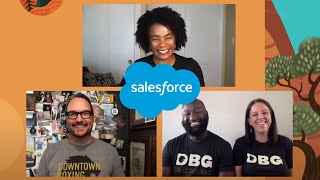
Transcript of a Salesforce 'Leading Through Change' live conversation (hosts Leah McGowan Hare and Sam Allen) with Callie (Kali) Sweeney and Jessica Hauser of Downtown Boxing Gym (Detroit). Covers the gym’s origin story, mission ('Books before boxing'), 100% high-school graduation rate since 2007, community impact, COVID-19 adaptations (cohorts, sanitation, screening, full-day support for distance learning), organizational growth and plans to scale, and how DBG uses Salesforce Community Cloud (V2MOM, dashboards, groups) to engage the board and track fundraising and tasks.
Questions this video answers
Since 2007.
27,000 square feet.
Just over 150 students.
Over 1,300 students on the waiting list.
250 students.
Chapters
The Downtown Boxing gym. If you hear the name, you might think they're just a gym. But they are so much more than that. Books before boxing is their motto, and that says it all. What Colleen Sweeney and Jessica Hauser have built in Detroit is so much more than boxing. It's about putting education first, providing support and prioritizing the next generation. Creating a safe space, leading a purpose driven life, building community. And when all of that is put to the test in a global pandemic, how do you find ways to overcome? Because sometimes we know you have to take three steps back in order to go five steps forward. And after all, what is boxing all about if not getting back up once you've been knocked down? Good morning, I'm Leah McGowan Hare. And welcome to another one of our live weekly conversations as part of our Leading Through Change series, a chance for you to hear from leaders across the world on how they are navigating these challenging times. Now, I want to preview the next hour. Sam Allen, the chief operating officer of salesforce.org will be speaking with Kali Sweeney and Jessica Hauser, who run the downtown boxing gym in Detroit. Now prepare yourself. If you haven't heard this gym story, you are going to be so inspired and you don't want to miss it. See, since 2007, this gym has been teaching kids in Detroit's toughest neighborhoods valuable life lessons from the classroom to the boxing ring. Now, after that, Jessica will share how the downtown boxing gym uses Salesforce's V2MOM framework to create their vision, values, methods, obstacles and measurements to drive alignment in their organization. And how her board members leverage analytics to track and engage donors, all within community cloud. And since today is all about Detroit, we will conclude with a special appearance by Mayor Hawthorne. And as we do every week on this show, we're always looking for ways to help others. So if you hear. No. When you hear the story of the downtown boxing gym, you're going to want to support. So we want to give you that opportunity. You can go to give.classy.org DBG to donate. Again, that link is give.classy.org DBg now, before I hand it over to Sam for a conversation with Kali and Jessica, let's take a look at what the downtown boxing gym is all about in this film.
Sam.
Unleashing the superhero inside of you. Man, I love that line. I'm going to use that for my kids. And that's what the downtown Boxing gym does. So now it's my pleasure to introduce the chief operating officer of salesforce.org, sam Allen to lead us in a conversation with these amazing leaders of the downtown boxing gym. Morning, Sam.
Good morning, Leah. Thank you for that introduction. I gotta say, the toughest job at Salesforce is following you in anything. Your energy is just amazing. So hello everyone and thank you for being here. As you saw in that short film, the downtown Boston Gym Detroit is really one of a kind. It's a very special organization that stems from the vision of two just absolutely amazing leaders, Callie Sweeney and Jessica Hauser. I first met DBG a couple of years ago when I was in Detroit doing some pro bono business consulting. And I was instantly blown away by the long term success of the org, which we'll talk about in a moment. And more importantly, I was absolutely inspired by Callie's steadfast devotion to his core values. So, Callie and Jessica, thanks so much for joining us today. We last spoke in Las Vegas back in January at the Consumer Electronics Show. And my Lord, has the world changed since then. So it's wonderful to have you here.
Great to be here.
So let's just dive right in. Callie, it would be great for you to take a couple of minutes and just walk us through your personal journey. And what led you to starting the gym?
What led me to start in the gym was the fact that I seen a lot of the same stuff in situations that I went through. I seen it still existing in our community. There was still no resources in our community. There was nobody there stepping up to actually lead these young men and women in the right direction. Myself personally, I went to Detroit Public Schools and I never learned how to read and write. I mean, bottom line, I never learned to read and write in school. From about the third grade, I realized that I had a problem. And instead of somebody telling me, let's see if we can fix this problem, they just told me. I was like, I was destined for prison or early grave. And they created a narrative for me and I kind of believed it. So I lived my life as if I was going to be dead or in jail before I was 21. And at some point in time, I just gave up on school. It was like in my 12th grade year, I believe. And I had a report card with all good grades. And I was like, impossible. I can't even read. I don't even know who. I don't even know the teachers because I was so embarrassed. I wouldn't go to the classroom. It got that bad. And so I got the report card and I said, man, you know what? I'm just Gonna try and do something else. I got out here and just started roaming the streets. Ended up in a gang culture, Joined a gang and became. Since I had nothing to live for, I didn't care about living or dying. I just kept going with it. And I watched a lot of my friends die early death and go to prison. And one day, my brother, he pulled me to the side and he said, man, listen, you do know the rest of the world don't live like this, right? I'm like, what do you mean? He's like, no resources, death and destruction all around. No anything to live for. And I was like, no, this is all I know. He said, the world is bigger than your four blocks. And he showed me a picture. He said, this is all your friends. And he pointed at him. He's just like, he's dead, he's dead. He's in jail. He's in jail.
He's dead.
Don't be the next guy in this picture. So I had a chance to really sit down and think about what it is that I really want to do with my life. The only thing that kept coming back to me is, I bet your life would be a lot easier if I had. If I knew how to read. And so I made it my mission to learn how to read. I went back to school, and I sat through some of the most embarrassing classes that I can ever go through because I couldn't really keep up. And the guy saw the potential in me. He said, stick with it. Go to another classroom. And then they slowed it down for me. And from that point, I never looked back. I got a job. I changed my life. And one day I was at my job and was like, okay, I've made it to where I want to be, but there's countless other people who haven't made, people who haven't made it to where they want to be. There's just so many kids out there that I see them going through the same things, deflecting and doing all the bad behavior that I used to do. So I was like, you know, this job is cool, but I quit. I quit the job. I found a place, and I said, how can I get to these kids? I noticed that they liked when I was teaching my son how to box. So I said, that's going to be the key to get the kids attention in an hour play. You can find out more about a person in an hour play than you can a lifetime of questioning. So what I did was I said, let's see what this hour play looked like. So we did the boxing. And more and more kids would just join in and join in, and more parents would bring their kids to me and I would have conversations with them. I asked them how your grades are, what do you plan on doing with your life? Where do you see yourself for the next five years? And so we developed a bond and people started trusting me. They started bringing more and more kids. So I found a spot and I rented the spot out and had some hard times. I ended up homeless. I ended up losing everything to try to keep the place going. Once I had overhead, it wasn't like we were doing it in the park. Once I had overhead, it became real hard. And from there I lost everything. I kept everything into the building. And Jessica came along at the end of it, right. We're at the edge of the cliff. And she came in and she made it into a non profit. And we've been going since then. 100% graduation rate.
Yeah, that's an amazing story. And I'll be honest with you. One of the things that blew me away when we first met was the fact that since 2007, 100% of your kids are graduating from high school. And it's not just that they're graduating because they're getting pushed to the system and having good grades, even though they can't read or write. Your program ensures that these kids are getting the education they deserve. Jessica, good segue. Why don't you tell us a little bit about how you met the gym and got involved?
Yeah, it was a total fluke. I had no idea that there was this incredible program being run. I just wanted to. I like, I don't box, don't ever hit me, but I like to do the workout. And so friend of mine said, why don't you go. I know this gym. Why don't you go down there and train? The owner of the gym could use a few extra bucks. And so I went down there and walked through the doors. And at the time, I was in graduate school studying international children's rights on the political side of the house. And so I'd seen a lot of after school programs. I walked through the doors thinking I was just going to a boxing gym and was just instantly struck by the passion, you know, kids of, you know, 8 to 18, all genuinely interacting with each other, laughing and joking. You could just feel it. And I was like, who is this? You know, who is Kali? What is happening? And, you know, when the mission. I'm not the mission. So when the kids are there, it's not going to stop and talk to me. So I just followed him around for two or three hours. Who are you? What is this place? What is happening? You know, And I saw adults genuinely interacting with kids to go do your homework, and a kid would go do their homework. You know, stuff that I just. You don't see that often. And at the end of that experience, I didn't actually work out. Kali said, you know, well, I'm glad that you're interested, what's happening, but I just got done telling the parents that I have to close. He was going to close, work three jobs, save up a bunch of money with the hope of reopening. And I like, hey, I don't know how to do this, but this place cannot close. It cannot close. And so I asked if I could get involved. And I still have no idea how we trusted a random stranger off the street with his, you know, his heart and soul, but I have never left. And so I just jumped in and started trying to build out as much of a solid foundation around the passion and the mission as possible over the last 10, almost 11 years.
Well, I can be honest with you. I get to know you a little bit. You are definitely an authentic person and easy to trust. So I can see how Kelly did that. You know, the times I've been in the gym, I'm also blown away by the love and the community. It is quite, quite amazing. So, Callie, maybe take a minute and talk about what the message is of these kids. I know some of these kids are probably like, I don't need you. I don't need this. You know, they were like, you. I'm going to figure this out on my own. What is your message to the kids and more importantly, what family they have about why it's important to come to the gym?
The message is just simple and plain. You know, we try to get them access to the resources that they might not necessarily have. And when I tell them, I tell them my life experience. I give them my testimony. I tell them, like, you know, from my point of view, what happened to me not being able to read right, not being able to read a menu and ordering the wrong thing off the menu, knowing that you don't even like it, but you just can't read it. And I told him, like, you know, it's better, you know, that you have a problem before anybody else knows that you have a problem. So now the next step is to, you know, don't follow somebody else's narrative. Create your own path and take. Make positive choices. Because I made A lot of wrong choices. And I just give them my testimony. I don't hold anything back. I tell them the truth. And I. I made a lot of mistakes, and I watched a lot of my friends make mistakes. And to use the resources that they have now and use those young legs and don't try to use them once you 40 years old because you can't catch up, then once you're 40 years old, it's real hard. So I try to tell them to do it right now and make the plans for the future. And that's just. Future planning is like the most important thing. And education is the key to mostly everything that you want in this life. Education is the most important thing to me. And I tell that to the kids all the time.
And just to jump in on that, one of my favorite messages that he gives to all of the staff is, you know, he says, I don't see bad kids. I just, you know, so we don't see bad kids. We just see kids that haven't been heard yet. I think the essence of that is super powerful.
Yeah.
Because a lot of times it's just, you know, people deflect, you know, in those situations. And a lot of kids were doing the same thing. And I could see it a mile away. When you deflect it, when you have a problem, you just ask the kid, you know, like, what's the real core problem? What's the problem at the end of the day? What's really causing all of this? And we just have conversations, so we just have open dialogue with the young men and women.
That's awesome. So, Jessica, talk to us a little bit about how much the gym has changed in the last 13 years and the change you've gone through. Because it is a really impressive. When you go there, the facility and the program and the parents and the drivers and everybody else. But I know it didn't start that way. So maybe talk a little bit about that.
Yeah, I'll say. The thing I'm most proud of is the core and the heartbeat of the mission has not changed. What has changed is the access to resources. What has changed is that we don't have a building with a roof that pours water every time it rains outside. So, you know. Yes. When Kylie first started, the building was in a 4,000 square foot, tiny old car wash that did not even have enough space for the 65 kids that were in it. We knew we needed to have a new building. We knew we needed a way to get kids to and from the program. Unfortunately, our Public transportation is not where it should be in the city. So if parents don't have a vehicle, there's really no other safe way for kids to get to, to and from a program. We knew we needed food, kids were starving and we needed really solid paid academic staff that could support our kids. And so over the last 13 years we have been chipping away at every one of those things. About five years ago, we moved into a 27,000 square foot building. We have just over 150 kids in the program now. We still have over 1300 kids on our waiting list. Pre Covid our goal was to get to 250 kids by the end of 2020. We now have seven vans. We pick up and drop off our kids from school and home. We have dinner every night or breakfast, lunch and dinner. When kids are with us full days. We have a full time academic staff of six. And then we have additional part time staff that are all paid same with some paid mentors and coaches, which is incredible. And you know, really the goal is for us to be able to replicate that successful model that very well funded school districts have. Right. So it's the social capital that kids are exposed to, the enrichment opportunities that kids are exposed to over and over. Not just one off, but. And so that's the beauty. Our kids are with us five days a week, all year round for years. So we have that opportunity to really find those light bulb moments and grow on and build on them. But a lot more to do. But the resources that we've been able to put in place thus far I think is pretty spectacular.
Yeah, I would agree with that. You mentioned one thing that I want to touch on. When I was there, you mentioned the number of kids that are on the wait list. And I remember looking around the facility and thinking, man, you've got a lot more capacity here. And Callie, remember you walked in the room and I said, hey, why don't you have more kids? Why not go from 150 to 200 to 250? And your response really hit me pretty hard. And you said, I absolutely refuse to compromise. If I, if my graduation rate drops from 100% to 99%, that's a failure. And that kind of blew me away because as a business person I'm thinking, what 99% is great, but with you, 1% means that's one or two or three kids that aren't making it through and you just refuse to compromise that. I think it's an amazing adherence to a value. Talk about that a little bit more and expand on why that's so important to you.
I mean, I would hate for a kid to come to our program and not get the full experience of the program because of overcrowded and they start slipping through the cracks. I mean, we want to scale, but we want to do it the right way. We don't want to have a kid get lost in the shuffle. And, you know, I can't stand to see any kid end up in a bad situation. That's just not something that I'm willing to live with. You know, I just want to try and reach every kid and do it the way that we've been doing it for the past going on.
Thirteen years.
Thirteen years. I don't want a kid to miss that opportunity just because we're trying to grow so fast. I want to do it the right way. This is super important to me because, to be totally honest, I mean, the county morgue is right around the corner from the jump. It's not too far from there. And that place stays open all day long. The county jail stays open all day long. The county jail is on the other end of it, which is south, and the county morgue is on the north, going to the north of the gym. And those places stay open 24 hours and they constantly packing people in there. You know, a kid that can't read or write, he's going to end up in a bad situation. So I want every kid to have the full experience of being in the gym, have that support, get those resources that they might not necessarily come by. It might just be something that's just having somebody take that one on one time with them. And I just don't want to see that happen.
It's an amazing adheres to value. I just, I can't compliment you enough on that. Hey, so Jessica, talk maybe for a moment about the impact that you have in the community just above and beyond the kids. And just as an example, one thing that I noted that was amazing was you have the moms who sit at the front desk and check everybody coming in. And those aren't people you want to mess with, by the way. You ain't supposed to be there. You're not going to be there. But maybe talk a little bit too about the overall impact the community that the gym is having.
Yeah. I mean, a message that Kali is always in our ear about is that we have to be expansive. Right. So it's not just about the students, it's about their families. It's about the larger community, our neighbors, and always that we need to always be thinking about every decision we make. How does that impact the larger community? So, yeah, specifically for job openings, whenever we have openings in any position, we send the job posting out to our family group first and see if there's interest, you know, with the families or with their friends or family. And if there is, then we go through that interview process first. If there's not, then we post it in a larger, you know, in a larger way. And so we do have, my gosh, I think about eight of our parents right now are currently employees. We also hire some of our high school students as interns so that they're able to start making some money and have take on a larger responsibility. We have a parent, our own version of a parent booster group so that there is that voice of our families in the mix at all times for the COVID reopening. For everything we've done Covid related, our parent. We've had parental representation every step of the way to make sure that we're aligned. We don't view ourselves in a silo and our families in a separate silo. We are a big family and we treat everything as such.
Yeah, it's one amazing community. And one comment. When I'm there, I love seeing the alumni that come back and just spend time with the kids on their own. Like these college age kids and young twenties that come in is awesome. You mentioned COVID 19. Obviously there's a lot of conversation right now everywhere about going back to school. My kids are going back to school. We're trying to figure that out. That's doubly triple either harder for an organization like yours. How has that been going for you? What have you been doing to get the facility ready for that?
We put all the proper markings down to make sure everybody stays six feet apart. We put dividers up across the tables. We put up all kinds of sanitation stations everywhere. We keep the kids in cohorts of five just in case of anything happen. We can easily trace it back to where it started and everybody's not exposed to it because of the number of kids that we have. We don't intermix the kids. We offset the days that they come into the facility. We've doubled our cleaning. Instead of just cleaning once a day, we clean almost hourly. We have checks. We have the screening process before you get in the van. We have a screening process before you come in the building. And if you leave out the building, you have to be screened again. We try to offset the days. We're just trying to keep everything as clean as possible.
Yeah, I'll add to that a little bit. As I said, you know, we've been staying really close with our parents. And so one big need from our parents was to have a safe space for kids to come during the day. So typically during the summertime, we'd be open full days. Kids would be with us from 10 in the morning till 7 at night. And, you know, so we had gone 100% virtual when we were mandated to do so. But as soon as we could safely reopen, we did. And we will, looking ahead into the fall, remain open full days based on the needs of the parents, as long as we safely can do that. Also, super proud. We had some really great creative folks help us with signage and some, you know, reopening documents that were very kid friendly. And I'll tell you what, that has worked remarkably because there's buy in, it's not punitive, there's buy in from all levels that this is just something we have to do and deal with as a community and we will get through it as safe as possible. But, you know, but it's important that kids have a safe space to go with parental supervision because most of our parents have to go back to work in person. They don't have the luxury of being able to work virtually.
Yeah, wonderful job with all of that. So, Callie, what's next for dbg? What are you thinking about for this next coming year? And a little bit after that.
Mostly just getting back open. Just getting, getting the gym back open. Having four days to make sure the kids don't have any slippage. You know, they come so far. We've got them up to grade or two grades above, you know, from where they were at or just bought them, brought them up to speed. We don't want the kids to slide back. That's the worst thing in the world. So I'm just looking forward to getting the gym back up and running in full force, taking care of the kids through the full day. And as far as in the future, we still plan on scaling. We still plan on, but we want to be able to do it the right way. So that's what I'm looking forward to in the future. Maybe come to your town to help you guys out.
Yeah, we would love to. You know, I think if we could rubber stamp and mirror that organization in every major city, it would be an amazing success. I still personally believe that's a mission we should think about long, long term, because it's so, so important. Maybe the last question, Jessica, how are you thinking about the future and what's next for dbg?
Yeah, I mean, exactly the same. Right. It's ramping back up for what we provide for the students in the fall. So we do a ton of academic intervention for the summer. That will continue. But fall, there's additional layers of relationships with the schools and, you know, having that dialogue to make sure kids are fully supported. So it's, you know, right now a big hurdle is like, getting all of our plans in place and functioning in a way that is fully supporting our families, who are almost all going to be virtual come fall, and supporting the teachers of our students to make sure that, you know, we're playing our part. And then as soon as we safely can get back to adding more students into the program and looking ahead down the road again, we're all in coming.
To a city near you.
Yeah. And look, I'm looking forward to helping on that journey. So, listen, I appreciate that dialogue. What I'd love to do now is bring my amazing colleague Leah back into the picture. I think she's going to run some Q and A from the audience.
Yeah, we have a few questions, but if you don't mind, Sam, before we go to the Q and A, can I just say, Kali, I want to thank first your brother for helping you have a bigger vision for yourself because that therefore impacted you and how you're impacting the kids. So one, thank you for sharing your story. I think oftentimes people don't realize how empowering their own story is. They feel like in order for me to give back or have impact, I got to have all these things. And there's so much power in just your story. And the fact that you just shared that you opened this show with, that was so moving to me and seeing how you are taking that to empower others to give back. And that is the cycle of the world that I believe in. Like, we all have a story to share that inspires other people to shine their light. And that's what your brother did. That's what you're doing. That's what you are doing, Jessica. So I'm just super inspired by your story. I'm like, I need to do more. I already told Jessica I'm coming to the gym and we're going to run a whole trailhead class. That's what we're going to do. We're going to do that. Thank you. Yes, we do have questions. So from Jill on the live stream says for downtown boxing gym, your gym does amazing work for kids, education and health how do you. Do you have programs in place, like workforce development programs for the parents to help educate them as well? Because we know sometimes when you just change the child and not the parents, there can be struggles. But when you lift the whole family, it's the impact, it has longevity.
Yeah. So our approach is not as direct with the parents, and that is on purpose. And that was something that I was able to really witness with Kali, with a lot of our parents, is that from his experience, is that, you know, if you, like, come at somebody often, especially once they're already older and feel like, you know, this is my path and this is what I'm doing, sometimes you can have get some resistance. And so instead of that, it's, you know, bringing people into the fold, having parents be coaches so that, you know, they're infused then with the values of the organization and they feel safe and then can open up and have dialogues and then, you know, and then you can explore opportunities to support them from that place. And we've seen great success. We've had parents go back to. Go back to school and get their GED and then go to college with their, you know, with their child that graduated from our program. We've connected parents to other job opportunities. So we do it, but in a. In a more natural, informal, informal way.
Great, great. That's really impressive. And I heard that you're talking about how you have hired some of the parents there as well at the front desk, because there's nothing stronger than a mama stopping people from coming in, you.
Know.
Protecting our kids. You know, I'm a mama bear. I know how that is. All right, from Doug on the live stream. Also, for downtown boxing gym, as kids are going back to school, how do you plan on providing support for distant learning? Because you said that you're going to be open all day now during the school year. So is that going to be in support of the distance learning, too?
Yep. That is why we're going to be open full days. So we have a schedule set up that's going to be aligned with the various student schedules. And so, you know, the time they have synchronous learning, they'll be on, you know, our WI fi, leveraging technology that we've provided for the student to be able to be. Be part of their classroom. And then we'll have our teaching staff, you know, there's blocks of time where they'll do help them with their homework, help continue the intervention that we're providing. And then there'll also be some, you know, enrichment added into that and physical fitness added into that and then and meals as well. So they'll be there full day, just like a school day with a little DBG spin on it.
I love that the learning happens there because also in the gym, one of my biggest concerns with distance learning and I have to also infuse in my children's schedule is physical activity, because you can literally find yourself sitting all day. So right there at the gym. That's so perfect. This next question is for you, Sam from Chelsea. As so many schools are defaulting to distance learning, how is salesforce.org helping to support schools and students, especially in underserved communities, to have access to technology to be able to continue learning?
That's a great question. Thanks for that. So a couple of things. One, we just did a $20 million grant to several public school systems in the U.S. new York, open, unified San Francisco, and some others to help drive better access to technology. We're also leveraging the work.com going back to work solutions that we've created for businesses. We're just turning those around and making them ready for educational systems. And we are delivering those services to, you know, not only K through 12, but also higher ed institutions at either for free or a very, very steep discount because, you know, we're all parents, too. We all believe in the educational system. And so it's a huge push for Salesforce in general. Salesforce.org is to help our communities get back to school and have a full suite of products that can help schools manage these things. As, you know, the, you know, the, especially in the US this thing is impacting communities differently. And there are some schools where kids are going back to school physically. My kids aren't going back. I'm in California. They're virtual. So different school systems see different capabilities and we're providing that.
Yes. Great. And I have a question for a downtown boxing gym. You all are so much more than boxing, but do you have just a membership program where people just want to come join to work out and get fit?
No. No.
You're like, you got, we're more than that. You got to come be part of the whole community.
It's strictly for the youth. We want to get them young before they, before they make any poor choices in life. We want to give them much education, I mean, much information, positive information as possible at a young age, get them access to technology, give them, you know, we don't have time to do a fitness class right now. We're trying to get these kids ready.
For the world I love it. I love it. And I loved how Jessica opened up the story that she just came there and started following you around, Kali, and she just never left. So she still. She's still following you around, and she's determined to. I love that everybody needs a Jessica in their life. I'm just saying. What a gift. What a gift. Well, thank you. That's what we have for Q and A, Sam. So I appreciate you taking the time to talk to us and just sharing your story. I do have a question. What is one of the most memorable stories out of downtown boxing gym that you can think of? Kali. And then you, Jessica, most memorable could be one of your students, could be a parent, could be somebody in your community.
I mean, every.
Every time I come in there, there's a memorable moment almost every day, you know. You know, you got kids who. Who the system have given up on, and now those kids are honor students, you know, and kids who they say would never make it through school. And those kids graduate from school or if a kid just learn how to do math every those days. I remember those days, and I hold them dear to my heart because those are the things that I did, learning how to read or learning how to do math and stuff like that. And those things, they really change your life. And when I see kids do that or they get something where it clicks or a young man or young lady comes back and they spread that knowledge to the next generation, all those days are memorable to me. So I love it. I'm loving every minute of it.
Awesome. What about you, Jessica?
Yeah, I mean, I second everything Kali just said. I really can't say much different. I'll say for myself, personally, really the most memorable thing is just how much I've learned about, you know, that it's not the child that is. That is. That has the problem that it's, you know, as adults, we are failing kids all over this country, and it's up to us to really step up and step in and make it right. And I'll say that has been the greatest gift that I've, you know, is just to have my eyes open to what is really going on and being able to make some impact on that.
Yeah. And I love that when you said earlier about that children are not bad. Right. You don't want to label children that because then that's what they will live up to. Right. Oh, I'm bad. So I'm just going to be bad. That's what you said. I am. So the behaviors that they might be doing are not in the best are going to serve them well or their community well. But you want to definitely distance the behavior from the person and give them space to create who they are and let them be the greatness that's within them and not these labels that are put on us regularly. So I think it's so very important that when you lead and you're leading an organization from that perspective, that is the impact. Right? And that is your mission and driving that. These are untapped potentials. These are unshined diamonds. These are great geniuses that need a space where they can be able to create and find themselves. So I loved that you said that earlier because I think that's so important. That's a narrative we have to change. Even as parents, when you're upset with your kid, you have to be mindful of the language you use because they absorb it and take it all on.
Hey, Leah, can I add my own personal story, my favorite memory, and then just one more comment back to the question about what Salesforce is doing. I was remiss if you can go to salesforce.com's blog or salesforce.org's blog and see all about our announcements and what we're doing for education. So when I was in DBZ the first time, you know, we were doing a lot of this pro bono consulting. We felt pretty good about ourselves. We sat down and tackled all the problems that Jessica and Callie laid out for us. And I remember Callie spa a little bit. He comes in the room, he's like, what y' all come up with? And we talked to him about it, and he says, you guys pretty satisfied, huh? Like, yeah. And he says, you know, you're gonna go home to your hotel tonight. It's probably a four star hotel. You're gonna have a steak and you're getting on your plane and fly back to San Francisco. You know what? You're just one more adult who's abandoned these kids. And that was very powerful to me. And it changed me and how I think about my place in the world and what I need to do to help. And so, you know, the mission you guys have is so beyond tremendous. And everything you're doing is amazing. And, you know, whatever I can do to continue to help you in your mission, you know, you can count on me.
Thanks a lot. Thank you.
I appreciate it.
Completely agree. Thank you. Thank you both, Kali and Jessica, and it was so great to hear from you both. And like I said, I'm just leaving. Whenever I hear these different stories, I leave inspired Figuring out what more can I do? What more can I do? Am I fully using my platform? Am I fully utilizing my resources to make an impact? So I thank you for inspiring myself, but we're not done with you. Jessica. I'm excited to learn more about how you in downtown boxing gym are leveraging Community Cloud. The floor is yours.
All right, thank you, Leah. Yeah. So I think you guys have all figured out we are a growing organization with lots of needs and lots of demand on everyone's time. We have an incredible board of directors who are also very busy, and we were trying to figure out a way to get them clear, concise, transparent information that would be right at their fingertips whenever they needed it. And thankfully, several of our board members actually use Salesforce and love it. And they came to us with a proposal because we had been implementing Salesforce, the fundraising side. They came to us with a proposal of implementing the community cloud. We dug into it a little bit and were totally blown away that one tool could really solve and answer so many of the pain points that we were facing and that the board was facing. And so we jumped in and have loved it and are still like totally shocked at how amazing it is. So I'm going to walk you through the power of the tool as if I'm Rakesh, our board chair, and show you how the community puts everything in one place, which really allows him and the rest of the board to align vision and fundraising subcommittee collaboration and track his own tasks. So we lead with our mission and heart and want to reinforce that message every time our board members log in. Here you can see our vision and values that carry through everything we do. As I mentioned, time with our board members is rare and valuable, so the community really supports collaboration through groups and chatter posts. The homepage provides a bird's eye view of what's happening. It's a single place for a quick check in where board members can post comments, see what records have been changed, provide feedback, or just simply stay in touch with one another. Another Salesforce tool we have implemented is the V2 Mom. As mentioned earlier, V2 mom stands for Vision, Values, methods, obstacles and measures. Annually, the organization goes into a strategy session where we create our V2 mom and our board does the same. What comes out of the annual board strategy sessions are board goals. Here you can see Rakesh's V2 mom that the larger board will align with. The beauty of this tool is there is total transparency. We can see what Rakesh is prioritizing and where he is at in the process. We are also able to see how his V2 mom maps the organizational V2 mom. This tool increases accountability and helps us measure what matters. There are quick visuals to understand what's happened over various quarters and to see if things are on track. By looking at the percentage complete or status, Rakesh can easily go in and update goal progress as circumstances change. For example, Rakesh has to hit pause on events because of COVID 19, so he is changing the status from on track to behind schedule Our mission is ambitious to serve on our board. Each board member commits to helping the organization fundraise by giving directly, which we call the give amount, and they also commit to helping get funds, which we call a get amount. The board also commits to tackle a percentage of our annual fundraising goal. It's quite hard to know if you're making a dent on your goals if there's not one space to easily find that information. As a result, we created a dashboard where the board can take one quick look and see where they're at. Target versus Actual. You can see the overall goal percentage, give percentage and get percentage. This speaks to the request for simple, transparent and clear information. Groups are one of our absolute most favorite community features because all the information is in one place and right at Rakesh's fingertips, and it gives DBG staff one space to communicate information to the board members. For some context, each board member serves on a subcommittee. Here Rakesh is clicking into his Community Engagement Subcommittee. Several things to mention. Having a space where they can discuss confidential information was critically important. Each group is private, so the information shared in this space is not visible in other chatter feeds. They can choose how often a summary of group activities are emailed to them so they can use their inbox to stay informed. We can keep private discussions in a group so that all members can see the full thread and participate, not just the ones that happen to be bcc. One of my most favorite benefits of this section is that it truly saves our staff time. Before we had groups, our discussions were scattered in emails or text messages, and there was not an easy way to get new board or committee members up to speed. New board members and DBG staff are now able to bookmark important information and upload important files. When onboarding new members, we are able to direct them to the group and they can easily get up to speed on their own. This saves our staff about one workday for each new board member, which is huge for us. Out of each board meeting or subcommittee meeting comes tasks. Previously we would have just had to hope that our amazing but again very, very busy board members would remember the tasks that they committed to, which, I must say, didn't always happen. Now, before a meeting ends, everyone logs in their tasks and has a simple way to track progress. This allows for accountability and transparency. It also gives DBG staff the tool to support board members fully. If we see a task that is stuck at any stage other than complete, we're able to harass them a little and reach out and see what's needed to move that task along. DBG really is a family, and we truly feel that the communities gives all of us that ability to have each other back, stay focused on what matters most, and just, you know, communicate as efficiently as possible. So thank you so much for this opportunity for allowing me to share that experience with you.
Thank you, Jessica, for that amazing demo and thank you, Sam, for facilitating such an amazing conversation and inspirational conversation with Kali and Jessica. Thank you both. Now, before we go on to our next awesome guest, Major Mayor Hawthorne, for a performance, those of you watching on Twitter, you're going to need to switch over, so come on over now to Salesforce Live so you don't miss it. That link is salesforce.com live again, salesforce.com live. I'll see you there. We'll be waiting for you.









