Brain Health and Resilience: Plum Village Monastics | Salesforce
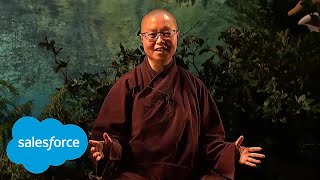
Transcript of a Plum Village monastics' presentation at Dreamforce on brain health and resilience (video titled "Brain Health and Resilience: Plum Village Monastics | Salesforce"). The session opens with a guided breathing/body-awareness meditation led by Sister Lang Nim and others, then presents three practical trainings for cultivating brain health and resilience: (1) stopping/returning to the present via mindful breathing and body awareness, (2) intentionally generating small moments of joy, and (3) learning to recognize, breathe with, and look deeply into painful emotions rather than pushing them away. The talk emphasizes interpersonal practices and mantras ("I am here for you," "I know you are there and I'm so happy," "I know you suffer and I want you to know I'm here for you," and "I suffer, please help"), frames resilience as both individual and collective, and closes with invitations to Plum Village practice and the Plum Village app.
Chapters
It. So, dear friends, welcome to this moment, the present moment. In Plum Village, we like to say we practice coming back to the country of the present moment just by being aware of our breath, being aware of our body. So, just as we heard already this morning, we invite you to come back to your breathing and be aware of your body just as it is. We'll start with a short guided meditation. I'm Brother Stream, Brother Phap Lu, my sister, Sister Lang Nim. It means the March of Heroes. And Sister Quin Nim, Sister Jem will offer a guided meditation for us to come back to the present moment and enjoy all the conditions of happiness that are here and now.
I would like to invite all of you to gently close your eyes. We will come back to the present moment and enjoy listening to one sound of the bell. To begin our session, I invite all of you to sit upright with good intention. Sit in such a way that you feel relaxed and stable. You can be aware of your breathing. Notice the air coming in and leaving from your nose. Be aware of your whole body sitting and allow all the muscles in your body to relax, releasing any tension or anxiety. Breathing in, I am aware that I am breathing in. Breathing out, I am aware that I am breathing out. In out. Breathing in, I give full attention to my in breath. Arriving with my in breath. Breathing out, I give full attention to my out breath. Feeling at home with my out breath. Arriving with my in breath. Feeling at home with my out breath. Breathing in, I feel the quality of my in breath. It may be short or long, light or deep. Breathing out, I feel the quality of my out breath. It may be shorter or longer than the in breath. I simply note the breath as it is quality of in breath. Quality of out breath. Breathing in, I am aware of my whole body. I feel the sensations on my face, my neck, my shoulders, my upper back, lower back, my thighs, my two knees, my feet, my toes, my arms, my hands. Breathing out, I relax my whole body. Aware of body relaxing body. Breathing in, I feel I am arriving fully present in my body. A half smile blooms on my lips as I release the muscles on my face and relax the tension in my forehead. Breathing out, I feel fully present in my body. Feeling at ease and at peace in my body. Fully present, at ease and at peace in my body. Breathing in, I feel joy to be alive in this moment. Like the beautiful sunrise over the horizon, radiating light in all directions, a source of life on earth. In the same way, I allow joy born from the awareness of my in breath, allowing this joy to permeate the whole of my body present everywhere. Breathing out, I smile to life, to the wonders of life in me and around me. Joy to be alive. Smiling. Continue to maintain awareness of your in breath and your out breath as we listen to two sounds of bell to end our session.
Sam. So good. Good morning, everyone. Thank you for coming this morning and expressing your interest in brain health and resilience. I guess that's the. The topic that we were asked to share with you about this morning. Actually, to prepare for this, we wanted to find out who was speaking before us. So we've been in the green room listening to the wonderful talks by Deepak and Deepak Chopra, Kat Graham and Emilia Clark. And actually, when I found out that we were speaking after Emilia Clarke, I asked my family, my blood family. Well, I'm speaking after this person. Do you know who she is? And I got this text that made me kind of concerned my brother. So my brother texted me and he said, oh, you're speaking after the. After the Mother of Dragons. You guys are so done. So I don't know how done we are, sitting up here speaking after the Mother of Dragons. I got to find out a little bit about the Mother of Dragons yesterday and today. It was very nice to listen to her share from this TV Persona, I guess, and listening to her share about some of her real challenges and suffering, how she was able to overcome. And that was very inspiring for me because it was a very real and lived experience. And so in speaking about brain health and resilience or sharing to you about brain health and resilience today, we just wanted to be able to offer you some things that you can really take home to your daily life and see if it could become a real lived experience for you, because we can. We have. There's so much science around brain health and resilience. There's a lot of information that you can read about, even mindfulness or awareness or consciousness. But what's important to us is to be able to touch it in our daily lives. So today, for. For my part, I would just like to share with you three ways, three things that we can do to help with. To help cultivate our brain health and resilience. And the first element, the first thing I would like to share about is what we call stopping, or the ability to come back to the present moment. And I see that we hear this expression a lot all the time right now in our. In the media or. Yeah, mindfulness is quite a big word now, and you get exposed to it quite a lot. In our monastery we have a bell, and one of the bells I have in the office that I work in, every hour, there's a bird sound. So when I heard the sound of the bird, it's a training for us to just come back to our breathing and stop what we're doing. And it was very automatic, whatever that bird sound was. And this is a part of our training because every single day, especially being here in San Francisco, I really recognize there's so much information that you can receive just by walking down the street. There's a lot of stimulus, just people's faces, the sounds, the traffic. And you can really feel the busyness of people. And in your pores, you know, you can feel the pace, the rush of our society. You can really experience this on a very real and visceral level just by walking down the street. So we have to be able to have some ways in order for us to kind of protect ourselves and also to be able to enjoy this without feeling like we are just being carried away by the energies of the majority, by the rushing of the majority, by the emotions of the majority. And so one of the very concrete ways in which we can help to bring our minds back to the present moment is by doing something that we have just all experienced together, which is mindful breathing. Simply coming back to our breathing and being aware of our breathing is a very powerful way in order for us to come back to the present moment. Because the very thing that prevents us from being aware of the present moment is our thinking, our thoughts about the past or the future, our worries, our anxieties, our perceptions. And it's very active up here. And, you know, I'm just making this gesture right now because we have the impression that our thoughts are coming from the brain. But who knows? A few thousand years ago, we thought the brain was here. Sorry, we thought the brain was here. Now we're thinking the brain is here. And I have no idea in a couple thousand years where consciousness or thinking will be located. But for now, in our time, it's here. So very often, the very thing that prevents us from really living in the present moment is our thinking. So we have to be able to have a way in order to calm our thinking. So the most powerful means that we have at hand, and every one of us, we breathe every single day, every moment. So it's always at hand, this breathing, and we can always come back to it in order to calm the thinking. And just as an experiment to see how powerful this tool that you have at hand is, you can imagine an Apple with legs. You can close your eyes for a moment and just imagine an apple and it has legs. Maybe an animated apple is running, and there's a dog chasing after this apple. So it's a very vivid image in your mind. You can play with this image for a little bit. You can hear the dog barking or the apple screaming. And now take a moment and just really feel the breath coming in and out of your body. Just really feel as the in breath goes in. Feel the breath entering your nostrils, expanding your chest, going down, expanding further your abdomen. And then you feel the out breath. Just feel as the breath releases from your body, this cool coming in and a bit warmer as it exits your body, just for a few breaths. You just come back and you feel the breathing. Wonderful. You can open your eyes now. Can I ask what happened to the apple and the dog? Yeah, you probably didn't pay attention to it anymore. And so anytime throughout the day, when you feel your thinking is really carrying you deeper into your worries or your anxieties, deeper into your fears, you can always take a moment to come back to your breathing. And in this few moments of just breathing, you calm your fear, you calm your thinking, you calm your anxiety, and you have a few moments where you restore clarity. And it's very important for us to be able to do this, especially in our society right now, when it's so easy to be carried away by the fears of the majority, the thinking of the majority, because we're also very connected through social media, through many different ways. With globalization, it's so easy for us to be more and more connected and to be more easily with that connection, we also become more easily carried away by the emotions of the majority, by the fears and anxieties of the majority. And so it's very important to be able to come back and to restore some kind of clarity within ourselves, because the actions that we want to take in our daily life, we want to base it on clarity and not on fear or anxiety. And so a very important training for mental health is this ability to be able to just come back and to be in the present moment, to be able to calm our mind through the breathing. And when we say to come back and be in the present moment, what we mean is to be aware of what's going on. So you've heard of the word mindfulness, and mindfulness is always mindfulness about something. It's not an energy that exists by itself alone. So mindfulness always has an object. So when we say we're mindful, it doesn't make sense. You can say I'm mindful of my breathing or I'm mindful of drinking tea, I'm mindful of walking. You cannot just say, oh, I'm mindful. You know, the monks and nuns will look at you funny. What are you talking about? So mindfulness is always mindfulness of something. And like I said, the very thing that prevents us from being mindful is our thinking, our dispersion. So when we are able to bring the mind home to the body by our breathing, just coming back to where the body is, by coming back to a few in breaths and out breaths, we start to notice what's going on in the present moment, what's going on in our body. There may be tension in your body. So when you stop the thinking and come back, okay, now I'm mindful of my breathing. And then you start noticing things, maybe you notice that it's wonderful to be alive. I'm still alive, I'm still breathing. That's an insight we can get by coming back to our breathing. We may also notice that when we come back to ourselves, bringing the body home to the mind, bringing the mind home to the body, it goes both ways. Bringing the mind home to the body, we can start noticing what's going on in our body. And for many of us in our society now, maybe we have gotten used to abandoning our bodies because we're so easily distracted by so many devices around us. Sitting in front of a computer for hours, or when we work, physical labor, etc. It's so easy for us to forget our body, forget that we even have a body. Maybe as you're sitting here listening to me for a few moments, you've forgotten that you have a body. So just take a moment now to come back to your body, see how your posture is, see how your body is feeling at this moment. It's very important for us to learn how to come back to our body and to take care of our body. So when we come back to our breathing, notice our body, there may be tensions and we have to be able to know how to release the tensions in our body. Maybe you've been in front of the computer for two hours, so it's time to stand up and stretch. These are very basic self care routines that we in terms of brain health and resilience that we have to be able to incorporate into our daily lives. And it's not just something we think about or we talk about, but we have to do. Just standing up, moving around, stretching for a few minutes, getting more Blood to your brain. Very helpful. And not only that, you release the tension that's there in your body. When the body holds a lot of tension, the mind also tends to hold a lot of tension. Imagine if you are talking with someone, to someone, and you hold a lot of tension in your body, right? Yeah. Your energy is like this, and you can't receive what the other person is saying. You're sending off a very tense energy. The other person is receiving this tense energy, and you cannot receive what the other person is saying. You're actually not. You cannot be present because there's so much tension in your body. So learn how to relax the body, learn how to take care of the body, and come home to the body. And you can do this throughout the day. For me, it's very easy, especially in the monastery, because we have that training of coming back when we hear the sound of the bell or the bird chiming. And so every time I come, the bird sings or I hear the sound of the bell, I take a few moments and I just come back to my breathing and come back to my body and I do a check in. How's my body feeling? So we won the first. So the first thing that I wanted to share about brain health and resilience was the ability to come back to the present moment. And the second thing that has a lot to do with brain health and resilience is to train ourselves in the ability to generate a moment of joy. And all of us, we need to do this. All of us were capable of generating a moment of joy. And if you see, I think on the screen, it says, mindfulness is a source of happiness. So in our tradition, we speak about joy that's born from mindfulness, meaning some of the things that we have just done already touches on some seeds of joy, like simply coming back to the body and being aware that we have a body that in itself is already a source of joy. Let alone there are so many things that happen in our day that can be a source of joy. And all we have to do is be able to recognize it. And by recognizing, then we immediately generate a moment of joy, a moment of happiness. Happiness doesn't have to be big. Joy doesn't have to be big. It could just be the awareness that I still have hair or I don't have hair. That's a source of joy for me. Right now when I go like this, it's like, ah, I don't have hair anymore. So then automatically I feel some. Instantly I feel some joy because I don't have to think about hairstyles or, you know, shampoo or gel or whatever, which I was obsessed with in my 20s, so going like this now, like, I really feel a lot of happiness just not having hair. Although, you know, no judgment on everyone who has hair. It's wonderful to have hair. I see it's also an expression of ourselves, and so that's being able to generate a feeling of joy. We have to be able to learn how to do just by coming back and being aware of what it is that we have. And also you can learn how to smile to yourself. It doesn't matter if there's nothing to be happy about at that moment, that you have nothing on hand that really excites you, or that you feel like it's important, etc. But just to be able to smile when at hand, have your smile ready so that it can provide you joy immediately at hand. That's also very important for us to train. Training each of us, we train in so many different areas. We are getting better and faster at so many different things, more skilled at so many different things. But this is one of the skills that maybe we haven't focused so much on. We focus so much on productivity, but we haven't focused so much on just a very basic capacity as a human being to generate a moment of joy or happiness so that we're not victims of circumstance, we're not victims of. We're not waiting for the happiness to come to us. We're not waiting for the joy to come to us. We can have it immediately just by coming back to ourselves, being aware of what's happening inside and around us. We are from a community of monastics and we also have many lay friends living with us. And I find in our community, or actually it's not so weird when we live in the monastery, but when we go outside, then I see, oh, this is how people are looking at us. Because sometimes, let's say we're walking through a park and there's this tiny flower, very small, and then one brother or sister would look at it in wonder. It's like. And then all of us kind of gather around this tiny flower. But so you see so much joy in this group of people, and it's only over a tiny flower that maybe was growing on a patch of grass in the middle of a city. And to other people, when they look at us, I don't know if they know what's going on. But that's also our capacity to be able to generate joy or happiness or access Joy or happiness over the smallest things in our lives. And each of us, we can do this every single day. We can learn how to recognize what brings us joy and what brings us happiness. It doesn't have to be big. And the third kind of training that I'd like to share with you is to be able to handle a painful feeling or a painful emotion. We can get good at many things, but this is very fundamental to our health and well being. Being able to handle a feeling of a painful feeling or a painful emotion when it arises. So in your daily life, when, Let's say you're at the office or something, you're speaking to someone and it really touches off some irritation in you, you have to be able to handle that irritation. And a very powerful way of handling that is to first of all come back to our breathing. Don't allow yourself to be carried away by your irritation or to be a victim of your own irritation. We can always come back to our breathing and calm down the irritation and then we can look a little bit further to see where that irritation has come from. Very often the irritation that we feel or the painful feeling that we have, or the painful emotion that we have, it comes from our perception of the situation, our perception of ourselves, our perception of our co worker, our perception or our ideas about what's right and wrong, what's beneficial for the team, what's success, what's happiness, etc. So a lot of the painful feelings and emotions that we experience on a day to day to day basis, it has a lot to do with the kinds of perceptions that we have. So we have to be able to first experience that painful feeling, to be able to recognize the painful feeling, whether it's anger or fear. A lot of times for me it may be frustration, not getting my way. So being able to recognize that feeling when it comes up and you can use our mindful breathing to embrace it, just be with it without feeling the need to push it away. For many of us, when fear comes up in us, we have the need to push it away, especially fear. Or when sadness comes up in us, we have the tendency to want it to go away immediately. It's like a crying baby. Sometimes when we hear a baby crying, we have the tendency, we have the desire to want to quiet the baby right away, but the baby needs maybe just a bit of attention. Maybe the baby needs you to hold her or him. The baby needs you to find out what's wrong, what's not going right at the moment. And so we have to be Able to. When a painful feeling comes up, when fear or sadness or anxiety comes up, we have to be able to be with it. Our mindful breathing can help. And we train ourselves not to push it away, not to make it go away right away. Because in our society of kind of instant gratification, we keep wanting things to go right. We keep wanting things to. Yeah, to go right. And it's this exact desire that prevents us from being calm when things don't go right. Also, it's that desire that prevents us from receiving things that are different from what we already know and believe, experiences that are different or that are challenging for us. So this is one way to train our brain health. Being able to take care of a painful feeling or a painful emotion when it comes up first, by recognizing it, breathing with it. Don't push it away, and look deeply into it to see what kind of perceptions are behind this fear and this anxiety. And as soon as we can recognize the kind of like the wrong perceptions that are behind our fear or anxiety, we have a way out. Maybe this fear is based on my idea that if I don't do this, I won't be successful, or if I don't achieve this level, I won't be good enough. And we have a few moments to examine, is this true? Is this perception correct? Does this have anything to do with my reality? Or is it just a wrong perception that I have? So, in training for brain health and resilience, we invite you to try out these three things. First, training yourself to come back to the present moment, really recognizing what is there, what's there. Two, being able to generate a feeling of joy and happiness. And three, training yourselves to handle painful feelings and emotions. And my brother will share a little bit more, more about this. Thank you.
Thank you, Sister. Maybe we can practice that right now to come back to our breathing, generate a feeling of joy. That joy is our freedom. As we listen to a sound of the bell, we can come back to our breathing and see what's going on inside. Practice this interoception. What is going on in our body, going on in our mind. Very interesting. So, as my sister shared, it's quite an experience for us to come out and share in this kind of space. That's why we do it together. So you see all of us up here, although maybe one person is speaking. Actually we are going as a body. A couple days ago, Mark was sharing about why the Plum Village monastics, always the monastics, it's not just one person. And that is part of our practice. To see that we are a whole, one body going together. And as human beings, when we practice to come back to ourselves, to generate joy, to embrace our difficult emotions, we find that we are much more together than we might think we are. In fact, it's our thinking that is dividing us, our thinking that is creating a barrier. So that is why when we experience being in touch with our breath, when we experience being in touch with our body, letting go of the thinking, we actually touch community. We touch our native humanity. And that is why we go into the monastery. It's not because we are looking to have a certain belief or be in a certain religion, or maybe necessarily on a so called spiritual path, but because when we go and we practice and we let go of our thinking, we come back to the present moment, we actually see that we share something very deep and precious in common, something very sacred. Earlier we heard about consciousness. The practice is to see it for yourself. We're not content enough with just reading about it, just hearing that there is a spiritual path, that there is the possibility to wake up, to have a moment of awakening. We want to touch it for ourselves. And that's why we come out here. We want to share that with as many people as possible. Listening to the former President Obama share about the importance of the climate crisis, I felt very moved together with this age of information which is pulling us in so many directions, touching a lot of fear. When I come back to my body and I come back to my breathing, I can establish myself fully in the present moment and notice this fear that comes up when I think about the future, when I think about our children, when I think about our families, when I remember how much joy I had as a child walking through the forest, breathing the air, seeing the squirrels run through the trees, scolding. That deep experience of being in nature, of being in touch with Mother Earth, is something we all want to share with many, many generations to come. All of us in this room, we have a deep desire to be happy, to walk freely on the earth. But in our way of thinking, in our way of dealing with our anger, our fear, our hatred, we often act in ways that make that future a little bit less possible, that free walking in the beautiful forest of Mother Earth. And so it is our deep conviction that as a community, we can create a resistance to that tendency, that tendency which manifests in the collective consciousness, which manifests in our individual consciousness by recognizing our fear, by embracing it. Just as we heard from Amelia, experiencing suffering and realizing how lucky we are to be alive. This is One of the greatest gifts to be made up of this body, this mind made of the supernova of pasta, explosions of many stars, we know in this body we are the universe. And when we are able to put down our thinking, that becomes a lived experience, reality, not just words, a lived experience of awakening. And it's not just an individual experience. Brain resilience is a collective matter. It's not a matter of only individuals. When we come to this event, Dreamforce, and we look around, we can see all of humanity represented in each of us. We carry our ancestors, our ancestors from Africa, our ancestors from Asia, from Europe, from America. We carry in this body, our ancestors, our non human ancestors are something like reptile ancestors or something like a fish ancestors. They are manifesting in us right here and right now, together at Dreamforce. And when we are able to come back to our breathing and let go of our thoughts about who we are, our thoughts about the future, about the past, we actually can see that those ancestors, that stream of ancestors manifesting in this very body, and that is the basis of community. We travel as a community because we feel deeply that happiness is not an individual matter, that if my brother or sister is suffering, then I also am suffering. And that with collective energy of mindfulness, we can really bring about a transformation in the world. That is the deep aspiration of Plum Village, to create communities of people who are breathing, mindfully, walking, mindfully seeing what's going on with the climate for themselves. We don't go around telling facts and figures or trying to tell you to do this or that because we want everyone to see for themselves. We know that we can only do it together. And it takes practice, it takes training. So as my sister said, if we can really put into practice stopping throughout the day, when we're on a busy street, when we're in our workplace, when we're sitting next to our loved one, maybe our child. Many of us will soon go home to visit our families. And when we see a brother or sister or a family member that maybe we haven't seen for a long time, we remind ourselves that we may never see them again. In our mind, we might think, oh, we have many years together into the future to live together. But as we saw from Amelia, sharing, we don't know how much longer this life will be available for us. So are we truly available for life? Are we truly available for our loved one? So we have a mantra that we practice, which is, I am here for you. I am here for you. You don't have to say this mantra. In Sanskrit or Chinese or some foreign language, just, I am here for you. We practice to look our brother or sister in the eye. Our mother, our father. If you like, you can hold their hand. And we let go of our thinking about the past, about the future, all of our fears. We breathe in and out mindfully, and we can look them in the eye without fear. Many of us fear to look each other in the eye. We want to immediately think about something else, do something else. But if we want to deeply touch compassion for. For the other person, we need to learn to overcome that fear, to not be carried away by our anxiety, our worry. Just hold their hand and say, I am here for you. It's very powerful, very magical. It is a mantra that I've used many times with my mother. I practice gratitude every day for my mother who brought me to life, who was there when I first breathed. And I know every time I say goodbye to her, sometimes I might not see her for another year. And I don't know if I will ever see her again in that form. And she will cry. And so I know I want to make the most of that moment. I don't want to get caught in whatever argument we may have had when I was 13 years old, whatever problem might be coming up in our family, in our relationship, but just to practice being there for her, I am here for you. And if you like to go deeper, we have a second mantra, and that is, I know you are there, and I'm so happy. Just like we recognize our difficult emotions, like fear and anger, we need to practice to recognize the presence of our loved ones. We need to practice to recognize the presence of even those who make us suffer, maybe a colleague who is always arguing with us. We feel like they're trying to pull us down, be an obstacle in our career path. If we touch a deep compassion, a deep aspiration to bring about a kind of collective awakening in our workplace, then we have a massive source of energy, a supernova of energy to be able to overcome our fear, our anxiety, and look our colleague in the eye and say, I know you are there, and I'm so happy. Even that colleague who caused us difficulties in the past. And they will be shocked. They'll be so surprised because in them too, there is a fear, there is anxiety about the relationship. Many of you may have heard of this longitudinal study that was done at Harvard. I think it started in 1942 or 43. About 700 men, some at Harvard, some in a very poor area of Boston, who were studied by many researchers. Throughout their whole life until now. Some of those that are still alive are in their 90s. And it's one of the most interesting insights that we have as human beings into what brings about happiness later in life. And the main takeaway from that study is that it is the quality of our relationships which determines our happiness after 50. For those who are able to share what's going on, even their difficulties with their spouse, with their children, those who are able to respond to adverse situations with humor rather than resentment, they have scientifically measurable happier lives when they are 70, when they're 80 years old. And so by learning how to look at that person who is causing us suffering and in our heart generate the energy of mindfulness, I can recognize that this relationship causes me suffering. It may be that I have wrong perceptions about that person. Maybe I misunderstood them. But now I can generate the energy of non fear. I can generate joy and say the words, I know you are there and I'm so happy. And you watch that colleague bloom like a flower, just like the little flower my sister shared about their face becomes a flower. Because all of that energy of resentment, of anxiety in your relationship can suddenly be transformed in an instant. That is a moment of awakening. That is where we get in touch with our collective energy of peace and understanding. And when we see our loved ones suffer, when maybe they don't say anything but they come home and avoid our eyes, maybe you see the way they go into the kitchen and they prepare the meal, there's some nervousness, some anxiety. Then we can find a moment and practice the third mantra, which is I know you suffer and I want you to know that I'm here for you. Compassion is a very powerful energy, as we heard already this morning. When we're able to touch our gratitude for the other person, all that they've done for us in our life, even if we are in a situation of conflict, we can still practice to touch gratitude for the very presence of that person. Somewhere there is some goodness, there is some kindness, some peace, some understanding. And as a practitioner, we know that we know how to generate joy. We know how to take care of a difficult emotion, a painful emotion. And we know that we can extend that capacity out into the world. As Deepak shared earlier, our teacher often talked about inter being. It's not a word that's in the dictionary, but it's an insight when we are able to really get in touch with our breath, let go of our thinking, our story of who we are, even our story of our suffering, which can be Something we get attached to. Then we touch this insight of into being. We see that we are not separate from the other person. We are made of only non us elements. We are made up of the sun, the earth, the rain, our father, our mother. Every cell of our body has all of these non us elements present. And if you take out any of these elements, we cannot be here. We do no longer manifest. And the other person is also made up of non them elements. When you practice that, that is called a concentration of inter. It's not the kind of concentration where you furrow your brow and you try to focus like that. It is the kind of concentration you get when you let go of your ideas, especially your idea of happiness. Our teacher often said, do you want to be number one or do you want to be happy? You have to choose. Unfortunately, many of us choose to be number one. We don't get to be number one. We're not even quite sure what is number one. But we keep running all of our lives. And those loved ones right in front of us who are suffering were unable to look them in the eye and say, I know you are there, I know you suffer and I am here for you. The greatest gift we can offer to those we love to be there, to be present for them when they're suffering. And each one of us has an enormous capacity to do it. But sometimes we forget a little bit. Like we learned this morning, we've just forgotten that we have that innate capacity to understand the other person's suffering, to listen deeply and bring about healing, to bring about transformation, that is creating a community of resistance. We don't want to continue to be isolated. We all here see deeply that we are already intimately connected from way before we entered this auditorium. And that is a source of joy, that is a source of happiness. And by listening deeply to the other person share about their suffering, we already bring about a profound and lasting transformation. Compassion is not only empathizing with the other person, it is bringing about transformation and healing in the suffering of the other person. So that we, when we ourselves are suffering. When we encounter an overwhelming fear about our future, about our future as human beings on this planet, as living beings, we will have someone, a brother or sister who can come to us, who will be at our side. And we can say to them the fourth mantra, the most difficult mantra, which is I suffer, please help. I'm suffering, please help. We open up ourselves. Usually when we suffer, we want to go away. We want to deny our suffering. Me suffer. I am not suffering. Don't Worry about me. But when we open up that capacity to share about our own suffering, just as we heard from Amelia this morning, we touch the seed of compassion in others. We help others to practice, to transform the violence and fear in their heart. And that is how we change society. That is how we bring about awakening in the world. And we change the future. We choose a different way for our children, for our families. Thank you for your practice. Thank you for coming here. I wish you a wonderful journey home, and I wish that you really take this to heart. We are doing this together. We are just sitting up here. It's just a skillful means. We are the reflections of one another, and we are already in your heart. And if you ever want to come and join us in Plum Village, we're very happy to have you there. Sometimes you need your batteries recharged. A little bit of reminding of who we truly are. And we just finished to share that. A good friend of ours has developed the Plum Village app that you can carry with us. So many of us have a cell phone, a smartphone, and it is a. It's something that is a volunteer work. It's not something we do. It's very. It's free, so we're not trying to plug anything. But it seems that it's something that's helped many people when they're traveling, when they're on their own to reconnect with this insight that we have come to together today. So you may meet us in Plum Village. Meet us on the virtual world of the Plum Village app. We are there for you in your heart, and we wish you a pleasant journey home after this beautiful dream forest together. Thank you for your listening and thank you for your practice. So we'll finish with the three sounds of the bell. We can come back to our breathing, come back to our body, and enjoy all the conditions for happiness that are right here and right now in this room. This is a legendary moment.
Sa.
So in Plum Village, we always take a moment after we share like this to massage our legs, take care of our body. Our body and mind are one. And then we may like to stand together and bow to one another in gratitude for creating this space, creating this energy of mindfulness together.









